
The sixth most populous city in the world is much more than just a big city. Colossal not only in size but also in cultural richness, with its intoxicating blend of ancient history and modernity, its vibrant daily life alternating with bohemian atmospheres, and its traditions coexisting with the most avant-garde trends, ancient Tenochtitlán can also be discovered by strolling through its neighbourhoods, listening to its sounds and tasting its flavours.
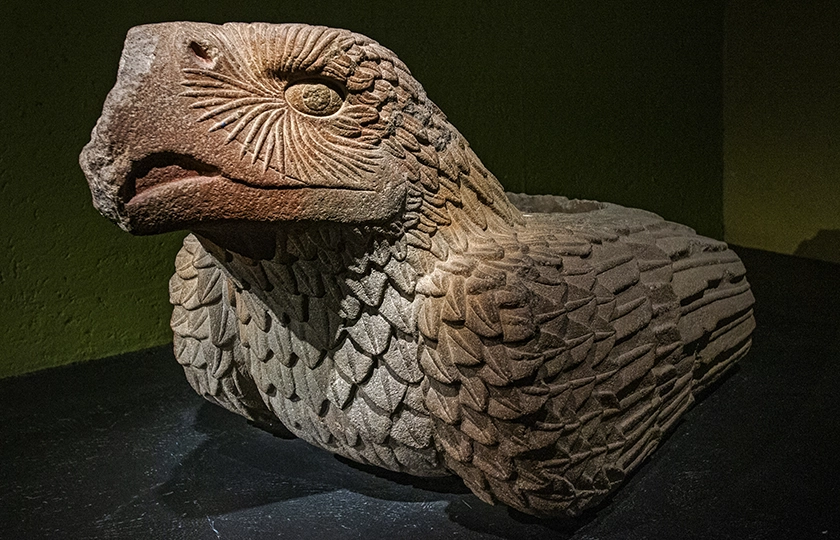
Tradition has it that the Mexicas, a faction of the Aztec people, heard the call of the god Huitzilopochtli back in the year 1064 of our calendar, who promised them a new land where they would have riches and be powerful. They left Aztlán, speculatively north of the Valley of Mexico, until they found the islet of the Texcoco salt lake where they saw an eagle devouring a snake on a nopal cactus, interpreting it as a sign that this was the place. That scene is now the image on the national coat of arms.
There they created their own identity as ‘Mexicas’, which in the Nahuatl language means ‘those from Mexico’, founding the city of Mexico-Tenochtitlan, an authentic city-state that was the result of a profound knowledge of how to make use of resources and an astonishing capacity for development.

The capital of the Mexica Empire was a remarkable aquatic city. Connected by a complex network of canals that its inhabitants used for transportation by canoe, they developed advanced agricultural techniques called chinampas or artificial islands for cultivation, to which they brought fresh water for irrigation by building aqueducts. They built bridges to connect with the mainland via three main causeways, and in the centre of the city they erected an imposing pyramid-shaped ceremonial centre dedicated to Huitzilopochtli and Tláloc, now known as the Templo Mayor, located to the right of Mexico City’s Metropolitan Cathedral and surrounded by palaces and squares. When Hernán Cortés arrived in Tenochtitlan, he was so amazed that he described it as the “Venice of the New World”.
Today, cosmopolitan Mexico City stands on those ruins, beneath which evidence of one of the most important cultures in the Americas is gradually coming to light, keeping alive the hallmark of an extremely friendly, welcoming people who are proud of themselves. The city with the second highest number of museums in the world also boasts four UNESCO World Heritage Sites and a cultural melting pot that make it a global benchmark, a genuine centre of knowledge and creativity that has produced universally renowned artists whose legacies are now indisputable milestones.
Xochimilco, the origin of the flower chinampas
Mexico City is a horizontal megapolis with superlative figures in every sense, vibrant and sometimes overwhelming, but amid the frenzy it retains its roots in nature, where it all began.
Xochimilco, without ever losing the dreamlike magic of its atmosphere, is much more than the colourful image of trajineras (traditional boats) sailing through the canals to the sound of mariachis, floating food stalls or flower sellers, pulque tastings (a liquor made from honey and agave) and the thousand curiosities that one can find in this aquatic labyrinth. Its value transcends even beyond the enigmatic attraction of the legends surrounding the Island of the Dolls, famous for the thousands of dolls hanging from trees since the middle of the last century when a farmer, obsessed by the tragic drowning of a girl in the canals, began collecting dolls regardless of their condition as amulets to combat the curse. Such was the curiosity it aroused in people that it ended up becoming a tourist attraction that Julián Santana, the island’s owner, allowed visits in exchange for payment in the form of a doll. Little by little, its fame grew to the point that it has been the setting for the filming of productions by Lady Gaga and Tim Burton, consolidating it as a culturally rich and unique attraction.
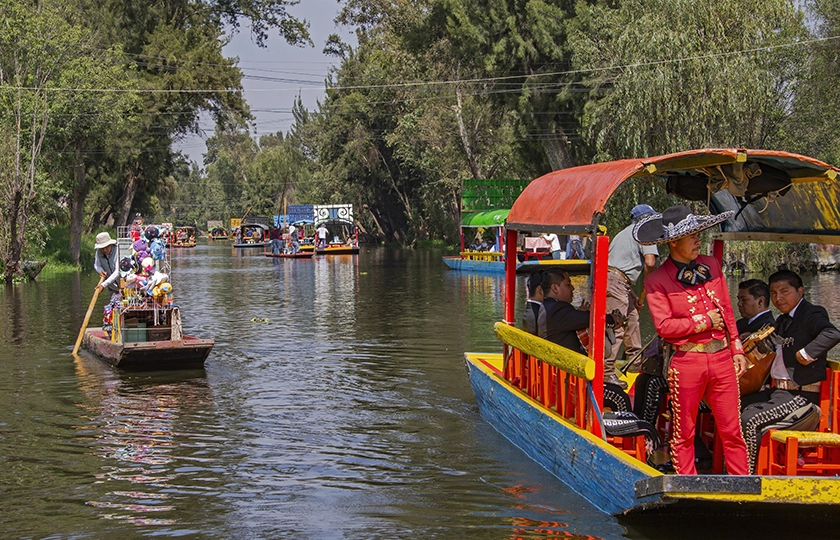
In the environmental sanctuary of Xochimilco, recognised as a UNESCO World Heritage Site for its historical and natural value, pre-Hispanic history is not a memory, but a tangible reality. Its canals are the living legacy of the chinampas, those floating islands that the Mexicas created as gardens to feed a constantly growing city and to plant flowers, a tradition that survives today, both in the many barges that ply the canals as street stalls and in the many nurseries that line the canals.
The universal pre-Hispanic legacy
The origins of Mexico City’s identity can be traced back to before the 15th century. Seven centuries after the founding of Tenochtitlan in the middle of a lake and criss-crossed by canals, today the historic centre stretches out and where there were once pyramids, now stands the Zócalo, the largest square in Latin America, marked by the National Palace, the Town Hall and the Metropolitan Cathedral.
“It was midnight, and I had the opportunity to live an unforgettable experience as an archaeologist: to see half of the monument, a marvellous sculpture with large reliefs and even traces of paint. Seeing it reminded him of the discoveries of the Aztec calendar and Coatlicue, archaeological monuments found by chance two hundred years earlier very close to there.” This is how Raúl Arena, an archaeologist and member of the Archaeological Salvage Service, describes his excitement at the discovery of the first remains of the Templo Mayor a few metres to the right of the cathedral in 1978.
The sacred complex of the Mexicas was the epicentre of the city’s social, political, religious and economic life, spread across the seventy-eight buildings that made it up. According to the thinking of the time, the temple was built at the exact point where the four cardinal points and the three vertical levels of the cosmos converged, namely heaven, earth and the underworld. For this reason, its location could never be changed, as it was considered to be the centre of the universe, even though it was enlarged in successive renovations.
Walking within its walls is like walking through a fundamental part of Mesoamerican history, from which an empire emerged. Its museum engages with the Mexica legacy through the artefacts that have been found, with particular emphasis on those recovered from the ceremonial centre, as well as an enormous monolith of the moon goddess, also known as Coyolxauhqui.
Throughout its eight rooms, we can learn about the elaborate pre-Hispanic society and gain a better understanding of its habits and customs, its commercial system, its beliefs and deities, its agricultural systems, and its flora and fauna.

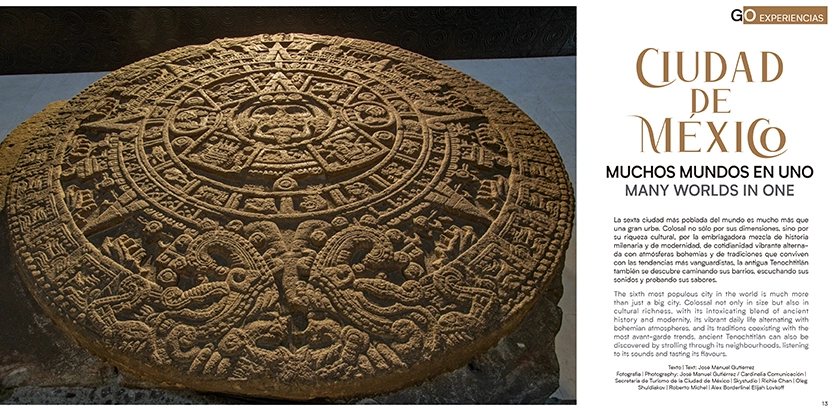
Among the most significant findings is the Sun Stone, also known as the Aztec Calendar, although this is on display at the National Museum of Anthropology.
To the south of the city lies the archaeological site of Cuicuilco, which dates back to 800 BC. Considered one of the oldest settlements in Mesoamerica, its discovery was vital to understanding the embryonic stage of the subsequent development of other civilisations in the region. The urban structure was dominated by a large circular pyramid, unique in pre-Hispanic architecture, which served as a ceremonial centre and symbol of the worldview of those people.
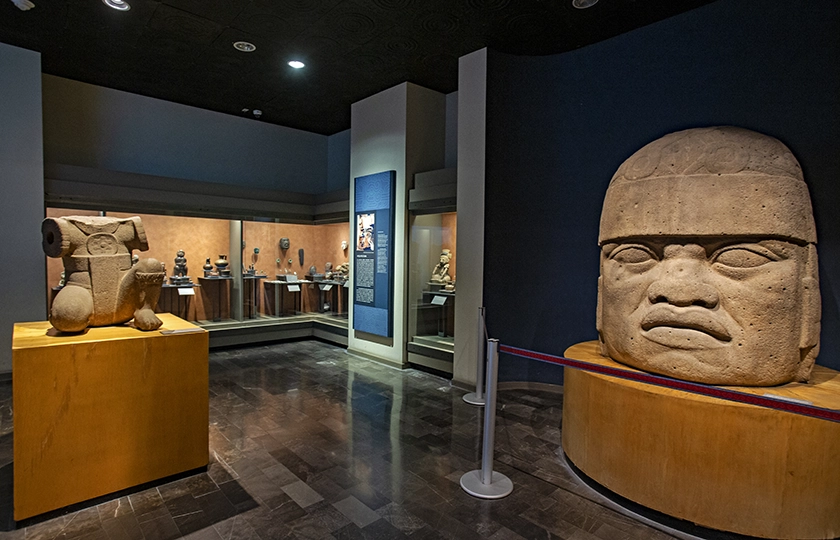
Back in vibrant Mexico City, in the heart of the Chapultepec Forest, stands a large building, modern in design and particularly evocative. Surrounding the central courtyard of the National Museum of Anthropology, the largest in the country and one of the most visited in the world, are twenty-four exhibition rooms with an immersive and spectacular setting. Conceptually divided between pre-Hispanic art and the ethnographic past of the country’s different regions, it preserves and safeguards more than ten thousand original pieces. Among them are the Sun Stone or Aztec Calendar carved in basalt stone, which, with its more than three metres in diameter and twenty-four tonnes, plays a leading role in the narrative; the colossal heads of the Olmec culture; the monumental Teotihuacan sculptures dedicated to the gods of water, the tomb of Pakal, the funerary offerings of Monte Albán, the steles of Xochicalco, as well as a Toltec atlas brought from Tollan-Xicocotitlan and the Monolith of Tláloc that guards the main entrance. And this is just a small sample of what it holds within its walls.
A city to enjoy
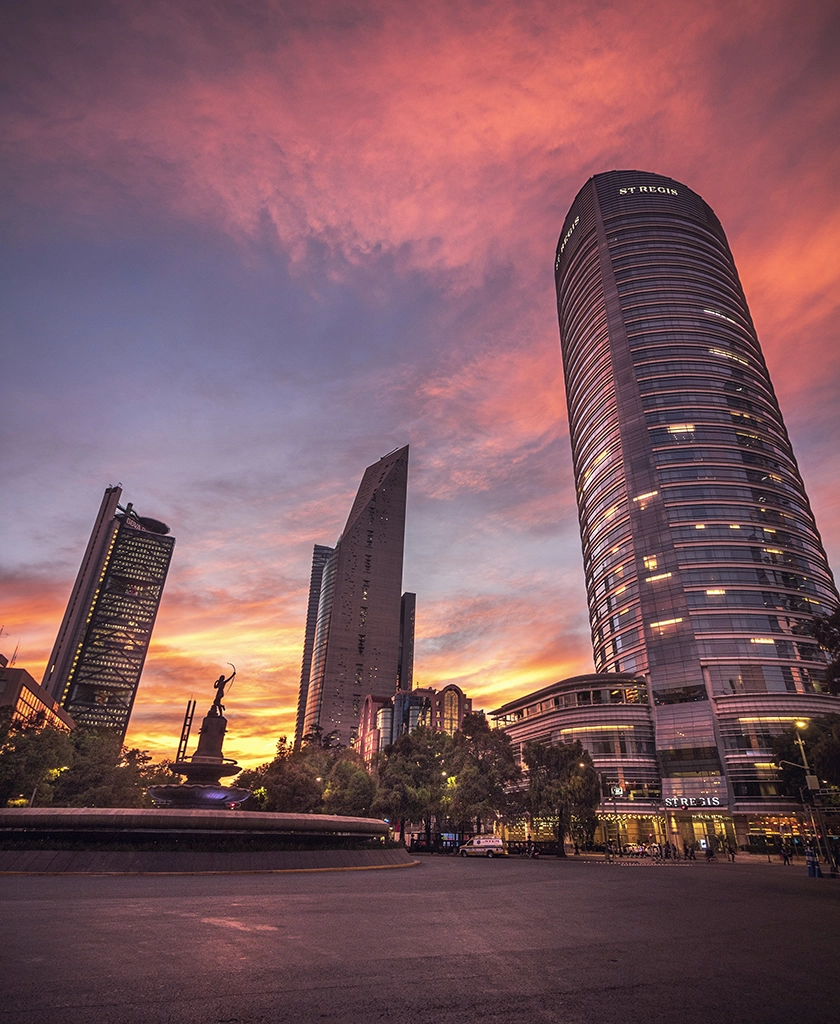
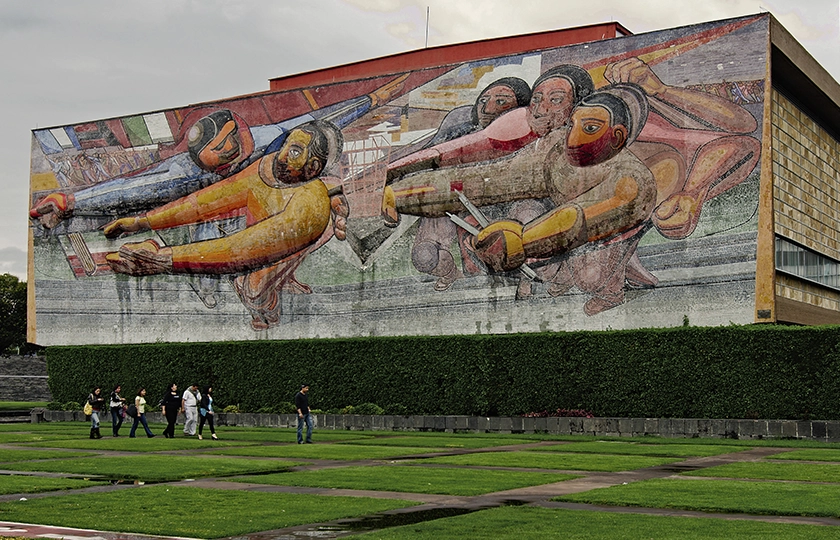
Mexico City, in all its grandeur, is a multifaceted setting dotted with a large number of enormous murals created by great artists. From the Reforma district, where modern office skyscrapers defy the seismic substrate on which they stand, to the exclusive residential area of Polanco, passing through the dreamy neighbourhoods of Coyoacán, Roma and La Condesa, where you can breathe in the most authentic essence, the mosaic is captivating.
Polanco represents sophistication, luxury and Michelin-starred restaurants without sacrificing cultural attractions such as the Soumaya Museum, one of the most important of its kind in the world with its reflective discourse through American and European art from recent centuries, or the Jumex Museum with its commitment to the most avant-garde international art.
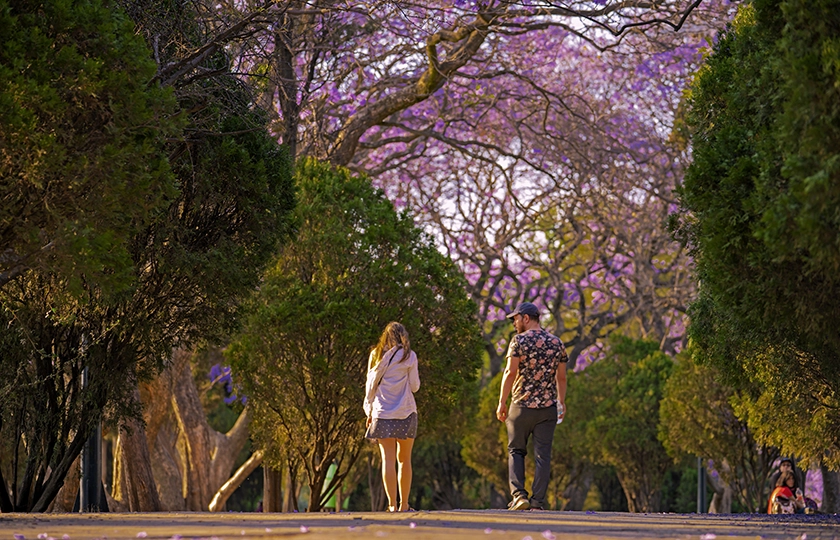
Roma and La Condesa are the bohemian side of the city, the epicentre of nightlife and culture with tree-lined avenues lined with beautiful Art Deco buildings, a cosmopolitan atmosphere and the culinary spectacle of the “taquerías de la Roma”, fashion boutiques by local designers and ideal places for strolling, such as España Park.
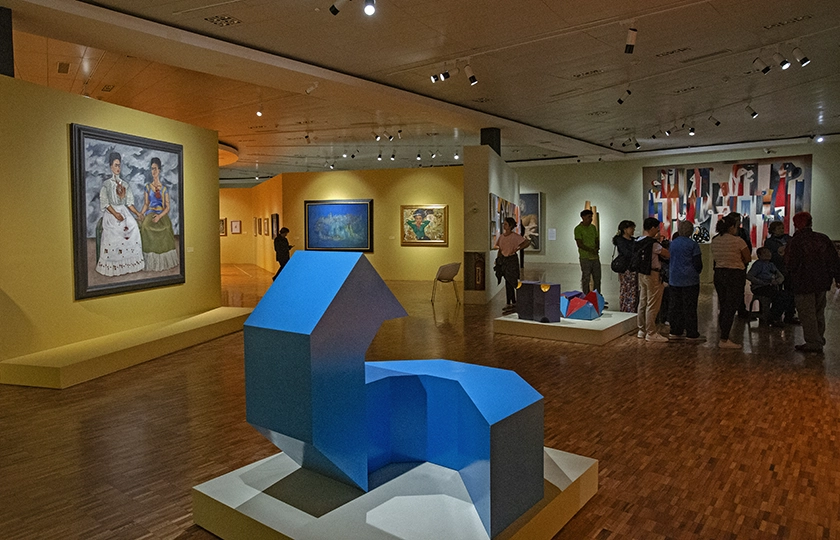
Chapultepec is the largest urban natural park in the world. It is so immense that it houses lakes, museums such as the National Museum of Anthropology and the Museum of Modern Art, which predominantly features works from the 1930s and includes excellent pieces by world-renowned artists such as Frida Kahlo, David Álvaro Siqueiros, Diego Rivera and many other Mexican artists.
Towering above the treetops and offering incredible views of the city, Chapultepec Castle is home to the National History Museum. What began as a recreational mansion during the second viceroyalty of New Spain in the 16th century is now a majestic building that alternates between Baroque and Neoclassical styles. Emperor Maximilian of Habsburg had his last residence there, full of luxury and refinement that can be visited today, but until then the complex underwent an eventful evolution.
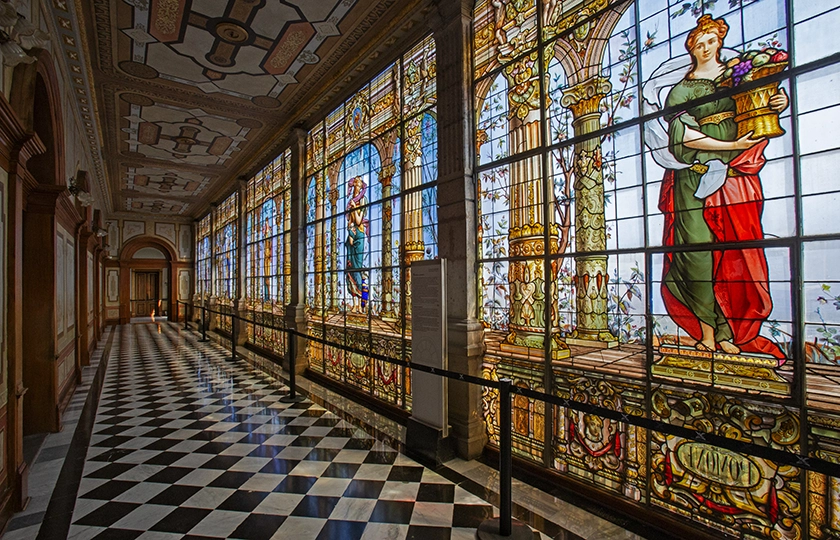
We cannot leave Chapultepec Forest without visiting the Los Pinos Cultural Complex, which was the official residence of the President of the Republic until 2018, transforming from a place of power to a place of recreation. In addition to the beautiful gardens featuring pine trees alongside busts of various presidents, the complex preserves an interesting collection of artwork reflecting the different tastes of the magnates, their furniture, memorabilia, and important documents from recent Mexican history.
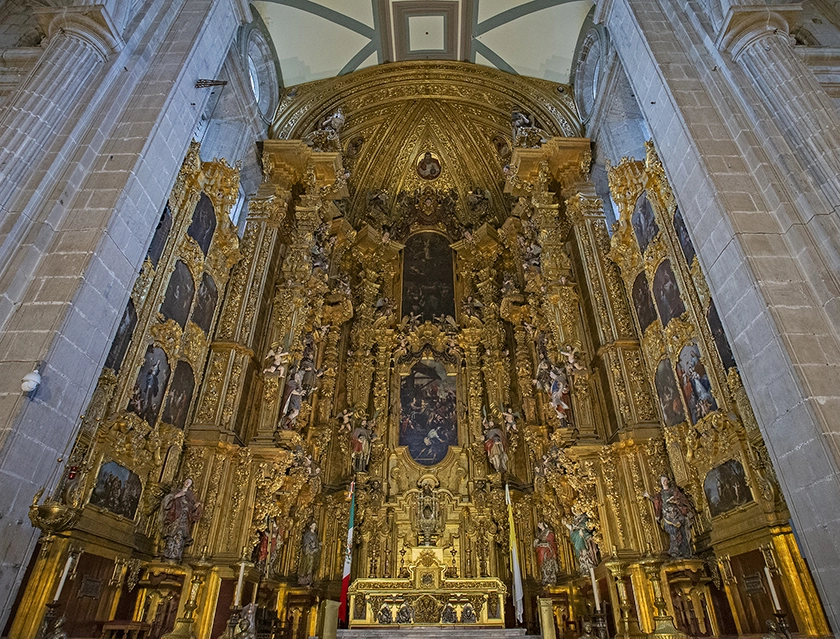
The Historic Centre, declared a UNESCO World Heritage Site, is another Mexican gem with more than two thousand culturally significant buildings such as palaces, colonial constructions and the Metropolitan Cathedral. Its prolonged construction between the 16th and 19th centuries resulted in it being a compendium of artistic and architectural styles, both inside and outside the temple, ranging from Gothic to Neoclassical, including Baroque and Churrigueresque.
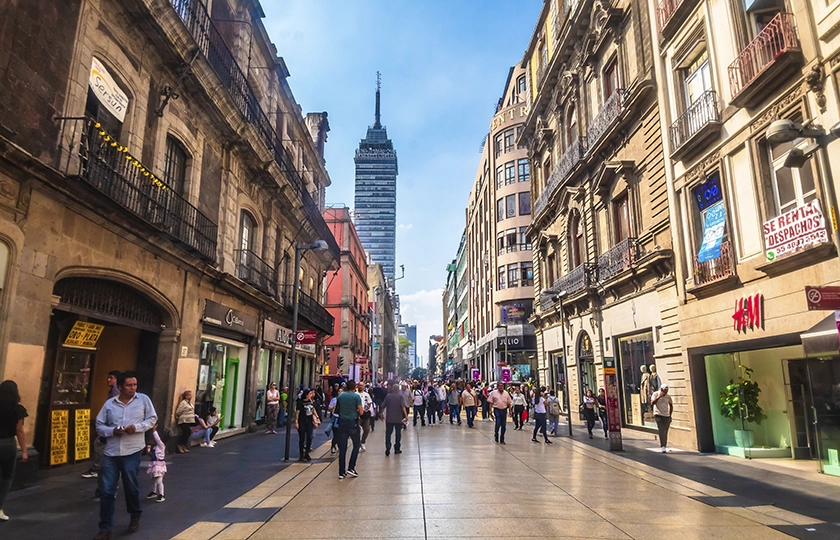
Following Madero Street, one of the first streets built by the Spanish and now full of shops and entertainment venues, you will reach the border with the Coyoacán neighbourhood. But first, the Post Office Palace is worth a stop for its eclectic architecture with Plateresque, Gothic and Mudejar influences, as well as its spectacular staircase.
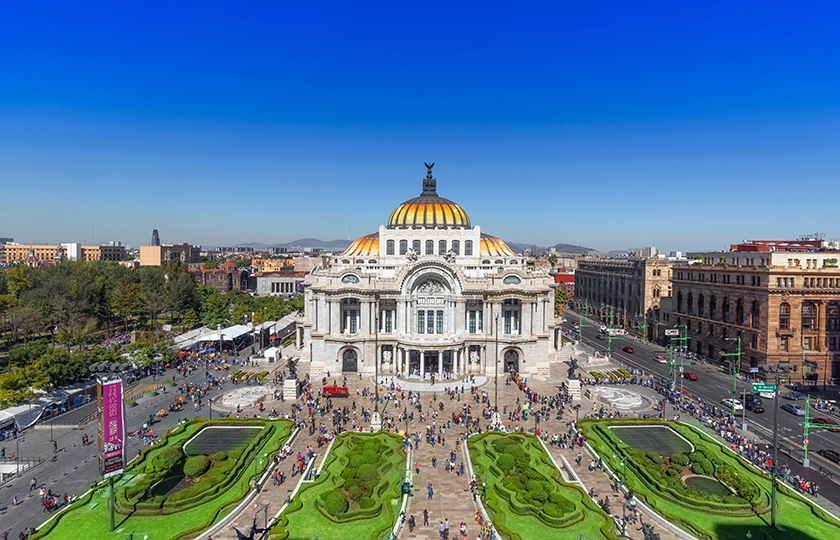
Opposite it stands the Palace of Fine Arts with its magnificent collection of seventeen murals by Mexican artists of the stature of Diego Rivera and David Alfaro Siqueiros, among others, filling the square it presides over with its elegant presence, befitting the National Theatre it once was. Its multifunctional design also allows it to host the National Architecture Museum, the National Symphony Orchestra and the National Opera Company.
Coyoacán is the most colonial neighbourhood and one of the most beautiful. Its magic invites you to stroll through the colourful cobbled streets and romantic squares, where you will find picturesque churches, art galleries, street stalls, bookshops and boutiques.
The epicentre of the neighbourhood is Jardín Hidalgo, a vibrant square lined with colonial buildings and dominated by the 16th-century church of San Juan Bautista. It is the ideal meeting place to enjoy street music, stalls selling all kinds of items, and delicious traditional food in unique restaurants, or simply relax on the terrace of a café watching the frenetic daily life of the evocative surroundings.
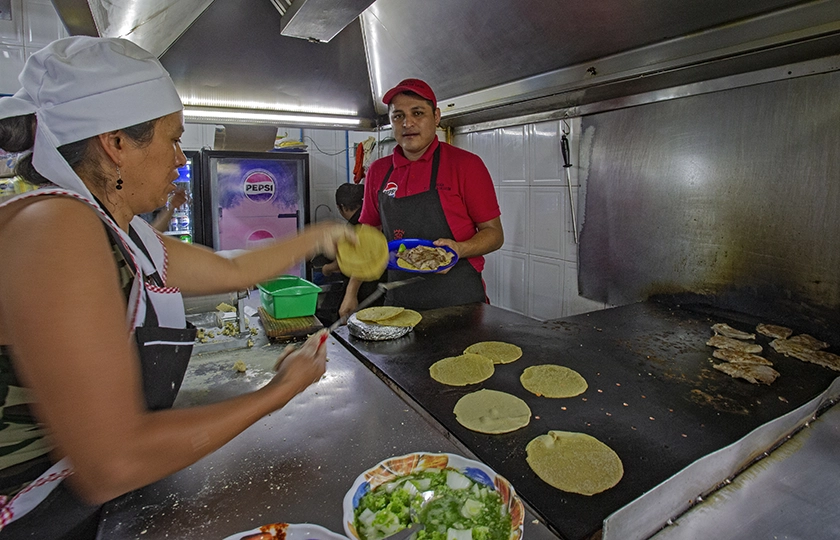
Nor can we overlook the Mexican Craft Market, where you can appreciate the more popular side of the arts, or the Antojillos Market, where you can sample delicious tacos and quesadillas, for example.
Frida Kahlo, the universal Mexican
The artist’s silhouette is present throughout the city. From Frida Kahlo Park to the most unexpected corners, her charismatic figure seems to accompany us, but there are two places that are essential to visit for the best experience of Mexico City.
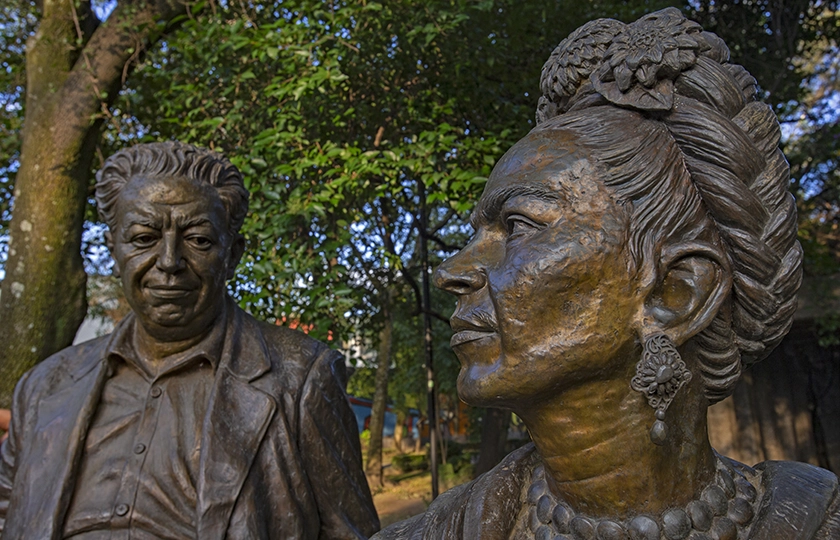
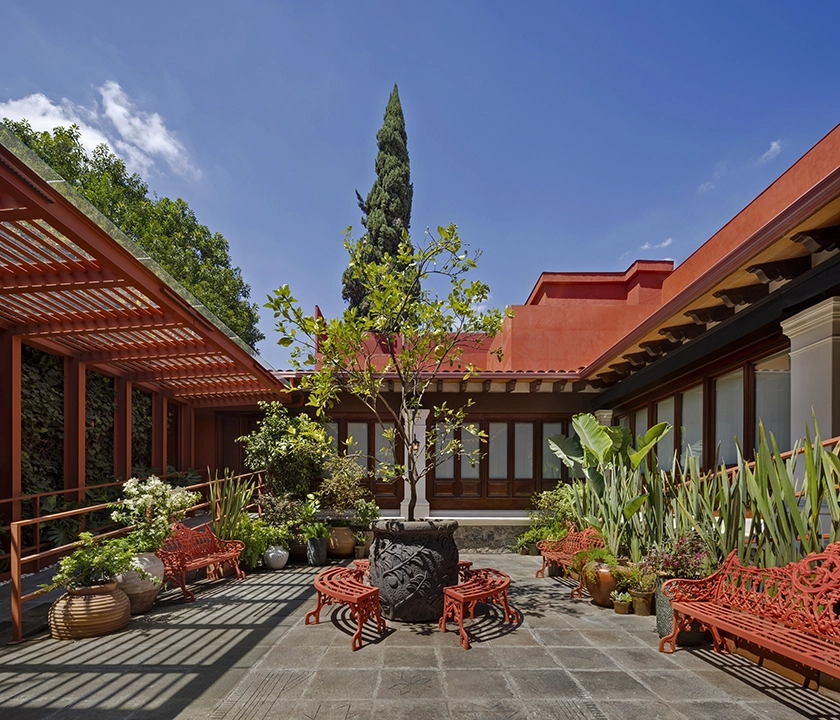
In the heart of the Coyoacán neighbourhood stands the Blue House the iconic house where she spent much of her life with Diego Rivera, offering an in-depth insight into her personal and artistic world, showcasing her life, her work and some of her husband’s original creations, as well as her relationships with other great artists.
The Kahlo House Museum, popularly known as the Red House, is much more than a museum setting; it is a family home and a laboratory of cultural heritage of incalculable value, a time capsule in which previously unseen memories, objects and stories of a fascinating family history have been preserved, and which the artist turned into her creative sanctuary.
Before leaving
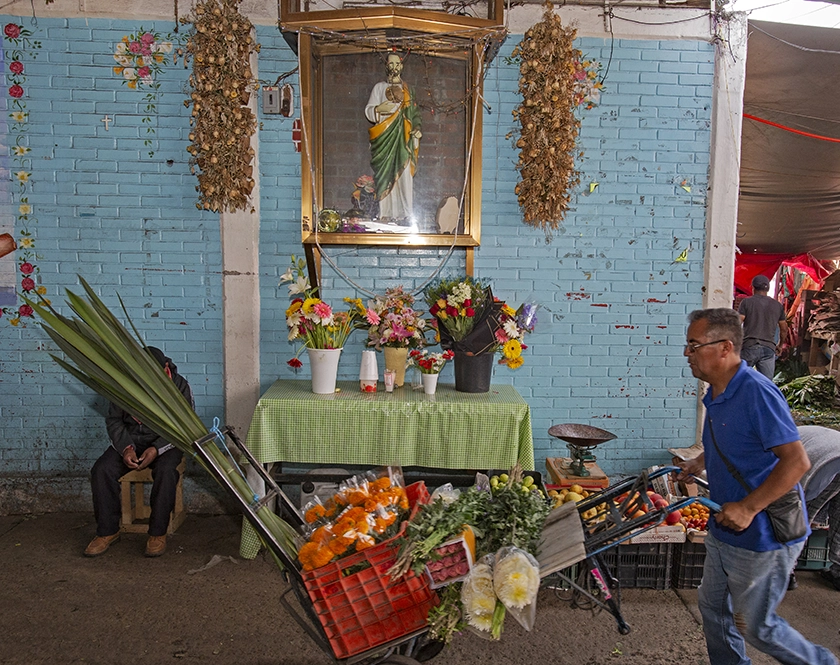
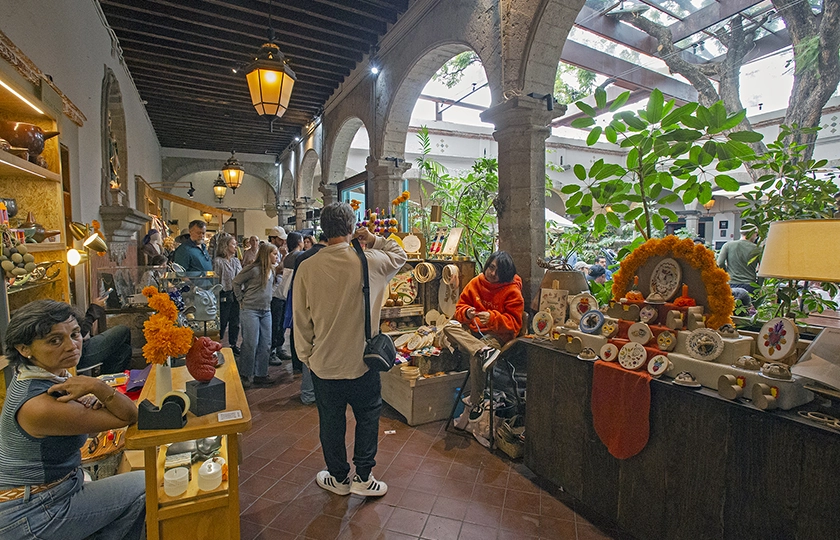
We cannot leave Mexico City temporarily without being seduced by the charm of the street markets. Scattered throughout the city, each one more colourful than the last, one of the most interesting is the Saturday Market in San Jacinto Square. Some of the stalls are concentrated inside a palace, while others are located in the square itself, bringing together artists and craftspeople who offer their authentic creations to lovers of art and culture.
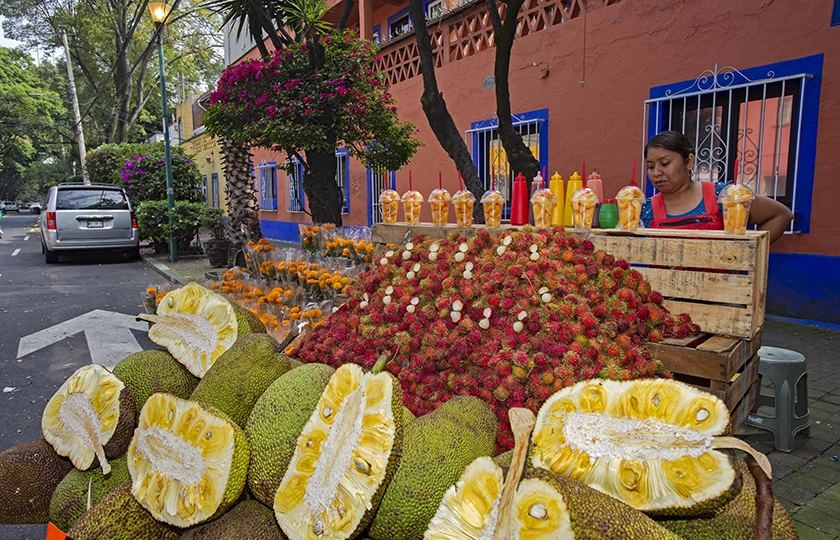
In a more prosaic but no less curious sense, there is the Central de Abasto. Considered the largest market in the world, products from here feed more than twenty million people every day. In addition to perishable goods, its aisles offer all kinds of raw materials and a spectacular selection of flowers.
It is open to tourists, who can purchase products without being wholesalers, but one of the most appealing aspects is immersing oneself in the other, more authentic side of one of the most evocative cities in Latin America.
It is absolutely impossible to show Mexico City in all its splendour in a single report, and this is just a small glimpse, so it is necessary to return.