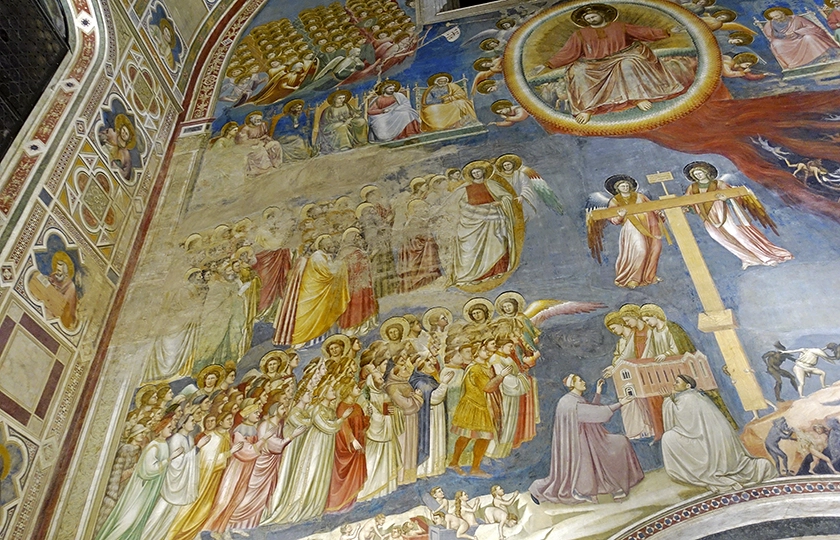
The chapel is a spectacle of colour, with biblical scenes depicted by familiar characters in everyday situations, rather than expressionless saints. One example is the two kisses: the first of love, the second of betrayal.
In the scene in the upper north-western corner of the wall, Saint Joachim appears with a shepherd. Saint Anne comes out to meet him and kisses him on the lips before the gaze of several women who are visibly delighted, except for a widow who hides herself in a black cloak. It is said to be the first kiss of love in painting. The second depicts Judas’ kiss: among crowds with sticks and torches, we see Jesus petrified but serene, and Judas wrapped in his cloak to give him the kiss of betrayal. The sky is lapis lazuli blue, the pigment in vogue in the “trecento”.
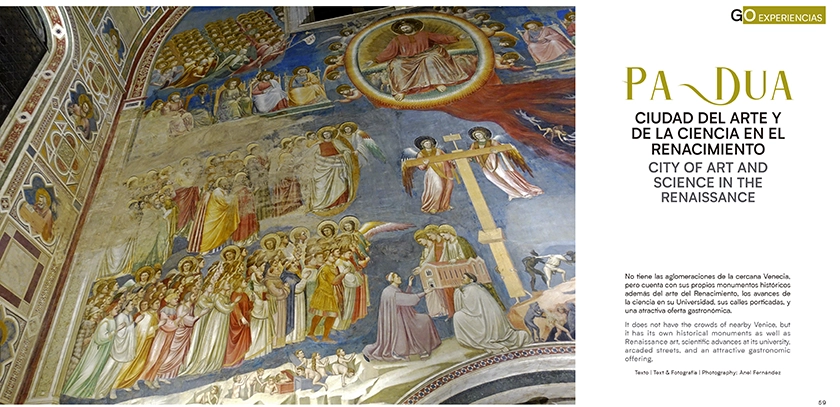
The Last Judgement fills the front wall. The painting is divided into registers, with the earthly world at the bottom, divided into three planes: one in which men are saved by angels, another opposite in which sinners are dragged away by demons, and in the centre is the cross of Christ. Hell stands out, plagued with grotesque, humanoid beings with horns, tails and greyish-black skin, mixed with animals such as snakes and dragons. It is reminiscent of The Garden of Earthly Delights painted by Hieronymus Bosch in 1500. Giotto lets his imagination run wild with the numerous tortures to which men are subjected.
Built in the 13th century, the Church of the Eremitani was decorated with frescoes by the region’s greatest Renaissance artists, including Andrea Mantegna. The church was destroyed by bombing in March 1944. The fragmentation of the famous murals in the Ovetari Chapel into some 80,000 pieces has been described as Italy’s greatest cultural loss during the Second World War. Today, the frescoes in the chapel have been restored and can be viewed as an immense jigsaw puzzle.
Of particular note in the church is a fragment of an ‘Ecce Homo’ by Guariento di Arpo located on a column in the fourth chapel. Eremitani is listed as a UNESCO World Heritage Site.
Also known as “il Salone” (the Hall), the Palazzo della Ragione was the former seat of the courts of Padua. Giotto and his workshop were commissioned to paint the frescoes on the walls, but the series was destroyed in a fire in 1420 and subsequently restored.
In that room, insolvent debtors were forced to strike their buttocks three times after undressing, a practice that gave rise to the Italian expression ‘restare in braghe di tela’, which can be translated as ‘to be left in one’s underwear’ in the sense of being left without assets, repeating three times the Latin formula ‘cedo bonis’.
The presence of an enormous wooden horse made by Annibale Capodilista for a merry-go-round and donated by the family to the city is surprising.
A jewel of late 12th-century Romanesque architecture, the Cathedral Baptistery is a small building attached to the Cathedral. Its interior is completely covered with frescoes painted by Giusto de Menabuoi between 1375 and 1378.
Giusto demonstrates that he has perfectly mastered Giotto’s lessons, creating scenes in perspective and figures with volume. The changing colours of the tunics, which bring liveliness to the performance, are his contribution to the teachings of the great master. In the scene of the baptism of Saint John, you can see the powerful colors as well as the subtlety of the transparency of Jesus’ clothing.
At the top, a solemn Pantocrator presides over the space surrounded by a circle of one hundred and forty-four angels and saints, creating an effect similar to that of a mosaic. Below, some figures look at the Virgin Mary with a certain amount of fear.
The Basilica of Saint Anthony, known as ‘Il Santo’, began construction in 1232 in honour of Saint Anthony and was completed in its main part at the end of that century. It has a Latin cross basilica layout, with three naves, six chapels and five cloisters, notably the ‘Chiostro della Magnolia’, so called because of the majestic magnolia tree that fills the centre of the enclosure.
To the left of the central nave is the 16th-century Chapel of the Saint, announced by an excessive light and on which the best Venetian sculptors of the time worked. The tomb is surrounded by angels and saints who stand out against the marble that decorates the entire room.
What is most surprising when visiting the Chapel of Relics is the sheer size of the enclosure, filled with reliquaries, crosses, chalices and countless other objects, among which the saint’s chin and tongue stand out, carefully encapsulated. This place is not recommended for sensitive individuals.
In the sacristy there is a curious fresco depicting Saint Anthony preaching to a crowd of fish who are listening attentively.
Science in the Golden Age of Padua
The University of Padua, founded in 1222, is among the oldest in the world. Popularly known as ‘Il Bo’ (the ox), the historic headquarters of this temple of knowledge was home to illustrious figures such as Galileo, Copernicus, Giovanni Battista Morgagni, founder of pathological anatomy, and William Harvey, who discovered blood circulation. Among the most important rooms are the anatomy theatre and the Aula Magna, which Galileo used due to the large number of students attending his classes.
Galileo spent eighteen years in Padua, where he taught mathematics at the University of Padua from 1592 onwards. During his stay, he built his own telescope with a lens that allowed him to obtain a right-side-up image instead of an inverted one. The use of the telescope as a tool for observing the sky forever changed the field of astronomy and was key to the scientific revolution. He discovered the phases of Venus, observed and detailed the craters of the Moon and the satellites of Jupiter. Galileo’s observations provided compelling evidence to support Copernicus’s heliocentric theory. On 8 January 1642, Galileo Galilei, one of the greatest scientists of all time, died after being forced in 1633 before the Tribunal of the Holy Office to renounce the heliocentric theory. As a tribute (and somewhat morbid curiosity), Galileo’s fifth lumbar vertebra, removed from his corpse almost a century later, is on display.
During the Second World War, the University distinguished itself in the fight for liberation from Nazism and was awarded the Gold Medal for Military Valour for the sacrifice of many young lives in the struggle to regain freedom. The high relief on the pediment of the inner courtyard bears an inscription in honour of a partisan brigade: ‘hic vivunt hic vigent hic renovantur in aevum tot bellorum animae’ ‘Here they live, here they flourish, here they are renewed forever, the souls of so many wars’.
The Botanical Garden of the University of Padua, also known as Orto Botanico, was founded in 1545 for the cultivation of medicinal plants, which at that time constituted the vast majority of “simple vegetables”, medicinal substances that came directly from the plant kingdom. It is the oldest university garden in the world that retains its original location and structure.
Since 1997, the Botanical Garden has been included in the UNESCO World Heritage List for ‘being the origin of all botanical gardens in the world and representing the cradle of science, scientific exchange and understanding of the relationship between nature and culture’. Around 6,000 species from all climates and continents are cultivated here, and rare and endangered seeds and species are preserved.
Known as the ‘meadow without grass’, the Prato della Valle is a large elliptical square which, in addition to being the largest in Padua, is one of the largest in Europe, surpassed only by Red Square in Moscow. In Roman times, it housed, among other things, a theatre, the Zaìro, where satirical comedies were performed.
It is located behind St. Anthony’s Basilica and is currently a cosy spot, perfect for a stroll. It is decorated around its perimeter by seventy-eight statues of historical figures (such as Petrarch and Galileo), between which runs a small canal.
Shopping and gastronomy
Padua is a pilgrimage destination, which is why the Basilica of Saint Anthony is surrounded by shops and street stalls selling souvenirs, from candles and key rings bearing the image of the saint to somewhat violent kitsch statues. You can even find a puff pastry filled with apricot jam called Torta di Sant’Antonio, which is said to represent the dome of the Basilica. It is the ‘Vero Dolce del Santo’ (the Saint’s True Sweet).
The typical cuisine of the area features fish dishes such as baccalà mantecato and sarde in saor, both delicious, which are offered as degustazioni di cicchetti (similar to Spanish tapas), accompanied by a glass of local wine such as prosecco. Gourmetteria is a centrally located establishment that is both a restaurant and a shop selling selected products from all over Italy, where we can sample these gastronomic delights.
http://turismopadova.it/en/