

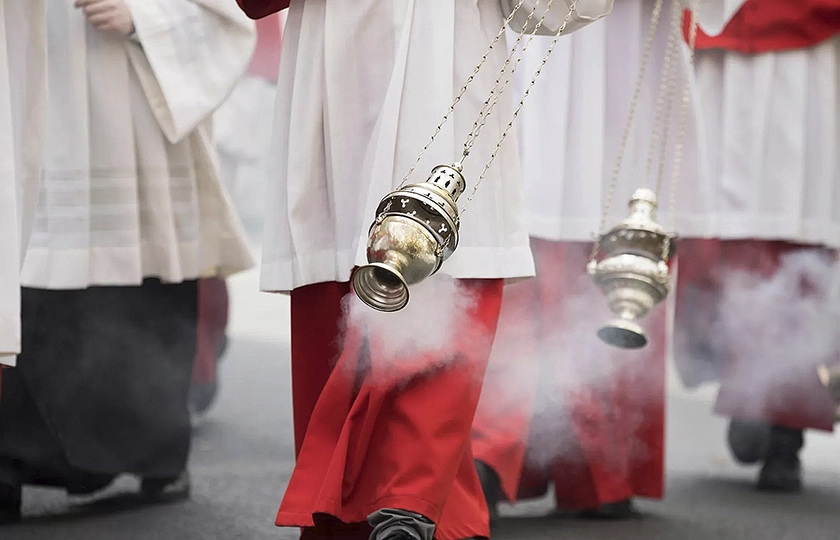
During the Easter period, folk festivals and processions take place in towns and villages across Italy.
Lazio - Rome
Palm Sunday
- At St Peter’s, the Pope blesses the olive branches and palms, which come from the Ligurian Riviera.
Holy Thursday
- At the Church of St John Lateran, the Pope celebrates the Liturgy of the Word. After the Gospel, the rite of the washing of the feet of 12 students from the seminary.
- At St Peter’s, the “Relichie Maggiori” are displayed: a fragment of the Cross, the lance and the Veil of Veronica, which are kept in a chapel closed to the public throughout the year.
Good Friday
- Procession at the Church of Santa Croce in Gerusalemme, where the relics of the Cross, brought from Jerusalem by Saint Helena, are housed.
- “Scala Santa”: many worshippers visit this building (Piazza S. Giovanni), where the staircase of 28 steps is located, said to be the steps Christ ascended to Pilate’s house to be judged. They were brought from Jerusalem by Saint Helena. One must not set foot on these sacred steps, which are covered by boards. The faithful may ascend them on their knees.
- Way of the Cross at the Colosseum: by torchlight, the Pope celebrates the solemn Way of the Cross.
Holy Saturday
- From the entrance to St Peter’s Basilica, the Pope blesses the fire and the Paschal candle; the hymns of the rite follow, and upon reaching the ‘Gloria’, the bells of all the churches in Rome begin to ring as an expression of joy at Christ’s resurrection.
Easter Sunday
- Papal message and blessing ‘Urbi et Orbi
Tuscany - Florence
Easter Sunday
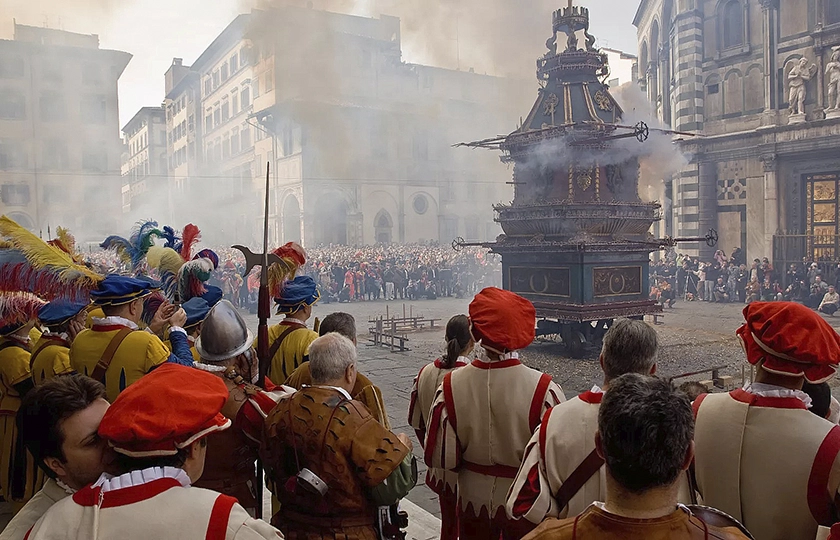
- “Explosione del Carro”, a ceremony of ancient origin that has been held every year at midday in Piazza del Duomo for centuries.
Umbria - Assisi
Holy Thursday
- “Rite of the Descent of the Crucifix” at the Cathedral of San Rufino.
Good Friday
- “Three Hours of Agony” at the Church of Santa Maria Maggiore. In the afternoon, a torchlit procession of the Dead Christ from the Cathedral to the Basilica of Saint Francis.
Sicily with its centuries-old rituals, processions and traditional flavours
In Sicily, Holy Week is a living tradition: the streets become a stage, communities find their identity in their own rituals, and devotion intertwines with music, craftsmanship and ancestral customs. It is a constant interplay between the sacred and the profane that makes Holy Week an intense and captivating experience for both residents and visitors alike.
In the centre of the island, Holy Week becomes a collective experience that brings together faith, identity and intangible cultural heritage. In Enna, the Good Friday procession features a parade of 2,500 hooded members of religious brotherhoods; the rites culminate with the ‘Paci’ on Easter Sunday and conclude with the ‘Spartenza’ on Low Sunday. In Caltanissetta, Holy Week is marked by the historic ‘Real Maestranza’ on Wednesday, the Varicedde on Thursday and the Vare on Friday, with bands transforming the historic centre into a veritable soundscape.
In western Sicily, faith intertwines with music and craftsmanship in intense and fascinating celebrations. Trapani preserves a centuries-old tradition with the Procession of the Mysteries on Good Friday, featuring sculptural groups, floral decorations and the rhythm of the bands accompanying the characteristic ‘annacata’; Erice experiences the same day in an intimate atmosphere amongst cobbled alleyways; Marsala offers the Living Mysteries on Maundy Thursday and a grand re-enactment with over two thousand participants. In Caltagirone, a Way of the Cross is held with participants in traditional costume, and Easter Sunday culminates in the ‘A Giunta’ ritual: the meeting between Saint Peter and the risen Jesus.
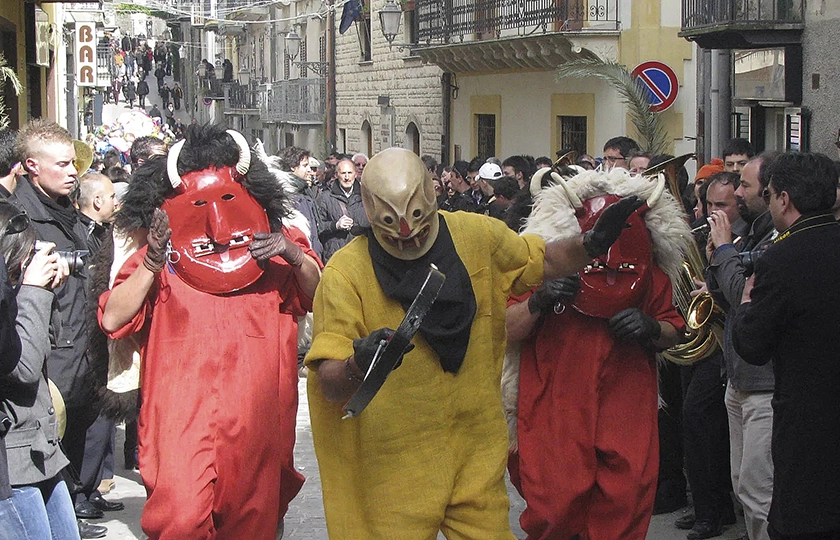
Prizzi (Palermo): on Easter Sunday, the “Dance of the Devils”: young people from the village, dressed as devils, roam the streets capturing people whom they do not release until they receive alms. The festival ends with the devils being captured by a group of angels who lead them before the Virgin and the Risen Christ.
Piana degli Albanesi (Palermo): on Easter Sunday, the “celebration of the Byzantine rite”: a procession in traditional 15th-century costumes. At the end of the ceremony, the women hand out the traditional “red egg”.
San Biagio Platani (Agrigento): “Festival of the Arches”; on Easter Sunday, a contest is held between the devotees of the Virgin Mary and those of the Lord in the area of the arches that line the town’s main street, adorned with various shapes of bread and vegetables.
Basilicata - Matera
‘Mater Sacra
This moving re-enactment of the Passion of Christ takes place in the “Sassi”. A deeply moving event centred on the Murgia del Gravina Canyon National Park, featuring a re-enactment of the crucifixion of Jesus and the two thieves. An event that fills visitors with awe at a story recounting the Lord’s resurrection. In the Murgia de Matera Park, the spectacle of death, from the descent to the announcement of new life brought by the Son of Man, will be performed.
In every town, ancient re-enactments are held in which tradition intertwines the Catholic liturgy with symbolic elements of popular origin. The entry of Jesus into Jerusalem is staged, enthusiastically welcomed by children waving palm branches, with Passion re-enactments in which the whole community takes part. In Montescaglioso, the highlight is the Good Friday Procession, featuring ancient Passion statues carried on the shoulders through the streets. This procession is recognised as Intangible Cultural Heritage of the Region.
In Barile, in keeping with the Albanian origins of the re-enactment, one of the main figures of the Way of the Cross is the ‘Zingara’, a beautiful local girl dressed in traditional Albanian costume and adorned with jewellery lent by the wealthiest families (a clear reference, therefore, to the town’s founding people).
In keeping with the evolution of the tradition, the character of the “Zingara” is also present in the living Way of the Cross held in Maschito; but also in Rapolla, Rionero and Ripacandida, although she does not share the same origins, the “Zingara” is one of the key figures in the Sacred Processions of Basilicata.
Abruzzo
In every village, there is an atmosphere of deeply moving fervour during Holy Week, when numerous, well-attended processions re-enact the key scenes of the Passion and the Resurrection. The statues, altars, choirs, women in penitential garb and hooded figures constitute an intangible heritage of extraordinary intensity – mythical and archetypal – which must be protected and passed on.
The heart of the Good Friday celebrations is the procession in Chieti, which has very ancient origins—the oldest in Italy, dating back to the year 842 AD.
In L’Aquila, the ceremony of the ablution of the altar with water and wine, held on Holy Thursday evening in the Cathedral of San Massimo, deserves special attention. The origins of the liturgical custom of purifying the altar, which is also found in the Eastern Churches, date back to the rituals of the Israelite Temple described in Exodus 29. The Good Friday procession in L’Aquila has very ancient origins. In fact, its origins can be traced back to at least 1505.
Calabria: ancient rituals, villages and traditional sweets
Holy Week in Calabria is a travel experience that combines spirituality, intangible heritage, historic villages and culinary traditions, offering visitors the chance to discover the region at one of the most iconic times of the year. During Holy Week, from north to south, communities and villages preserve ancient rites in which devotion, folklore and popular participation bear witness to an authentic, intense and deeply Mediterranean Calabria.
Among the most evocative celebrations are those of the Arbëreshë communities, where Easter follows the Greek-Byzantine rite and culminates in the traditional ‘vallje’, dances of victory and liberation performed by people in traditional costume as they parade through the villages.
In addition to the rituals, Calabrian Easter is also celebrated at the table. The queen of the tradition is the cuzzupa, widespread throughout the region under different names, shapes and textures, and decorated with one or more whole eggs, a symbol of rebirth. Rounding off the gastronomic tour are the cuddùre or curùji and glazed biscuits such as ’ncinetti and fiscòtta, often flavoured with lemon, candied fruit or ricotta, an expression of a confectionery tradition that keeps alive the link with rural culture and local produce.
For an international audience, Calabria presents itself as an ideal destination for a spring break combining cultural heritage, living traditions, villages and seasonal cuisine: an invitation to discover the region beyond the beach season, through authentic experiences rooted in local communities and capable of offering a distinctive and contemporary travel experience.
Source: ENIT SPA