
From major European art collections to the experimental architecture of the Vitra Campus, this Swiss city offers a journey where painting, design and architecture interact on an equal footing.
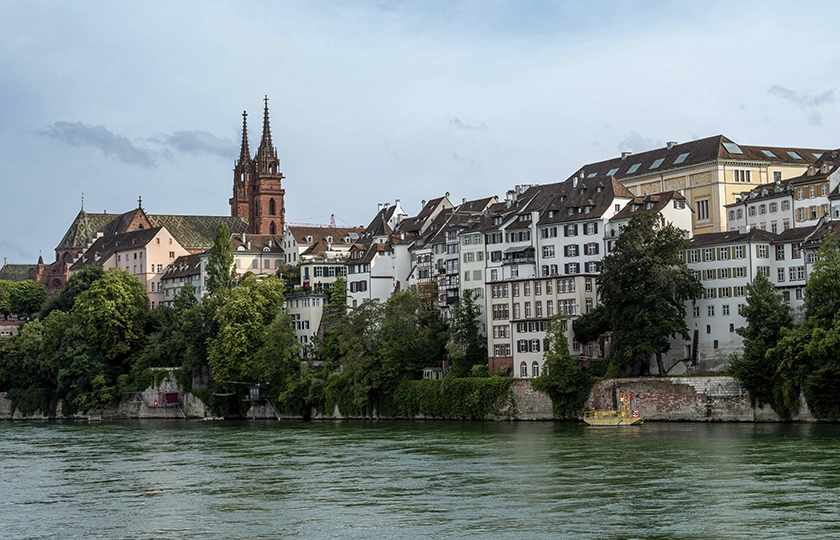
In Basel, you need only cross a bridge over the Rhine to step back in time. Literally. On one side, the collections that have shaped the history of European art; on the other, buildings that seem to anticipate what is yet to come.
This coexistence—so natural that it almost goes unnoticed—is what has made the Swiss city one of Europe’s most unique cultural enclaves. With over 40 museums in a relatively small urban setting, Basel boasts an unusual cultural density, further reinforced by the international impact of Art Basel, which places it at the centre of the global art circuit every year.
Here, art is not organised into a single itinerary. Nor is there any need for it to be. It appears, intersects, shifts in scale. Sometimes it is in a single room, other times in an entire building.
Institutions such as the Kunstmuseum, one of the oldest on the continent, or the Fondation Beyeler, where Renzo Piano’s architecture complements some of the key works of modern art, form part of that very fabric. They do not function as isolated stops, but as parts of something broader.
And then there is the Vitra Campus. A few kilometres from the centre, but operating on a different logic. What was once an industrial site has become a complex of buildings designed by architects such as Herzog & de Meuron and Frank Gehry. You don’t come here to view ‘a collection’. You walk, you observe, you gradually come to understand it. Almost without realising it.
It is in this transition—from the painting to the space, from the museum to the architecture—that Basel becomes particularly interesting.
This way of moving through the city is also beginning to be applied to some cultural trips. Fewer fixed itineraries, more interpretation of the place.
The proposal developed by Mundo Amigo follows this line of thinking, presenting Basel not so much as a succession of visits, but as a journey that takes shape as you go along.
“Basel is not a city that can be understood through isolated visits. It makes sense when you start to see how the museums, the architecture and the context in which they are situated relate to one another. That is where the journey changes,” explains Mikel González.
This perspective is echoed by Natalia Núñez, an art historian and creator of the digital project Parte del Arte, through which she brings works and artistic movements to a wider audience using more direct language.
During the tour, her role is not so much to guide as to accompany from a different perspective: to spark conversations, connect ideas, and suggest interpretations not always found in the exhibition texts. A different way of approaching art that does not replace the academic perspective, but rather broadens it.
In Basel, it all comes together. Because art isn’t confined to a single place. It lies in how things relate to one another. And that is where the journey ceases to be merely a tour and becomes something else entirely.
About MUNDO AMIGO
Mundo Amigo is an agency specialising in high-end cultural travel, with a proven track record in creating unique experiences centred on art, music, history and heritage. In collaboration with leading institutions such as the Thyssen-Bornemisza National Museum and the Reina Sofía School of Music, it designs itineraries that offer an ‘inside’ view of culture: private tours, meetings with experts, attendance at exclusive events, and tours that reveal the soul of each destination. With a carefully curated and rigorous approach, Mundo Amigo has established itself as a leader in premium cultural tourism for travellers seeking depth, knowledge and excellence.
Source: MDG Comunicación