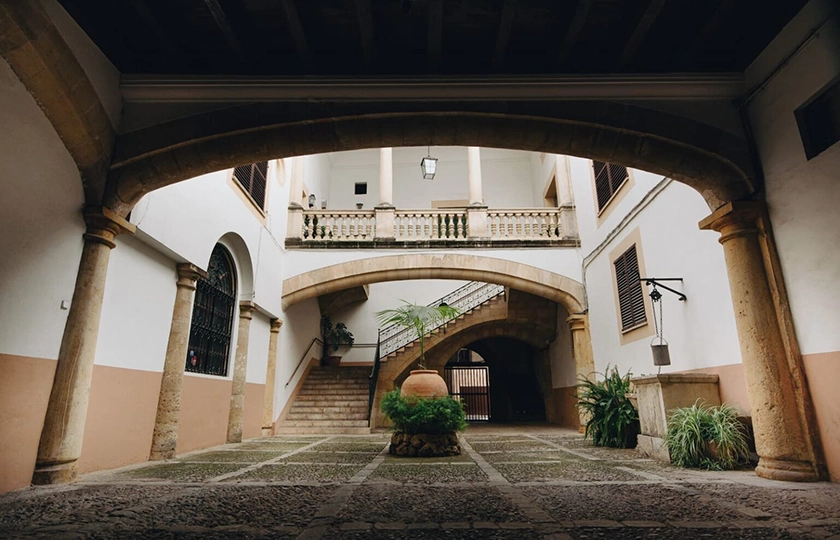
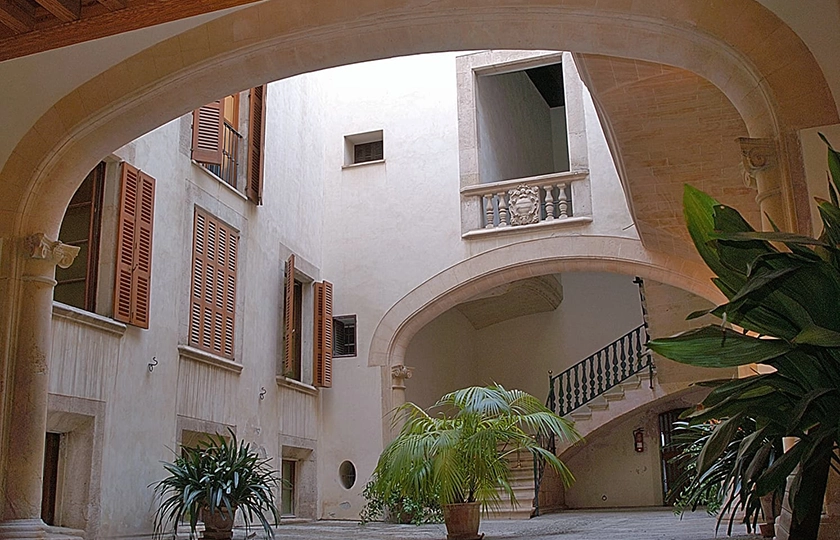
- Each of these historic sites retains its own character and offers a unique insight into life in Palma.
- This tour of the old town invites you to discover, on foot and at your own pace, one of the most authentic hallmarks of the Balearic capital.
Palma’s history is not only to be found in its squares or grand monuments; it can also be discovered within palaces and stately homes, where light, air and silence have, over the centuries, shaped a unique way of living in the city. As various writers have noted over the years, Palma’s courtyards are memorable spaces, places of calm and understated beauty that continue to reveal, behind every open doorway, the city’s most authentic soul.
Far more than mere ornamental spaces, Palma’s courtyards originated as a clever solution to adapt to the Mediterranean climate. Situated between the street and the dwelling, they acted as natural thermal regulators, promoting ventilation and the entry of light, whilst organising domestic life and serving as a place for socialising and interaction.
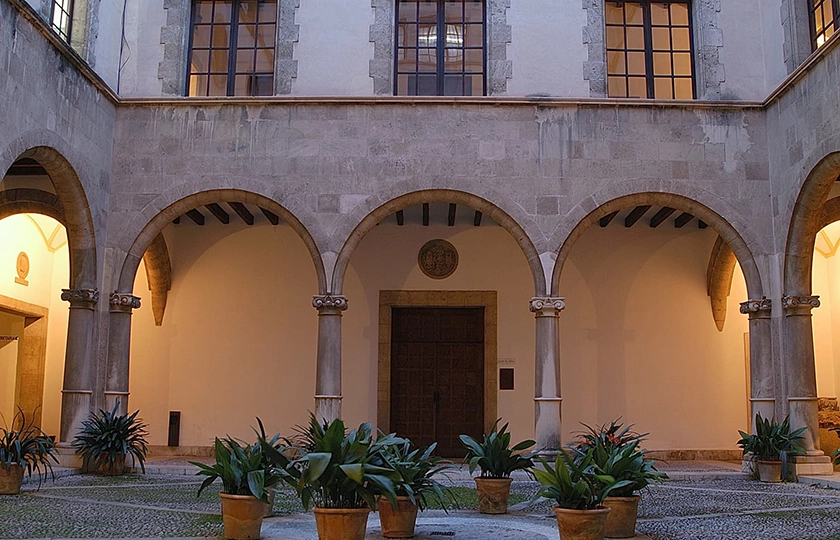
Their design reflects a unique combination of Roman, Islamic and medieval influences that evolved to become one of the most characteristic features of Palma’s civil architecture. This uniqueness has given rise to a network of courtyards that is hard to compare with that of other Spanish cities.
Concentrated in the old town and separated by just a few minutes’ walk, they form an urban route that invites visitors to discover the city at a leisurely pace, linking narrow streets, hidden squares and the entrance gates to the stately homes once occupied by the city’s most influential families.
Casal Solleric, the heart of Palma’s cultural fabric
Situated on the Passeig del Born, it is one of the most representative examples of 18th-century stately architecture and one of the city’s most elegant buildings. It combines grandeur, balance and light, with its lowered arches standing out, beneath which a magnificent imperial staircase unfolds.
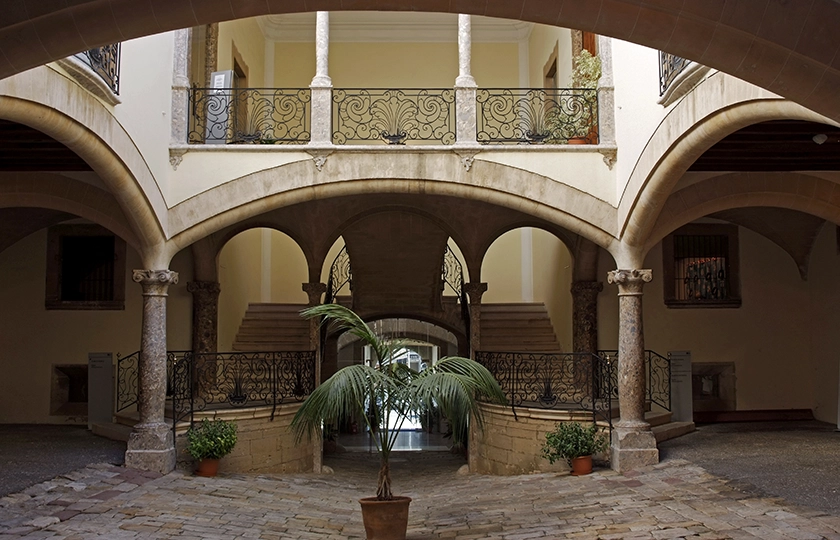
Can Oms, a haven behind the façade
Owned by the Oms family since the 17th century, its current courtyard is the result of alterations carried out during the 18th century. Of particular note is the preserved Gothic portal next to the entrance hall, which links the building to Palma’s medieval history.
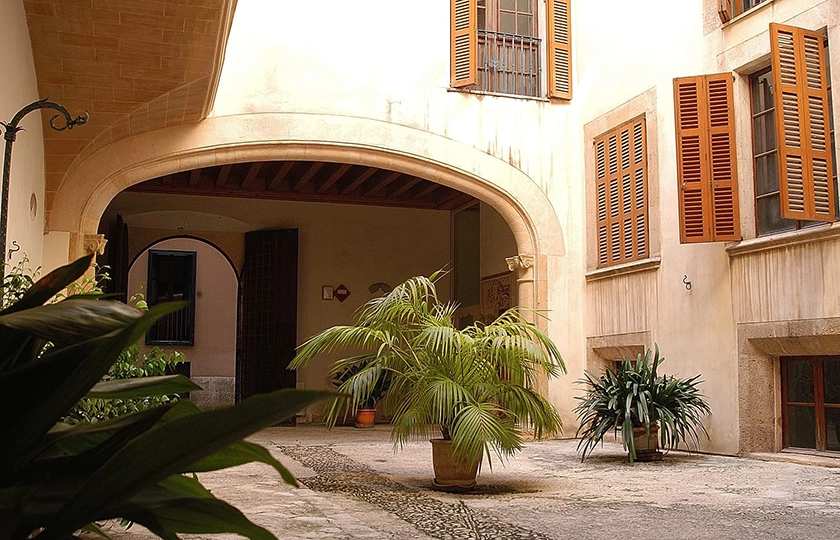
Can Balaguer, the city’s memory
Formerly the residence of the Balaguer del Racó family, this medieval mansion retains a trapezoidal courtyard dominated by a double-flight staircase and a coffered entrance hall. Now converted into a cultural space, it offers an insight into the evolution of Palma’s noble residences over the centuries.
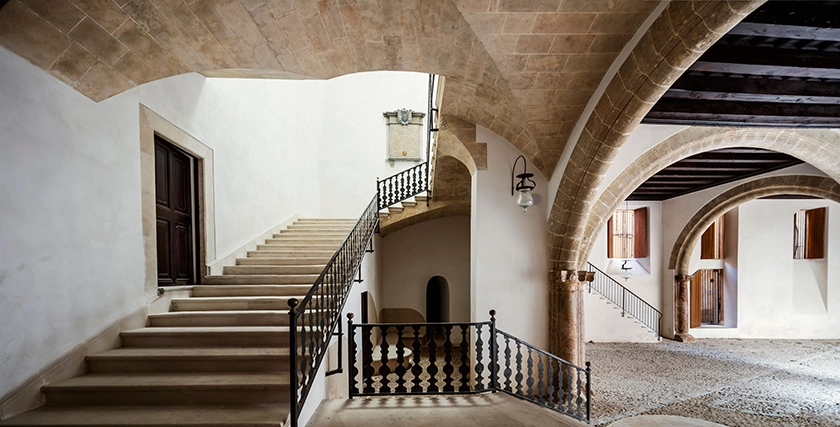
Can Bordils, between history and documentation
Now home to the Municipal Archives, Can Bordils is one of Palma’s oldest stately homes, built in the 13th century on foundations dating from the Muslim period. Its courtyard, restored whilst respecting the building’s historic structure, is a magnificent example of the architectural evolution of stately homes.
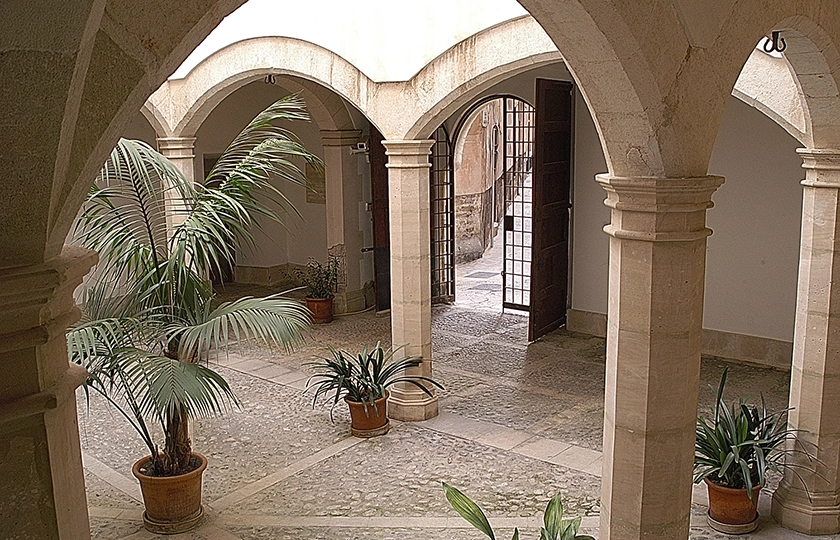
Can Vivot, the splendour of the Mallorcan nobility
Built on medieval foundations and renovated in the 18th century by the first Marquis of Vivot, this mansion boasts one of the most monumental courtyards in Palma. Its Corinthian columns, the three-arched gallery and the elegant staircase make this space one of the finest examples of the Baroque style in Palma. It was declared a national historic-artistic monument and later a site of cultural interest.
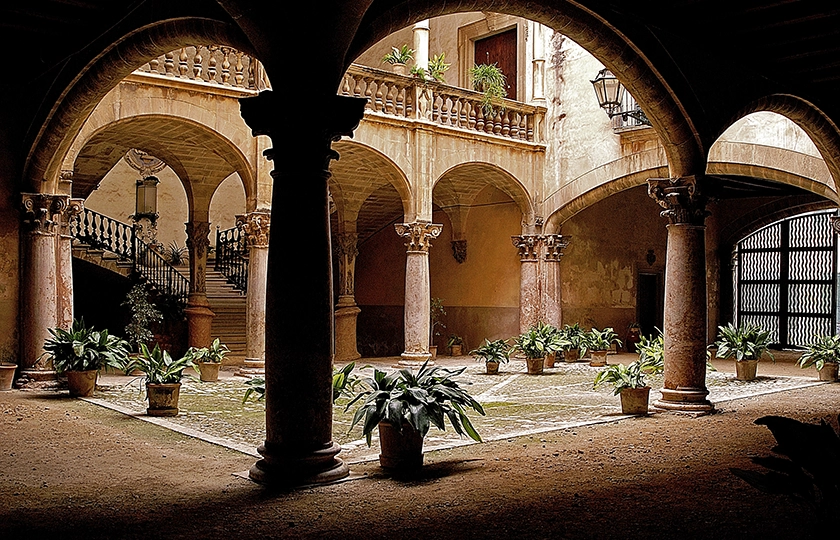
Can Oleza, a courtyard that set the trend
Situated in one of the city’s most historic areas and dating from the late 17th century, it is a landmark courtyard that brings together all the elements that would later characterise the courtyards of Palma’s houses: extraordinarily low arches, the loggia, Ionic columns with very pronounced entasis, and the wrought-iron balustrade. The beauty of the composition achieved at Can Oleza set a trend for renovation in Palma throughout the 18th century.
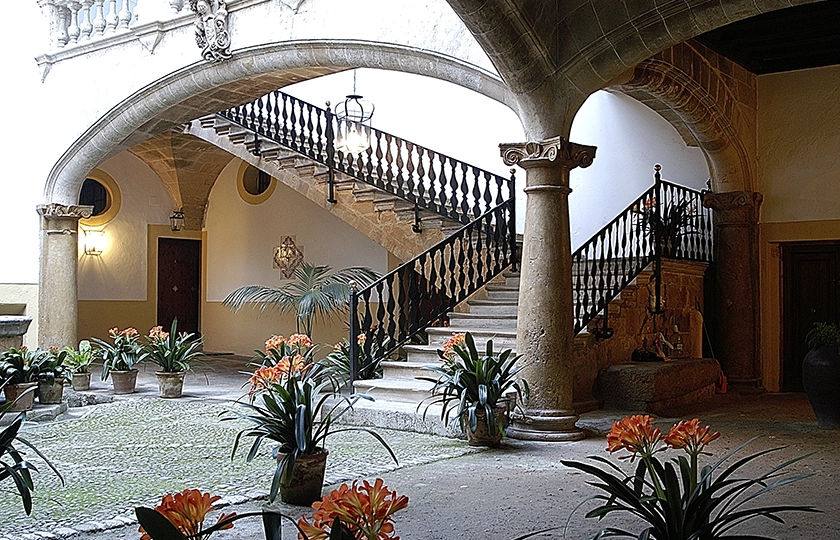
Estudi General Lul·lià, the courtyard of learning
This historic building, linked to the Mallorcan intellectual tradition, retains the serene atmosphere of a space dedicated for centuries to study and the exchange of ideas. Its courtyard reflects the close relationship between architecture and academic life in the historic city.
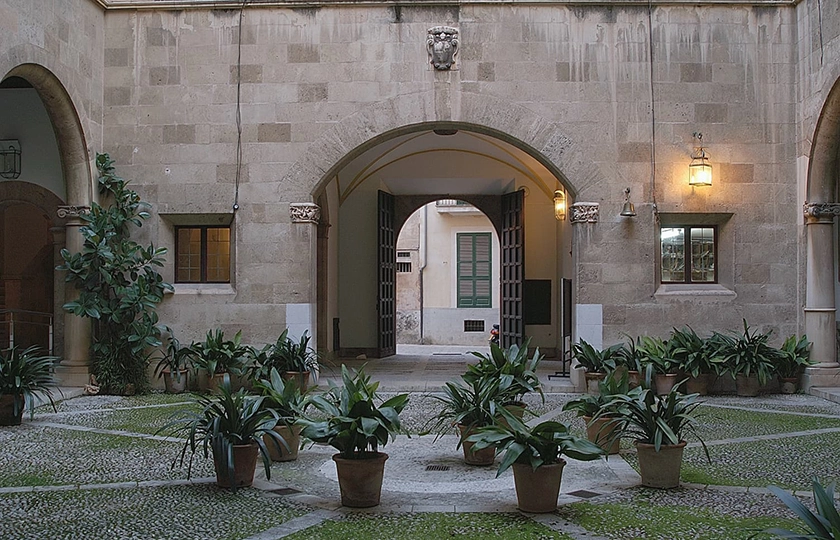
Cal Comte de Montenegro, an understated gem
Situated on one of the most elegant streets in the old town, right in the heart of the La Lonja neighbourhood, this building forms part of the ensemble of grand noble residences that shaped modern Palma. Its Gothic-style courtyard epitomises the sobriety and refinement that characterise Mallorcan stately architecture.