

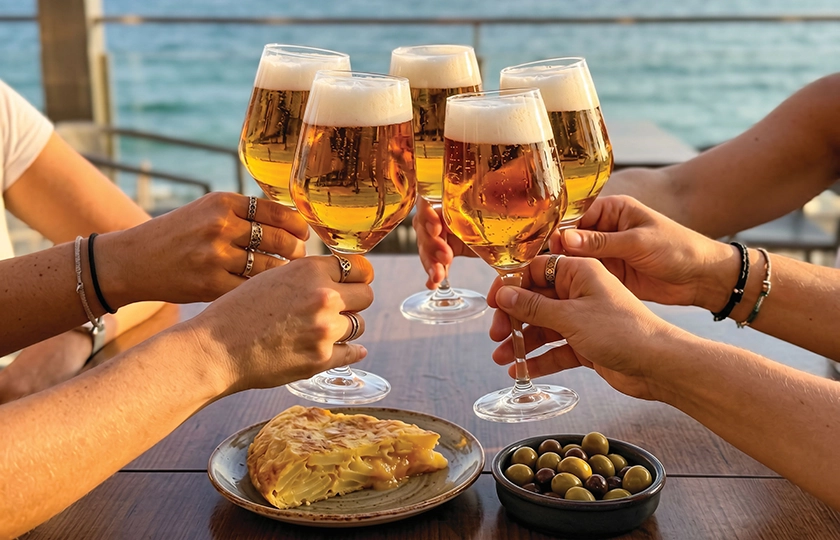
Breweries, ingredients, gastronomy, culture and unique geography all form part of a tourist experience that already exists in Spain, but which does not yet have a recognisable name.
What if your next trip began and ended with a beer? Not just to sit on a terrace and order a caña, but to discover where it’s brewed, what ingredients go into it, how it has evolved, what varieties exist, which foods it pairs best with, or what region lies behind each brew.
All of this already exists in Spain. What was still missing was a word to encapsulate this concept – until now: ZITOTURISMO.
The term, derived from zythos – the Ancient Greek word for fermented cereal beer – gives a name to a range of experiences that have been developing in Spain for years: visits to breweries and museums, brewery tours, tastings, pairings, festivals, workshops, exploring ingredients and raw materials, and itineraries linking beer, gastronomy and the local area.
It is not, therefore, a question of inventing a new way of travelling, but rather of raising the profile of a tourist experience that already exists and is still little recognised by the general public.
A drink that forms part of the way we socialise
In Spain, beer is much more than just a drink: it forms part of our culinary culture and the way we socialise. It is present at gatherings with friends and family, as an aperitif, whilst enjoying tapas or around a table, forming part of those little everyday rituals that turn eating and drinking into a shared experience.
In fact, the Spanish pattern of beer consumption is closely linked to moderation, companionship and pairing with food, in keeping with the Mediterranean lifestyle. According to data from Cerveceros de España, 86 per cent of consumers enjoy beer in the company of friends or family, and nearly 90 per cent of occasions on which beer is consumed take place in social and gastronomic settings.
It is precisely this social and gastronomic dimension that helps us understand why beer can also become a way of travelling and discovering every corner of Spain: behind every brew lie ingredients, people, recipes, traditions, landscapes and a culture that is an integral part of the region.
A beer-producing country with much to discover
Spain has a huge brewing sector, with more than 250 breweries spread across the country. In 2025, it produced 41.5 million hectolitres of beer, 5.1 per cent more than in 2019, and established itself as the second-largest beer producer in the European Uniona, behind only Germany. But the phenomenon goes far beyond production.
According to the 2025 Socio-economic Report on the Beer Sector in Spain, produced by Cerveceros de España in collaboration with the Ministry of Agriculture, Fisheries and Food, beer is associated with more than 5,200 million euros of tourism expenditure in Spain. Furthermore, around 30 per cent of the beer consumed in Spain is accounted for by tourists, and in 2025, beer consumption by tourists in the hospitality sector rose by 4.1 per cent.1
This has a direct impact on the local economy: over 90 per cent of the raw materials used by the Spanish brewing sector come from within the country, including ingredients such as malting barley and hops.2
1 Cerveceros de España (2026) Socio-economic Report on the Beer Sector in Spain 2025
https://cerveceros.org/uploads/6a4671ec7ea87__AAFF_Informe%20Socioeconomico%202025%20WEB.pdf
2 Ministry of Agriculture, Fisheries and Food. (2026, 11 March). Luis Planas: Spain consolidates its position as the second-largest beer producer in the European Union.
From ingredient to destination
Zitotourism allows you to discover that there is much more to a beer than just a drink. Visiting a brewery and learning about the brewing process, discovering the origin of its ingredients, taking part in a tasting, exploring its gastronomic possibilities, learning about local projects or touring areas linked to its production are just some of the experiences that allow you to engage with beer culture from a tourist’s perspective.
These experiences are already part of what various destinations have to offer and bring together gastronomy, culture, the local area and leisure, but they do not yet have a widely recognised concept that unites them.
This is where ‘beer tourism’ comes in: a term to identify and raise the profile of a way of discovering destinations through their beer culture.
An experience that already exists, but which we do not yet know how to name
The National Statistics Institute (INE) itself includes within gastronomic tourism trips motivated by experiences such as discovering a region’s cuisine, visiting restaurants, taking part in food tastings or participating in gastronomic tours.3
Zitourism fits precisely into this category: a way of getting to know a destination through one of its products, its people, its cuisine and its territory.
And Spain offers a particularly favourable environment for its growth. In 2025, the country welcomed 96.8 million international tourists, who spent 134,712 million euros4. The opportunity, therefore, lies in transforming what already exists into something more recognisable.
Because perhaps the traveller isn’t looking for ‘beer tourism’. Perhaps they do not yet know it exists. But they may well be looking for exactly the experience that lies behind it. Beer tourism is not just about drinking beer. It is about travelling to discover everything that lies behind it.
Spain has a lot to offer, and when it comes to beer, too.
3 National Institute of Statistics. (n.d.). Gastronomic tourism. Glossary of terms.
https://www.ine.es/DEFIne/en/concepto.htm?c=5338
4 National Institute of Statistics. (2026). Spain in Figures 2026.
https://www.ine.es/prodyser/espa_cifras/EEC_2026_PUBLICACION_COMPLETA.pdf
About CERVECEROS DE ESPAÑA
Cerveceros de España is the organisation that has represented virtually the entire beer production in Spain since 1922. This association currently comprises: MAHOU SAN MIGUEL, DAMM, HEINEKEN ESPAÑA, HIJOS DE RIVERA, GRUPO AGORA, COMPAÑÍA CERVECERA DE CANARIAS, AGÜITA!, ALMOGAVER, ALTHAIA, CERVEZAS ANTIGA, ARRIACA, B&B, BARCELONA BEER COMPANY, BASQUELAND, BIDASSOA BASQUE, BLACKLAB, BREWERY, BOGA, CALEYA, CÁTEDRA BEER, CCVK, DOUGALL’S, EL CAMINO, CERVEZA ESPIGA, GARAGE BEER CO, GRAN VÍA BEERS, LA CANIBAL, LA CIBELES, LA FEM, LA PIRATA BREWING, LA SAGRA, LA SALVE, MALTMAN BREWING, MOND BEERS, MONTSENY, MORLACO BEER, NAPARBIER, NAO LANZAROTE, OCTAVO ARTE, OSO BREW CO, ROCKERBEER, SAN FRUTOS, SCONE CRAFT BEER, SOMA, TYRIS, VILLA DE MADRID, CERVEZAS YRIA, ZETA, as well as AECAI (Spanish Association of Craft and Independent Brewers).
Source: BURSON GLOBAL