

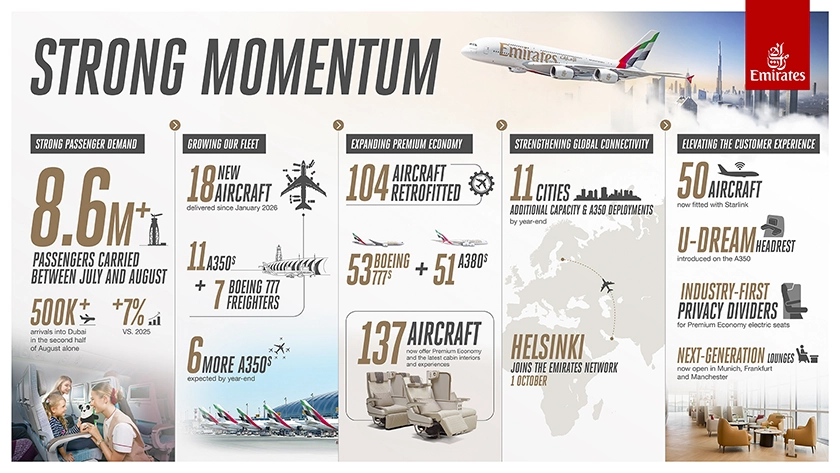
- Summer performance exceeded expectations: Emirates carried more than 8.6 million passengers between July and August; arrivals in Dubai on Emirates flights in the second half of August rose by 7 per cent compared with the same period in 2025.
- Fleet and network: 104 aircraft have completed the retrofit to date; Premium Economy is now available on 137 aircraft. 18 aircraft have been delivered since January, with a further six A350s due before the end of the year; Helsinki joins the network on 1 October.
- Product investments: this year saw the launch of the industry’s first U-Dream headrest for Economy Class and Premium Economy seats with privacy dividers, as well as the new-generation Emirates Lounges.
Emirates has concluded the summer season ahead of expectations and is entering the winter season with strong booking momentum across a growing number of markets, whilst the airline continues to invest in its fleet and industry-leading products, its global network, and in offering customers greater flexibility when making bookings and comprehensive travel cover.
Between July and August, Emirates carried over 8.6 million passengers, maintaining strong load factors across its entire network. The airline is currently operating at approximately 93 per cent of its pre-disruption capacity, whilst demand continues to grow as the winter travel season approaches.
Bookings for the winter season, which begins in late October, are performing well despite a general trend towards last-minute travel decisions. South Africa, Brazil, India, Portugal, Egypt, Ghana, Colombia, Saudi Arabia and Pakistan are among the markets where demand is currently higher than last year, alongside Nepal, thanks to Emirates’ partnership with flydubai.
The UAE also remains a market with strong outbound demand, whilst demand for premium travel with Emirates continues to grow.
Strong demand during the summer
Emirates’ services to and from West Asia, Europe, the Middle East, the Americas and Africa recorded load factors of over 75 per cent during the summer, with particularly strong performance on routes to and from Indonesia, Côte d’Ivoire and across the UK.
Demand for Premium Economy grew across the network, with the Americas recording the highest growth in demand for this cabin class.
Dubai also continued to attract strong inbound traffic. By the end of August, more than half a million customers had arrived in Dubai on Emirates flights, 7 per cent more than in the same period last year. Among the travellers were residents returning ahead of the start of the new school term, new residents moving to Dubai to live and work, and visitors choosing the city for a late-summer getaway.
Over the summer, customers had even more reasons to choose Emirates. The airline strengthened its flexibility offering with a free date change anywhere on its network and unlimited free date changes for travel to Dubai.
It also reduced refund fees for journeys to Dubai and introduced Comprehensive Travel Cover, a pioneering policy that includes medical cover in the event of conflict and airspace disruptions, backed by airline-arranged accommodation, ground assistance and rebooking where necessary.
Fleet upgrades and product investments gather momentum
Since January 2026, the airline has taken delivery of 18 aircraft: 11 new A350s and seven Boeing 777 freighters, with a further six A350s scheduled to arrive before the end of December.
To date, 104 aircraft have completed Emirates’ retrofit programme, including 53 Boeing 777s and 51 A380s. This brings the total number of aircraft offering Premium Economy and Emirates’ latest cabin products to 137. By the end of December, this figure will have risen to 155 aircraft.
This expansion of the new products’ reach offers customers many more opportunities to experience Emirates’ latest cabins. Premium Economy is now available on services to 90 destinations, and a further six destinations will receive the product before the end of this year, including Paris, Delhi, Stockholm and others.
Connectivity is also being enhanced. Around 50 Emirates aircraft are already equipped with Starlink, and installations are progressing in parallel with the retrofit programme to offer high-speed in-flight internet to a greater number of customers.
This year, Emirates has also launched the innovative U-Dream headrests on board its A350 Economy Class, the industry’s first Premium Economy seat with privacy dividers, and its new state-of-the-art signature lounges, with new facilities already welcoming customers in Munich, Frankfurt and Manchester.
More destinations, frequencies and connectivity
Emirates’ network will continue to expand ahead of the winter season, with new destinations, additional frequencies and more state-of-the-art aircraft deployed in key markets.
Helsinki will join the Emirates network on 1 October, served by the A350. This aircraft currently operates to 30 destinations from Dubai, a figure set to rise to 36 by the end of the year.
Emirates is also increasing capacity on several routes to meet demand. Accra, Tokyo Narita, Ho Chi Minh City and Hanoi will receive a second daily service, whilst one of the airline’s daily services to Delhi will be operated by an A380.
The Emirates A350 will be deployed to Larnaca, Malta, Nairobi and Hamburg from late October, followed by Mauritius in November. The upgraded Boeing 777s will be introduced to Stockholm in October and Frankfurt in November, extending Emirates’ latest in-flight products to a wider range of markets.
Beyond its own network, Emirates’ 168 code-share, interline and intermodal partnerships offer customers access to a further 1,750 cities. On an average day, more than 13,000 Emirates customers connect to their destinations via services operated by partner airlines.
The partnership between Emirates and flydubai has become one of the hallmarks of the Dubai hub experience. Currently, the two airlines offer access to more than 214 unique destinations in over 100 countries, providing more than 4,600 connection opportunities via Dubai.
Emirates customers can travel to more than 100 flydubai destinations, whilst flydubai passengers can access more than 140 Emirates destinations. Kathmandu, Zanzibar, Krabi and Belgrade are among the most popular flydubai destinations for Emirates customers.
Since the partnership was launched in 2017, the two airlines have carried over 28 million passengers across their integrated network.
Coinciding with Emirates’ launch of flights to Helsinki in a few weeks’ time, flydubai added Chittagong, in Bangladesh, in April 2026; Benghazi, in Libya, in June; followed by Aleppo, in Syria, and Bangkok (Don Mueang Airport), in July. The expansion continues in September with Pokhara, in Nepal.
From Spain, Emirates offers five daily services to Dubai (three from BCN, two from MAD) and a daily flight between Barcelona and Mexico City.
Source: SERGAT Agencia de Comunicación