

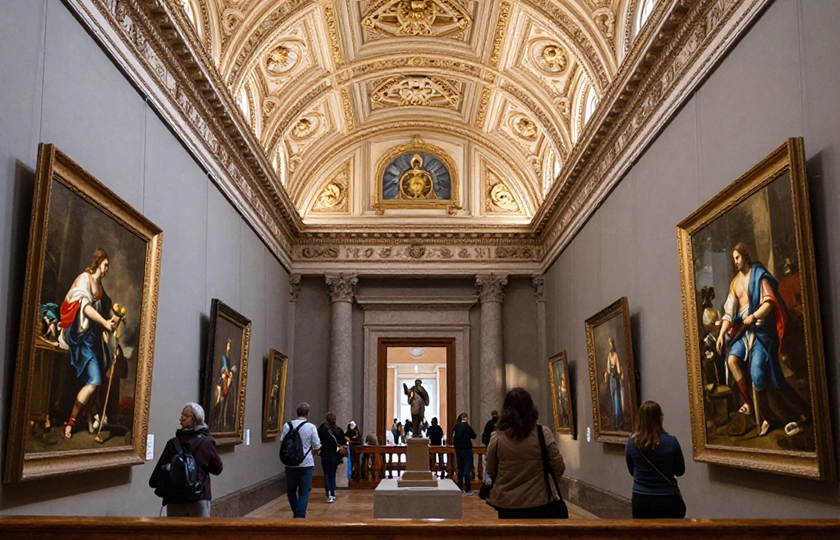
The reopening of the Pergamon Museum, ‘Documenta 16’, ‘Skulptur Projekte Münster’, the 450th anniversary of Rubens or the new architecture in Baku reflect a shift in the cultural traveller: first they decide what they want to see, and then where to travel.
First, the exhibition. Then, the destination. First, a museum reopening after years of closure, an artistic event that takes place only once a decade, or the anniversary of one of the great masters of painting. And from there, the journey.
This reversal in the way destinations are chosen is one of the trends that Mundo Amigo is identifying for 2027. The cultural calendar is becoming increasingly important in the decision to travel, and an exhibition, a festival, a reopening or an exceptional event can, on its own, be reason enough to make the journey.
“For a long time, the usual approach was to decide you wanted to go to Berlin, Antwerp or Buenos Aires and then see what exhibitions were on. We’re increasingly seeing the opposite process: there’s something specific you want to see, and you build your trip around that”, explains Mikel González, director of Mundo Amigo.
The company analysed these trends during the event held today at the Radisson RED Madrid, Atocha, attended by over a hundred travellers, with the participation of representatives from the German National Tourist Board in Spain and the Flanders Tourist Board (VISITFlanders), as well as guides and specialists linked to their cultural programmes.
Germany is set to host three of the major events of 2027
One of the clearest examples will be Germany.
The Pergamon Museum in Berlin will partially reopen to the public on 4 June 2027 after several years of closure for renovation. One of its greatest icons, the Pergamon Altar, will also return, alongside a new exhibition at the Museum of Islamic Art.
Just eight days later, documenta 16 will begin in Kassel – one of the leading international events for contemporary art, held every five years and directed by Naomi Beckwith for this edition.
And at virtually the same time, Münster will host Skulptur Projekte, an exhibition that is particularly unique as it is held only once every ten years. Its sixth edition will take place in 2027, coinciding with the project’s 50th anniversary.
The fact that these three events are taking place within a few weeks of one another makes Germany a good example of how the cultural calendar can in itself determine the best time to travel.
The close relationship that Mundo Amigo maintains with the German National Tourist Board in Spain allows us to follow these kinds of events closely and analyse how they are shaping interest in already established cultural destinations.
“The interesting thing is that we’re not talking about a new destination. Berlin, Kassel and Münster were already on the European cultural map. What’s changing is that there’s now a new and very specific reason to return,” says González.
Returning to a familiar city because something new has happened
This desire to return is another of the trends that Mundo Amigo has identified for 2027.
The experienced cultural traveller does not necessarily always seek to discover new countries. They also return to cities they know when there is an exhibition, a restoration, an anniversary or a new interpretation of the city’s heritage.
In Antwerp, 2027 will offer a very specific reason to return: the 450th anniversary of the birth of Peter Paul Rubens. The KMSKA is preparing a major exhibition centred on the Flemish master and his world, an event that will allow visitors to revisit his work and its context from new perspectives.
For Mundo Amigo, the case of Flanders demonstrates that an anniversary or a major exhibition can provide a new reason to discover — or rediscover — a familiar destination.
“A traveller may have been to Antwerp several times and yet have a completely different reason to return in 2027. That is one of the interesting changes: we no longer need to tick destinations off a list. We can return because new cultural interpretations can always emerge,” explains Mikel González.
Contemporary architecture opens up new horizons
The phenomenon also works the other way round: culture is putting places on the radar that traditionally did not feature at the top of the list for cultural travel.
Azerbaijan is one such place. Situated between East and West, the country has, over recent decades, used contemporary architecture as one of the tools for its transformation and international opening up.
Today, Baku offers visitors the chance to explore some of the major contemporary architectural languages through projects linked to international figures and practices. The Heydar Aliyev Centre by Zaha Hadid Architects, with its fluid forms and parametric language, has become one of the city’s new icons.
Alongside it, the presence of projects by HOK (Hellmuth, Obata & Kassabaum), Foster + Partners and Coop Himmelb(l)au offers a glimpse into different ways of understanding contemporary architecture: from functionalism and sustainability to the most radical proposals linked to deconstructivism.
More than just a succession of distinctive buildings, this concentration of international architecture offers an insight into Baku’s transformation and the country’s determination to forge a new identity that bridges its historical heritage and contemporary aspirations.
For Mundo Amigo, this type of destination holds particular appeal for travellers who are already familiar with the major European capitals and are seeking new destinations in which to explore architecture, design and contemporary art.
“There is a generation of cultural travellers who have visited Paris, London, Rome or Berlin many times. This means they are beginning to look towards places that, a few years ago, they might not have considered, but which today offer very compelling cultural attractions,” notes González.
Discovering another side to destinations we think we know
It isn’t always necessary to change countries. Sometimes, all it takes is a different perspective.
Argentina is one such example. As opposed to the better-known tourist routes of Buenos Aires or Patagonia, the north and west of the country offer a different cultural perspective through architecture, contemporary art, landscape and wine.
In Salta, the museum dedicated to James Turrell at Bodega Colomé brings contemporary art into the heart of the Andean landscape. In Mendoza, venues such as Killka, at Bodegas Salentein, combine art collections, architecture, gastronomy and landscape.
The trend points towards a traveller who is not content merely to visit a country’s iconic sites, but seeks out lesser-known regions, less obvious collections and connections between disciplines.
From destination to content
For Mundo Amigo, behind all these examples lies a single shift.
The cultural traveller of 2027 will be less reliant on lists of ‘must-see places’ and more willing to organise their itinerary around what truly interests them: an artist, an exhibition, a building, a composer, a historical period or a major cultural event.
It also implies more focused trips. Not necessarily longer ones or those involving more visits, but ones with a clearer selection and greater depth.
“When there is so much information available, the challenge is no longer finding things to do. It is choosing which ones are truly worth the trip. And in this regard, culture is increasingly becoming the starting point, not the afterthought”, explains Mikel González.
The reopening of the Pergamon Museum, the almost unprecedented coincidence of documenta and Skulptur Projekte in Germany, the 450th anniversary of Rubens in Flanders, or the growing interest in architecture and collections outside the major circuits all point to the same phenomenon: the map of cultural travel is no longer drawn solely by destinations. It is also shaped by the calendar.
About MUNDO AMIGO
Mundo Amigo is an agency specialising in bespoke cultural travel for individuals, institutions and private clubs. Its programmes centre on art, music, history, architecture and heritage, and are led by specialists who enable travellers to gain a deeper understanding of each destination.
Throughout its history, it has organised cultural programmes for institutions such as the Thyssen-Bornemisza National Museum, the Friends of the Prado Museum Foundation, the Guggenheim Museum Bilbao, the Reina Sofía School of Music and Club Matador, amongst others.
Source: MDG Comunicación