

- The 2026–2028 Framework Plan for Tourism Action makes international marketing a tool to help transform the Spanish tourism model.
- Turespaña will promote new destinations in international markets, reposition established destinations and strengthen the tourism segments with the greatest potential to generate value: premium, gastronomic and MICE.
- The Plan incorporates artificial intelligence to improve the visibility and promotion of undiscovered Spanish destinations in new digital environments.
- Five objectives and nine programmes form the roadmap, which will be implemented each year through Annual Operational Plans open to sector participation.
- Further information is available on the dedicated PMAT 2026–2028 microsite: https://www.tourspain.es/pmat/
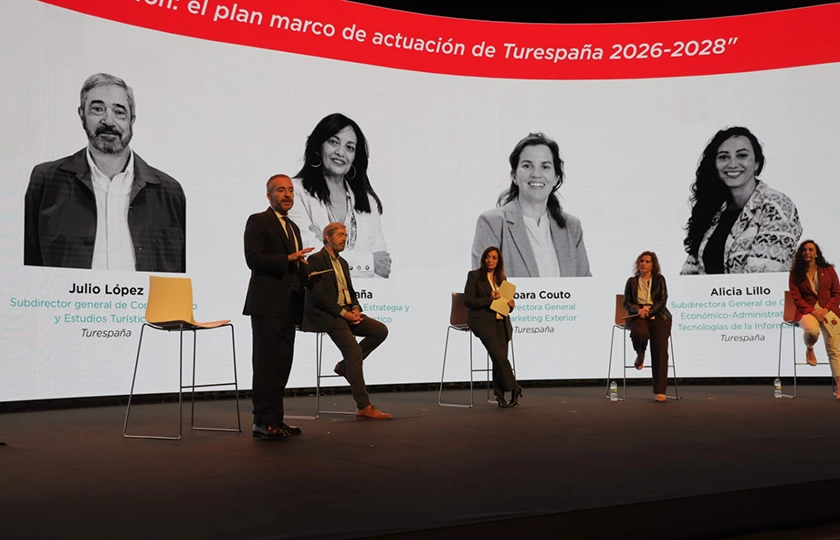
During the Turespaña 2026 Convention currently taking place in Zaragoza, Turespaña has presented the Turespaña Framework Action Plan (PMAT) 2026–2028, the roadmap that will guide its activities over the next three years and which represents an evolution in the concept of international tourism marketing: from a strategy focused primarily on promotion to one that also seeks to steer demand towards higher-value tourism that is better distributed geographically and seasonally, and more sustainable.
The PMAT puts the ‘Spain Tourism 2030’ Strategy and its commitment to responsible marketing into practice within Turespaña’s sphere of action. The aim is to help ensure that Spain not only remains a leading tourist destination but can also grow more effectively, generating greater economic and social value, extending the opportunities offered by tourism to more regions and reducing its environmental impact.
“Spain is entering this new phase from a position of leadership. The challenge now is to grow more effectively: to ensure that tourism generates greater value, that its benefits reach more regions, and that it contributes to the well-being of residents and visitors”, said Miguel Sanz, Director-General of Turespaña, who presented the working document alongside his management team.
More destinations and greater value
One of the PMAT’s main priorities will be to promote the so-called ‘destinations waiting to be discovered’ more vigorously in international markets, particularly areas in ‘Green Spain’ and inland regions, as well as less-explored areas within the main tourist destinations.
In 2025, the autonomous communities located outside the major traditional tourist destinations accounted for just 12.7 per cent of international arrivals, despite representing almost a third of the Spanish population.
Through Spain is Much More, Turespaña will support their international promotion and present a narrative of Spain based on its territorial, cultural and natural diversity. The campaign “Think you know Spain. Think again” will invite international travellers to discover a broader, more diverse Spain, linked to unique experiences.
For established destinations, the challenge will be different. Programmes such as Spain Trusted Destination and (Re)Discover Spain will seek to strengthen their reputation and offer new reasons to return, promoting experiences with greater added value and off-season travel.
In line with this, the PMAT identifies three strategic segments due to their capacity to generate value, promote seasonality and reinforce the positioning of the Spain brand: premium tourism, gastronomy and MICE.
Tourism enters the era of artificial intelligence
The PMAT also incorporates a new initiative to adapt Spain’s tourism positioning to the transformation of digital channels for travel inspiration and planning.
Turespaña will analyse how Spanish destinations are represented and recommended in artificial intelligence systems and will promote ‘AI-Ready’ multilingual content, designed to be interpreted, indexed and recommended by these systems.
The aim is to ensure that destinations with lower international profile are also present in these new environments where travellers make their decisions. Competition for tourism visibility is no longer limited to search engines and social media, but extends to the responses and recommendations generated by artificial intelligence.
Five objectives and nine programmes to transform tourism marketing
The new roadmap is structured around five objectives and nine action programmes. Alongside promoting destinations waiting to be discovered and repositioning established ones, the PMAT seeks to strengthen Spain’s leadership in the premium, gastronomic and MICE segments and to enhance Turespaña’s role as a facilitator of tourism transformation.
For the first time, the Plan also incorporates into its overall strategy the conservation and enhancement of the heritage assets managed by Turespaña, which comprises 102 buildings, including 100 Paradores and the Conference Centres in Madrid and Torremolinos.
A roadmap open to the sector
The PMAT is also the result of a process of consultation with the sector carried out by Turespaña, which included a survey aimed at destination managers and professionals from tourism companies, with around 800 responses, as well as meetings with forums and associations.
This collaboration will continue throughout the programme’s implementation. The nine programmes will be set out in detail each year through Annual Operational Plans (AOPs), which will define actions, budgets and monitoring indicators, and will involve the sector in operational planning.
“Spain Tourism 2030 sets the course and the PMAT is our roadmap for moving towards it. It is also an invitation to destinations, businesses and the sector as a whole to work together so that tourism continues to be a great opportunity for Spain, in an increasingly balanced and sustainable way”, concluded Miguel Sanz.
PMAT 2026–2028 microsite: https://www.tourspain.es/pmat/
Programme for the 6th Turespaña Convention: https://convencion2026.tourspain.es
X: @Turespana_
Hashtag: #ConvencionTurespaña
About the SPANISH TOURISM INSTITUTE (TURESPAÑA)
TURESPAÑA is an autonomous body reporting to the Ministry of Industry and Tourism, via the State Secretariat for Tourism, whose objectives are to maintain and strengthen Spain’s leading position as a global tourist destination; to help improve the competitiveness and resilience of the Spanish tourism sector, and to consolidate a tourism model based on economic, social and environmental sustainability through the efficient management of international tourism demand.
Source: TURESPAÑA