Beyond the Jordan, the biblical river in whose waters Jesus Christ was baptised, lies a land of hospitable people through which almost all peoples have passed. It would take less time to mention the cultures that have not left their mark than it would to mention those that have, so the Hashemite Kingdom of Jordan is a treasure chest of surprises to be discovered at leisure.
There is much to see in Jordan beyond the clichés. Due to its strategic location between East and West, it has always been a coveted land, a Holy Land for Jews, Christians and Muslims, a passage for merchant caravans and pilgrimage routes, the setting for the filming of mythical movies and, above all, a country that holds so many cultural landmarks that make it a destination with its own personality, without the need to form part of other neighbouring itineraries.
Deserts, legendary fortresses, archaeological sites with their chapters of history, holy sites and mystical trails, waters to float or dive in, an extreme and therefore fascinating nature, justify the fact that Jordan is much more than Petra.
Jordan, "the one who flows downwards"
Taking as our metaphorical compass the meaning of the word Jordan in Semitic languages, we set out on a journey up and down, from north to south, through the valley of the river in which Jesus Christ was baptised and which marks the border with the neighbouring state of Israel, along the tectonic fault line that separates the African and Arabian plates. On the way to say goodbye to him in the lake we know as the Dead Sea, four hundred and twenty-six metres below sea level, the road will be a string of surprises.
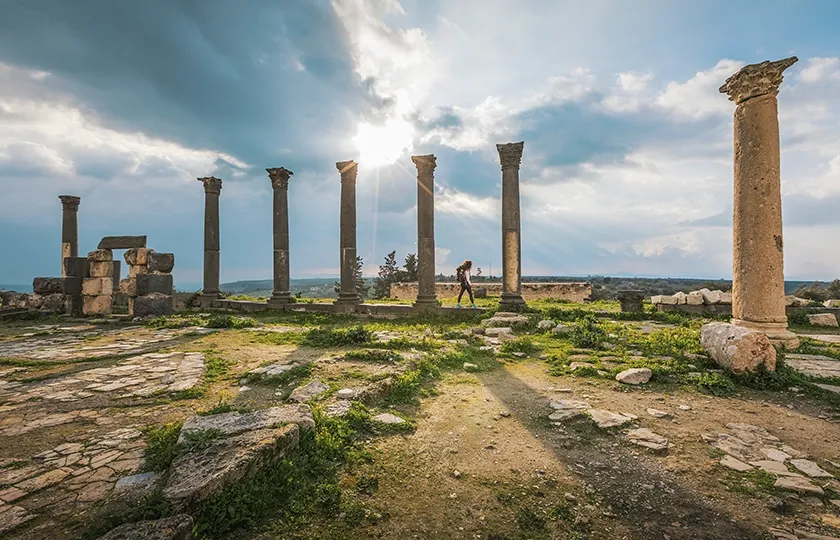
Umm Qays is an ancient Jordanian city located on the site of the ancient Roman city of Gadara, very close to the borders with Syria and Israel. It was part of the Greco-Roman Decapolis as one of the ten most important cities of the Empire, in what is now the Middle East, and recognised at the time as a cultural centre for its intellectual lifestyle and as the birthplace of great philosophers of antiquity. The Greek historian Polybius describes Gadara in 218 BC as “the strongest of all the places in the region“.
Overlooking the Jordan Valley from its mountaintop position, the city is like an open-air history book, with incredible panoramic views stretching as far as the Sea of Galilee, the Lebanese border and the Golan Heights.
The superimposition of Roman architectural remains from the 3rd century BC with others from the Ottoman period is striking, but the theatres, especially one made of black basalt, the garden with carved sarcophagi, the peculiar basilica, an underground mausoleum, baths, a city gate, an interesting necropolis and the remains of what was once a hippodrome are particularly noteworthy.
Umm Qays also owes part of its fame to its references in biblical texts, since, according to these, Jesus performed one of his miracles here, casting out demons from a man “in the country of the Gadarenes“. Matthew’s Gospel tells of an encounter between Jesus and two men “possessed by demons” in the cemetery here, where they are exorcised.
We continue south to find another of those special places that make Jordan different. Tel Mar Elias is associated with Tishbe, referenced in the Bible as the home and possibly birthplace of the prophet Elijah, revered by Jews, Christians and Muslims alike.
In addition to its historical importance, it is of great cultural interest thanks to its magnificent archaeological heritage, including two Byzantine churches, whose floors are decorated with splendid mosaics with geometric and plant motifs. On one of the mosaics there is an inscription invoking St Elias blessing the presbyter and his wife, also indicating the year AD 622 as the year of completion of the work of art.
To the northwest of the building is a baptistery, probably built later, but also paved with mosaics. To the southwest are the remains of what may have been a monastery, with a burial chamber that can be accessed via a staircase carved out of the rock. The colourful pieces of cloth tied to the trees reveal that even today, Tell Mar Elias remains a sacred place.
We return to the banks of the Jordan River to find the Site of the Baptism of Jesus, whose oldest record of its location is found in the bequest of an anonymous pilgrim from Piacenza in 570. The archaeological site, located about nine kilometres north of the Dead Sea, is of immense importance to Christianity because it is recognised as the place where Jesus of Nazareth was baptised by John the Baptist. It consists of two areas connected by the densely vegetated Wadi al-Kharrar: Tell Al-Kharrar, also known as Elias Hill, and the area just over a kilometre from the river, with churches, baptismal fonts and remains of ancient religious buildings dating from Roman and Byzantine times, as well as from the Middle Ages. These include a monastery, churches, chapels, water installations, several ponds, caves and other dwellings of hermits and monks.
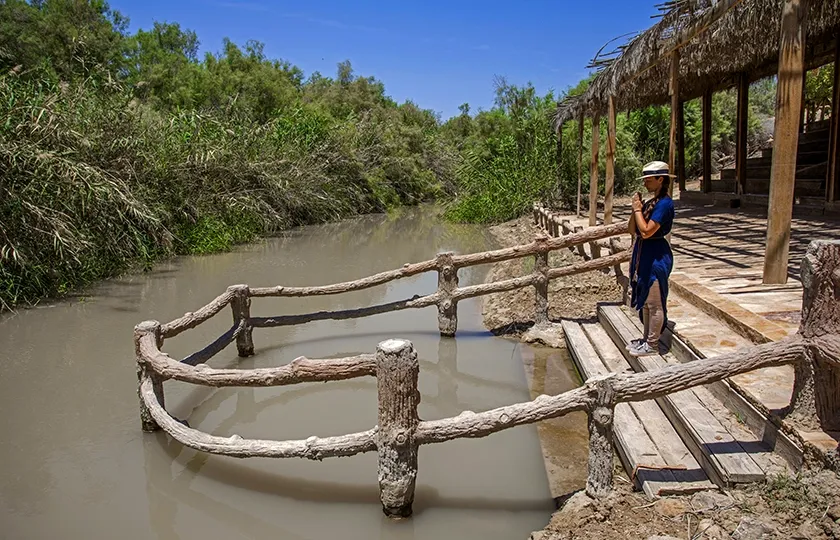
The most impressive part of the ruins is the Greek Orthodox monastery with a Byzantine-era crypt. In the Middle Ages, the Byzantine Emperor Manuele Comnenus (1143-1180) had the monastery rebuilt and fortified, but it fell into decline again. In 1882 the Greek Orthodox Patriarchate bought the land and revived the religious community. The Aramaic-Syriac name of the monastery is very old, and is also preserved in Arabic: Mar Yuhanna, literally the Lord John (cf. the ancient Christian invocation Mar-ana tha, “Come, Lord”, in 1 Cor 16:22).
Eight Christian churches in the area share ownership of these symbolic sites: Catholic, Greek Orthodox, Armenian, Coptic, Ethiopian, Romanian, Syrian and Russian.
The place of baptism is indicated by the Arabic name Qasr al-Jahud, the fortress of the Jews, probably in memory of the passage of the river by the Israelites when they reached the Promised Land (Jos 3:14-17).
We continue downstream to the Dead Sea, mentioned in the Bible and visited by Cleopatra, to bid farewell to the Jordan in one of the most spectacular landscapes on the planet, before heading to other fascinating landmarks.
A fertile and evocative desert
“where God commanded Moses to go up, saying to him, “Go up to Mount Arabo, Mount Nebo, in the land of Moab, opposite Jericho, and behold the land of Canaan which I am giving to the children of Israel to possess, and die on that mountain where you are going up”.” So our God, Jesus, who never abandons those who believe in him, also deigned to do this favour to my desires“. This is how Egeria, the 4th century Galician traveller, described what she felt when she climbed Mount Nebo, one of the most mythical places in history and our next stop.
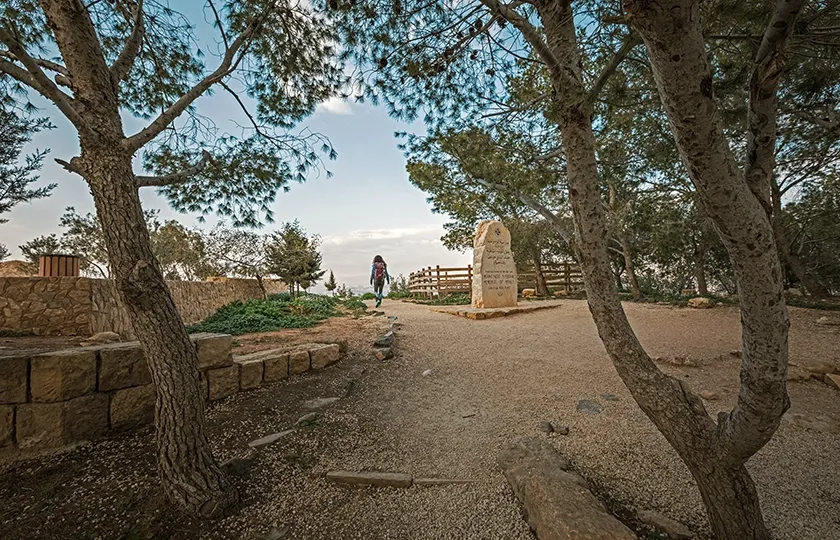
On the spot where, according to the Scriptures, Moses beheld the Promised Land and the prophet Jeremiah hid the Ark of the Covenant in one of its caves, a primitive church was built in the 4th century, enlarged in the Byzantine period and decorated with 6th-century mosaics.
We came down from the mountain to visit Madaba. Located on what is known as the King’s Road, it became the archiepiscopal see under Emperor Justinian. Famous for its virtuoso mosaics, most notably the one in St George’s Church, known as the Map of the Holy Land, which places 150 biblical sites with Jerusalem at the centre. Other splendid mosaics are in the Archaeological Museum, such as the one from the church of the Virgin of the Apostles and others decorated with flowers, plants, birds, animals and scenes from mythology and everyday life. The serenity of Madaba invites you to wander the streets and visit the craft shops where you can make your own mosaic.
Um er-Rasas is another of Jordan’s archaeological landmarks with Roman, Byzantine and Muslim remains. Cited in the Book of Jeremiah as the biblical settlement of Mephaat, today it enjoys World Heritage Site status. In addition to the inexhaustible source of knowledge that its constructions represent, it is essential to comment on the discovery of the largest and best preserved mosaic in Jordan. Found in the church of San Esteban, it is dated to 785 and signed by four masters. It depicts hunting and fishing scenes, as well as the most important towns in the region.
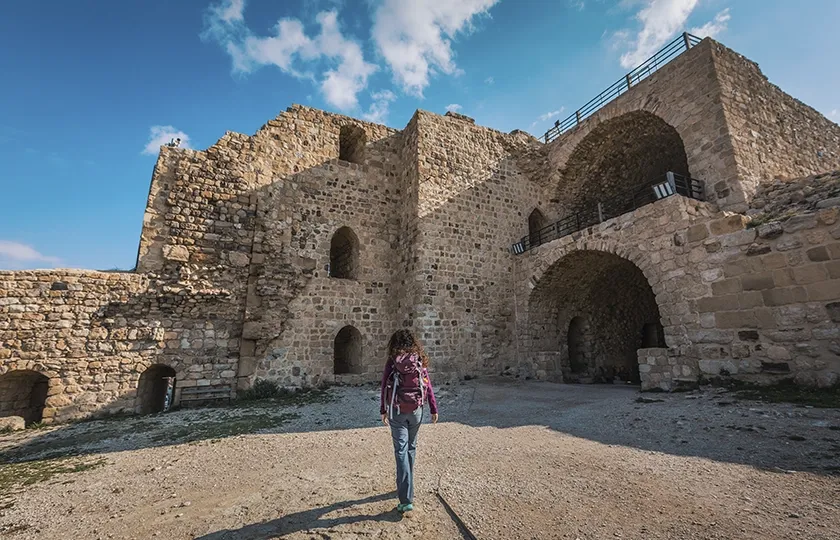
Our next stop is Mukawir, the hill fortress of Herod the Great where his son, Herod Antipas, ordered the beheading of John the Baptist after the fateful dance of Salome. Protected on three sides by deep ravines that made it almost impregnable, it did not deter Herod, who erected a wall with high corner towers. In the centre he built a palace that was “impressive in size and beauty“, according to Josephus.
We set course for another of the particularly suggestive places. The great fortress of Kerak, which witnessed fierce fighting between Saladin and the Crusaders. Built in the 12th century on the orders of Baldwin I as a key part of the defensive line linking the Dead Sea to the port of Aqaba, coinciding with the Damascus caravan route, it fell by force into the hands of Saladin, who pardoned all prisoners except the ruthless Reinald of Châtillon, whom he executed himself.
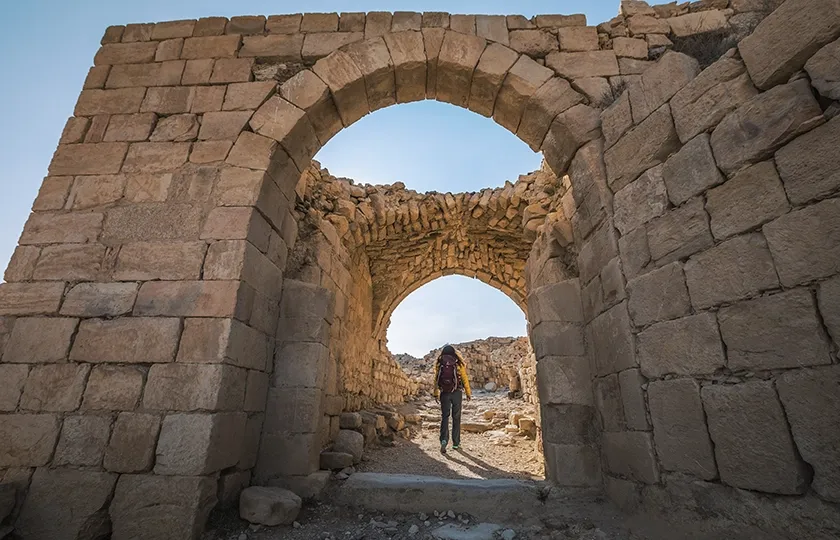
Within the same defensive axis is the hilltop castle of Shobak. Its imposing 12th-century appearance in the middle of one of the most pristine areas, together with its excellent state of preservation, justify a stop along the way.
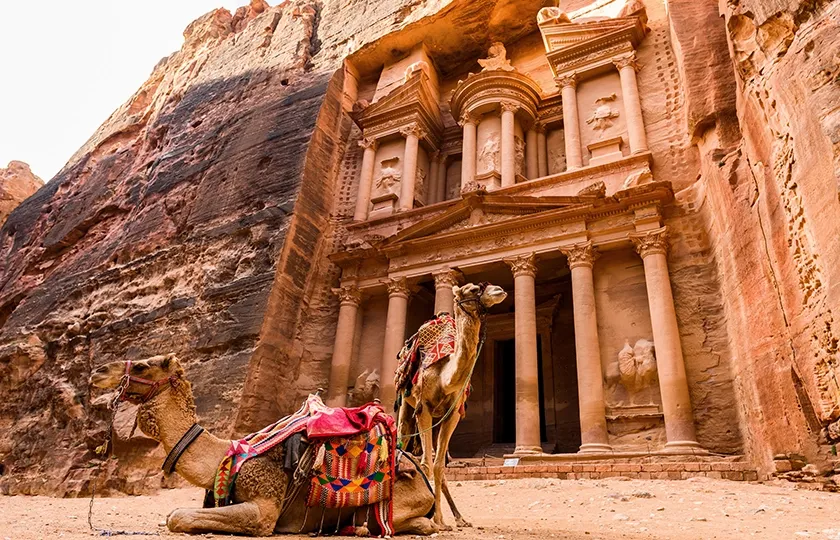
Petra represents one of Jordan’s most iconic images and is well worth a feature on its own, but it cannot be overlooked on this fascinating journey. The ancient Nabataean city, now a World Heritage Site, was an important trading centre on the merchant routes back in the 6th century BC. The Treasury, the universal façade carved into the rock after crossing the reddish stone gorge, together with the Monastery with its no less beautiful stone urn, are just a small sample of the sublime excellence of this architectural jewel.
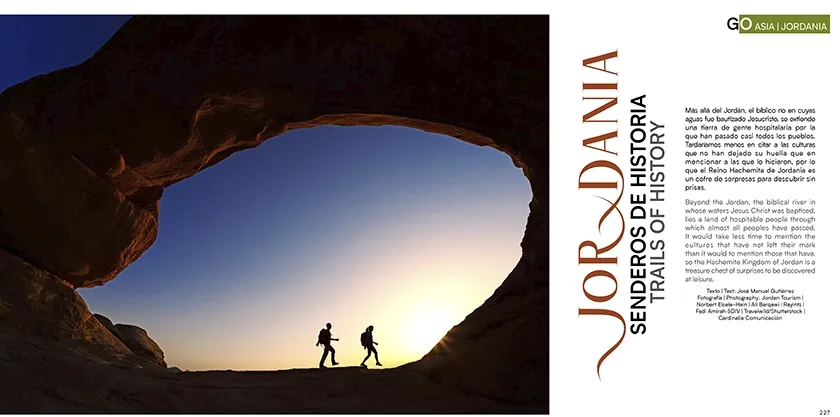
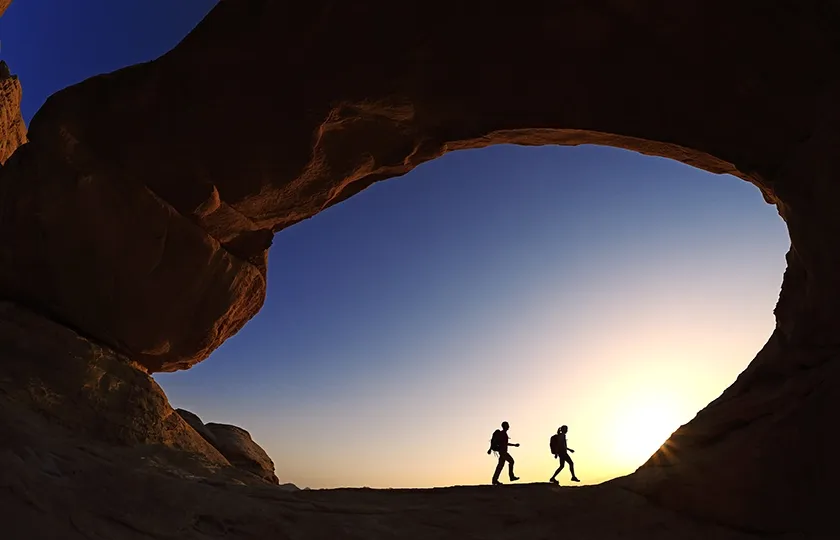
With the daydreaming at its peak and the sadness of knowing that the journey is coming to an end, we set off for our last destination, the desert of Wadi Rum, that magical place, still inhabited by Bedouins, where the sensation of peace enters through the pores and where the wind and water have carved this labyrinth of rocks that want to touch the sky, some of them decorated with rock art more than four thousand years old under an unimaginable starry sky.