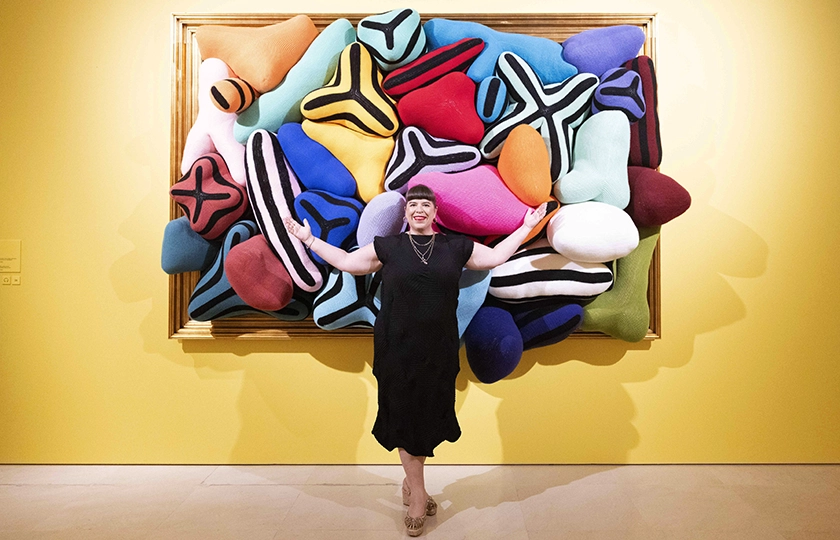
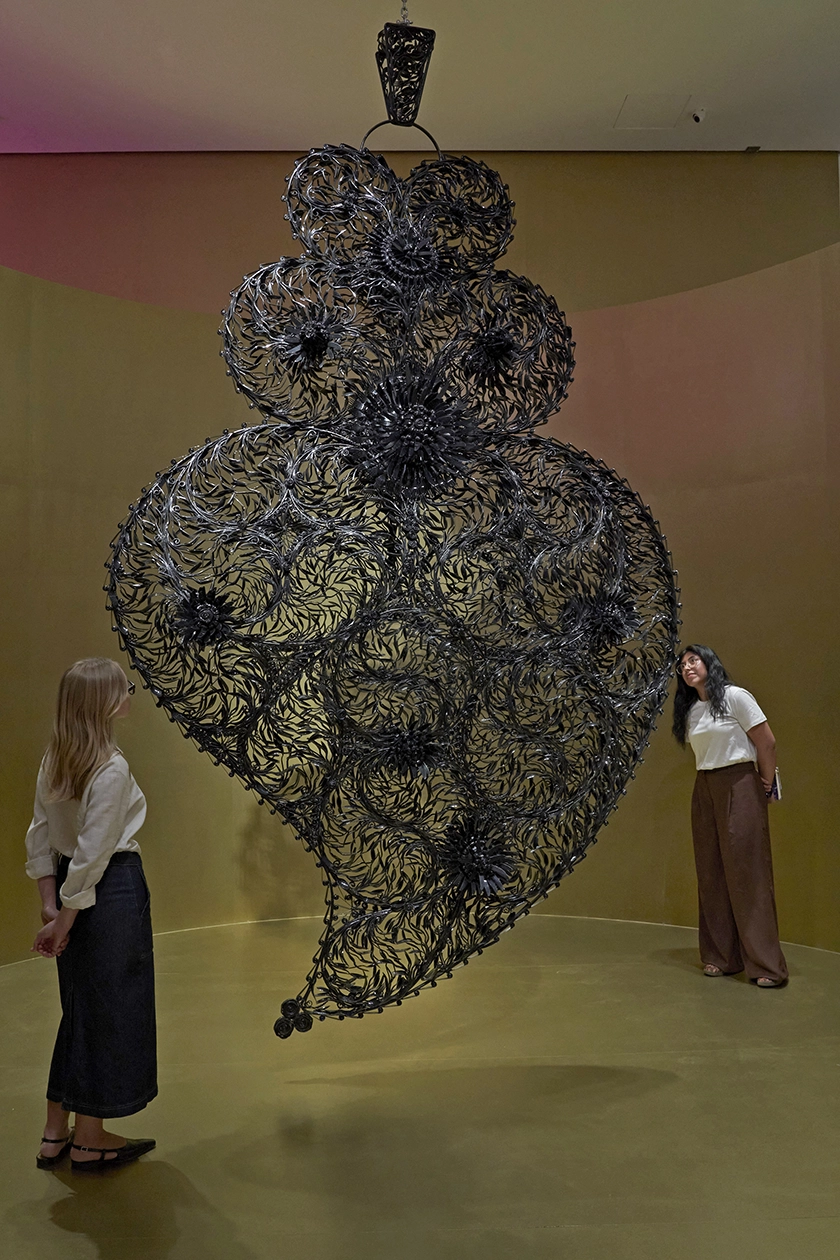
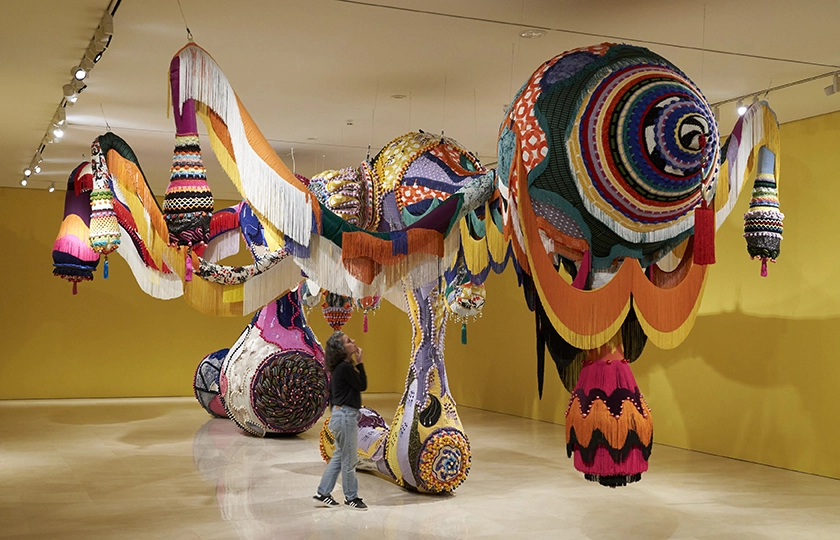
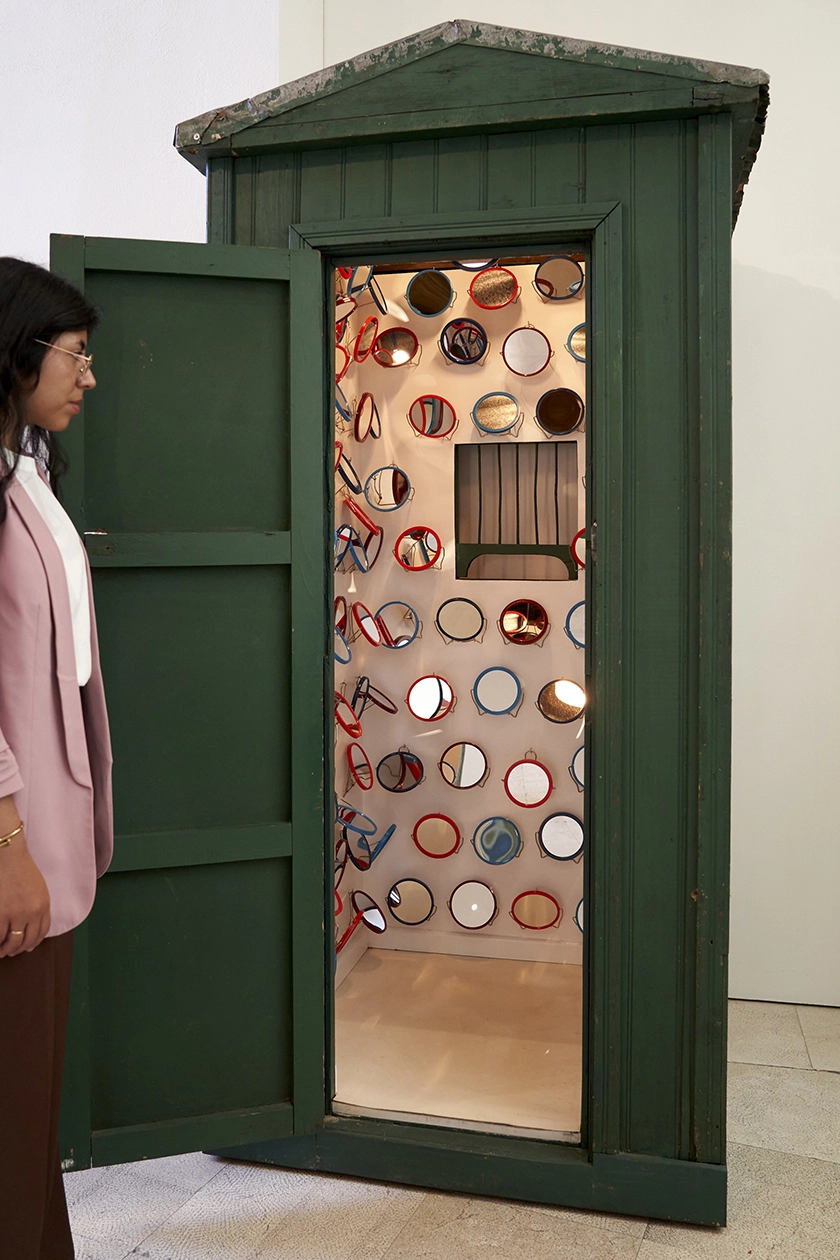
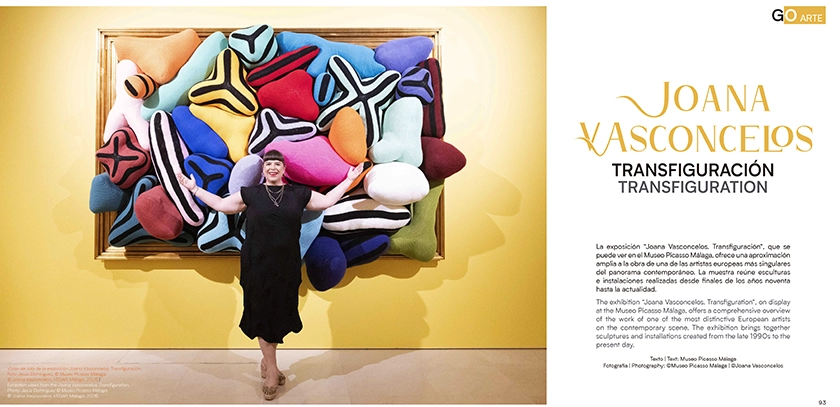
The exhibition “Joana Vasconcelos. Transfiguration”, on display at the Museo Picasso Málaga, offers a comprehensive overview of the work of one of the most distinctive European artists on the contemporary scene. The exhibition brings together sculptures and installations created from the late 1990s to the present day.
Curated by Miguel López-Remiro, artistic director of the Museo Picasso Málaga, the exhibition underscores the museum’s commitment to international collaboration and to presenting unique projects in the field of contemporary art.
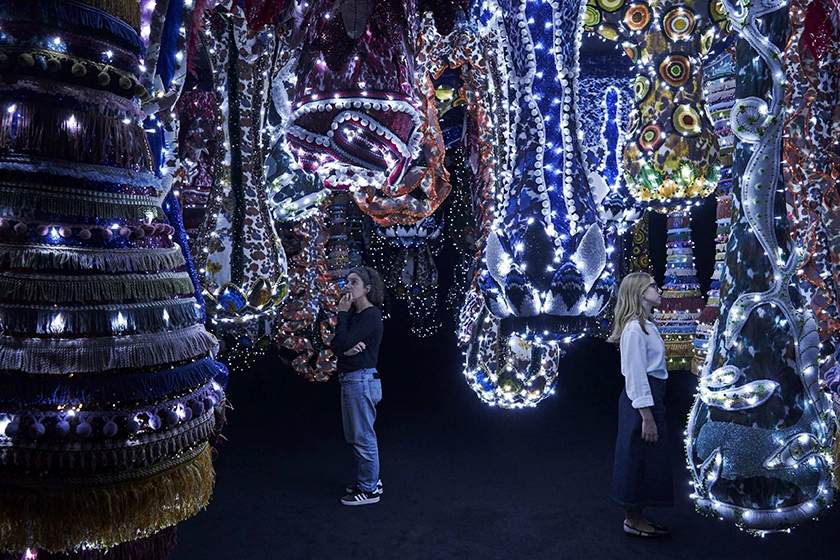
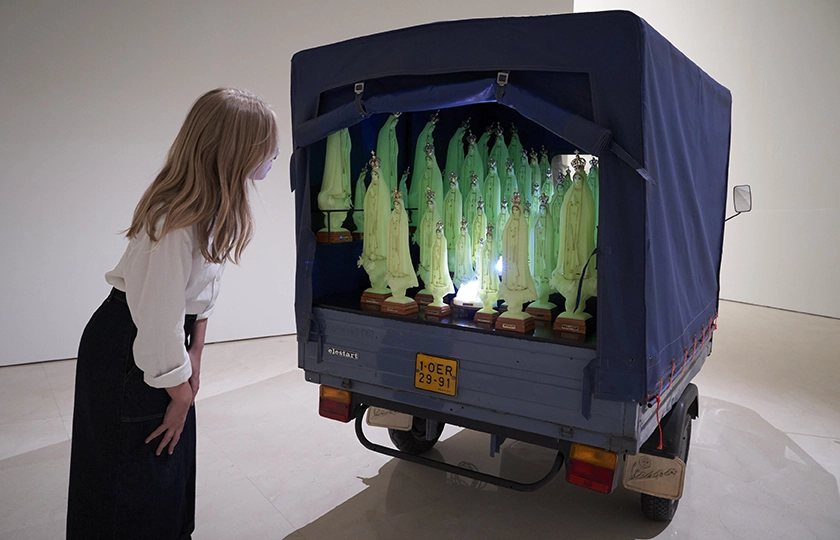
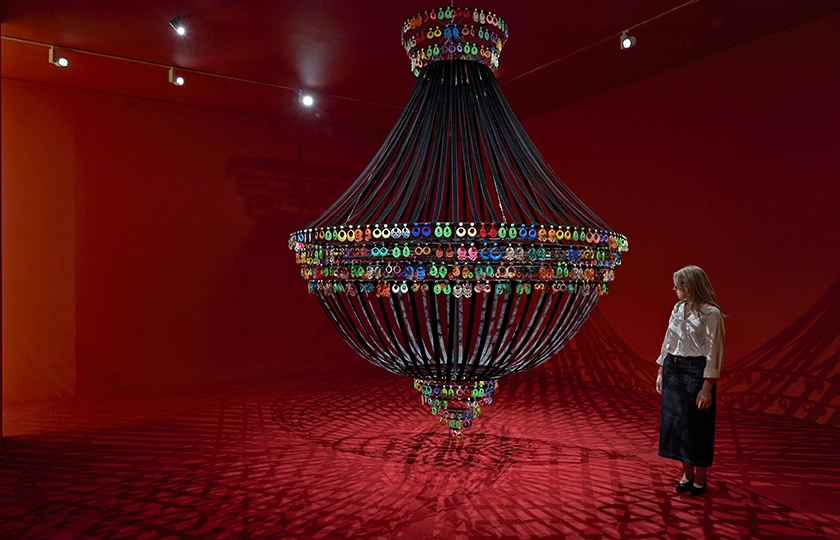
‘Joana Vasconcelos. Transfiguration’ at the MPM offers a comprehensive overview of her career through a collection of thirteen sculptures and installations that allow the viewer to explore how to shift the meaning of objects without erasing their memory. The exhibition’s title accurately captures this process: textiles that become architecture, ornamentation that takes on a structural role, everyday objects that function as critical devices, the home that opens up as a public stage, and the museum that becomes a space for experience, going beyond mere conservation. This concept runs through the exhibition galleries, where the everyday takes on a monumental scale; the utilitarian takes on a ceremonial character; and the domestic expands into the architectural.
The act of ‘transfiguring’ does not involve replacing or erasing the original: it remains what it is, but begins to reveal itself in a different way. Objects retain their material identity and cultural significance, although their meaning is transformed when placed within a new perceptual framework. Joana Vasconcelos illustrates this point in the following quote: “If we look at Picasso’s Les Demoiselles d’Avignon, they are there, but at the same time, they are not there. Through geometric forms, which are not natural, they have been transformed; their identity has changed.”
A unique work
Joana Vasconcelos (Paris, 1971) is a Portuguese artist whose work draws inspiration from her country’s material culture. Drawing on everyday objects, popular symbols, industrial materials and craft techniques passed down from generation to generation, his work explores art’s capacity to transform the familiar into visual and spatial experiences that alter our perception of the world.
Over recent decades, he has established himself as one of the most distinctive voices in European contemporary art, thanks to his work in sculpture and art installations, which re-examine material culture, folk traditions and everyday objects from a critical perspective rich in sensory experience.
Vasconcelos’s work offers an aesthetic experience that combines visual allure and reflection, inviting the viewer to rethink what they thought they knew, and demonstrating how art can change the way we see things. The exhibition’s curator, Miguel López-Remiro, regards “the artist’s work as a series of operations that reorganise our cultural hierarchies: between the domestic and the public, the artisanal and the industrial, the popular and the monumental”. For her part Joana Vasconcelos herself states that, for her, contemporary art creates spaces for interpretation that can be ‘physical, mental, conceptual or spiritual’.
The artist takes recognisable elements — household items, industrial materials, cultural symbols or fragments of folk tradition — and subjects them to processes of transformation that alter their scale, their function and their relationship with space. Through these practices, the everyday can take on a monumental dimension; the utilitarian can become ceremonial; and the ornamental can take centre stage in the artistic experience. However, these displacements do not erase the memory of the objects: the viewer recognises their origin, even though they can no longer relate to them in the same way. It is within this tension that the experience of transfiguration is triggered. To reach that point, the scale acts as a consequence, not as a result. Vasconcelos does not set out to provide definitive answers: “I want to ask questions,” he repeatedly states. For her, “Art, when it is not conceptual, does not need to be translated; it needs interpretation and feeling; it needs emotion. When you work with people’s emotions, it is more interesting: with my work, I do not seek to provide answers; I want to ask questions.”
Tradition and domestic knowledge
One of the most distinctive aspects of Vasconcelos’s work is her use of craft techniques historically associated with the domestic sphere, such as crochet, embroidery and textile work. These practices, passed down from generation to generation and often sidelined in the official narrative of art history, form the starting point for large-scale sculptures and installations. His work thus unfolds in a realm where tradition, craftsmanship, popular culture and technology are constantly intertwined. For Joana Vasconcelos, craftsmanship brings together techniques, materials and knowledge passed down through the ages. In this context, her reflections on the feminine – understood as a way of thinking and of structuring artistic practice – take on particular significance. This aspect is evident in their studio in Lisbon, a space with ‘a homely feel’ where more than fifty people work under a model of horizontal, collaborative and mindful governance. The artist says she is very grateful for the historic moment in which she is living: “At last, women today can take their place in world history; they can have a voice and speak from their own unique perspective. Women – many women, including women in my own family – were unable to have a voice; they were unable to study art or become the artists they wanted to be.”
Picasso and the experience of transfiguration
Vasconcelos recalls the impact his first visit to Guernica had on him as a teenager. Standing before the canvas, at the age of just seventeen, he realised that war could be experienced not as a narrative or historical representation, but as a physical and emotional experience. “Looking at the painting, I could feel the war,” he recalls. That experience revealed to him that transfiguration does not eliminate emotion, but rather intensifies it: the image is altered, but the feeling remains and, in a sense, is amplified.
This line of reasoning takes on a particular significance in the context of the exhibition at the Museo Picasso Málaga. Rather than seeking to establish an explicit dialogue with Picasso’s work, the exhibition is part of a tradition in which the everyday, the popular and the vernacular become active materials for artistic experimentation. Within this context, the notion of transfiguration is inevitably reflected in the work of Pablo Picasso.
For Picasso, the vernacular served as a space of freedom where past and present coexist without hierarchy. For Vasconcelos, tradition is presented as a living entity in which the popular and the everyday do not evoke nostalgia, but rather represent a field of transformation, capable of being displaced, fragmented and reconfigured. In both cases, the transformation does not involve a radical break with the original context, nor an extreme act of estrangement; rather, it is a more subtle process that absorbs diverse languages and causes them to mutate without erasing their memory. The popular and the domestic do not appear as a starting point to which one returns, but rather as a space for action. Objects are no longer interpreted solely in terms of their function, but are instead understood in terms of their capacity to be reorganised and to take on new meanings. Its origin remains recognisable, but its status changes: the form remains the same, whilst the meaning expands.
In this context, exhibiting her work at the Museo Picasso Málaga takes on a special, almost intimate significance for the artist. Exhibiting here is like stepping into Picasso’s home: ‘When you enter a space like this, a place that belongs to Picasso, whether you like it or not, you connect with Picasso’s energy, with his homeland, with his identity, with his native Málaga.’
In this way, the exhibition not only traces a journey through Joana Vasconcelos’s work, but also creates a field of resonances where different ways of understanding artistic transformation converge. Transfiguration ceases to be merely a concept and becomes a shared experience: a way of seeing that challenges the familiar and opens up new possibilities of meaning.
Publication and accompanying events
To mark the exhibition ‘Joana Vasconcelos. Transfiguration’, a bilingual catalogue in Spanish and English has been published in collaboration with La Fábrica. This large-format, hardback, padded volume features a curatorial essay by Miguel López-Remiro, artistic director of the Museo Picasso Málaga and curator of the exhibition, as well as a previously unpublished interview with the artist.
The exhibition also features an audio guide available in Spanish and English, which offers a detailed tour of the exhibition and Vasconcelos’s work, as well as a podcast on the Museo Picasso Málaga’s Spotify, Ivoox and Apple Podcasts channels.
The programme is enriched by cultural and educational activities aimed at different audiences.
https://www.museopicassomalaga.org/en