

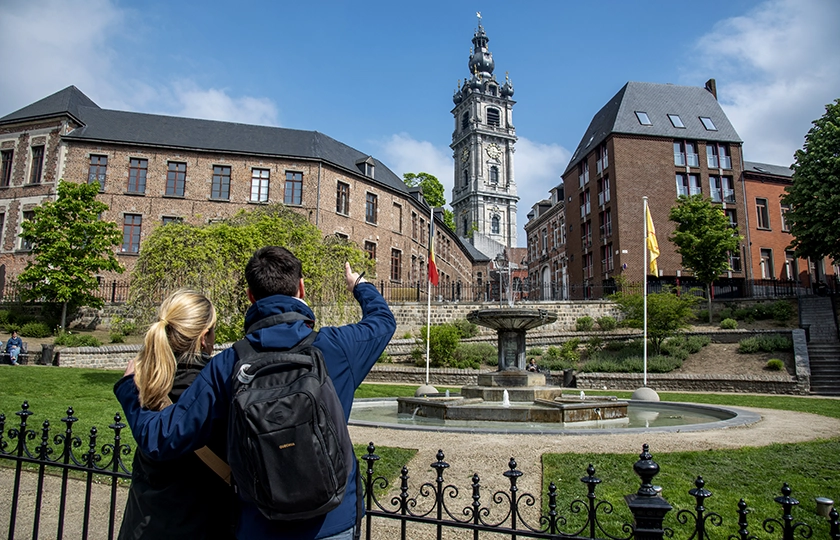
In this vibrant city, where there is no shortage of occasions to celebrate, its architectural heritage and ancient streets lend it all the charm of historic cities.
A medium-sized town with many pedestrianised streets and majestic buildings, making it a pleasant place to visit; it is characterised by its deep roots in the past and its modernity. This and other reasons explain why it was chosen as the European Capital of Culture in 2015.
Situated in the south of Belgium, in the Wallonia region and very close to the French border, it maintained close ties with Spain during the 16th and 17th centuries, as it formed part of the Netherlands under the Spanish Crown; a period which left its mark in cultural, military and architectural terms. This can be seen in a house next to the Town Hall, which features stepped gables and a bust of King Philip IV of Spain.
It also boasts numerous museums that showcase and celebrate both contemporary and historical artistic creation, as well as science and history.
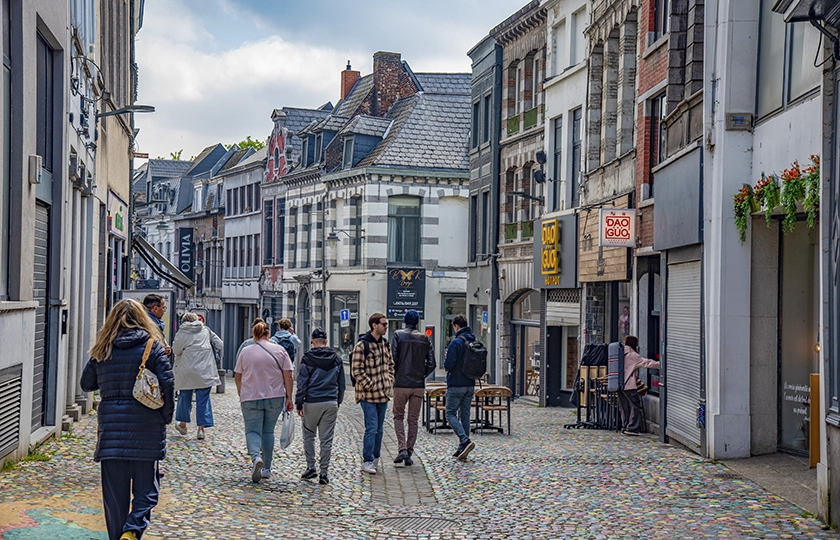
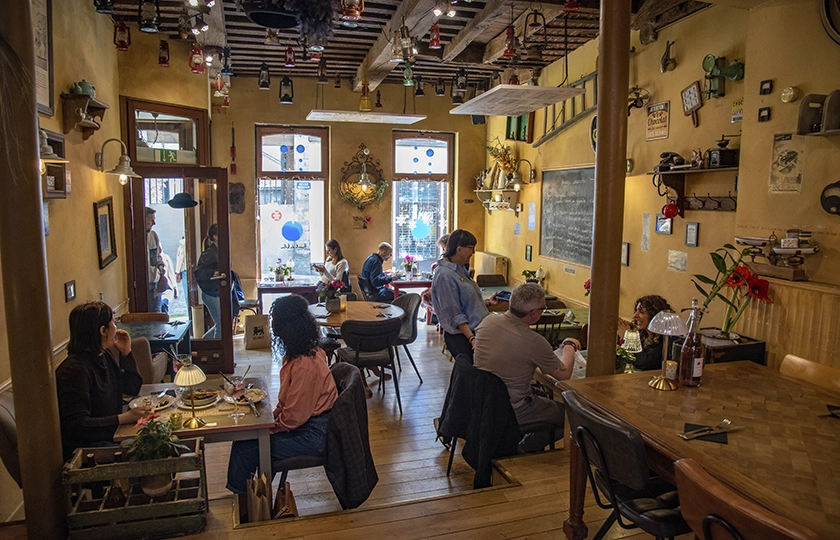
To really get a feel for the city, take a leisurely stroll through its secluded streets, where you’ll find everything from stone-built Gothic houses to numerous buildings with murals on their walls – thanks to a City Council initiative that promotes urban art through a trail called “L’art habite la Ville”. Also on the pedestrianised Rue des Fripiers, with its restaurants and numerous shops, we’ll walk on cobblestones painted in different colours, which give the street a very cool feel. Very close by is the “Boule de Bleu” restaurant, which specialises in original salads, organic produce and homemade desserts and, luckily, they speak Spanish.
‘It might be worth my speaking to you again about Mons, as it is a charming city’, is how Victor Hugo described it.
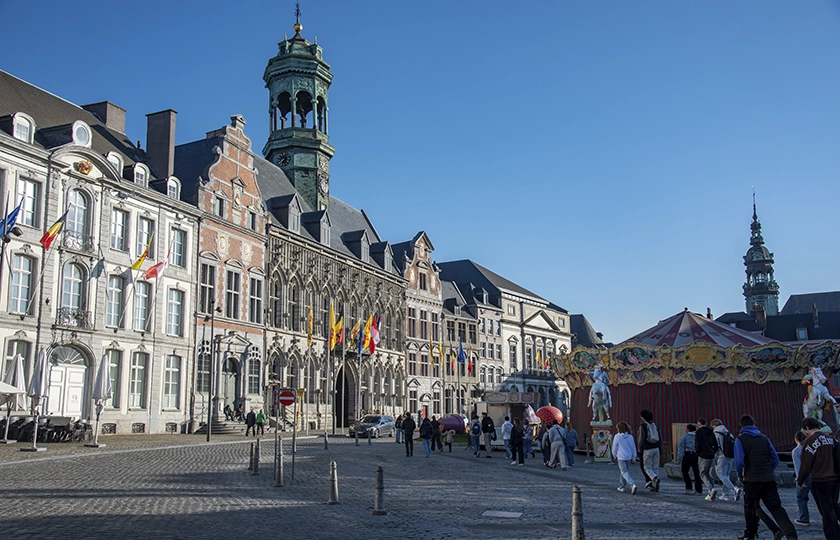
We begin this tour at the Grand Place, a symbol of Mons’s history, culture and hospitality. It is an architectural gem surrounded by historic buildings from different periods and in various styles: Gothic, Neoclassical and Renaissance.
In what is one of the most beautiful squares in Europe, we find stunning buildings such as the Casa del Toisón de Oro, the former Lonja de los Paños and the impressive Town Hall building. Built in the second half of the 15th century, this majestic Gothic-civil style building is notable for its ceremonial halls dating from the 16th, 18th and 19th centuries, as well as the mayor’s office, which houses examples of Mons gold and silverwork and beautiful 17th-century tapestries, presented to the city by the King of France, Louis XIV, following the siege of 1691. Behind the main building lies a true haven of nature, the Jardín du Mayeur, featuring the bronze statue of ‘Le Ropieur’.
A symbol of good luck, anyone passing through the Grand Place must perform a ritual that has been repeated for centuries: stroking the head of the Grand Garde monkey with their left hand. ‘Whatever a woman desires, the monkey can do.’ Tradition has it that if a young woman wants to get married, or a newlywed couple wants to have a child during the year, they must perform this simple ritual.
When the weather is fine, the square fills with people in its bars and restaurants, who come to enjoy Walloon cuisine whilst taking in the unbeatable views. It is here that the battle between St George and the dragon (Doudou) is re-enacted every year, a ritual confrontation known as Lumeçon which attracts thousands of visitors. It forms part of the Ducasse Festival, which has been declared part of the Intangible Cultural Heritage of Humanity; a true symbol of the city’s ancient traditions, beginning at the collegiate church and continuing with a procession through the streets of Mons, culminating in the magnificent ascent of the Golden Chariot (Car d’Or), a Baroque carriage carrying the relics of Saint Waudru, the city’s patron saint.
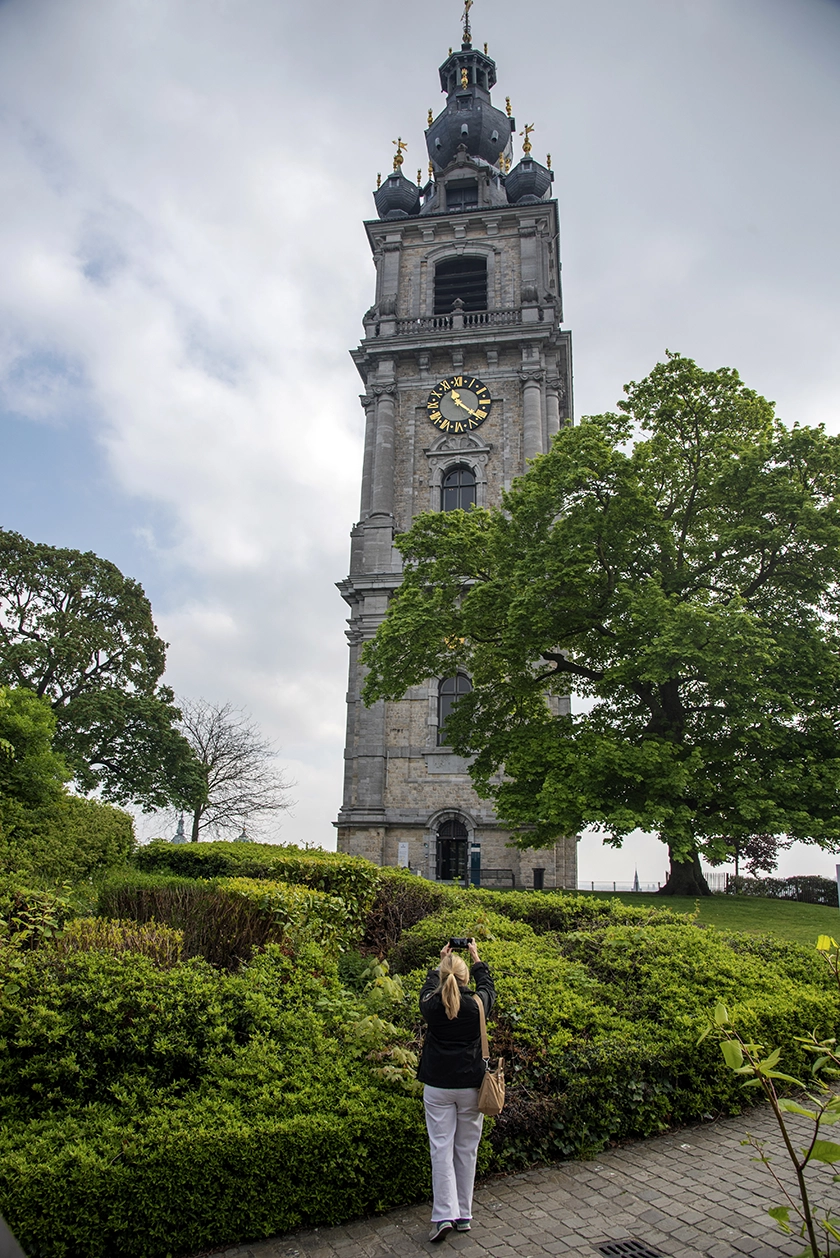
The sparse remains of the castle lie very close by. The most notable feature of the site is the city’s emblem, the Beffroi belfry, also popularly known as the Catiau, which, at eighty-seven metres high and with forty-nine bells, is Belgium’s only Baroque belfry. The panoramic lift brings us closer to the magic of the bells and the carillon, and we visit an interpretation centre that showcases their history. The tradition and skills of the bell ringers were recognised by UNESCO in 2016 as Intangible Cultural Heritage of Humanity.
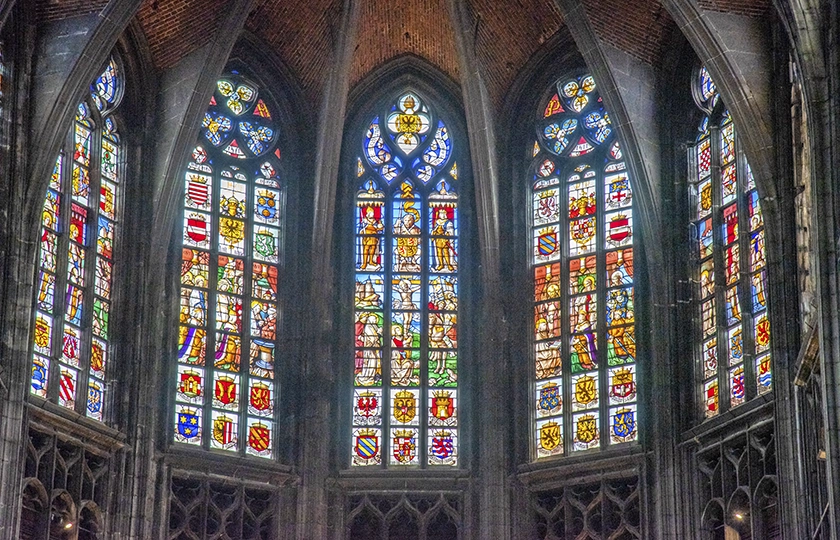
Walking down Rue de Clercs, we come to the collegiate church of Sainte-Waudru and its relics. Built in the Brabant Gothic style between the 15th and 17th centuries, it features splendid 16th-century alabaster statues by Jacques Du Broeucq; excellent stained-glass windows from the same century; and one of the finest collections of religious metalwork in Belgium, dating from the 12th to the 19th centuries. It houses the Golden Chariot that we mentioned when discussing the Ducasse Festival.
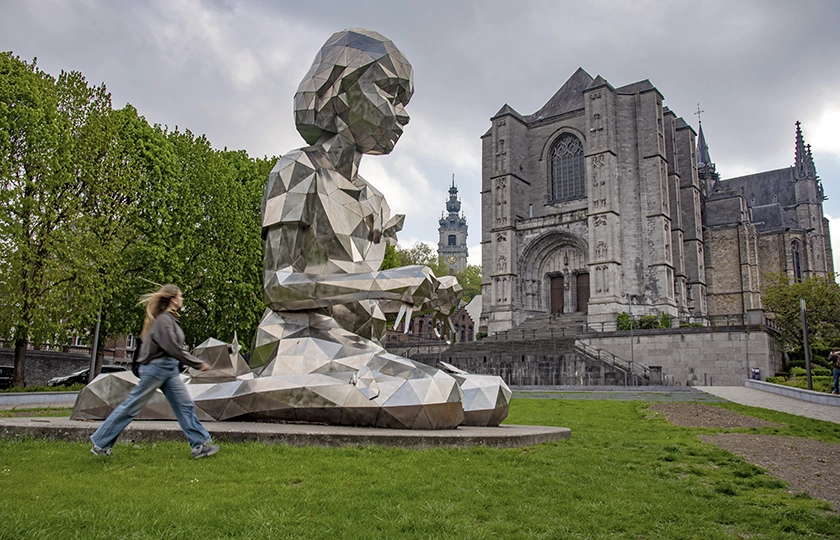
Right opposite the collegiate church, a secluded park is dominated by a silver statue called “Lucia and the Butterflies”, which is one of the most Instagrammable sculptures in the area.
Our trip to Mons will be even more complete if we visit other equally interesting places: the Castle of the Dukes of Havré, the Royal Theatre of Mons, the Neolithic Mines of Spienns and the Saint Lazare Brewery.
The Castle of the Dukes of Havré, situated on the outskirts of Mons, is a real gem where you can experience the magic of the building and its magnificent gardens. The Royal Theater of Mons, built in the neoclassical style between 1841 and 1843. The Neolithic Quarries of Spienns and their SILEX’S Interpretation Centre are one of the oldest and largest flint extraction sites in Europe and have been designated a UNESCO World Heritage Site. The Saint Lazare Brewery, which specialises in a wide range of craft beer styles brewed using unique recipes, in small batches, and in collaboration with its customers.
As I mentioned at the start, Mons has a range of exhibition spaces covering a variety of themes, from history to the natural sciences, including archives, painting, fine arts, Art Nouveau, decorative arts and children’s art.
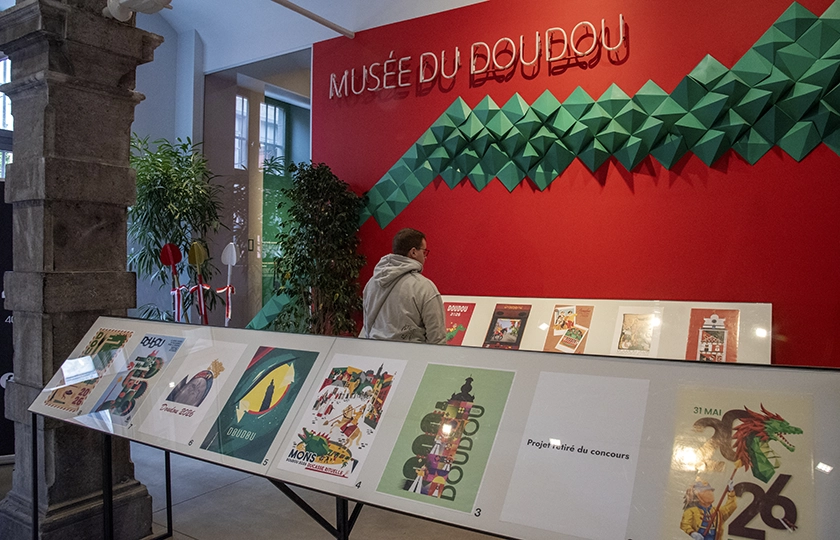
Behind the Town Hall, in the former Monte de Piedad building which houses several museums, is the “Doudou” Museum, one of the places most dear to the hearts of the people of Monte. In the Jardin du Mayeur, the “Doudou” museum invites us to discover the Ducasse ritual and its rich world, a true treasure of Mons’s world heritage and folklore, through an authentic immersive experience that brings to life the legendary battle between St George and the dragon.
The Walloon city has other places that are well worth a visit. This is the case with the Mundaneum Museum, an archive comprising twelve million bibliographic records and listed on UNESCO’s Memory of the World Register. La Casa de Van Gogh en Cuesmes, donde el brillante pintor holandés vivió por un breve periodo y que alberga bocetos que realizó durante su estancia en Cuesmes, la correspondencia que mantuvo con su familia y la pintura original «Les Becheurs», pintada en 1880. The Art Nouveau Museum, situated in the Casa León Losseau, an architectural gem of this artistic movement. The BAM, Mons Museum of Fine Arts, a museum with a space for cultural creation where events are held. The Regional Museum of Natural Sciences, with a history stretching back more than 170 years. The François Duesberg Museum of Decorative Arts, covering French society from the reign of Louis XVI to the Restoration. The Mons Memorial Museum, or MMM, which showcases the military history of the Mons region from the Middle Ages to the 20th century. L’Amusette, a centre dedicated to exploring water and the environment for children aged between two and a half and twelve.
You might be interested in:
https://revistagotravel.com/en/wallonia-industrial-heritage-pride-walloons-en/