Published in December 2024
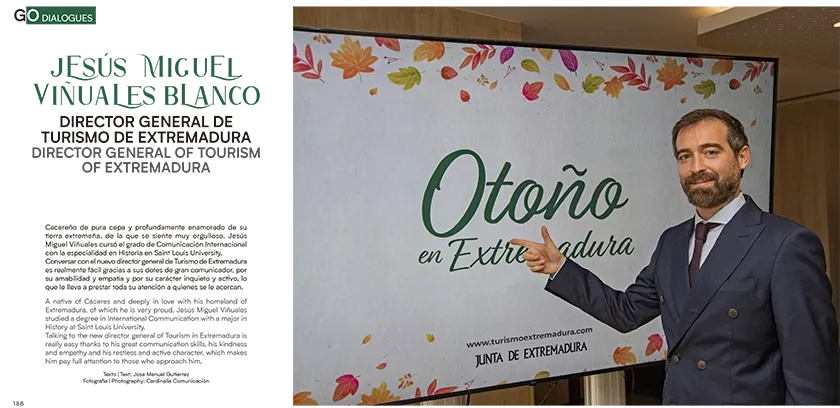
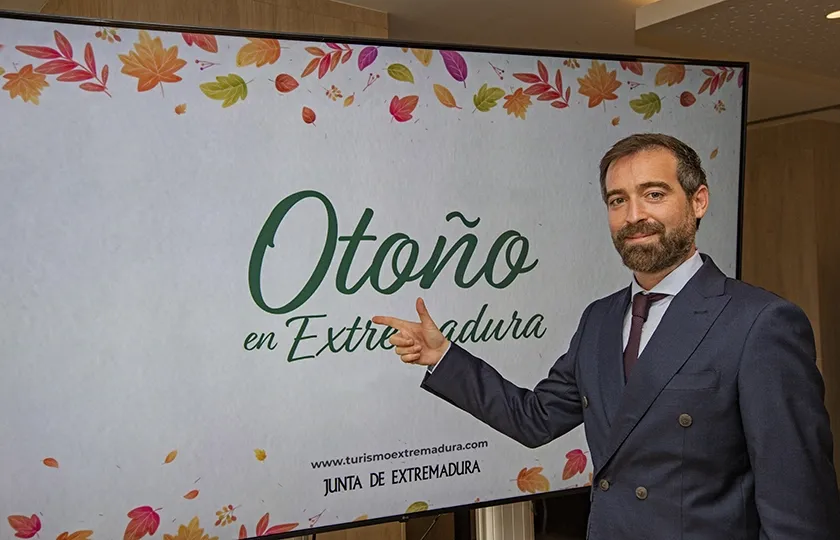
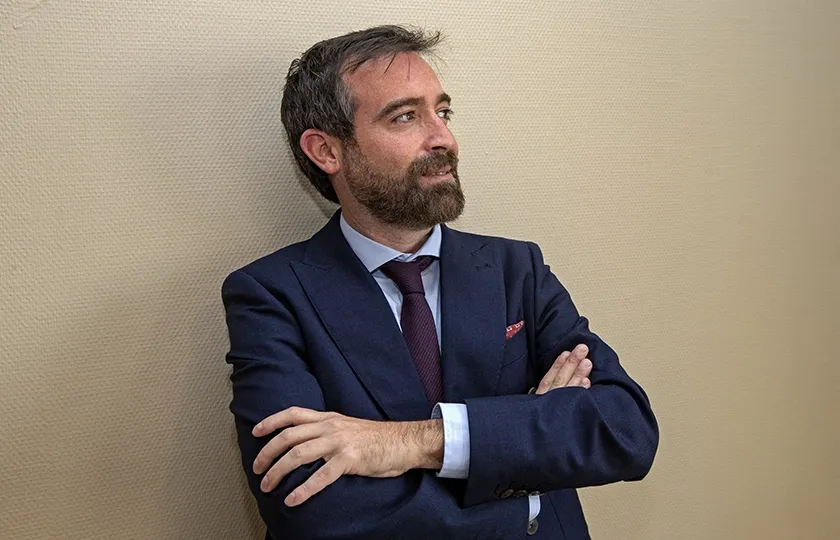
A native of Cáceres and deeply in love with his homeland of Extremadura, of which he is very proud, Jesús Miguel Viñuales studied a degree in International Communication with a major in History at Saint Louis University.
Talking to the new director general of Tourism in Extremadura is really easy thanks to his great communication skills, his kindness and empathy and his restless and active character, which makes him pay full attention to those who approach him.
His intense professional career has always been linked to tourism communication, occupying positions of high responsibility in the media as well as in large corporations and public-private entities. As a result, it has a global vision of the sector that it wants to apply for the benefit of Extremadura, clearly defining the guidelines that will position its territory as a modern and consolidated destination on the world tourist map.
For Jesús Viñuales, his land is genuinely polyhedral and each of its values are sufficiently powerful assets. to be the pillars of a sustainable future and a cross-cutting wealth generator.
Q.- What values make Extremadura a destination you always want to return to?
A.- Our people, our nature, our historical and cultural heritage, our gastronomy. Also the proximity and good relations with Portugal. These are our main distinguishing features in terms of tourism. Extremadura has an immense historical legacy, including three World Heritage Sites (the monumental complex of Cáceres, the archaeological site of Mérida and the monastery of Guadalupe, the cradle of Hispanity) and dozens of towns and cities with an enormous wealth of heritage and culture, such as Badajoz, Plasencia, Trujillo, Zafra or Hervás. We are one of the Autonomous Communities with the most quality foodstuffs, as attested to by our twelve Designations of Origin and five Protected Geographical Indications, examples of the excellence and variety of our gastronomy. And, of course, our nature. I am not exaggerating when I say that Extremadura is a natural paradise with more than fifty protected areas, such as the Biosphere Reserves of Monfragüe, Tajo Internacional and La Siberia.
Q.- With the difficulty that comes with the short time you have been in office, what are the priority lines of work to continue consolidating the tourist destination?
A.- Our strategy is based on the three pillars I mentioned earlier (heritage, gastronomy and nature). They are our spearhead and where we are really strong and competitive with other inland destinations. We are committed to quality tourism, which has an impact on the territory, and to our people and our companies, which are our main ambassadors both inside and outside Extremadura. Tourism is going through a good period in our Autonomous Community, as shown by the data on travellers, occupation and employment in recent months. This is a strategic sector for Extremadura, which contributes 8% of the regional GDP and continues to grow. In addition, it generates wealth and makes it possible to dynamise and settle the population in rural areas. We work closely with other public administrations and the business sector to promote tourism and to continue the training and professionalisation of the sector. We aspire to be one of the benchmarks among inland destinations.
Q.- From a tangible point of view, what does it mean for the people of Extremadura that their land is part of the Intelligent Tourist Destination Network?
A.- It will be very difficult for any destination to compete and appear on the map if it does not have the right digital tools. The tourism sector in Extremadura cannot miss this train. We are talking about technological infrastructures that offer personalised services and products, accessibility for all, interaction and integration of visitors with the environment and projects and implementations that improve the lives of residents, among other measures. Currently, Extremadura has thirteen full members within the Spanish Network of Smart Tourist Destinations (DTI Network), which are the Provincial Councils of Cáceres and Badajoz, the City Councils of Badajoz, Mérida, Cáceres, Plasencia and Llerena, and six regions of the province of Cáceres (Valle del Jerte, Valle del Ambroz, Trasierra-Tierras de Granadilla, La Vera, Sierra de Gata and Las Hurdes).
Q.- The precepts of sustainability are becoming increasingly important in tourism models and Extremadura has just received an award from the FiturNext Observatory for its Sustainable Gastronomic Routes. What criteria have been followed to achieve this meritorious recognition?
A.- The Fiturnext award, among more than 250 national and international projects, has been great news and an endorsement of a strategy in which we firmly believe. The Sustainable Gastronomic Routes, promoted by the Regional Government of Extremadura, are product clubs created around some of the most emblematic foods of our region. The Cheese Route, the Iberian ‘Dehesa de Extremadura’ Route and the Olive Oil Route are made up of 365 companies, such as cheese dairies, ham dryers, oil mills, accommodation, restaurants, tourist activity companies and specialised shops. They all work together to showcase exceptional local products. They offer more than 60 experiences, from guided tours to tastings and samplings, which allow you to enjoy not only a gastronomic activity but also to get to know the environment, the traditions of the region and its people and culture of the places of production.
Q.- What sustainability concepts are being applied to other tourism resources?
A.- I would like to make a comment on sustainability. When people hear the term ‘sustainability’, they often make the mistake of stopping and thinking only of an accommodation or tourism company that is energy self-sufficient and environmentally friendly, but there is more to it than that. In Extremadura we have a sustainable tourism model from a social point of view, which benefits both those who come to visit us and those who live here, avoiding overcrowding and other problems generated by mass tourism. The tourist of the 21st century is looking for those destinations that are not yet so mature and with a characteristic that we have in Extremadura, which is authenticity. Because here we are authentic!
Q.- Is there any aid from the Extremadura Regional Government for the digitalisation of the sector and for the improvement of energy efficiency?
A.- We have announced and launched various grants to improve the quality, digitalisation and energy efficiency of tourism companies.
I would like to highlight a subsidy plan, endowed with 2.5 million euros, to transform our tourism offer. These grants will enable companies to implement improvements to their infrastructure, services and processes, from the installation of customer lifts to the purchase of equipment and IT applications or expenditure on online marketing support. After the deadline of 31 October, we received 223 applications with an investment value of 6.1 million euros, so if we subsidise 50 percent, the first call has exhausted the 2.5 million credit available for these lines of aid. It has been a success.
In addition to this, 3.7 million euros will be granted for energy-efficient renovation of accommodation. We subsidise, by direct concession, between 40 and 60 percent of the investment, a measure that benefits owners, operators, lessees or concessionaires of accommodation. that contract improvements to their heating and lighting installations.
In the same vein, I would like to add that the Junta de Extremadura has authorised the contracting of the energy efficiency works, by means of digitalisation and self-monitoring of the Hospederías de Extremadura with a budget of 1.17 million euros.
Q.- Tell me about the Hospederías de Extremadura brand and what these establishments contribute to the Extremadura offer.
A.- They add quality to the hotel and catering offer in the region. The Hospederías de Extremadura network is made up of eight four-star hotels (seven in the province of Cáceres and one in the province of Badajoz). They are located in Garrovillas de Alconétar, Alcántara, Hervás, Jerte, Monfragüe, San Martín de Trevejo, Ladrillar (Las Hurdes) and Llerena. All of them have a special charm, as they are located in unique sites and protected areas or in historic buildings. They also have restaurants where the traveller can enjoy the pleasures of Extremadura’s gastronomy and seasonal products. For example, in autumn a tasting menu has been designed by the kitchen management team of the Hospedería, very complete, very local and within reach of all budgets (30€), which I was able to enjoy at the Hospedería de Alcántara a relatively short time ago. It consists of honeyed wild boar croquette and potato mousse, fallow deer carpaccio and Torta del Casar ice cream, rice with hare, Alcántara-style partridge and, for dessert, repápalos (a very Extremaduran sweet). This menu will be changed every season to take advantage of the different seasonal products. I recommend that all travellers take advantage of the Hospederías network to enjoy a sensory experience, both for the idyllic setting in which the hotels are located and for the good work of our chefs, enjoying the flavours of yesteryear that evoke the traditional cuisine of our grandmothers’ kitchens, but with a touch of modernity.
Q.- Experiential tourism has a good setting in Extremadura. What do you consider to be the most representative offers?
A.- I was talking earlier about the Sustainable Gastronomic Routes. Visit a dehesa to learn about the origin and production process of acorn-fed Iberian ham and then take part in a class with a master ham cutter. Be a shepherd for a day and make cheese with your own hands. Tasting and knowing how to distinguish a good extra virgin olive oil. These are just some of the experiences that travellers can enjoy in Extremadura. But there are many more, and not only in the field of gastronomy. Throughout the region there are companies that have created incredible and unforgettable activities for their clients. Watch the flight of an Iberian imperial eagle or a black vulture on a safari through the dehesa. Contemplate the stars in a place of exceptional beauty. Get to know the world of bulls on a livestock farm. Stay in a unique establishment amidst centuries-old holm oaks. I do not want to forget the cultural and museum offer of Extremadura, which is very important in this type of experiential tourism. It’s wonderful, for example, to see a play from the Mérida Festival in the majestic Roman theatre on a summer night.
Q.- Extremadura is rich in biodiversity and intangible heritage. What is being done to conserve the natural environment and safeguard intangible culture?
A.- We give the highest priority to the conservation of biodiversity, traditions and tangible and intangible cultural assets, and we support these initiatives. In Extremadura there are many good examples and one of them is the Magic Autumn of the Ambroz Valley, in the north of Cáceres. This year it has been awarded the title of Fiesta of International Tourist Interest. Over several weekends, the villages of the region offer a wide-ranging programme combining 70 nature, cultural and gastronomic activities. They organise guided routes to discover the natural environment and historical heritage, the Transhumance Festival, sporting events, markets of local products, concerts, mycological days, music, magic and theatre shows and other activities. Throughout the year, not only in autumn, festivals and celebrations are held all over Extremadura that respect nature and celebrate our intangible heritage. Take, for example, the Cherry Blossom Festival in the Jerte Valley in spring, which is of National Tourist Interest.
Q.- With the enthusiasm of someone who loves their land so much, where would you like to see Extremadura in 2030?
A.- I have always been deeply in love with my homeland. I think it is the best place to invest and to be able to undertake a life project. It is a quiet, safe place, full of nature and extraordinary people. I would like to see it on the podium of honour of inland tourism destinations, improving some infrastructure networks such as the train or being able to offer from our airport in Badajoz some connection at European level, something that would undoubtedly boost tourism in the region. and would allow Extremadurians themselves to travel to other places.
But always maintaining our own identity, the authenticity of Extremadura and the charm of our people that characterises us and, as I said at the beginning, is our main differentiating factor.