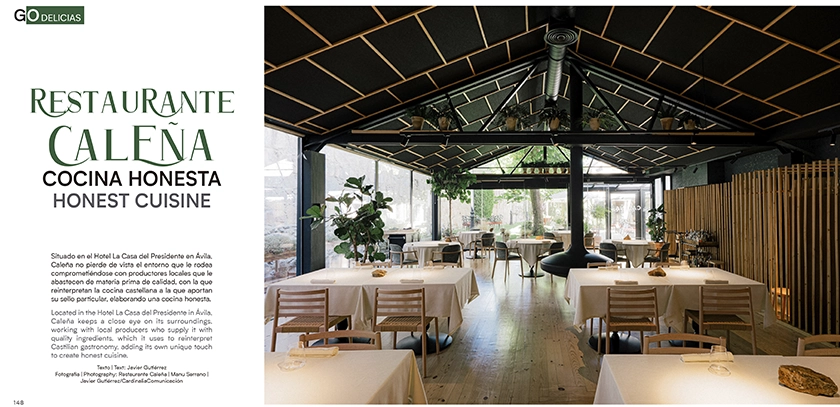
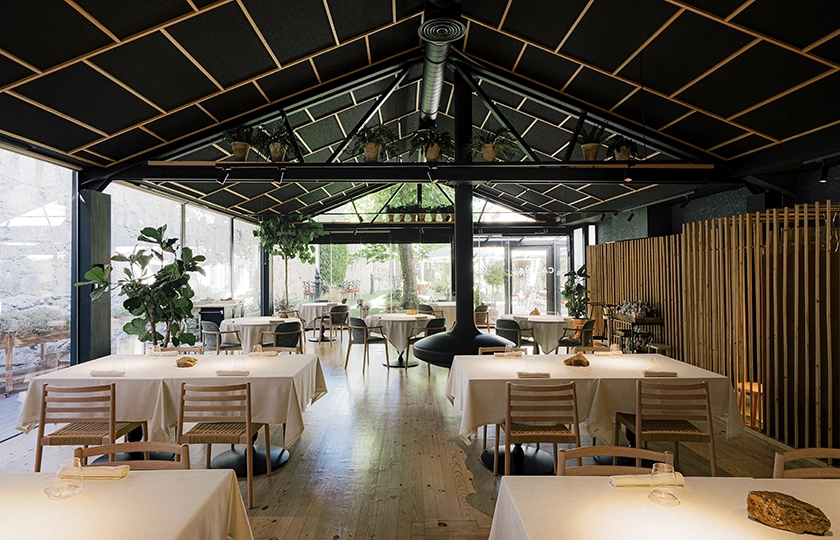
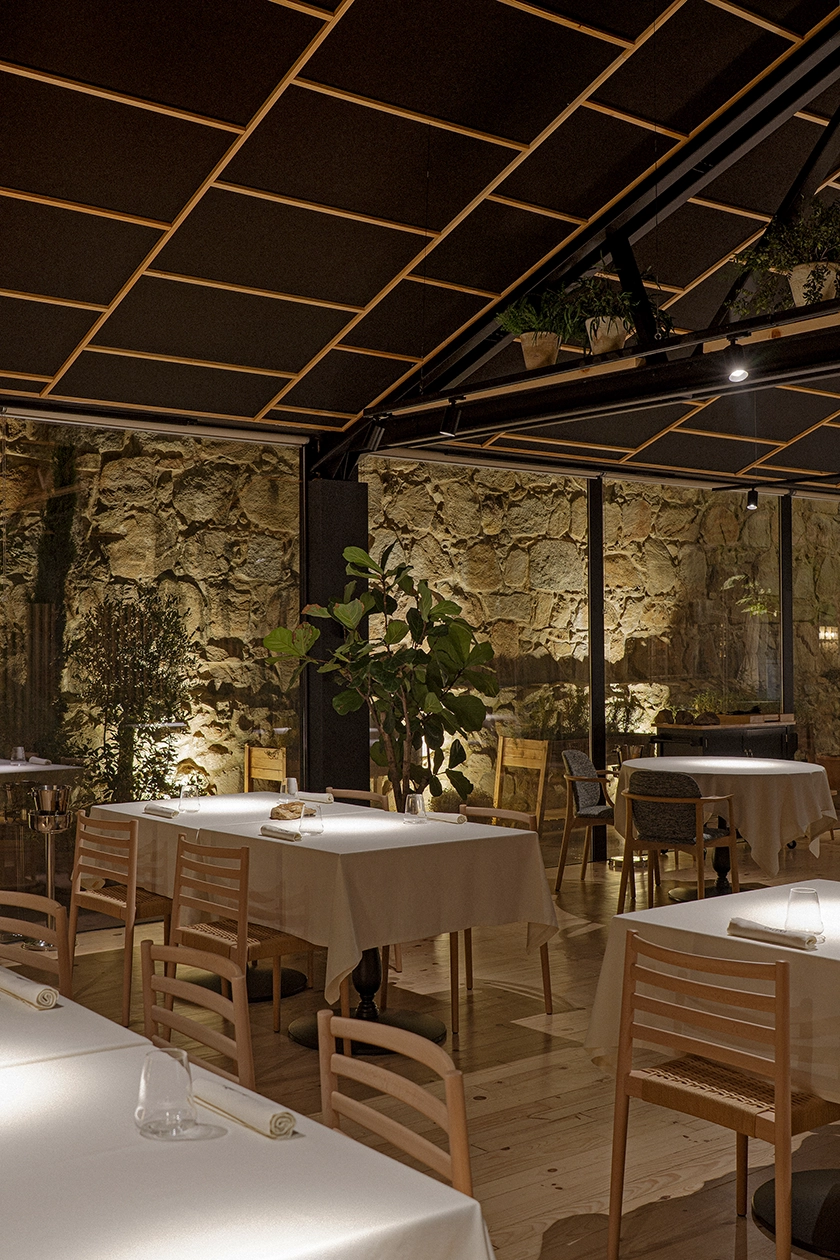
Located in the Hotel La Casa del Presidente in Ávila, Caleña keeps a close eye on its surroundings, working with local producers who supply it with quality ingredients, which it uses to reinterpret Castilian gastronomy, adding its own unique touch to create honest cuisine.
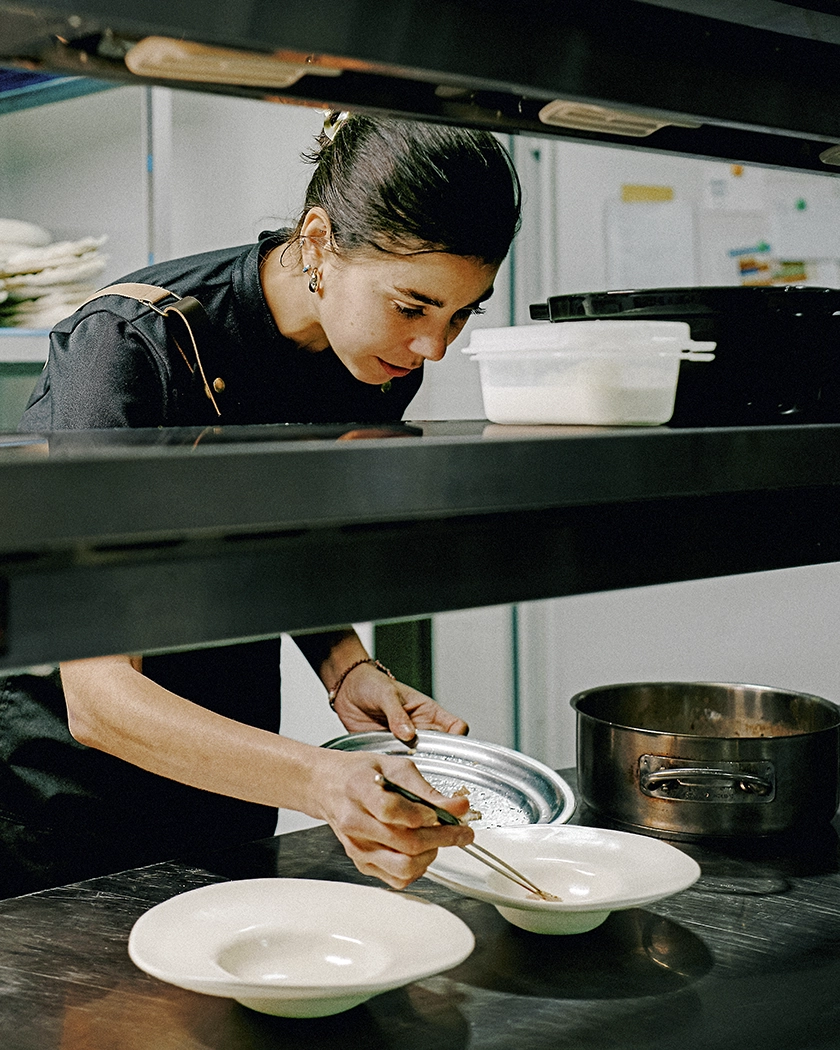
With chef Diego Sanz at the helm and accompanied by a team of young chefs, Caleña is beginning to write its own story. The beginnings could not be more encouraging, as they have achieved the fastest Repsol Sun in history, as well as being included in Traveler’s Hot List within a few months of opening.
Its opening in November 2024 began with a menu featuring twenty-two dishes that showcased traditional recipes and absolute respect for the ingredients. The next step was to evolve into a seasonal menu created by popular demand: ‘Tresbolillos’, consisting of twelve courses that take diners on a journey through the tradition, history and produce of his region, Castile and León.
‘Tresbolillos’, a tribute to the region's culinary tradition
The menu pays homage to local cuisine and the techniques that have shaped the region’s culinary traditions, with the chef’s unique reinterpretation through the use of ingredients and techniques that define the area’s produce. Anyone who knows the chef will clearly see that the menu takes us on a journey through his childhood in his native Valladolid, through the city of Ávila that has welcomed him, through the region that unites them, Castile and León, and through his family.
‘Tresbolillos’ is tradition, history, product, family and legacy. Twelve courses, two of them desserts, with a very Castilian start.
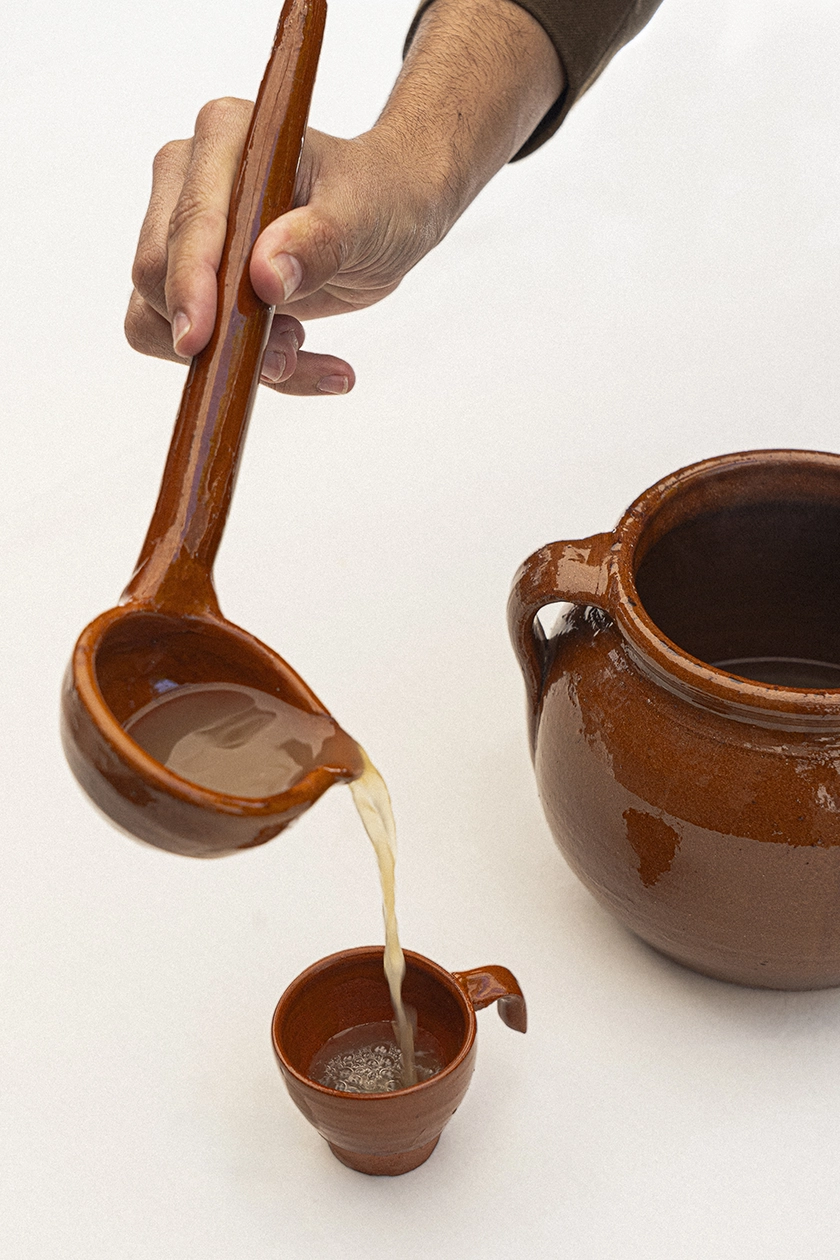
Welcome: Garlic-Bread-Paprika, a Castilian soup symbolising Castile and representing its people, who learned to survive on the essentials, hospitality and tradition. Cooked in an OCCO (Korean pot) for eight hours to caramelise the bread and garlic, it is served directly in the dining room from the pot itself in traditional bowls.
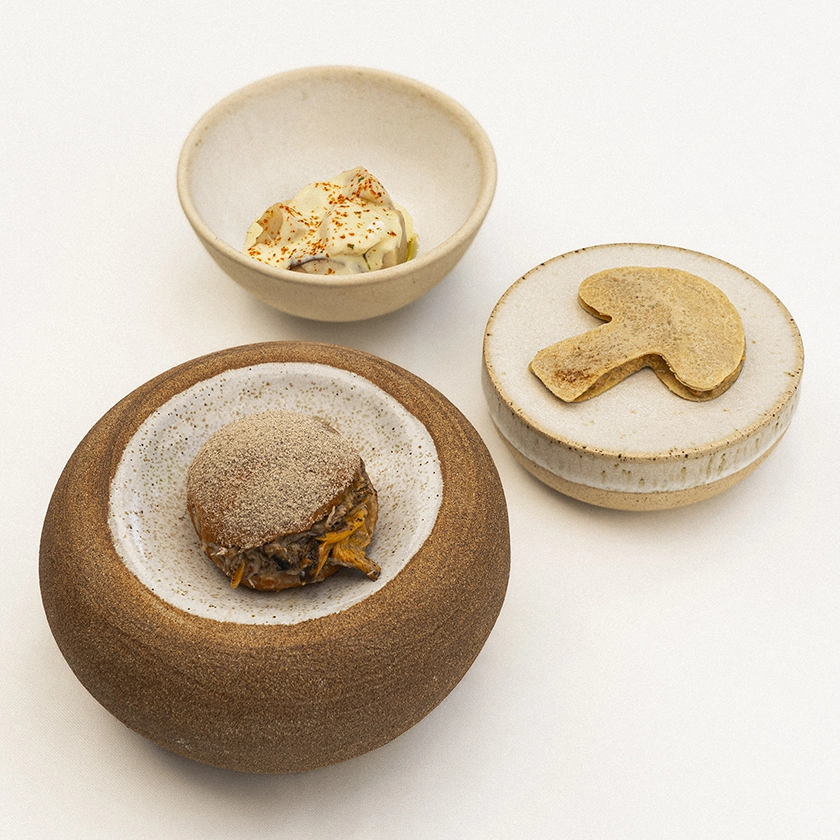
Childhood: Boletus-Chanterella- Elver of mountain: talking of childhood. With this dish, the chef knows how to adapt to the season and convey the scent of the mountains in three bites. The first is a mushroom-shaped biscuit with chanterelle pâté. The second dish consists of boletus mushrooms confit in olive oil, which, together with the water from the mushrooms, is used to make a pil pil sauce from the mushrooms themselves. And the third is the abisinio, a typical dessert from Valladolid that is transformed into a savoury dish with a filling of Iberian pork ribs and black trumpet mushrooms.
To speak of Castile and León is to speak of pickled dishes. Marinade: Carrot-Pickled-Golden Wine. Pickling is one of the most important preservation techniques in the region’s gastronomic culture. With this dish, in which carrots take centre stage, you honour the history and tradition of this region.
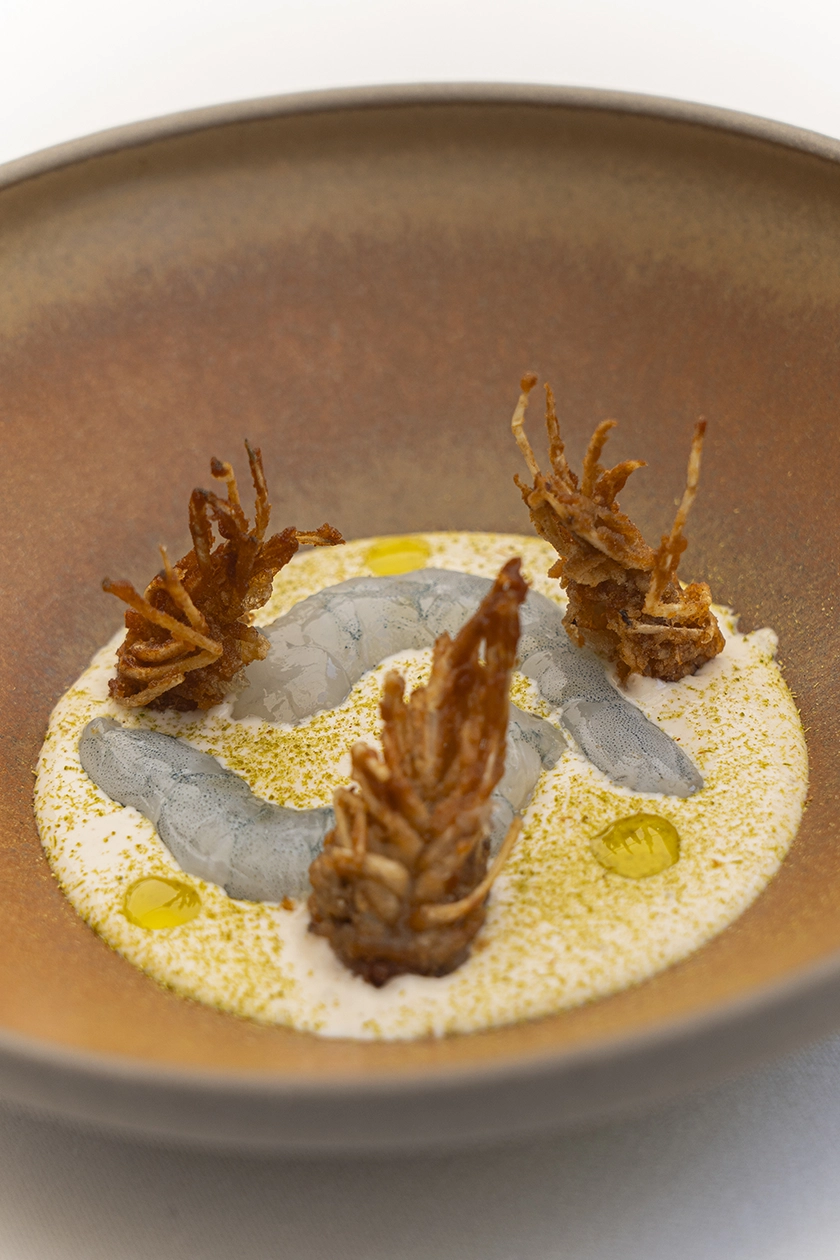
Environment: Prawn-Pine tree-Pine nut. This dish clearly demonstrates Caleña’s commitment to local products and the region’s economy. Raw materials such as Medina de Noray prawns, farmed in the waters of the Duero River, in the Medina del Campo area, are an unusual product that the chef plays with, likening them to ‘prawns among pine trees’ and accompanying them with a pine nut soup.
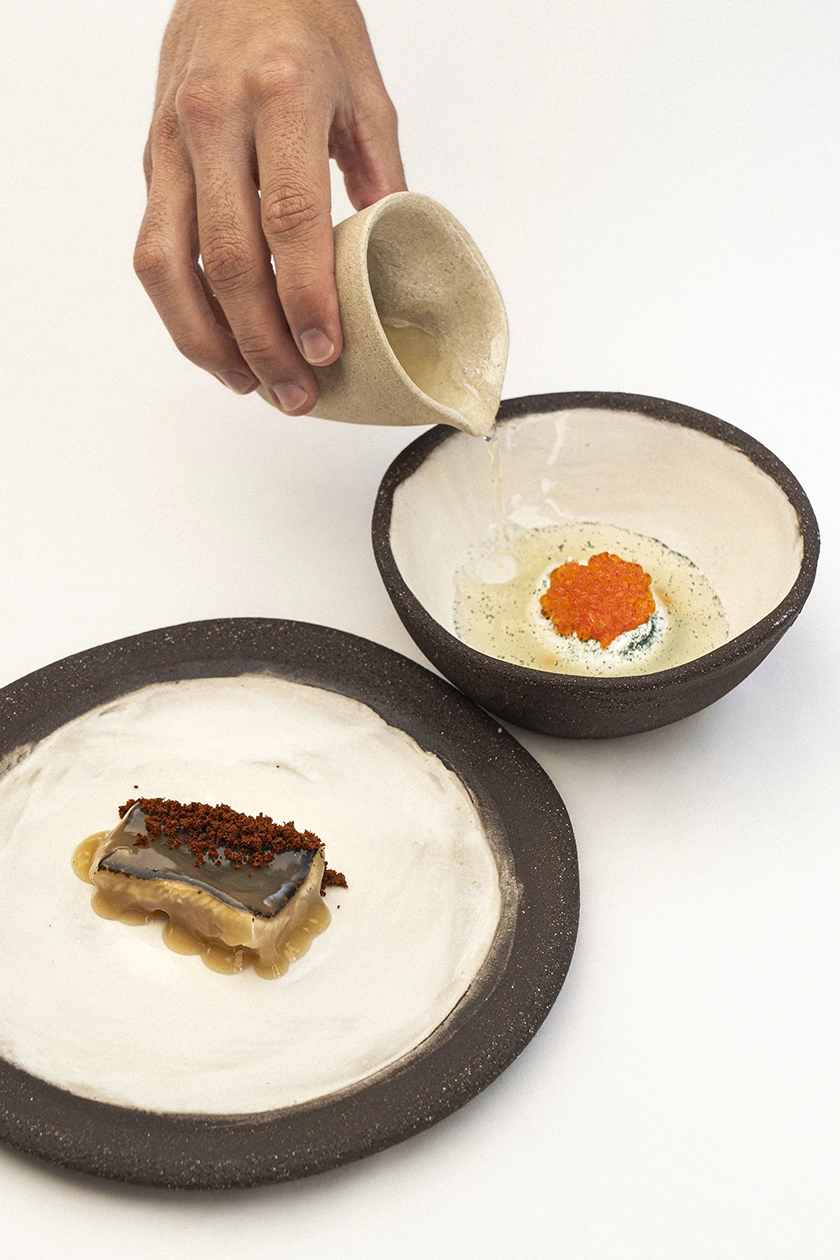
The past and the importance of preserving our heritage are reflected in Past: Trout-Riverweed. A vindication of the “fario” trout, which was abundant in the Adaja River in the past but disappeared due to several factors, including climate change. This is trout loin cured in lard, another way of preserving food in the past. To make it, the chef has adapted a recipe from the Middle Ages used by monks, preparing this fish with bacon or ham to enrich the dish.
Without a doubt, one of the culinary offerings of the province of Ávila is “patatas revolconas”. Ávila: Potatoes-Torreznos (fried pork rinds)-Truffles it is the chef’s tribute to a dish that is so beloved and deeply rooted in the area. To prepare it, set aside the potato skin and place it on top of a mixture of the potato itself, poached onions, crispy bacon, La Vera paprika, egg yolk and black truffle.
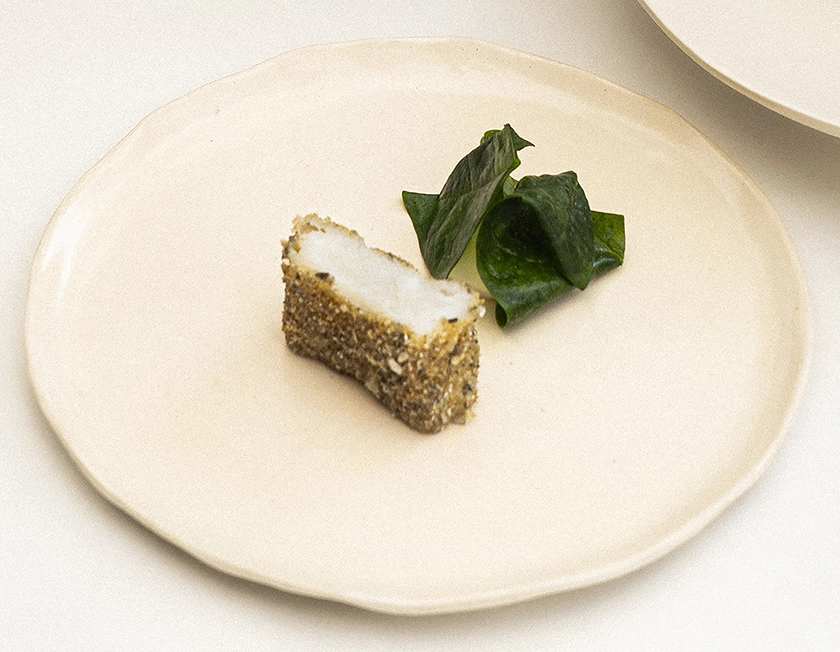
Throughout history, cod has been very important in Castile and León because it can be preserved by salting, thus providing food in times of scarcity or as a substitute for meat during Lent. Conservation: Cod-Beeswax-Spinach It is made using an ancient and little-known preservation technique: preservation in beeswax, which allows the cod to retain more of its flavour than with traditional salting.
Territory: Wild rabbit-Snail, two products that define Ávila and its ecosystem. With this dish, the chef demonstrates his clear commitment to protecting the land and a healthy ecosystem.
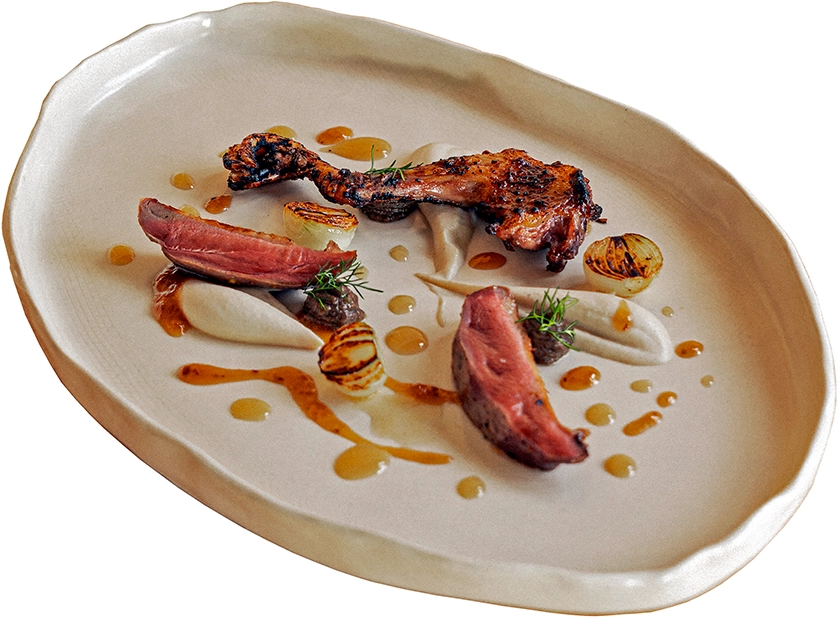
With the following proposal, diners are transported to Tierra de Campos without leaving their table at Caleña. Tierra de Campos: Pigeon- Apiona-bo-Grapefruit draws on the region’s extensive plains of fertile land, historically known as the ‘breadbasket of Spain’ for its cereal production and the natural habitat of pigeons and wood pigeons.
The chef once again connects with the region through a product that represents tradition, gastronomy and culture throughout the province of Valladolid: suckling lamb. To prepare Origin: Lamb-Salad-Mojo, he moves away from the parts that are usually eaten, focusing on other more special and lesser-known parts.
As for the bread that accompanies all these delicacies, diners can choose between two types of bread. On one hand, there is the typical torta de aceite, a bread typical of Valladolid and closely linked to the chef’s origins, and on the other, there is bread from La Serrana del Obrador de Abantos in El Escorial. Both are served with oil and sheep’s milk butter from La Pistonuda, a cheese factory in La Vega de Palencia. This would be the third pass, and its name is Share: Bread.
We have reached the final part of the menú: the desserts, which consists of two courses. Family: Agraz-Vine leaf-Pinot noir brings with it a story in which the protagonists are Diego Sanz, chef, and Diego Ortega, owner of the hotel and the Alta Pavina Winery. When the chef was a child, he often visited the village pine forest, and to get there he had to pass by a winery: Alta Pavina. For this reason, this coincidence is made into a dessert. They produce a grape juice from Alta Pavina grapes, known as green grape juice. This unripe grape is used to make a sorbet that is served with a sponge cake made from grape skins and raisins, lacto-fermented vine leaves from the winery, and a sabayon made from the wine itself. The entire dish is smoked with Alta Pavina vine shoots.
Penury: Chicory-Chestnuts-Barley. A product created from the humble traditions of Castile and León, where the inhabitants developed the ability to make the most of what the land gave them. The dessert is a journey into the past, combining roasted chicory, which replaced coffee, nutritious barley that filled the bread bins, and lupins.
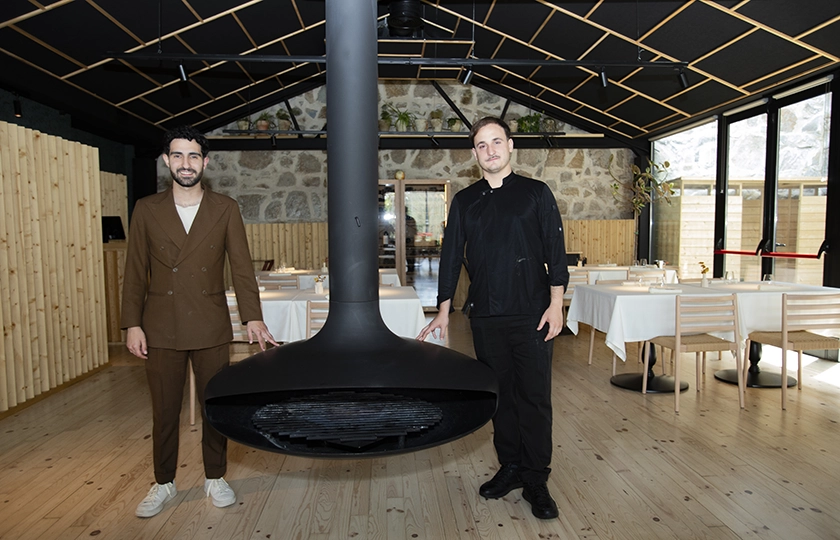
Each dish on the menu tells a story about the region, and Adrián Abella is the narrator in the dining room. With a team of seven people under his command, he trained as a catering services manager in Castellón and his professional career includes working at the three Michelin-starred Disfrutar restaurant in Barcelona.
Caleña's liquid proposal
Sommelier Luis Secades is responsible for putting together Caleña’s wine list. Trained in sommelier studies at the Madrid Chamber of Commerce, he also shares his knowledge about the richness and diversity of wine at Vinology.
To pair with the menu, he has chosen two options with four and six wines each, starting the short and long options with a Colet Navazos Brut Nature to accompany the first three courses.
Linarejos from Bodegas las Pedreras in Ávila’s Cebreros PDO has been chosen to accompany the fourth and fifth courses. This is an Albillo Real white wine aged for seven months in barrels, which, once finished, is blended with a small percentage of manzanilla from Sanlúcar de Barrameda.
Approximately halfway through the menu, the wine selections are separated, with the short list opting for Pavina Rosé from Bodegas Alta Pavina, a rosé made from the Pinot Noir variety, while the long list opts for a Ribera del Duero wine, Fuentenebro de Albillo Mayor, aged for ten months in oak barrels.
The two proposals converge once again with Pegaso Zeta, a pleasant and delicate wine from the Sierra de Gredos, produced from old organic Garnacha vines, to which the slate and granite soils lend depth and fruity character.
Before reaching the desserts, the extended menu includes Pago la Pavina red wine, a blend of Tempranillo and Cabernet Sauvignon aged for fourteen months in barrels, characterised by its complexity and balance.
Finally, the desserts in both menus are paired with Moscatel MR, a sweet white wine from Málaga made with Muscat of Alexandria grapes.
La Casa del Presidente
What was once Adolfo Suárez’s summer residence, the first president of democratic Spain, is now home to the La Casa del Presidente hotel, owned by the Ortega family, who also own Bodegas Alta Pavina. Built in the 1970s, its walls witnessed historic events during the Transition. The place where the hotel reception is located today was then Suárez’s office, and it is said that momentous meetings for the future of Spain were held here. As a curiosity, it is worth mentioning that in the large bookcase that occupies one of the walls there is a secret door designed to facilitate escape in case of emergency. This 5-star boutique hotel has only ten rooms, and the rest have preserved the aesthetics of the period. Highlights include the living room decorated with Chesterfield sofas, display cabinets with crockery and a large fireplace ideal for combating the harsh Ávila winters, the old dining room of the house, which is always available to guests for working or holding meetings, and the old kitchen, which remains almost intact, from the Talavera tiles to the stoves and wood-burning oven. Located in the historic centre, this hotel is ideal for discovering the most beautiful and surprising corners and the monumental heritage of a city declared a UNESCO World Heritage Site.