

- Data from the Spanish Ecotourism Observatory for 2025 confirms that ecotourists are frequent visitors to protected areas: 74% visit them two or more times a year, although 66.3% were visiting their chosen destination for the first time.
- Well-preserved natural surroundings remain the main reason for travelling: 49.2% of respondents cited visiting natural areas as their primary motivation, followed by exploring and observing nature, at 35.3%.
- The average spend per ecotourist stands at €178.94 per person per day, continuing an upward trend since 2019, with a cumulative increase of 34%.
Ecotourists return time and again to nature, but not necessarily to the same place. This is one of the main conclusions drawn from the Study on Demand for the ‘Ecotourism in Spain’ Product 2025, produced within the framework of the Spanish Ecotourism Observatory, promoted by the Spanish Ecotourism Association and funded by the State Secretariat for Tourism.
According to the report’s data, 74% of the ecotourists surveyed visit natural areas two or more times a year, and almost half, 49.4%, do so between two and four times a year. However, 66.3% stated that it was their first time visiting the chosen destination, compared to 33.7% who were already familiar with it. This combination confirms a trend of particular relevance to the sector: the ecotourist is a traveller loyal to protected natural areas, whilst preferring to discover new nature destinations on each trip.
Furthermore, the Observatory’s historical data shows that this behaviour is not an isolated snapshot of 2025. Since 2023, the majority of travellers surveyed have opted to visit natural areas between two and four times a year, a trend that has remained stable across the last three editions of the study. Ecotourism is thus no longer seen as a one-off experience but is establishing itself as a recurring form of travel.
For the Spanish Ecotourism Association, this behaviour fully justifies a network such as Soy Ecoturista, which brings together destinations and companies linked to protected areas, committed to their conservation and specialising in offering authentic ecotourism experiences. “The data shows that a customer of a company affiliated with Soy Ecoturista may be interested in travelling to another similar destination within our network on their next ecotourism getaway. We are not just talking about one-off visitors, but travellers who incorporate natural areas into their usual way of travelling and who seek new experiences in well-conserved areas,” says Amanda Guzmán, manager of the Ecotourism Association in Spain.
The study, corresponding to the 2025 data collection campaign, was compiled from 1,116 valid questionnaires collected between 1 January and 31 December 2025, with the collaboration of 39 companies from 16 destinations across 9 Autonomous Communities. In 2025, Soy Ecoturista comprised 53 certified ecotourism destinations and more than 800 companies committed to the conservation of protected areas and sustainable development.
The well-preserved natural environment, the main reason for the trip
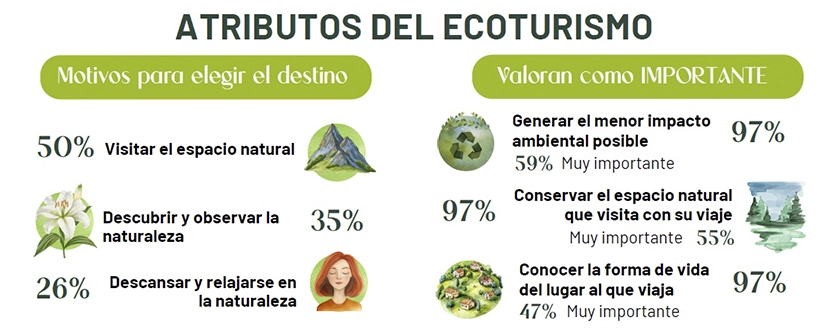
The Observatory’s findings confirm that nature remains the primary reason for choosing an ecotourism destination. 49.2% of respondents cited visiting natural areas as one of their two main motivations, followed by discovering and observing nature (35.3%) and resting and relaxing in nature (26.3%).
These figures highlight that well-preserved nature acts not merely as a backdrop to the trip, but as the true driving force behind the choice of destination. The report also shows that ecotourists prioritise motivations directly related to nature, which clearly distinguishes ecotourism from other tourism products such as active, cultural or gastronomic tourism.
However, although nature is the main reason, the experience at the destination extends to other elements linked to the local area. The most frequently undertaken activities are enjoying local cuisine, at 53.4%; guided tours or walks, at 51.6%; and visiting villages, at 51.3%. In other words, the ecotourist travels drawn by natural spaces, but completes their experience with local culture, cuisine, villages, local produce and guided activities that help them understand and appreciate the destination they are visiting.
This behaviour reinforces one of the distinctive values of ecotourism: its ability to link nature conservation with the life of local communities. Travellers do not merely observe the landscape; they explore it, interpret it, enjoy it and contribute to the local economy through their spending at the destination.
Guided experiences, satisfaction and local impact
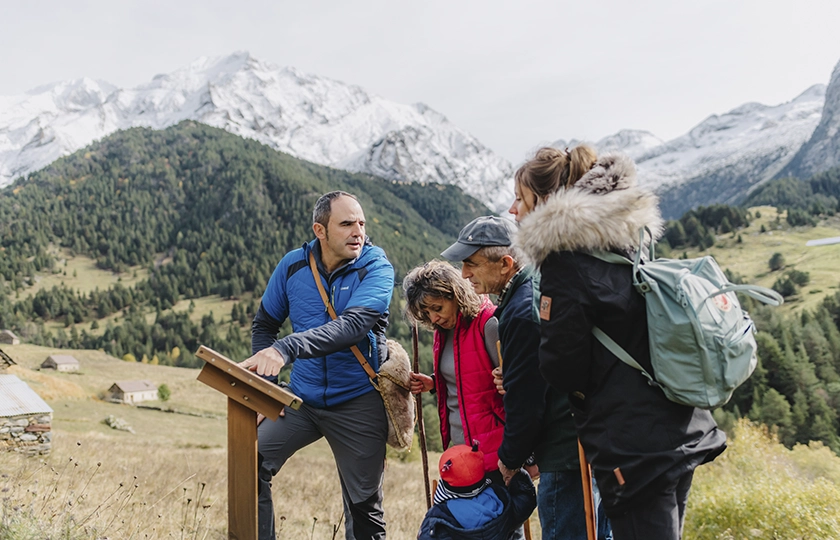
Ecotourism activities are once again playing a prominent role in the traveller’s experience. More than half of those surveyed—54.2%—say they booked services with an activity provider during their trip. Among the activities enjoyed, guided tours or walks in natural areas stand out, undertaken by 64.6% of those who booked activities, followed by cultural activities (28.6%), wildlife watching (28.3%) and active ecotourism (23%).
The report also reflects a gradual diversification of the experiences booked. Guided visits to local producers now account for 15.7% of those who booked activities, a particularly significant figure as this type of experience fosters a connection with the local economy, the preservation of traditional activities and the conservation of associated agricultural landscapes.
Satisfaction with these experiences is very high: 99.7% of ecotourists would recommend the booked activities to others, including 95.2% who would definitely do so and 4.5% who would probably recommend them. This figure confirms the quality of the offerings provided by member companies and their ability to enrich the traveller’s experience.
However, the Observatory also identifies significant room for improvement in the link between accommodation and activities. Among participants who accessed the questionnaire via accommodation providers, only 22.5% booked the services of an activity provider during their trip. This figure highlights an opportunity to strengthen the promotion of guided experiences by the participating accommodation providers themselves, helping travellers to gain a better understanding of the destination’s natural and cultural values.
Closer contact with local businesses
The study also highlights changes in the way travellers organise their trips. When it comes to accommodation, digital channels remain the dominant method, but there has been a rise in direct bookings with establishments. Bookings made via the accommodation’s website or email account for 36.8%, almost on a par with online booking platforms, which stand at 37.6%. When telephone bookings are included, direct bookings with the accommodation account for 49.5% of the total.
This trend is even more pronounced when it comes to booking activities. 58.7% of ecotourists who booked activities did so directly with the company, via the website, email or telephone, whilst online marketing platforms accounted for 26.6%. For the Spanish Ecotourism Association, this figure is particularly positive, as direct contact with local businesses helps ensure that a greater proportion of the value generated by the trip remains within the region.
A traveller who leaves a positive impact on the destination
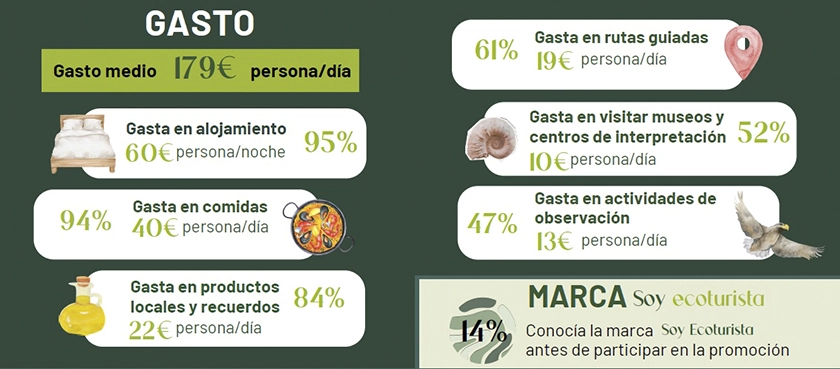
The Observatory confirms ecotourism’s ability to generate economic impact in destinations. The estimated average spend per ecotourist stands at €178.94 per person per day, 2.1% higher than in 2024. Beyond this annual increase, the figure is particularly significant when viewed in perspective: since 2019, when average spending stood at €133.70, the cumulative increase has reached 34%.
Accommodation represents the largest expenditure item, at €60.48 per person per night, followed by meals in bars and restaurants, at €39.18 per person per day. Together, these two items total €99.66 and account for 55.7% of the average daily expenditure on the trip.
Added to these items is spending directly associated with the local area and ecotourism experiences. Average spending on local products and souvenirs stands at €22.01 per person per day; guided tours in natural areas amount to €19.20; adventure and sports tourism activities, €14.81; nature observation activities, €13.35; and visits to museums and interpretation centres, €9.92.
Furthermore, 84.1% of respondents spend money on local products and souvenirs, which has a positive impact on local economic sectors such as producers, craftspeople and retailers. This figure reinforces the idea that ecotourism not only benefits tourism businesses but can also act as a catalyst for the wider local economy.
A commitment to conservation and an opportunity for Soy Ecoturista
The report once again confirms the high level of environmental and social awareness among ecotourists. Specifically, 59.4% consider it very important to minimise the environmental impact of their trip; 54.7% regard it as very important that their trip helps to conserve the natural environment they are visiting; and 47.3% attach the utmost importance to their trip contributing to local development. The category with the highest level of positive consensus is learning about the way of life in the destination, considered important, quite important or very important by 97.1% of respondents.
Furthermore, 41.1% of ecotourists say they are willing to contribute financially to conservation programmes for the natural environment they visit, whilst 45.2% are undecided and only 13.7% reject this possibility. Among the preferred methods for channelling this contribution, the purchase of merchandise related to conservation programmes and the voluntary additional payment associated with the tourist experience or service stand out.
One of the most revealing findings of the report is that the willingness to contribute increases when travellers are offered a specific method. The study finds that more people choose a voluntary contribution scheme than those who answer ‘yes’ to the general question of whether they would be willing to contribute financially. This suggests that presenting clear mechanisms, linked to a tangible return or a specific experience, can mobilise more travellers than a generic appeal for donations.
In this context, Soy Ecoturista establishes itself as a tool for inspiration, recommendation and loyalty-building for travellers who already have a strong inclination towards ecotourism. Prior awareness of the brand also shows a positive trend: in 2025, 14.5% of respondents stated that they were already familiar with Soy Ecoturista before taking part in the promotion, compared to 10.7% recorded in 2024, representing an increase of almost four percentage points.
Although Soy Ecoturista still faces the challenge of raising its profile, the data from this study confirm the network’s potential to connect frequent visitors to natural areas with new destinations that meet their motivations: well-preserved nature, authentic experiences, committed local businesses, learning, conservation and local development.
The findings of the Spanish Ecotourism Observatory provide further insight into a traveller who seeks not only nature, but also meaning, coherence and a positive contribution from their getaways. This profile confirms the strategic role of the “Ecotourism in Spain” product as an attractive and specialised offering, capable of attracting committed visitors, raising awareness among tourists, businesses and residents, and generating economic activity in protected areas and their catchment areas. In short, it demonstrates how ecotourism is an effective tool for conservation and local development.
Profile of the ecotourist
The profile of the ecotourist analysed corresponds mainly to an adult domestic traveller, mostly aged between 35 and 65, in full-time employment and with a high level of education. 87% of those surveyed live in Spain, with Madrid and Barcelona being the main source regions, whilst among those living outside Spain, Germany, the United Kingdom and France stand out.
Ecotourists also tend to travel in small groups. Travelling as a couple remains the most popular option, at 46.3%, followed by groups of between three and five people, at 26.4%. Overall, trips involving fewer than six people account for 78.6% of the sample. Travellers without children under the age of 12 also remain the majority, accounting for 80.9%.
About the SPANISH ECOTOURISM OBSERVATORY
The Observatory is a sociological tool, designed by the Spanish Ecotourism Association with the support of the State Secretariat for Tourism, for the systematic collection of basic information on the ecotourism sector through questionnaires. With studies carried out since 2018, it is hoped that, over time, the results will provide data of great strategic interest for understanding the sector’s development, assessing the socio-economic impact of this form of tourism, and gaining insights ranging from the consumption habits and profile of ecotourists to trends in the types and numbers of companies specialising in this niche market, as well as the management models applied in ecotourism destinations.
About the SPANISH ECOTOURISM ASSOCIATION
The Spanish Ecotourism Association (AEE) is a non-profit, public-private partnership – private organisation created in 2010 to promote ecotourism in protected areas. It is mainly composed of associations of tourism entrepreneurs located in natural areas, organisations managing protected areas, public administrations involved in the tourism management of these areas, rural development groups, nature conservation organisations, universities and companies specialising in tourism.
The AEE is the body that manages the ‘Ecoturismo en España’ product club, with the support of the Secretary of State for Tourism. It is a pioneering initiative offering ecotourism experiences in protected natural areas, guaranteeing travellers that their visit contributes to local development and the conservation of biodiversity. It currently brings together 56 destinations and more than 800 companies which, under the Soy Ecoturista brand, are committed to the conservation of protected areas and their sustainable development.
Source: SPANISH ECOTOURISM ASSOCIATION