

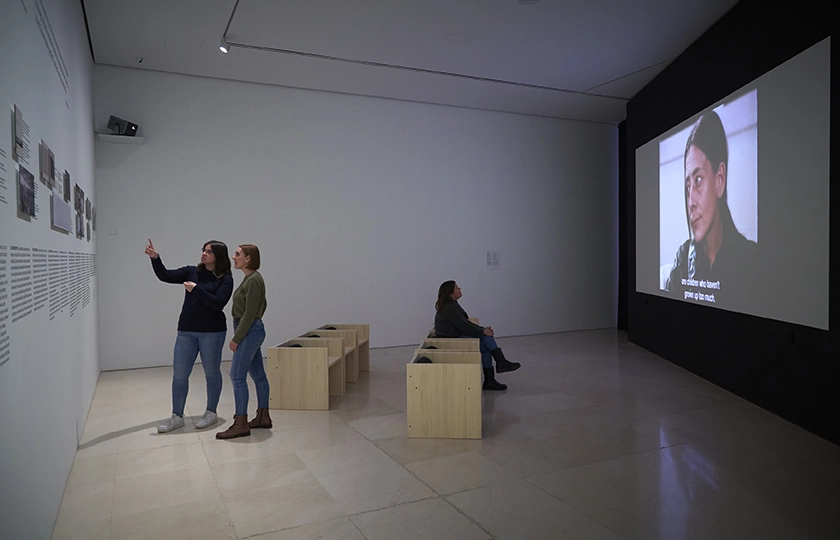
- The exhibition Elena Asins. Antigone brings together two works from the last creative cycle of this Spanish conceptual artist at the Museo Picasso Málaga, coinciding with the tenth anniversary of her death.
- Classical tragedy, geometric abstraction and ethical criticism intertwine in a visual discourse of great symbolic power, showcasing the intellectual and formal radicalism that defined Elena Asins.
- Through the sculpture Antigone and her audiovisual piece Hemón, Asins reflects on the limits of language, extreme logic and resistance to power.
- With a career marked by intellectual rigour and formal refinement, Elena Asins (Madrid, 1940 – Azpíroz, Navarre, 2015), winner of the National Plastic Arts Award in 2011, was a pioneer of computer art in Spain.
- Her final work offers a contemporary reading of Sophocles’ famous tragedy, in dialogue with the artistic and philosophical tradition that has inspired creators of all eras, including Picasso himself.
- The exhibition is part of the Guest Work programme at the Museo Picasso Málaga, which has previously hosted works by James Turrell and William Kentridge.
- The exhibition, curated by Miguel López-Remiro, artistic director of the MPM, and organised in collaboration with the Reina Sofía National Art Museum, is the first monographic presentation of Asins’ final work in a museum.
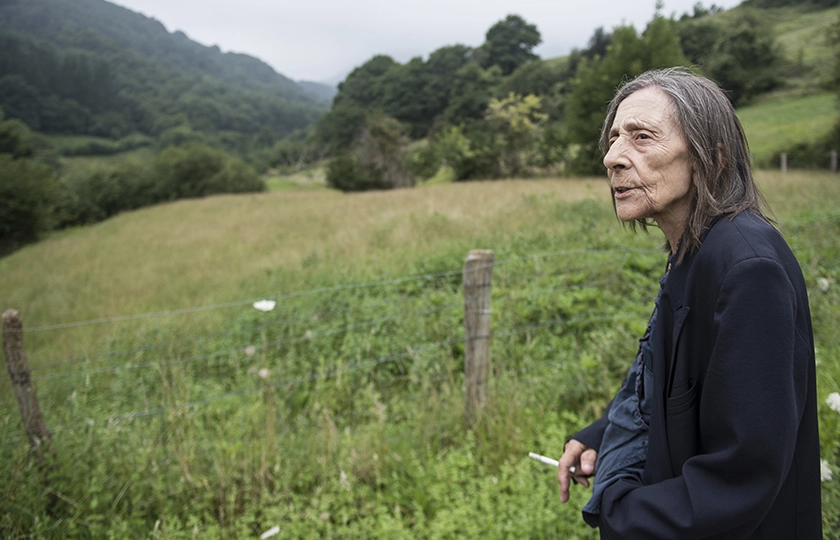
The Museo Picasso Málaga opens a new exhibition year with the show Elena Asins. Antigone, which can be seen from 30 January in its temporary galleries. With the monumental sculpture Antigone as its centrepiece, complemented by the audiovisual work Hemón, the exhibition presents Antigone not only as a mythological reference, but also as a final manifesto of Asins’ thinking, in which law, ethics, language and resistance converge.
A contemporary interpretation of classical tragedy
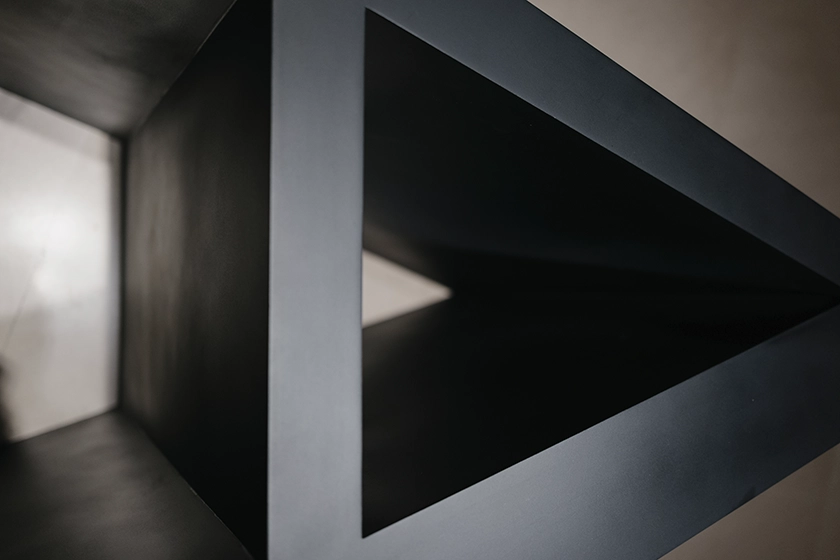
Elena Asins’ sculpture Antígona (2010–2015), part of the collection of the Reina Sofía National Art Museum in Madrid, represents the symbolic posthumous culmination of her career. Through a monumental structure constructed from the Greek characters of the heroine’s name, “Αντιγόνη”, the piece evokes ethical intransigence in the face of power, the impossibility of dialogue and condemnation consummated in silence. Asins transforms language into visual architecture and invokes the mourning, moral disobedience and individual responsibility that define the myth. Although the work is materially identified as Corten steel, its technique includes an internal tubular structure of Corten steel, TIG welding and two-layer polyurethane paint, which underlines its status as a conceptual construction and not merely a sculpture. The blackness of the material, the rigidity of the form and the absence of ornamentation reinforce the idea of inevitable death, of an unyielding logic. Like the artist herself, the sculpture remains firm in its internal structure, without compromise.
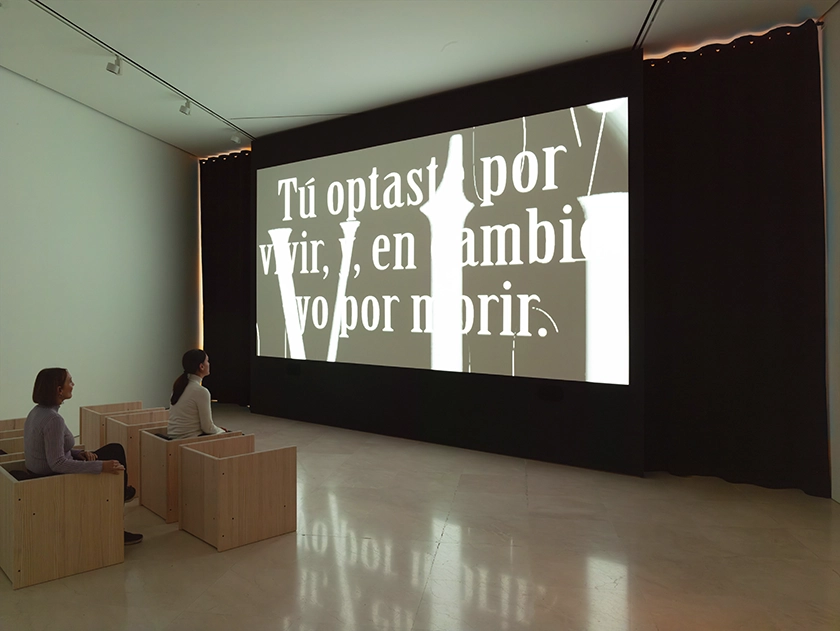
The exhibition is enriched by the continuous projection of the black-and-white video Hemón, which lasts more than eight hours. It was made during the last years of Asins’ life and completed on 19 May 2015. Hemón, the name of Antigone’s fiancé, is the audiovisual echo of Antigone, the lament of the observer who is unable to intervene. Through repetitive visual sequences, lines, silences and a distorted voice, Asins constructs a closed universe where language becomes a prison. The work demands an active reading from the viewer, a mental reconstruction of meaning, in tune with the philosophical influences of Wittgenstein and Max Bense that marked her thinking. This unpublished audiovisual piece also belongs to the collection of the Museo Nacional Centro de Arte Reina Sofía, and features music composed by the artist herself on a synthesiser, accompanying her voice and the reading of the text, creating a new space for understanding her work.
Both pieces engage in dialogue with classical tragedy from a contemporary, conceptual and critical perspective. In them, Asins revives Sophocles’ myth to warn of the dangers of dogmatic obsession with compliance with the law and to reflect on the inflexibility of human beings. It is difficult not to see in Antigone and Haemon an allusion to her own biography: a life lived with rigour, without concessions, on the border between the rational and the immaterial.
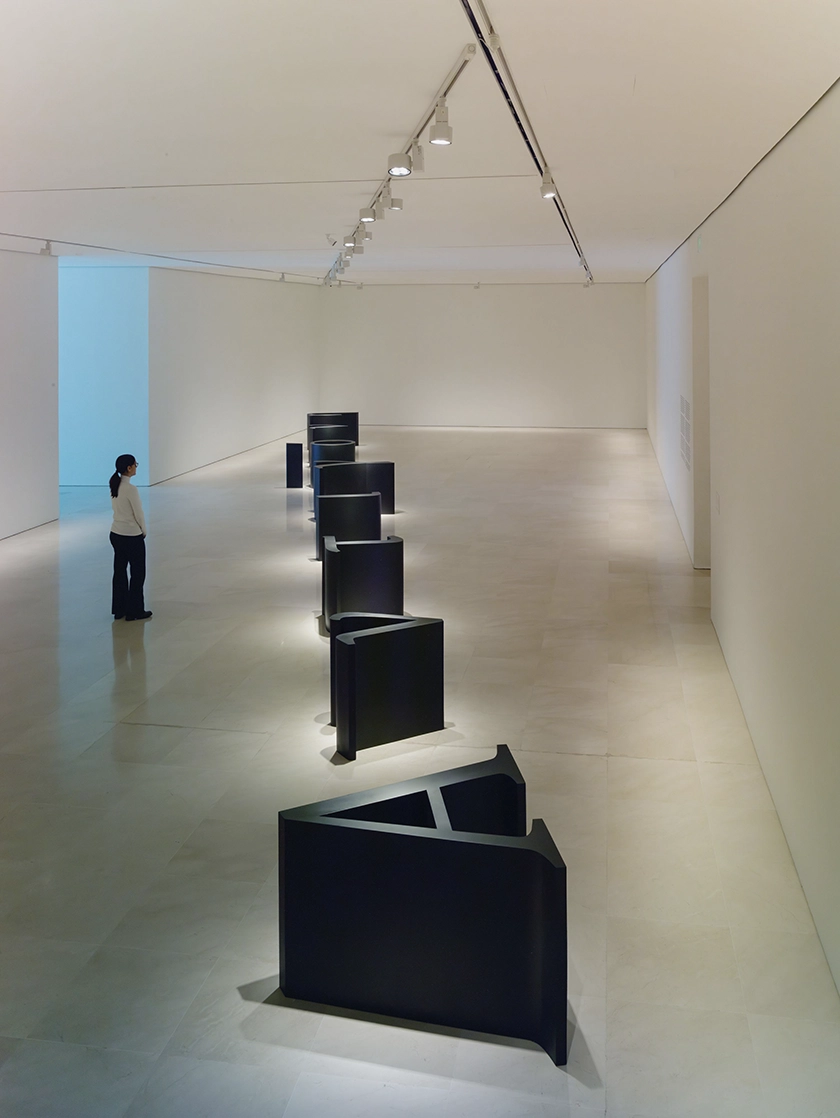
The exhibition rooms are complemented by an educational space that includes a panel contextualising the artist’s life and work and screening the documentary Génesis, directed by Álvaro Giménez Sarmiento (Producciones Malvalanda, 2014). Lasting 17 minutes, this film, which won the Biznaga de Plata Audience Award in the documentary short film section at the 2015 Malaga Film Festival, invites viewers to delve into Asins’ artistic world.
With images of the imposing nature of her adopted village, Azpíroz, Giménez Sarmiento exalts a telluric atmosphere surrounded by a play of images and voices that reveal the artist’s overwhelming personality.
The exhibition is part of the Guest Works programme at the Museo Picasso Málaga, which has previously hosted works by James Turrell and William Kentridge. The exhibition, organised in collaboration with the Reina Sofía National Art Museum, reinforces both institutions’ commitment to excellence and cooperation between museums for the dissemination of artistic heritage and is the first monographic presentation of this final work by Asins in a museum.
In the words of Miguel López-Remiro, curator of the exhibition and artistic director of the Museo Picasso Málaga, “Elena Asins. Antigone presents the final work of one of the most rigorous figures in Spanish art of our time: a project in which classical tragedy, geometric abstraction and ethical criticism converge to turn language into structure and myth into thought. Having known and worked closely with Elena Asins had a decisive influence on my understanding of art from the perspective of rigour, independence and intellectual responsibility. Placing her work at the centre of the Museo Picasso Málaga today is also a way of passing on that demanding teaching to new generations. Produced in collaboration with the Museo Reina Sofía as part of the Guest Workprogramme, the exhibition reaffirms our idea of a museum where the artist is at the centre and where art is not only contemplated but also thought about.”
A tribute on the tenth anniversary of her death
Elena Asins (Madrid, 1940 – Azpíroz, Navarre, 2015), was an artist, writer and art critic whose career was characterised by profound intellectual consistency and absolute independence from market trends. She trained at institutions of great international prestige: she studied Fine Arts in Paris, semiotics with Max Bense at the University of Stuttgart, computer art at Columbia University (New York), and participated in seminars at the Computing Centre of the Complutense University of Madrid. Her work, pioneering in the use of algorithms and computing in art since 1967, was developed in two-dimensional, three-dimensional and audiovisual formats. His work forms part of important public collections and museums, including the Reina Sofía National Art Museum, the Valencian Institute of Modern Art (IVAM), the Spanish Abstract Art Museum in Cuenca, the Bilbao Fine Arts Museum, the Spanish Institute in New York and the Kulturbörherde in Hamburg.
She has held more than 40 solo exhibitions and participated in numerous group exhibitions in Spain, Germany, Japan, Austria, and Switzerland. She was awarded the Gold Medal for Merit in Fine Arts (2006), the First Prize for Public Sculpture in Vitoria (1998), and received grants from institutions such as the Juan March Foundation and the Ministry of Culture, among which the National Prize for Plastic Arts in 2011 stood out “for the coherence of her career and the vitality, complexity and variety of her work, linked to the constructive tradition of the avant-garde and characterised by a formal resolution, refined and open to a wide range of languages and formats – concrete poetry, drawing, books, sculpture and video – as well as fields close to music and architecture. The use of calculus theory and algorithms in her artistic creations makes Elena Asins one of the pioneers of computer-assisted art in Spain.”
In addition to her plastic production, she developed an intense theoretical work in concrete poetry and experimental aesthetics, giving lectures and workshops at universities and cultural centres in Europe and the United States. Elena Asins occupies a unique place in Spanish contemporary art today: her work, deeply influenced by logic, semiotics and geometric abstraction, developed outside the mainstream, guided by an ethic of thought that turned language into structure and art into a form of knowledge.
This is not the first time that Elena Asins’ work has been shown in Malaga. Since the early 1970s, several solo exhibitions dedicated to the artist have been organised in the city, held in 1971 at the Museum of Fine Arts (now the headquarters of the Picasso Museum Malaga); three years later, at the Provincial Council; in 1980, at the Colectivo Palmo; and in 1998, at the College of Architects of Malaga. This significant connection attests to the city of Malaga’s interest in her work and her figure.
Antigone in art: a universal symbol
Antigone is one of Sophocles’ greatest tragedies (first performed around 441 BC) and one of the most interpreted myths in Western culture. The play is set in Thebes after the death of her brothers Eteocles and Polynices, who fought over the throne. Creon, the new king, decrees that Polynices, considered a traitor, should not be buried.
Antigone, defying the law of the state and defending divine and family laws, decides to bury him even though she knows her act will be punished. Her moral disobedience leads to her condemnation to be locked alive in a cave, where she eventually commits suicide. Her fiancé Haemon and her mother Eurydice also die, triggering the final catastrophe that confronts Creon with his own hubris.
The central themes of the myth—resistance to power, moral duty, justice, divine law vs. civil law, the role of women, tragedy as a result of intransigence—have made Antigone a universal symbol and a source of inspiration for artists throughout the ages. Her refusal to obey unjust laws, her defence of conscience in the face of power, and her tragic fate have been reinterpreted by creators such as Pablo Picasso, who found in her an image of silent courage and ethical commitment. In times of crisis, Antigone reappears as an uncomfortable mirror that confronts us with the need to defend what is right, even when doing so means confronting power, silence or the law.
In Antigone and Haemon, Elena Asins channels this tragic tension into a geometric and conceptual territory, where form acquires ethical value. Her works thus become a final manifesto on the limits of language, the fragility of justice, and the need to resist that which denies human dignity.
Catalogue and other activities
To accompany the exhibition Elena Asins. Antígona, a comprehensive bilingual catalogue in Spanish and English is currently being finalised and will be published in the coming weeks. It includes recently taken photographs of the installation in the galleries of the Museo Picasso Málaga. The publication is not conceived as a traditional catalogue, but rather as a visual reading of the work in dialogue with the architectural space designed by Richard Gluckman in the Palacio de Buenavista, showing Antigone installed as a spatial manifesto. With 65 pages and designed by Underbau, the book features a curatorial text by the artistic director of the Museo Picasso Málaga and curator of the exhibition, Miguel López-Remiro, as well as illustrations, documents, photographs and a brief biography that allow for a deeper understanding of the multiple perspectives of this exhibition project.
The exhibition also has an audio guide available in Spanish and English, which offers a detailed tour of the exhibition and through Asins’ life, as well as the podcast El arte del ritual (The Art of Ritual), produced for this exhibition, on Spotify, Ivoox and Apple Podcast. The programme is rounded off with cultural and educational activities aimed at different audiences, linked to dance, music and other fields. In addition, meetings, talks and workshops are organised in which Asins’ work is related not only to art, but also to philosophy, history and mathematics. It can be consulted on the official website: www.museopicassomalaga.org.
Opening image: Photo: Jesús Domínguez © Museo Picasso Málaga
Source: MUSEO PICASSO MÁLAGA Press Office