

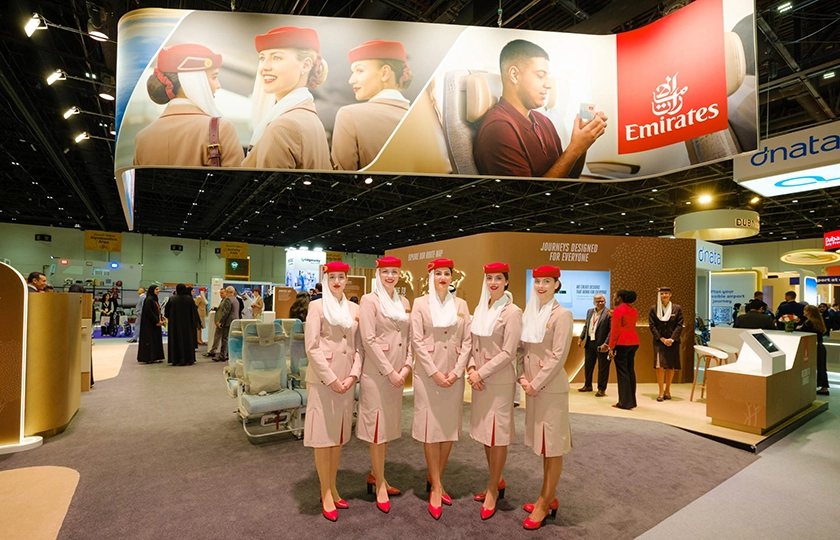
Emirates has officially unveiled its interactive stand at the 8th edition of the AccessAbilities Expo, the region’s leading event dedicated to accessibility and inclusive innovation, which took place at the Dubai World Trade Centre from 19 to 21 October 2026.
The exhibition was officially opened by His Highness Sheikh Ahmed bin Saeed Al Maktoum, Chairman and Chief Executive Officer of the airline and Emirates Group, and patron of the AccessAbilities Expo.
The Emirates stand unveiled several innovative and forward-looking ideas currently under development, including a cabin familiarisation concept being explored for blind or visually impaired customers, an accessible suite in the VIP lounge for customers with reduced mobility, and biometric boarding gates for customers with accessible travel needs.
Mostafa Karam, Senior Vice President of Emirates’ Customer Care and Service Audit Division, said: “Emirates’ ambition is to help build a more inclusive future for aviation as an essential part of the customer experience. We are looking beyond specific services and working with our partners to ensure accessibility is considered throughout the entire journey, from planning and the airport environment to the in-flight experience and at destinations. Guided by our customers’ feedback and the experiences of those who live with these conditions, we are focusing on practical improvements that reduce barriers, expand options and enable people to travel with greater clarity, confidence, independence and dignity.”
Exploring the Emirates cabin for people with impaired vision
At its stand, Emirates presented an immersive experience centred on accessibility that recreates the in-flight journey for blind or visually impaired passengers. Through a combination of spatial audio, tactile exploration of the seat and guided interaction with a host, the experience replicates key moments of the cabin experience in a calm, premium setting. Visitors can immerse themselves in an audio-guided experience in a real seat from an Emirates A350 fitted with a U-Dream headrest, whilst the audio describes all the elements of the cabin around them. Beyond the technology, the experience highlights how well-thought-out design can help passengers gain confidence, understand their surroundings and travel with greater independence, dignity and ease.
Barrier-free access and Emirates biometrics in Dubai
At the Emirates stand, visitors can view and try out the Emirates Biometric Path. In Terminal 3 at Dubai International Airport, Emirates’ hub, accessible boarding gates feature a barrier-free design and biometric technology that allows passengers with disabilities to move around smoothly and independently. The area is currently equipped with a network of cameras that automatically adjust to different heights and angles without restricting or hindering the movements of wheelchair users.
Emirates’ self-service check-in kiosks have also been upgraded, with text-to-speech functionality, more user-friendly touchscreens, Braille and tactile elements, audio accessibility via headphone connections, and height-adjustable interfaces that cater to a wider range of passenger needs.
Emirates’ Accessible Lounge Suite
Emirates also unveiled a new wheelchair-accessible space, offering guests with reduced mobility a comfortable and private place to rest and recharge before their flight. The Emirates Lounge Suites offer customers a private space to relax, work and dine in complete comfort, and were first introduced in the First Class lounges in 2024. Inspired by the Emirates experience both on the ground and on board, they combine a premium design with integrated technology, such as wireless charging and entertainment screens. The Accessible Lounge Suite is the next evolution of this concept. It is designed for wheelchair users, passengers with reduced mobility, elderly travellers and anyone who might benefit from greater comfort, space for transfers or postural support, whilst maintaining the privacy and premium quality of the original suite. Featuring wood, leather and marble finishes from the latest Emirates lounge palette, the suite incorporates accessibility into the design itself, with an electric recliner offering lift, swivel and recline functions, and integrated grab rails that provide greater support and independence. The suite also features a dedicated space for storing a wheelchair, so that guests can rest independently or with the assistance of a companion. The prototype is currently being developed for First Class, with the possibility of extending it to other cabin classes in the future.
The Emirates stand also showcased several of the products and services the airline offers its guests
Emirates Travel Rehearsals programme
Emirates Travel Rehearsals are bespoke travel simulations, organised by Emirates in partnership with airports around the world, which allow children and young people with autism, accompanied by their families and support networks, to practise navigating the airport in preparation for a real flight. This reduces the anxiety associated with travelling and helps them fly with greater confidence. More than 35,000 Emirates staff have been trained to assist customers with autism and can help make both their journey and the Travel Rehearsals easier for them. Emirates teams work very closely with airport authorities and their partners to ensure that every rehearsal is a positive and rewarding experience for families.
The airline has completed 80 Emirates Travel Rehearsals across six continents, benefiting more than 400 families. These have taken place at airports including: Accra, Amsterdam, Antananarivo, Athens, Bangkok, Barcelona, Bengaluru, Birmingham, Bogotá, Bologna, Brisbane, Brussels, Budapest, Cairo, Cape Town, Cebu, Christchurch, Clark, Colombo, Copenhagen, Da Nang, Dallas Fort Worth, Dar es Salaam, Delhi, Denpasar (Bali), Dubai, Dublin, Durban, Düsseldorf, Edinburgh, Geneva, Glasgow, Guangzhou, Hamburg, Hanoi, Harare, Ho Chi Minh City, Hong Kong, Houston, Istanbul, Jeddah, Larnaca, Lisbon, London Gatwick, London Heathrow, London Stansted, Los Angeles, Luanda,
Lusaka, Madrid, Malé, Manchester, Melbourne, Miami, Milan, Muscat, Newcastle, Nice, Orlando, Oslo, Paris, Perth, Peshawar, Phuket, Port Louis, Rio de Janeiro, Rome, Seattle, Stockholm, Sydney, Taipei, Tokyo, Toronto, Trivandrum, Valletta, Venice, Vienna, Warsaw and Washington D.C.
The Accessible & Inclusive Travel Hub on emirates.com
The Accessible & Inclusive Travel Hub, available on the emirates.com website, brings together information to help customers learn about Emirates’ accessible and inclusive travel services, plan their journey and identify the assistance available. Customers can browse the sections by type of disability: mobility assistance, visual impairment, hearing impairment, etc. Alternatively, they can search by stage of the journey: before the flight, departure from Dubai, on board, connecting in Dubai and arrival in Dubai. A third option allows customers to browse by specific needs, such as requesting special assistance, preparing for the journey with the autism-friendly guide, consulting the map and sensory guides for Dubai Airport, finding Emirates assistance via Be My Eyes – the support app for people with visual impairments – or applying for the Sanad tourist card to access useful services in Dubai, amongst other options.
The hub also includes specific sections on travelling with a wheelchair and mobility aids, and detailed information on medical travel, such as the Frequent Traveller Medical Card (FREMEC) for eligible customers with stable medical conditions, as well as guidance on travelling with medication and medical devices. In addition, it features a section dedicated to family travel, with clear information on travelling with children, travelling whilst pregnant and unaccompanied minors.
Emirates’ sensory products and fidget toys
Emirates has designed a range of sensory products and fidget toys for customers of all ages, available on board in all cabin classes. It is widely recognised that these items provide a familiar tactile activity and can help some neurodivergent passengers regulate sensory input, concentrate or feel more comfortable during their journey. To support these passengers, Emirates has designed a tactile stress ball in the shape of an aeroplane, two types of stress cube and a rubber popper in the shape of an aeroplane featuring the airline’s logo. These items are offered to neurodivergent passengers, anyone who is feeling unwell on board and, where appropriate, those with a fear of flying.
Accessibility features on the ice in-flight entertainment system
As part of Emirates’ commitment to setting standards in accessibility for people with disabilities, the airline offers more than 850 films with closed captions for deaf passengers and 200 films with audio description for visually impaired passengers. Emirates’ headphones are also compatible with hearing aids when set to the ‘T’ position. To help alleviate anxiety or promote relaxation, there are 12 Wellbeing TV channels and 31 podcast channels and playlists from Happiness and Wellbeing, featuring meditation sessions and soothing sounds.
On board Emirates’ Airbus A350-900, a new user interface has been designed for ice, in collaboration with Thales and organisations representing people with visual impairments, to ensure that all passengers enjoy an intuitive, high-quality in-flight entertainment experience. The interface includes audio cues for navigation, voice descriptions of content information, and support for touch and swipe gestures, helping blind or visually impaired passengers to navigate and select content more independently.
Emirates’ accessible Chauffeur Drive service
Customers in Dubai now have access to 10 wheelchair-accessible vehicles bearing the Emirates branding. The Emirates Chauffeur Drive accessible vehicle is a Mercedes V-Class fitted with a low-floor conversion kit, offering easy and safe access, increased headroom, an electric lift mechanism to assist passengers in getting in and out, and various seat configuration options. Once inside, additional restraint systems ensure the safety of customers with severe mobility impairments. Emirates chauffeurs are receiving training in mobility assistance and in caring for customers with disabilities. Currently, the accessible vehicle is used for First Class and Business Class customers entitled to the chauffeur service in Dubai, and plans are in place to expand its availability in the future.
Emirates’ commitment to accessible travel encompasses the following
Driving change
Emirates is driving change in the aviation sector with the aim of making travel more accessible and inclusive for everyone. As part of this effort, Emirates established a dedicated Accessibility and Inclusion office and, in March 2025, became the world’s first airline to be certified as Autism Certified. Emirates has trained over 35,000 staff to assist customers with autism and has rolled out the Travel Rehearsal initiative across six continents, enabling customers to familiarise themselves with the details of the airport experience before travelling.
Designing with dignity
Emirates is working on designing new policies, processes and products centred on the dignity of customers with accessibility needs. With the aim of ensuring that all customers can fly with confidence, in recent years Emirates has introduced a new accessibility policy and commitment, implemented new processes in its call centres to meet customers’ needs, launched the Accessible & Inclusive Travel Hub on emirates.com to enhance the customer experience, and introduced numerous new products to facilitate accessible travel, developed based on direct feedback from communities and groups with accessible travel needs.
Advancing accessibility
Emirates continues to drive the accessible travel agenda in a constantly evolving landscape, doing what is right and responsible, step by step, whilst prioritising innovation. The airline also collaborates with a wide range of international partners to continue making progress, from legislators and operators to specific groups and communities, as well as customers from around the world. Emirates also aims to improve accessibility by standardising its processes globally and ensuring consistency across all channels: online, via call centres, at airports and on board.
Source: SERGAT Agencia de Comunicación