

- The airline goes beyond conventional methods, with a commitment to investing in multiple data sources that ensure global coverage and greater accuracy in turbulence prediction.
- Optimal turbulence forecasting available through complementary technologies such as IATA Turbulence Aware, Lufthansa Systems’ Lido mPilot and SkyPath ensures greater comfort and safety for passengers.
Faced with the growing challenge posed by turbulence for airlines due to its increased frequency and intensity, Emirates has adopted a proactive, data-driven approach to mitigate the occasional discomfort it can cause.
The airline has implemented a diverse and multifaceted strategy that leverages different sources of information to provide accurate, real-time data on turbulence.
This approach has helped to reduce unexpected encounters with severe turbulence on flights across its network, with new initiatives launched last year helping to improve the onboard experience for passengers and crew.
Captain Hassan Alhammadi, Senior Vice President of Flight Operations at Emirates, states: “We recognise that turbulence remains a challenge that cannot be completely eliminated, but we are committed to doing everything possible to minimise unexpected encounters with severe turbulence by collaborating with partners who share our vision of using advanced technologies and adopting artificial intelligence to improve operations. Although we are still in the early stages, we are already seeing validation of the potential benefits these systems can bring. While we cannot promise turbulence-free flights, these initiatives have contributed to a significant reduction in incidents of unexpected severe turbulence over the past year, helping to make travel safer and more comfortable for our customers.”
He adds: “Our approach with weather forecasting and technology partners, as well as our active participation in IATA’s Turbulence Aware programme, also allows us to present valuable data and information to the aviation industry as a whole, as we work collectively to address this growing meteorological challenge.”
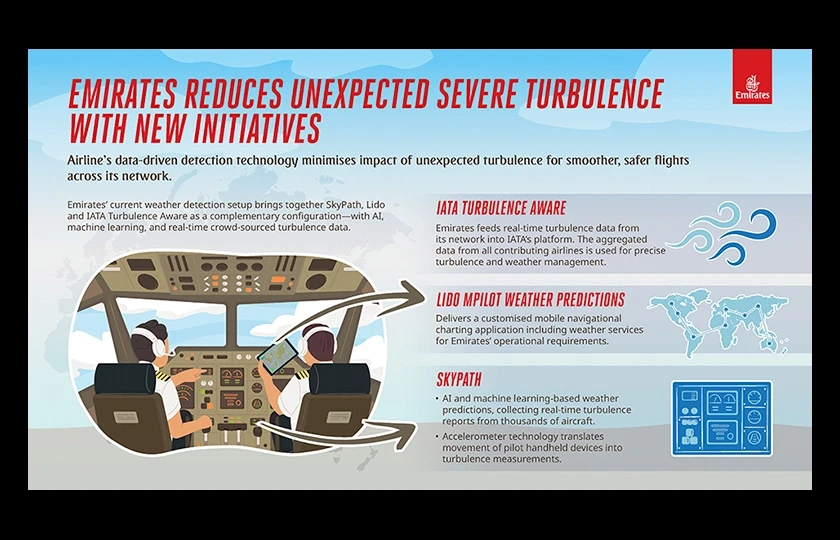
Emirates’ current weather detection configuration brings together SkyPath, Lufthansa Systems’ Lido mPilot and IATA’s Turbulence Aware as a complementary configuration, providing revolutionary innovation through artificial intelligence, machine learning, real-time turbulence data obtained through crowdsourcing and pilot reports:
SkyPath: Emirates partnered with SkyPath last year to develop and improve weather forecasts based on artificial intelligence and machine learning that identify areas of turbulence that conventional methods cannot detect. The SkyPath platform integrates real-time turbulence reports from thousands of aircraft with cutting-edge analysis, using advanced artificial intelligence and machine learning to generate accurate predictions, even for areas with no current flight activity or turbulence that is difficult to detect in ‘clear air’.
SkyPath collects information from a variety of sources: eddy dissipation rate (EDR) data for universal turbulence measurements, automatic dependent surveillance-broadcast (ADSB) transponder data, and SkyPath’s patented iPad accelerometer technology, which translates device movement into accurate turbulence measurements to provide pilots with useful information.
Weather forecasts for Lido mPilot
Emirates’ long-term collaboration with Lufthansa Systems offers a mobile chart application that is customised and tailored to the airline’s operational requirements. Through collaborations with sources such as the German Weather Service, Lido mPilot provides highly accurate weather reports, real-time data on clouds and convection, as well as turbulence and icing forecasts to improve pilots’ situational awareness. Emirates continuously collaborates with the Lido team to improve the quality of meteorological data and global coverage.
IATA Turbulence Awareness
Since joining IATA’s Turbulence Aware programme last year, Emirates has actively contributed and consumed real-time turbulence data from its extensive network across the Middle East, Africa, Asia and Australia. This data is entered into IATA’s global turbulence platform, which aggregates contributions from participating airlines worldwide to provide a comprehensive, real-time view of atmospheric conditions.
By integrating this data into its electronic navigation chart application, Emirates provides its pilots with real-time turbulence visualisations. This promotes more informed decision-making in the cockpit, enabling crews to anticipate and avoid areas of turbulence, ultimately improving passenger comfort, operational safety and fuel efficiency.
About EMIRATES
Emirates is the world’s largest international airline, connecting travellers to over 150 cities. Emirates operates the world’s largest fleet of Boeing 777s and Airbus A380s, and now operates the Airbus A350, offering spacious cabins and iconic onboard features across its entire fleet. With a culturally diverse workforce, Emirates serves its global customer base by offering exceptional services and first-class products, and has earned recognition from its customers for its industry-leading services, both on the ground and in the air.
Source: SERGAT Communication