

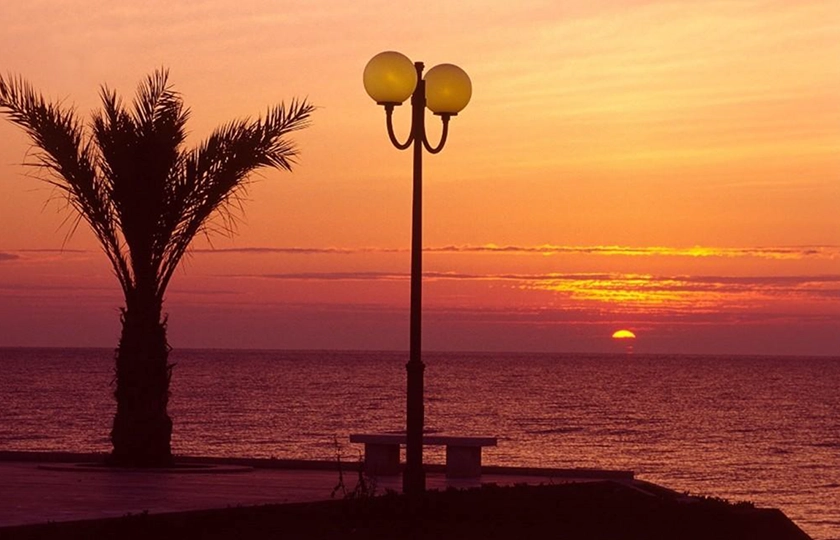
On the shores of the Ionian Sea, sand; on those of the Tyrrhenian Sea, rocks. What unites them is peace and a zest for life.
June is the month of the sun. The ideal time to discover the magical sea of Basilicata.
The star at the centre of our solar system has been revered since the dawn of time, and it is precisely in this month that the summer solstice takes place. It is not only the official start of the warm season, but a moment that humankind has always shrouded in magic. Marked by the megaliths of Stonehenge, remembered by the Venerable Bede at the festival of Litha, also mentioned in J.R.R. Tolkien’s The Lord of the Rings, celebrated in ancient times by the pagan peoples of northern Europe, yet also linked to the birth of John the Baptist, the solstice has always endowed June with the role and charm of a pivotal month around which the year revolves.
Basilicata is often thought of as a land of mountains. And it is true that rugged, mountainous terrain covers most of the region.
But the sea is there—in fact, there are two. A double coastline that is sure to satisfy all the needs and desires of those who love the sea, the sun and the warm sand.
Notwithstanding this, the two coasts, the Tyrrhenian and the Ionian, with their marked differences, have one thing in common: the total relaxation they guarantee. Zero chaos, plenty of space, miles of tranquillity and plenty of activities to enjoy.
Ionian Coast
A stretch of almost forty kilometres of golden sand stretches from Metaponto to Nova Siri, and everyone knows it: it is the Ionian coast of Basilicata, also known as the Metapontino. A name that evokes the fertile plain and the Magna Graecian city of Metaponto, the historic gateway to this stretch of the Ionian coast.
But history is merely the backdrop to a story with a single protagonist: the sea. The beach stretches for miles with fine, light-coloured sand that is almost uninterrupted. The seabed slopes very gently, the water shifting from a pale turquoise to a deeper blue. The sensation is one of an open, breathable space, never stifling.
Behind the shore lie gentle dunes, strips of sand, patches of Mediterranean scrub and large pine forests that in some places reach right down to the shore. The dark green of the pines, the golden sand, the blue of the sea: crisp, clean colours, enhanced by the full southern sun.
Those who choose the Ionian coast of Basilicata for a swim find, above all, this: freedom. Freedom to stroll unhindered, to choose between equipped beaches and stretches of free, and often secluded, sand. To enjoy the sea in an active way or, conversely, in complete tranquillity. There are modern establishments, holiday resorts, beach clubs, facilities for families, easy access and well-organised spaces; and always the chance to find an almost private beach, with the only sounds being the wind rustling through the leaves and the waves gently breaking on the shore.
Metaponto is the starting point of the journey: the classic example of a comfortable holiday, with historic beaches, long stretches of sand and extensive pine forests. Marina di Pisticci offers a more elegant and nautical touch, linked to the marina and the chance to enjoy the Ionian Sea from the open sea too, with boat trips and excursions. Further along, Scanzano Jonico retains a less polished character, much appreciated by those seeking open beaches and a more direct connection with the surroundings. Policoro perhaps represents the best balance between swimming, marina facilities and nature, whilst Nova Siri and Rotondella round off the coastline with a quieter, more remote atmosphere.
All these towns, and all these beaches, share a common feature: firstly, there is only sand and no rocks; furthermore, to reach water deep enough not to touch the seabed, you have to venture quite a distance from the shore. A guarantee for families: children can run, have fun and play without their parents worrying about beaches that quickly become deep and rocky.
Beyond the typical ‘beach vibe’, the Metapontino coast reveals another side. This stretch of the Ionian Sea lends itself naturally to light sailing and water sports (though, incidentally, there is also a highly sought-after golf course that hosts international tournaments): sailing, windsurfing, kitesurfing, SUP, canoeing and sport fishing. The constant winds allow for year-round sporting activities, and even more so in June, when there are fewer people and the sun is already warm. Out at sea, moreover, it is not uncommon to spot marine wildlife, including dolphins and whales.
The beach does not end at the shore. Just a few metres from the sea, ecosystems of great value begin: river mouths, wetlands, coastal forests and nature reserves. The Metaponto Forest and the Policoro Marsh Forest reveal what this plain was like before land reclamation and agricultural modernisation: a vast, humid, intricate coastal forest, inhabited by migratory birds, reptiles, small mammals and rare plant species. In just a few minutes, you can leave the blazing sun of the beach behind and find yourself immersed in the shade of sandy paths, amongst channels, clearings and wildlife observation points. Here, tourism has not erased the landscape.
Behind the coastal strip lies one of the most fertile agricultural plains in the south, dotted with citrus groves, fruit orchards and specialised crops; a little further on, the hilltop villages, the white villages and the vestiges of Magna Graecia come into view. Metaponto preserves the most monumental legacy with its archaeological park and the Tavole Palatine; Policoro carries on the legacy of Heraclea; Bernalda, Pisticci, Tursi and Montalbano Jonico offer different urban landscapes, traditions and scenery.
But here everything always seems to come back to the sea: even the cuisine, with fish from the Ionian Sea and produce from the plains, brings this constant dialogue between water and land to the table.
The greatest luxury of the Ionian coast is offering a wonderful, calm sea.
Tyrrhenian Coast
Whilst Basilicata’s Ionian coast is characterised by its vastness, sandy beaches and tranquillity, Basilicata’s Tyrrhenian coast is exactly the opposite: a place of sheer cliffs.
Here, the region overlooks the sea from a single, beautiful town: Maratea. Thirty-two kilometres, nestled between Campania and Calabria, are enough to create one of the most spectacular seascapes in southern Italy.
In Maratea, the coastline breaks, cuts in, rises and plunges. Limestone cliffs, green walls plunging into the blue, rocky outcrops, nooks and crannies, sea caves, small bays hidden amongst the headlands. It is a spectacular stretch of the Tyrrhenian Sea. The prevailing feeling here is not one of open space, but of discovery. Every bend in the coastal road, every descent through the Mediterranean scrub, every path carved into the rock leads to a beach different from the last. There are beaches of dark sand like Cala Jannita, of light pebbles like Santa Teresa, of soft sand like Castrocucco; some are easily accessible, others only by sea or via steep stairways that turn a swim into a minor conquest.
This is the luxury of Maratea: not offering a single sea, but dozens of different seas within a radius of just a few kilometres. From the water, one can ‘read’ the coastline better. Excursions, dinghies, kayaks and small boats set off from the marina. From the open sea, one can observe the continuous succession of caves, coves and outcropping rocks—more than 130 natural cavities shaped by the wind and salt. As if a mountain had fallen into the Tyrrhenian Sea.
Maratea, on the other hand, is not a compact urban centre, but a scattered territory: the municipality is divided into a constellation of small hamlets, settlements facing the sea or perched on the hillsides, each with its own beaches and its own identity: Acquafredda, Cersuta, Fiumicello-Santa Venere, Porto, Marina di Maratea, Castrocucco, Massa, Brefaro, Santa Caterina, and so on.
The table reflects the constant interplay between the Tyrrhenian Sea and the mountains: alongside blue fish, anchovies and the ancient memory of garum, there are the red tomatoes of Maratea, the mozzarella and caciocavallo of Massa, the bread of Trecchina, the Anginetti of Lauria, the Cuccìa of Rivello and a constellation of flavours that changes within the space of a few kilometres.
Similarly, small-scale artisanal activities and local productions deeply rooted in the territory endure: cheese dairies, bakeries, biscuit factories and, above all, ancient manual skills such as libbaneria—the weaving of plant fibres used to make baskets, ties and everyday objects.
In Maratea, as in the Ionian region, the sea is not just for swimming. The crystal-clear, deep waters make the area an ideal spot for snorkelling, diving, stand-up paddleboarding and coastal sailing. A sea waiting to be discovered. Overlooking this natural spectacle, almost as a landmark, stands the Christ the Redeemer of Mount San Biagio. Standing over twenty metres tall, it dominates the Gulf of Policastro and reminds us that in Maratea, everything unfolds vertically. Then, just beyond the coast, lie the forests and villages of the southern region — Trecchina, Rivello, Lauria, Lagonegro, Noepoli — nestled between the Pollino and the Lucanian Apennines. The Tyrrhenian Sea is always there, just round the bend, ready to reappear.
Further information here.
Source: ENIT S. P. A.