

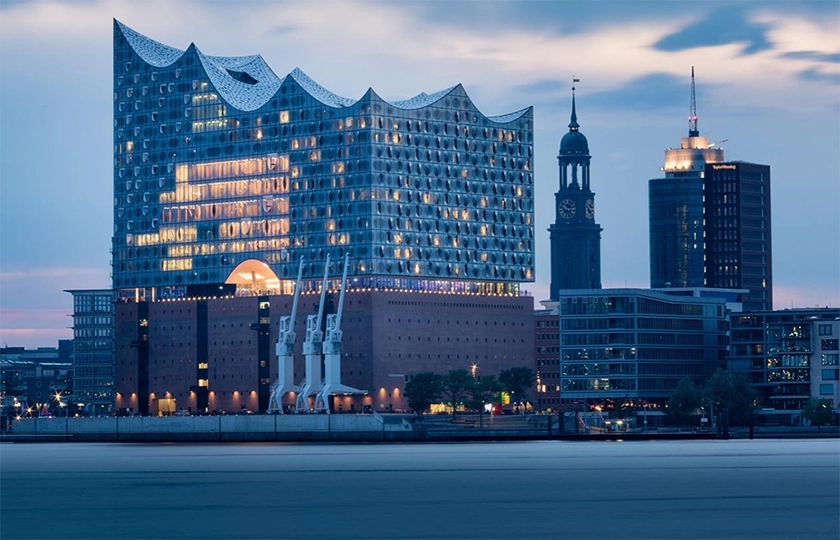
The Elbphilharmonie in Hamburg and the new cultural landscape that is redefining travel in Europe.
It has never been easier to listen to music. Any symphony is available in a matter of seconds, in multiple versions, recorded in the world’s finest concert halls. And yet, alongside this unlimited availability, something seemingly contradictory is happening: more and more travellers are planning their trips around a specific date on the musical calendar.
Hamburg’s Elbphilharmonie is one of the epicentres of this phenomenon. Opened in 2017 on the site of a former port warehouse and designed by Herzog & de Meuron, the venue has not only redefined the city’s skyline: in less than a decade it has welcomed over 25 million visitors, with an average of nearly 17,000 people a day on its panoramic terrace.
What has truly established the Elbphilharmonie as a destination is its programme. Conductors such as Sir Simon Rattle, Paavo Järvi and Sakari Oramo form part of an international programme that no longer attracts only local audiences, but generates cultural exchanges between European cities.
When you add to this a world premiere—the new version of the second movement of Mendelssohn’s Violin Concerto by Richard Dubugnon, scheduled for spring 2026—the event takes on the scale of a major occasion.
In classical music, the first performance of a work is not just another date: it is history in real time.
Such moments are shaping a European map parallel to the traditional tourist one. From Vienna to Salzburg, from Bayreuth to Hamburg, cultural mobility is increasingly driven by symphonic seasons, festivals and premieres. People travel less for the postcard view and more for the score.
In this context, Mundo Amigo, in partnership with the Bilbao Philharmonic Society, has designed a programme centred on the key dates of the Hamburg season in April 2026, structuring the trip around a specific artistic itinerary that includes concerts, pre-concert talks and meetings to contextualise the programme.
“The city is the setting, but the reason is the music,” explains Mikel González, director of Mundo Amigo. “There are people who no longer choose a destination, but a programme. If the concert is worth it, the journey makes sense.”
Beyond this specific case, what is emerging is a shift in thinking. In an era marked by unlimited access to digital content, the live experience gains value precisely because of its unique nature.
Travelling to hear a live performance may seem like a niche activity. However, it reveals a contemporary way of moving around Europe: not ticking off cities, but being exactly where something is happening.
Source: MDG Comunicación