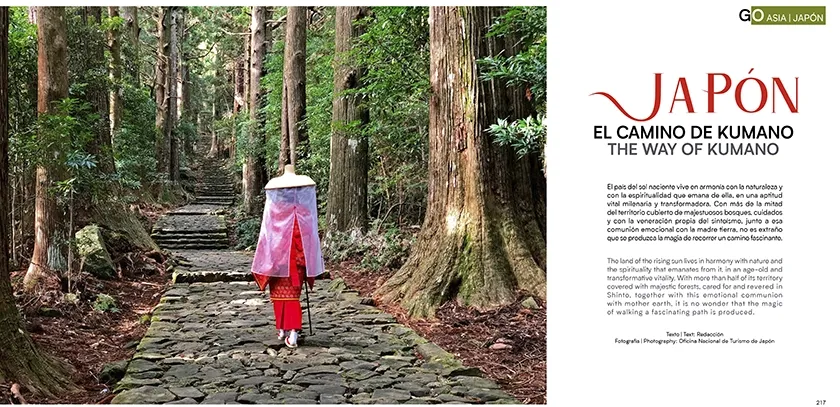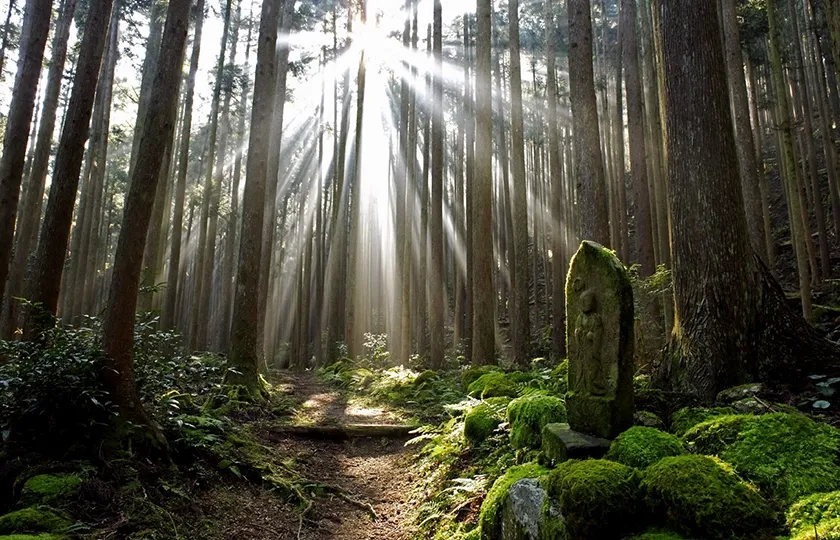
The land of the rising sun lives in permanent harmony with nature and with the spirituality that emanates from it, in a millenary and transforming vital aptitude, with more than half of its territory covered by majestic, sustainable and well-tended forests and with the veneration of Shintoism, together with this emotional communion with mother earth, it is not strange that the magic is produced to initiate the Path towards purification.
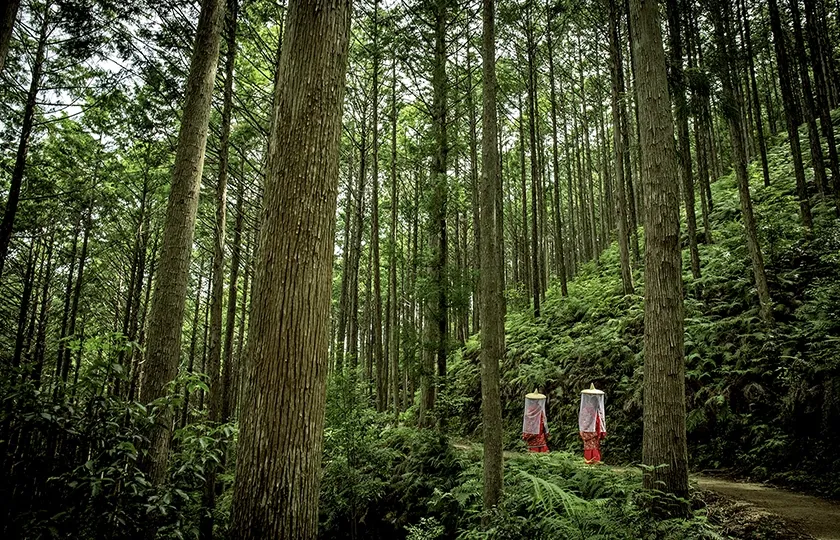
The term Kumano is intimately linked to Japan’s ancient spiritual heritage and more specifically to the pilgrimage route through the mountains of the Kii peninsula, a path that pilgrims have been walking for over a thousand years in search of enlightenment and contemplative silence.
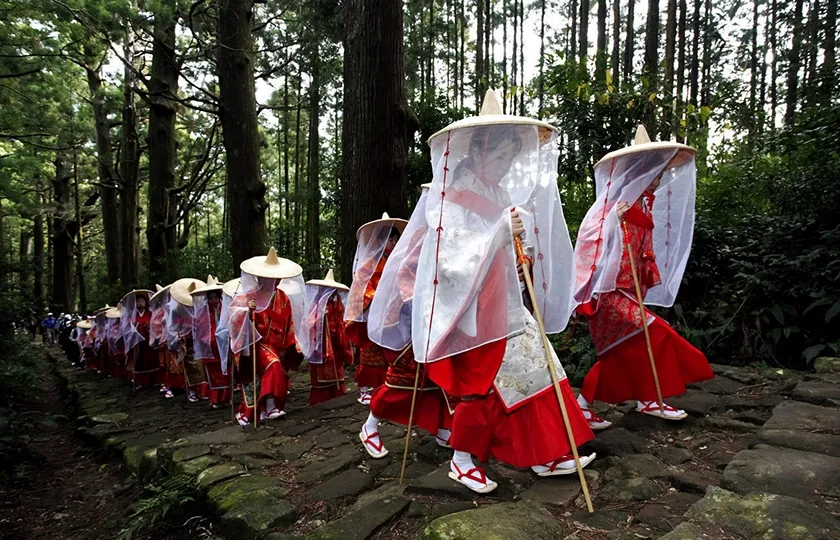
Traditionally, especially between the 8th and 12th centuries, emperors performed the ritual of reaching the three sacred Shinto temples of Hongu, Nachi and Hayatama once or twice in their lifetime, making successive ceremonial stops such as dancing, reciting poetry and bathing in the rivers they forded, as a form of purification. This justifies the existence of ninety-nine other Oji temples, whose mission is to provide protection and guidance, along the route through the country’s best-kept towering cedar forests, rich in hot springs and an inexhaustible source of legends. The territory through which it runs has always been considered a space with a powerful spiritual charge, the natural landscape in which the gods live. In addition, the route has great historical significance as one of the few places where the symbiotic relationship between Buddhism and Shintoism survives, despite the banning of Buddhism in the 19th century.
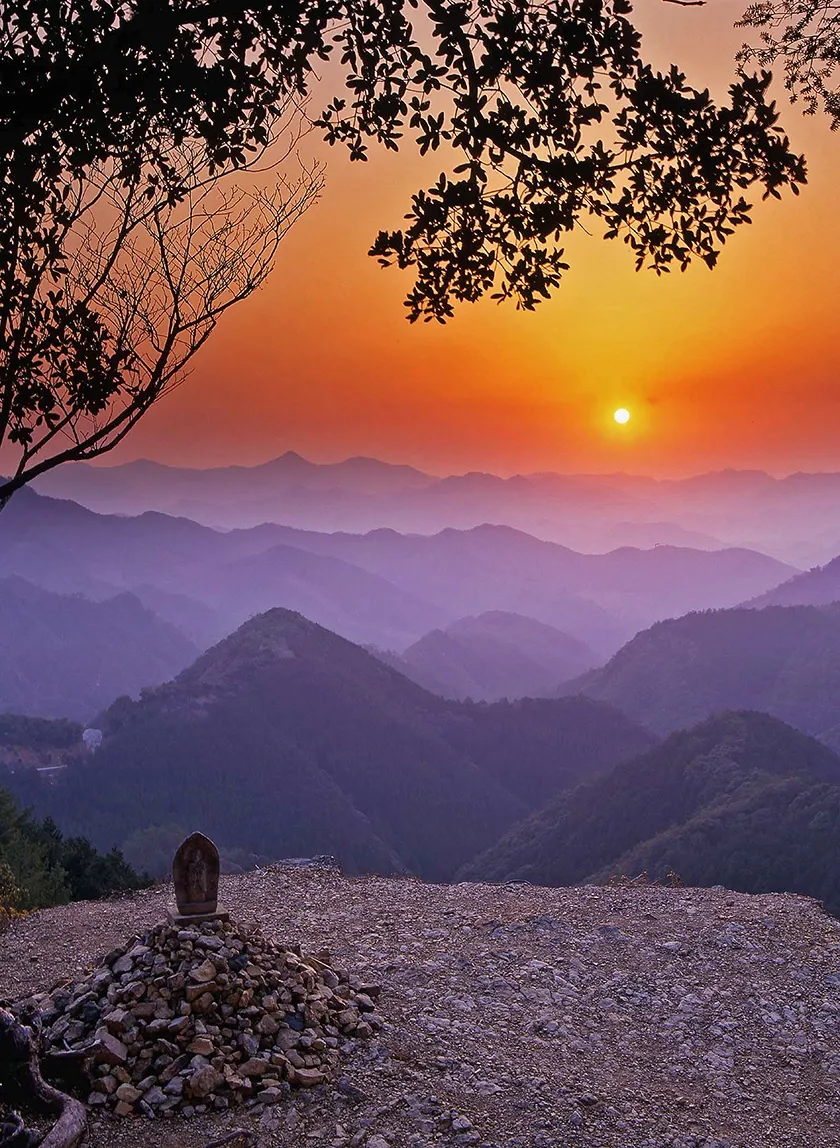
Declared a World Heritage Site, the Kumano Way has been twinned with the Spanish Camino de Santiago for twenty-five years. Separated by thousands of kilometres, while dawn breaks in the former, dusk falls in the latter, very close to Finisterre, where the world was thought to end. But there are many symbols through which, despite their different religious roots, pilgrims find spirituality.
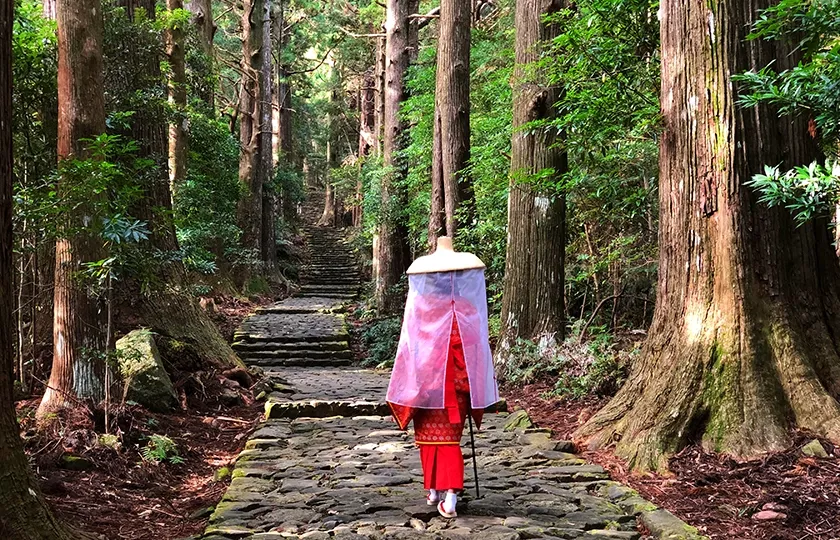
Both are routes of peace, tolerance and spirituality and, among the parallels, one could cite the Jacobean scallop and the three-legged raven symbol of Kumano; the torii or gates that mark the sacred character of the different places; the clothing of the pilgrims on the Camino de Santiago, reminiscent of the Apostle’s clothes, as opposed to Kumano, which is inspired by the traditional kimono; the luxuriant nature of both routes, with an abundance of forests that verge on magical realism; and finally, the exceptional cultural heritage that accompanies both Routes.
Three shrines for a promise
Legend, history and spirituality merge in the Kumano Way as naturally as religiosity is experienced in Japan, a unique eclectic exercise between Shinto and Buddhism. Thus, the walker who crosses the narrow pass of the “stone of the mother’s womb” that cuts the breath, feels the purification of the soul and a rebirth on coming out on the other side; or the emotion of reaching the hill from which tradition says that three moons can be seen aligned, among many other allegories.
The Kumano Way is Japan’s most long-established pilgrimage route, linking the three symbolic shrines of Kumano Hongu Taisha, Kumano Nachi Taisha and Kumano Hayatama Taisha under the name of Kumano Sanzan and the surrounding sacred sites.
La ruta más importante es la de Nakahechi, con una longitud de cuarenta kilómetros y un desnivel que oscila entre los seiscientos y los mil doscientos metros.
Starting from the Takijiri oji shrine where it is necessary to perform the ritual of ringing the bell to alert the gods of our presence, bow twice, clap your hands, say a silent prayer and bow again, before continuing on our way.
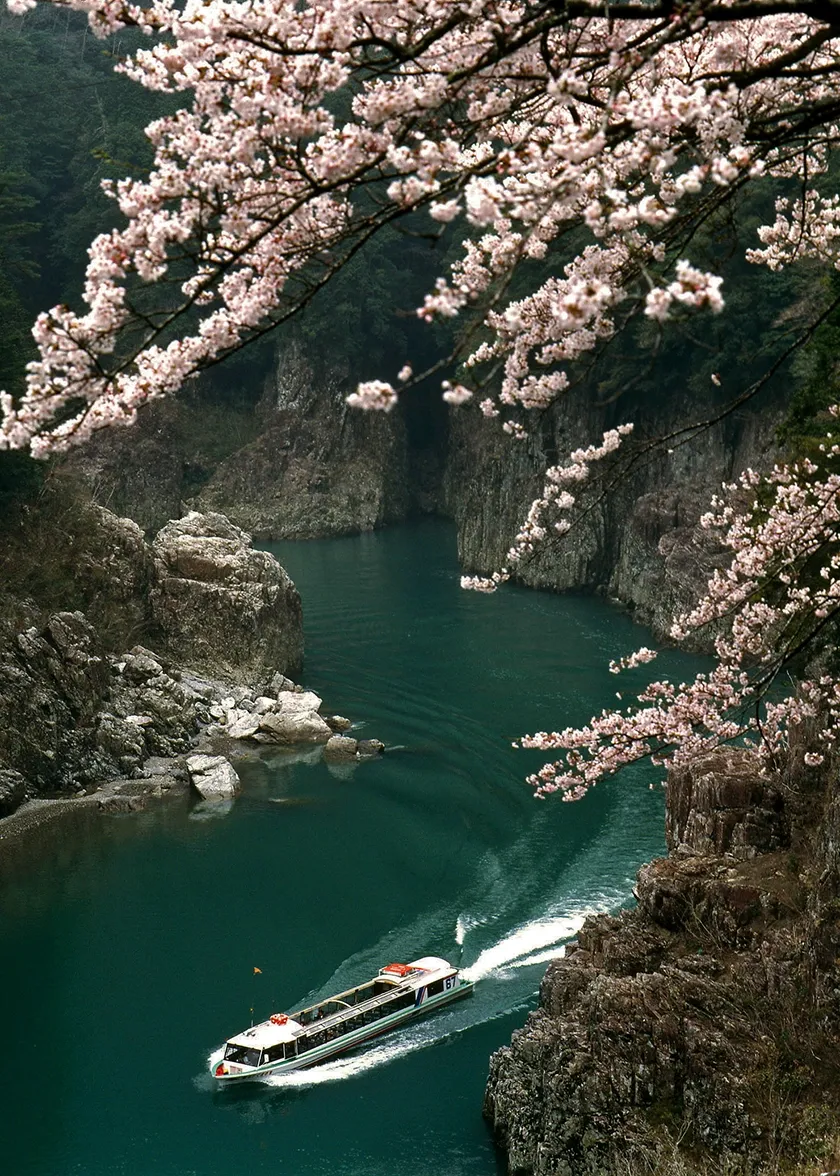
The path climbs up steps worn out by so many steps over so many centuries, marked by small Buddha statues in memory of the deceased who did not make it and under a vast, silent forest that invites you to think and to find yourself. Step by step the road climbs up and down from the peaks to the streams of the valley, passing charming villages with their camphor trees and cherry blossoms in spring, where there are always tea houses and cosy guesthouses where you can enjoy the local cuisine. Hosshinmon’s oji shrine is an indication that the end of the first stage is near. Entering through its torii is a symbolic act of rebirth in the Pure Land, as from here the thick forests are left behind to give way to a more open landscape of tea fields and bamboo.
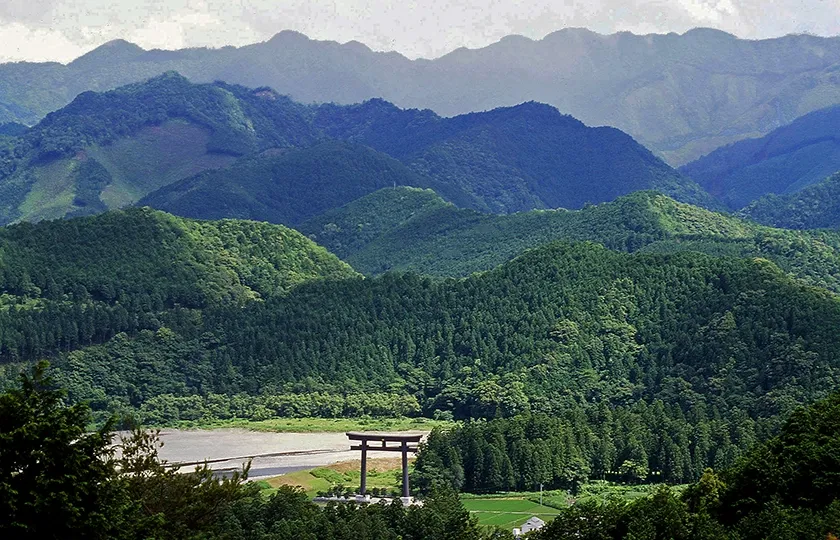
Suddenly, in the distance, a huge torii, almost forty metres high, breaks the landscape in the middle of the pilgrimage path, marking the entrance to Oyunohara, where the Hongu Taisha shrine, the most sacred shrine on the Way, has stood for a thousand years.
With a transcendental sensation, the pilgrim feels as if he is entering the spiritual world as he contemplates the beautiful silhouette of the sanctuary, whose wooden façade and large cypress bark roof blend into the surroundings.
Entering the grounds via the long staircase lined with flags and passing by the temizuya or ablutions fountain is exciting, as is standing in front of the Shinmon Gate. A twisted rope of rice cane indicates that we are in a sacred place. Meanwhile, pilgrims follow the ritual of stopping in front of each building to pray to the four gods who dwell here.
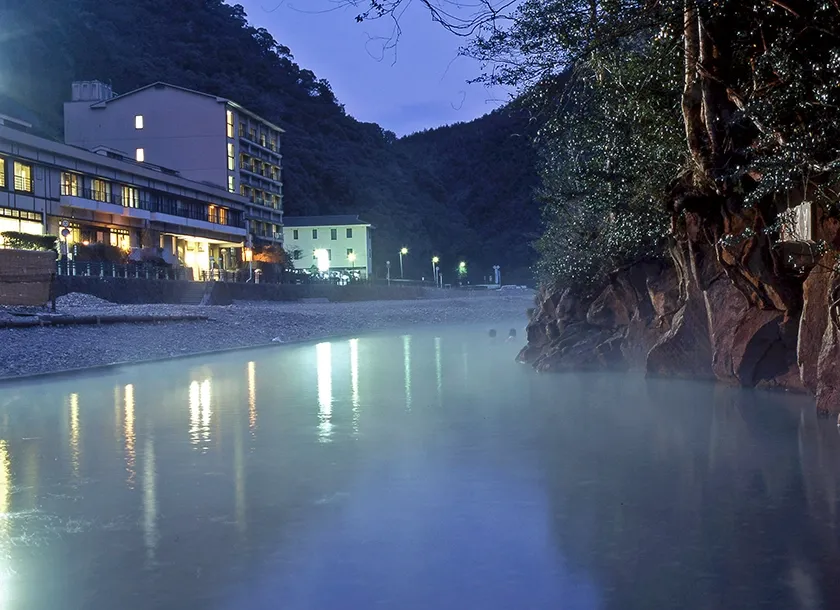
In spring, the Kumano Hongu Taisha Spring Festival takes place, when parents and children immerse themselves in the sacred hot springs of Yunomine Onsen as an act of purification before walking part of the Way. In August, the Yata-no-Hi fire festival is held at the shrine’s original location, featuring a burning shrine and fireworks.
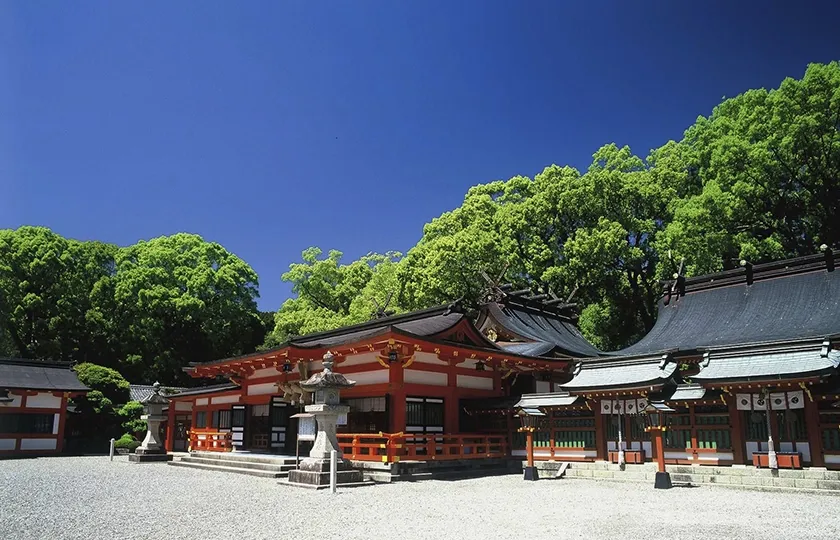
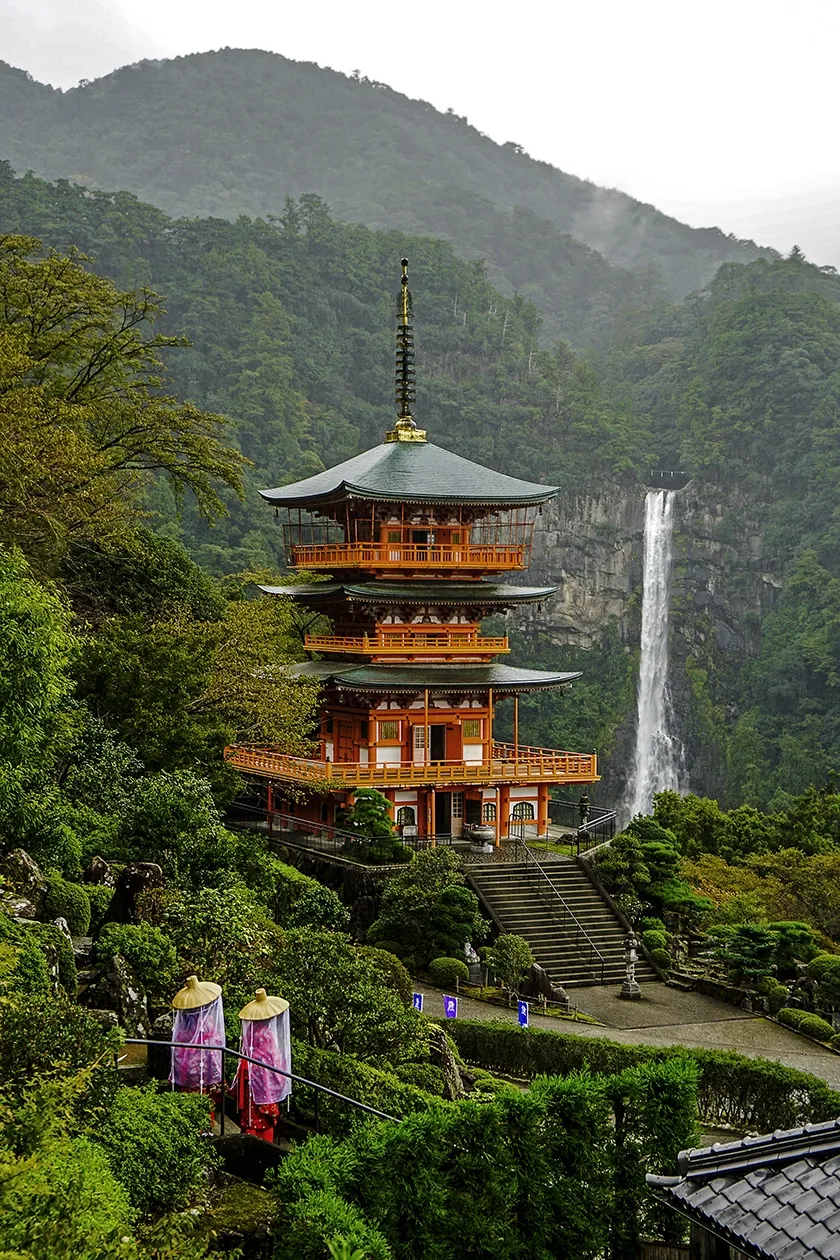
The great Nachi Taisha, in glowing orange and white and dedicated to twelve deities of Kumano, is composed of a Shinto shrine and a Buddhist temple, set against a backdrop of beautiful waterfalls. The “husband and wife”, a pair of eight hundred year old cedar trees flank the two hundred and sixty seven steps leading up to the sacred ground. At the top, a camphor tree, a very symbolic tree in Japanese culture due to its longevity, almost a thousand years old, spreads its branches embracing part of the sanctuary.
Kumano Nachi Taisha Shrine and its neighbouring Buddhist temple of Seigantoji formed a spiritual unity in the past. A connection that they have not lost today, representing the harmony of nature, which manifests itself beautifully here with the Nachi waterfall, a landmark that even before the construction of the sanctuary and the temple was a source of inspiration and a way of spiritual connection.
At the foot of the 133-metre waterfall is the Hiro shrine in honour of the waterfall deity. Admission is free, but you have to pay 300 yen to get to the viewing platform.
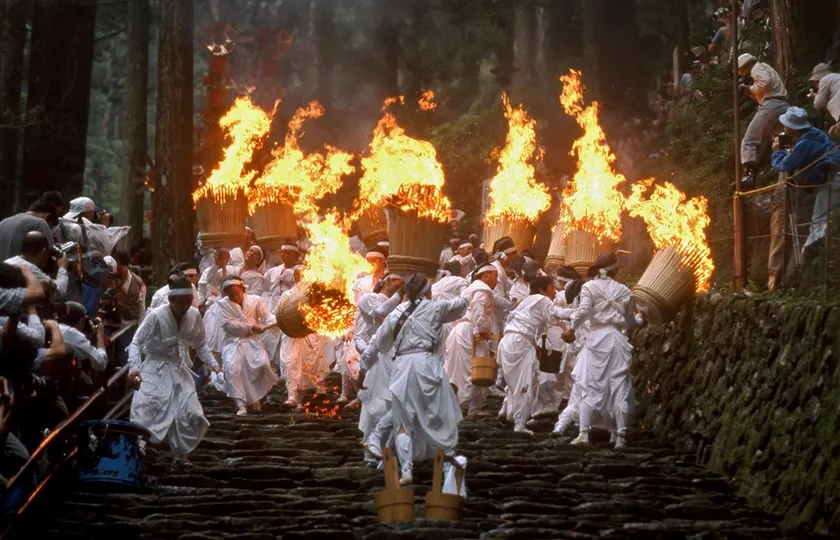
Every July 14, the Nachi Fire Festival takes place, an ancient ritual in which people walk the path between the shrine and the waterfall carrying torches as a sign of purification.
Situated at the mouth of the Kumano River, where the mountains of the Kii Peninsula merge with the Pacific Ocean, stands the Kumano Hayatama Taisha Shrine, the third shrine on the genuine pilgrimage route. This Shinto precept of communion between the natural and the spiritual is manifested at the entrance to the compound in the Nagi tree, a splendid thousand-year-old specimen considered to be one of the twelve deities worshipped here, and the nagi dolls, made from its seeds, bring luck in love and marriage, according to popular belief.
Inside, the Treasure Room holds a dozen national treasures, pilgrims’ offerings and around a thousand antique jewels donated by the Imperial Household in the 15th and 16th centuries.
For over a thousand years the Japanese have used this Way as a process of purification through rigorous rituals. Today, without losing its primitive essence, it is a fantastic way to commune with a sustainable cultural and natural landscape that is unique in the world.