
- Business tourism and destination intelligence will be other key factors for tourism in the capital this year.
- International tourism spending will reach an all-time high in 2025, with growth of 11% compared to 2024 and 71% compared to 2019.
- The capital expects to close 2025 with 11.2 million visitors and 23.8 million overnight stays.
- The United States, with growth of 6.4%, consolidates its position as the main source market, with very positive performance from Argentina and Brazil.
- The city is moving towards a quality model that generates more value and well-being for the people of Madrid.
- Madrid is strengthening its role as the world capital of tourism by bringing together the main governing bodies of the sector, UN Tourism and WTTC.
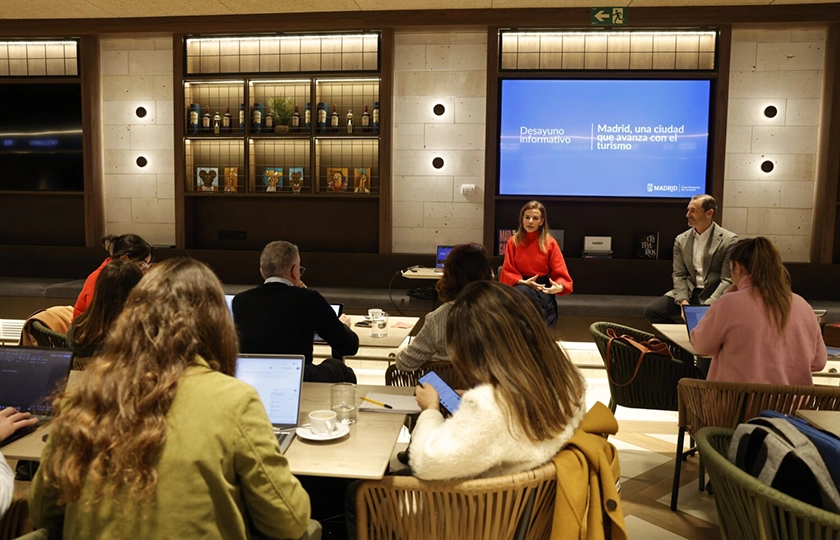
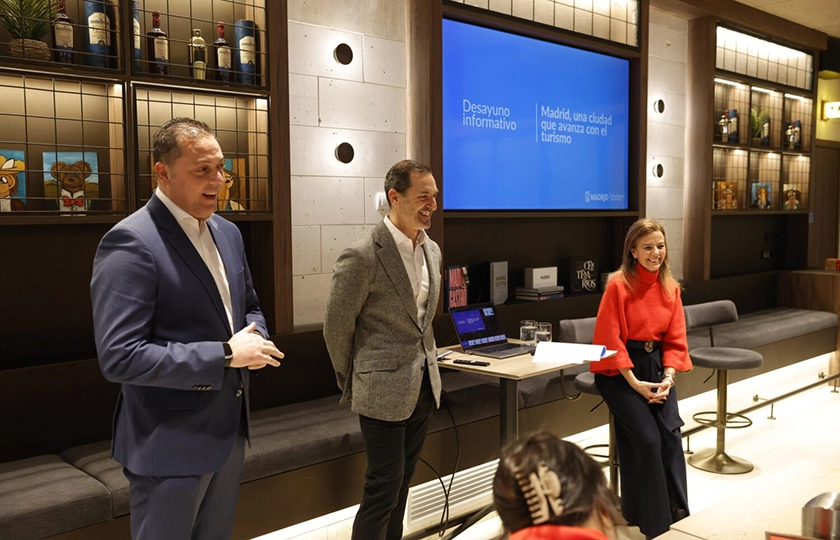
The Councillor for Tourism, Almudena Maíllo, took stock of the city’s tourism performance in 2025 during the informative breakfast “Madrid, a city that moves forward with tourism”, in which she highlighted that the capital expects to close the year with international tourist spending of €17.9 billion, 11% more than in 2024 and 71% more than in 2019, confirming tourism as one of the city’s main economic drivers.
During his speech, Maíllo stressed that ‘Madrid is moving forward with tourism when it is managed wisely and with a quality model that generates well-being for Madrid’s residents’. In this regard, he pointed out that the average expenditure per visitor stands at €1,960, while the average daily expenditure reaches €314.5, indicators that reinforce the evolution towards higher value tourism for Madrid. 2025 has also shown a balanced evolution of the main tourism indicators, with an estimated 11.2 million visitors and nearly 23.8 million overnight stays, of which 66% correspond to international tourism.
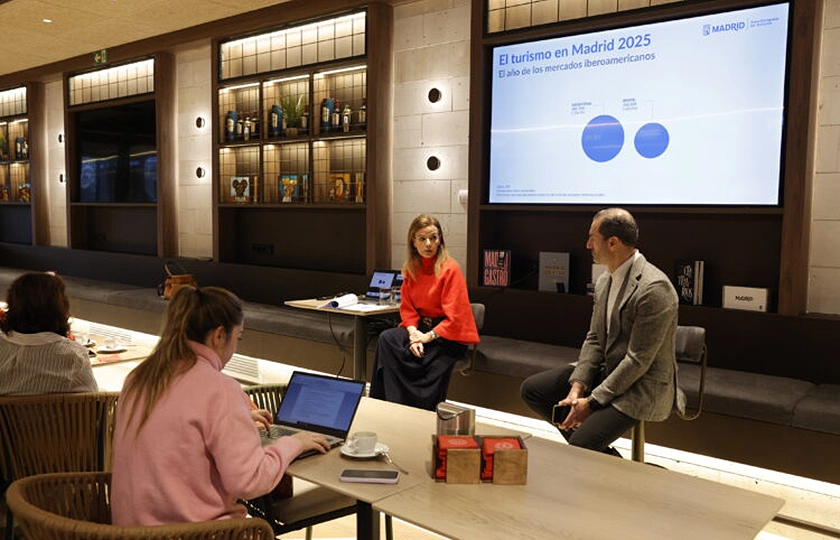
In terms of the breakdown of the main international source markets, the United States consolidated its position as the leading market for Madrid, with more than 1,030,000 visitors in the first 11 months of 2025, representing growth of 6.4% compared to the same period last year. It is followed by Italy, with 407,478 visitors (+2.6%), France, with 335,812 (-0.5%), and the United Kingdom, which recorded 327,665 visitors (+11%). Alongside these markets, the dynamism of the Latin American markets of Argentina, which reached 187,750 visitors, with growth of 28.4%, and Brazil, with 152,329 visitors, 20.9% more than in the same period last year, stands out.
This growth is also occurring in a context of low tourist pressure, with a ratio of 3.17 visitors per inhabitant, one of the lowest among major European urban destinations. Added to this is high visitor satisfaction, with an overall rating of 8.8 out of 10 according to the tourist perception survey. Ninety-nine per cent of visitors recommend Madrid and 91% say they would visit the city again.
These results reinforce the model of orderly growth promoted by Madrid City Council, based on greater value, lower tourist pressure and better coexistence between visitors and residents. For the councillor, ‘Madrid has shown that it is possible to grow in tourism without sacrificing the identity of the city or the quality of life of its residents.’

Tourism in 2026: decentralisation, experiences and business tourism
Looking ahead to 2026, Maíllo pointed out that Madrid faces a key year for consolidating its tourism model with three main priorities: the decentralisation of tourism, strengthening the city as a capital of experiences and promoting a new business tourism strategy aligned with the city’s strategic sectors.
In terms of decentralisation, he highlighted the roll-out of the second phase of the “Te faltan calles” (You’re missing streets) campaign, an initiative that showcases the personality and tourist attractions of 22 tourist areas in the city; the Usera transformation project with the installation of elements that reinforce the identity of the area as a space for coexistence with Chinese culture, thanks to an investment of €10.5 million, financed with Next Generation funds from the European Union through the Destination Tourism Sustainability Plan (PSTD), and the consolidation of Carabanchel as the city’s cultural hub.
The year 2026 will also reinforce Madrid’s position as a capital of experiences, with a stable calendar of major cultural, musical and sporting events. Among the main new developments are the return of Formula 1 to Madrid, which will position the city as the benchmark Grand Prix in Europe in terms of hospitality; a concert schedule featuring internationally renowned artists such as Bad Bunny, Rosalía, Bruno Mars and The Weeknd; the opening of nine five-star hotels; and the planned visit of Pope Leo XIV to Madrid.
Business tourism will be another major focus in 2026. Maíllo has announced that Madrid City Council is developing a new strategy that will prioritise attracting conferences and specialised events in strategic sectors for the city, such as big data, cybersecurity, fintech and e-health.
This commitment will strengthen Madrid’s position as an international hub for knowledge, innovation and professional meetings, generating economic impact and a positive legacy for the city in terms of talent, internationalisation and competitiveness. The councillor pointed out that Madrid has been voted the world’s best destination for conferences and meetings by the World Travel Awards for the seventh consecutive year.
Intelligence applied to the destination
In 2026, Madrid will continue to advance in the use of intelligence applied to the destination as a key tool for better managing tourism. The roll-out of the new digital ecosystem and the implementation of the Tourism Intelligence System (SIT) will enable more personalised experiences to be offered, the real contribution of tourism to be measured and data-based decision-making to be supported, with the aim of improving both the visitor experience and the quality of life of Madrid’s residents.
The councillor also highlighted the role of air connectivity as one of the pillars of quality tourism growth in Madrid. In 2025, Adolfo Suárez Madrid-Barajas Airport reached 68.1 million passengers, according to AENA data, representing an increase of 3%. The city has 447 routes, 90 airlines and connections to 76 countries. New routes are planned to open in 2026 to Fortaleza (Brazil), Halifax and Toronto (Canada).
Almudena Maíllo concluded by highlighting that Madrid has become the world capital of tourism by concentrating the main governance headquarters of the sector. The capital is home to the headquarters of UN Tourism and has recently been chosen as the headquarters of the World Travel and Tourism Council (WTTC). It is also the European headquarters of Virtuoso, the most important consortium in high-impact tourism.
Source: Press Office of TURISMO CIUDAD DE MADRID