

- A living heritage of culture, history and community.
- With eight of the ten theatres featured on UNESCO’s new website dedicated to Italian-style community theatres, the Marche region is reinforcing its role as an international cultural destination.
This recognition highlights not only the architecture but also a history of participation, social life, and culture that remains alive in these areas.
On 26 July 2026, during the 48th session of the World Heritage Committee held in Busan, South Korea, the “System of 18th- and 19th-century Italian-style community theaters in central Italy” was inscribed on the UNESCO List.
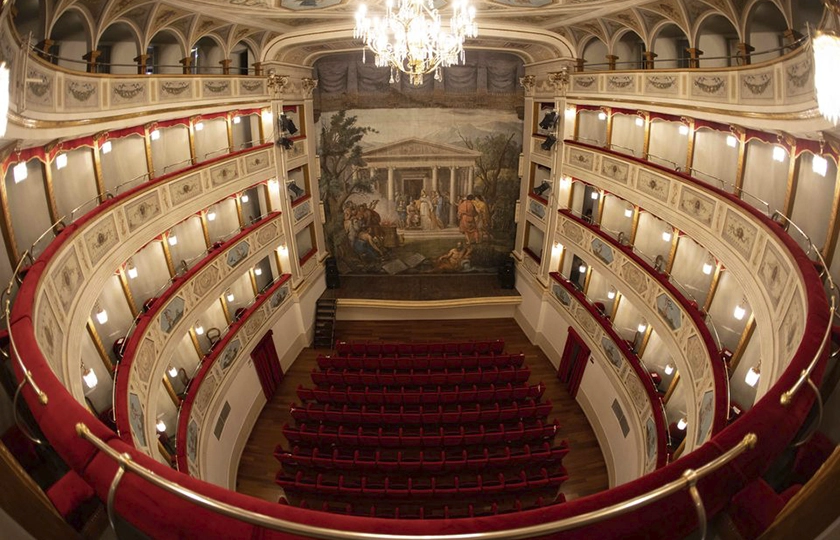
The group comprises ten theaters: eight in the Marche, one in Emilia-Romagna, and one in Umbria. In the Marche region, the sites include the Giovanni Battista Pergolesi Theatre in Jesi, the Ventidio Basso Theatre in Ascoli Piceno, the Serpente Aureo Theatre in Offida, the Teatro dell’Aquila in Fermo, the Lauro Rossi Theatre in Macerata, the Feronia Theatre in San Severino Marche, the Gentile Theatre in Fabriano, and the Bramante Theatre in Urbania.
This recognition holds special significance for the Marche, known as ‘the region of a hundred theatres,’ thanks to the extraordinary presence of historic theatres in both large cities and the smallest villages. The UNESCO network thus becomes a new lens through which to interpret the region, capable of bringing together cities of art, villages, architecture, music, traditions, and landscape.
‘Condominial’ does not refer to an architectural style but to a model of ownership and participation. Between the 18th and 19th centuries, citizens and local communities contributed to the construction and management of the theaters; the purchase of a box could constitute a form of co-ownership, which could even be passed on by inheritance. The theaters were, therefore, much more than mere venues for performances: they became spaces for gathering, social life, and exchange. The traditional Italian-style auditorium, with its stalls, tiered boxes, foyers, salons, and stage machinery, reflects this relationship between architecture, society, and culture.
A distinctive feature of this recognition is the continuity of their original function: the theaters remain active and host performances, concerts, operas, festivals, and cultural initiatives. For international visitors, UNESCO’s heritage thus becomes an authentic experience: stepping into a historic theater, attending a performance, and, at the same time, discovering art, gastronomy, the landscape, and local traditions. The tour reinforces the appeal of the Marche region as a destination capable of combining history and modernity, culture and the local area: a heritage born of the communities, which is still preserved and lived by those same communities today.
Further information here.
Source: ENIT SPA