
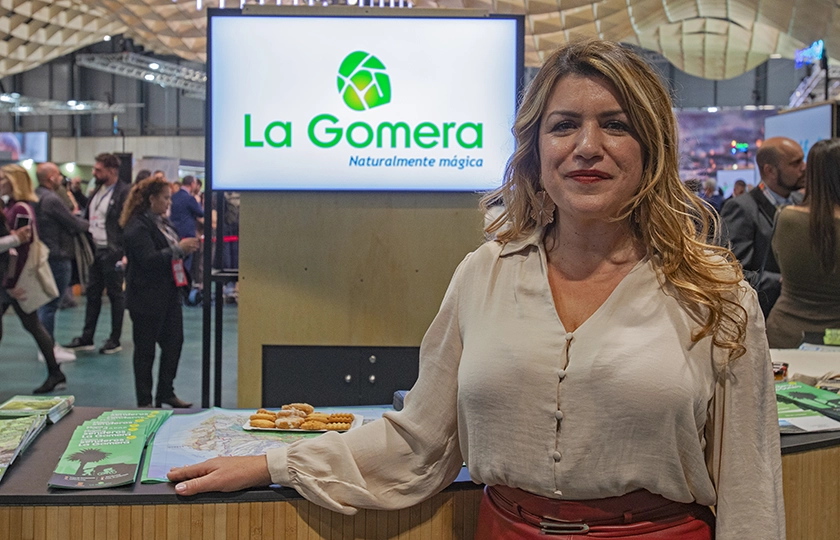
With a degree in Geography and History and a Master’s degree in Education from the University of La Laguna, Maribí exudes warmth and positivity throughout her narrative. Her love for her homeland, her constructive spirit and her excellent academic background are enabling her to strike the perfect balance between theory and pragmatism, thereby laying the foundations for sustainable tourism development capable of generating widespread prosperity.
Throughout her long professional career, during which she has specialised in environmental planning and tourist itineraries, as well as the production of risk maps, she has held senior positions as a geographer within the Environmental Prevention Service and on the La Gomera Island Agri-Landscapes project, amongst others.
This has enabled him to build up a wealth of experience that he now wishes to put to practical use on his island and put it firmly on the global tourism map, following a clearly defined roadmap. He discusses all of this in detail in this interview.
Q. What are the key strategies for promoting La Gomera as a tourist destination?
A. To focus on a positioning strategy that prioritises nature, authenticity and the Gomero people’s deep-rooted connection to their history and culture, thereby establishing the island as a destination defined by its natural character, far removed from anything artificial or digital.
Q. What are tourists looking for when they visit La Gomera?
A. Look for an island that embraces you – with its own distinct character – a landscape shaped over generations, an island that speaks for itself when you lose yourself in its sounds, in its natural surroundings dating back to the Tertiary Period, such as Garajonay National Park; unwind in wild coves, free from crowds and noise. They come to listen to the birdsong whilst reading a book beneath a grove of palm trees, to explore its network of over 600 km of trails, or to cycle through a variety of landscapes they have never seen before, where the blue sky blends with the magic of the mist amongst ancient forests. Visitors come to sample the local specialities or listen to the sound of ‘chácaras’ and drums at the traditional festivals.
Q. How is the balance between sustainability and economic development achieved?
A. On La Gomera, we believe that tourism development only makes sense if it helps to improve the quality of life for those who live on the island and, at the same time, protects what makes us unique. That is why we operate under a model in which economic growth goes hand in hand with land conservation, respect for our natural resources and the protection of our cultural identity.
Our aim is not to pursue massive growth, but rather to foster a balanced, mindful and responsible form of tourism that can create opportunities for the local population, help retain residents and revitalise sectors such as retail, hospitality, agriculture and crafts, without compromising the natural environment that defines us.
La Gomera has managed to maintain this balance thanks to sustainable planning, focusing on low-impact activities, responsible transport, the restoration of footpaths, energy efficiency and the promotion of our local resources.
Q. The natural environment is one of the island’s main assets. What makes it so special?
A. The island of La Gomera, covering an area of just 374 square kilometres, has 33% of its territory designated as protected areas, as it boasts more than a dozen protected natural areas, including Garajonay National Park, which has been declared a UNESCO World Heritage Site, as well as a Biosphere Reserve covering the entire island and the surrounding sea.
It has also been awarded the “Whale Heritage Sites” designation, an international accreditation that recognises outstanding destinations which promote responsible and sustainable whale and dolphin watching of wild whales and dolphins in their coastal waters.
Q. To what extent is La Gomera’s intangible heritage linked to its natural heritage?
A. The island of La Gomera, by its very nature, has always been closely linked to the land and its people. From this connection, a rich heritage has been preserved, including folklore, the ‘pie de romance’ (a traditional form of verse), poetry, a cuisine rich in local produce such as palm honey – the queen of Gomera’s cuisine – and its wines, made from a grape variety that has survived for hundreds of years; as well as traditions and legends.

Q. What are the main defining features of intangible heritage, and what measures are being taken to preserve it?
A. Before the advent of the telephone or mobile phone, the people of La Gomera were able to communicate across the island’s rugged terrain using ‘silbo’, a unique language that has been declared Intangible Cultural Heritage of Humanity.
Currently, the Island Council of La Gomera and various local organisations have committed to the conservation and upkeep of this cultural asset, such as teaching it as a shared subject in primary schools; the creation of free schools open to anyone who wishes to learn, whether locals or visitors; and the demonstration of this form of communication at various cultural and tourist events, such as fairs, conferences and traditional festivals, not only locally but also across borders throughout the country and internationally.
Q. How is the concept of conscious tourism being developed on the island?
A. The Tourism Department is currently implementing various initiatives aimed at raising local awareness, including training courses for the sector and the creation of a “Good Practice Guide” designed to support the conservation of the local environment and promote water and energy savings.
Collaborating to clean up beaches and public spaces.
We are working with local businesses to replace plastic bags with paper ones.
We are distributing bins to prevent litter on beaches and in public spaces.
We are distributing cloth bags at various tourism events to promote the reuse of items.
Q. Tell me about La Gomera’s new tourism initiatives for the rest of 2026.
A. With funding from the European Next Generation programme, La Gomera’s Tourism Department has developed the ‘La Gomera, Circular Island’ Tourism Sustainability Plan, comprising initiatives aimed at establishing the island as a safe, sustainable and high-quality tourist destination, capable of showcasing its natural and cultural heritage whilst creating economic opportunities for the local population that will help to retain the local population.
These include: the upkeep and maintenance of its network of footpaths; improvements in energy efficiency; enhanced tourism promotion through digitalisation and promotional campaigns; the creation of new tourism products to boost the local economy; training for professionals; and so on.
Q. Gastronomic tourism is a major asset in many Spanish regions. Is La Gomera also moving in that direction?
A. Yes, without a doubt. La Gomera’s cuisine is one of our greatest cultural expressions and a key part of the tourist experience we offer. To talk about La Gomera is also to talk about its flavours, its local produce and the people who keep centuries-old traditions alive.
At the Tourism Department, we are working to promote local specialities such as palm honey, artisan cheeses, almogrote and our wines, which are produced using traditional viticulture methods on steep terraced slopes. All of this forms part of a culinary tradition that is deeply rooted in the local area and landscape.
We are also promoting culinary tours and experiences that connect visitors with local producers, wineries, sugarcane juice makers and restaurants that prioritise locally sourced produce. Cuisine thus becomes a way of getting to know the island from the inside, gaining an understanding of its culture, traditions and way of life.
Q. Looking ahead to 2030, how would you like to see La Gomera featured on the global tourism map?
A. We would like La Gomera to continue to be recognised as an authentic, sustainable and deeply human destination, an island capable of growing without losing its essence.
We aim to establish ourselves as an international leader in sustainable and nature-based tourism, demonstrating that it is possible to develop a tourism model that respects the local environment, culture and people. A destination where visitors come not only to enjoy extraordinary scenery, but also to reconnect with themselves and discover a different way of understanding time and life.
La Gomera does not aim to be the most crowded destination, but rather one of the most special. It is a place that leaves a lasting impression on visitors precisely because it has retained its authenticity.