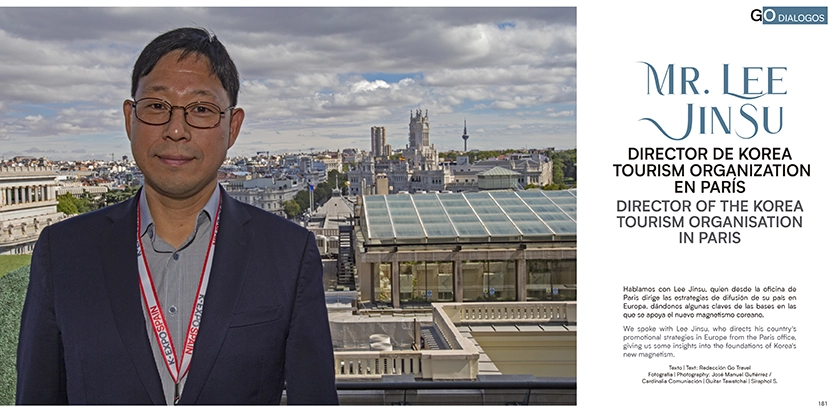
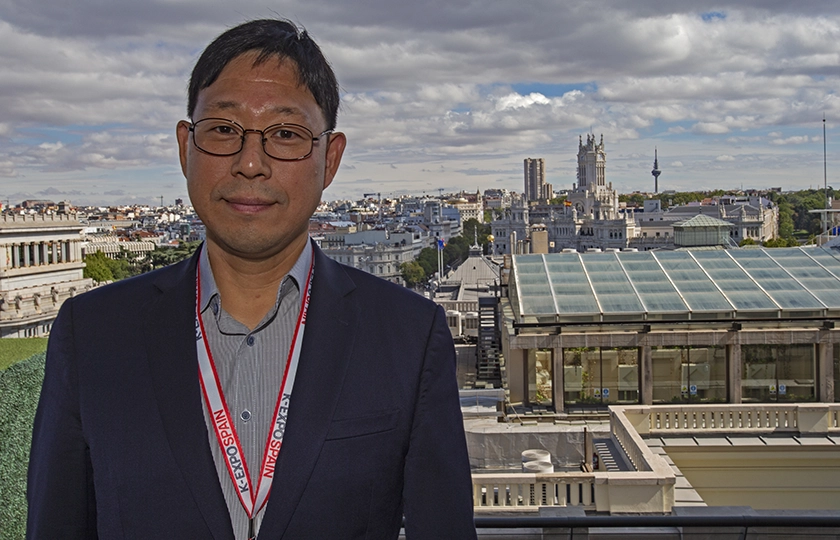
We spoke with Mr Lee Jinsu, who directs his country’s promotional strategies in Europe from the Paris office, giving us some insights into the foundations of Korea’s new magnetism.
South Korea has experienced surprising growth in visitor numbers of close to 50%, surpassing its neighbours Vietnam and Japan, and is now approaching pre-pandemic levels.
With figures exceeding sixteen million international tourists, the outlook is positive thanks to the widespread phenomenon of Hallyu or ‘the Korean wave’, its commitment to quality tourism, improvements in air connectivity with Europe and its firm commitment to sustainability and the environment.
Q.- What are the pillars on which Korea is based as a cultural tourist destination?
A.- Let’s say there are three strong points. Firstly, it is true that many European tourists travelled to Korea for its cultural heritage, as the country has seventeen UNESCO World Heritage Sites, mainly related to monumental heritage and the Buddhist religion. After the pandemic and with the spread of Korean films and series, interest in learning about and experiencing Korean lifestyles has grown, especially among younger generations.
The Korea Tourism Organisation is sponsoring three highly representative festivals. One of them is the Hwaseong Fortress Cultural Festival, a historical festival held in Suwon to celebrate Suwon Citizens’ Day. Hwaseong Fortress, a UNESCO World Heritage Site, is a popular tourist destination offering various activities and performances such as parades, official ceremonies, and traditional theatre. The Ice Fish Festival takes place on the banks of the Hwacheoncheon Stream in Hwacheon-gun. This celebration takes place in a clean and pure area where otters and sancheoneo fish live, a special type of salmonid that lives in low temperatures. The event consists of several fun activities, including fishing through forty-centimetre-thick ice, catching fish with your hands, etc. Anyone who wishes to experience something new and consume the catch is welcome to participate.
The Incheon Pentaport Rock Festival, the gateway to Korea due to its proximity to the international airport, attracts more than 100,000 visitors each year with performances and musical presentations by Korean and foreign rock bands. In addition, during the festival, a number of secondary activities take place in nearby towns. It is currently recognised as an important international rock event that is steadily gaining popularity.
This is just a sample of the variety of tourists who visit our country.
Q.- Tell me about the main tourist destinations in Korea.
A.- Speaking of cities, the most visited is Seoul, but there are others nearby, such as Suwon, which I mentioned earlier. Q.- Speaking of cities, the most visited is Seoul, but there are others nearby, such as Suwon, which I mentioned earlier; the modern city of Incheon, the third largest in the country, has an interesting cultural and gastronomic offering; and Jeju Island, located south of the Korean peninsula, is a destination highly valued by nature tourism enthusiasts for its environmental values.
Busan, Korea’s second largest city and home to the International Film Festival held every September, is a cosmopolitan city and an important health destination linked to its spas, but it is also highly valued for its magnificent beaches. In addition, it has many other attractions such as Beomeosa Temple on Mount Geumjeongsan and Haedong Yonggungsa Temple located by the sea. The natural environments of Camellia Island, at the end of Haeundae Beach, and Taejongdae Park, in addition to their ecological value, are magnificent places to contemplate the coast of Busan.
The city is also renowned for its markets. Jagalchi Market only sells fish, while Gukje Market sells all kinds of items. Seomyeon Market, the liveliest night market of them all, is the perfect place to enjoy Korean cuisine at its street stalls.
The city of Gyeongju is famous, among other things, for having been the capital of the Silla kingdom for nearly a thousand years. Thanks to its legacy, today it is a cultural and heritage destination of the highest order.
The city of Jeonju is a magnificent gastronomic destination, where you can taste the best bibimbap in Korea, a traditional dish made with rice, various vegetables, chicken or beef, tofu, egg and chilli paste, among many other ingredients.
On the other hand, as admission to most Korean monuments is free, it is very difficult to determine which ones are the most visited. Nevertheless, the National Museum of Korea always has a large number of visitors. Seoul has the five most interesting palaces in the country. Gyeongbokgung is the most important royal palace of the Joseon dynasty. It is located in the centre of the city. Its architecture and the pond surrounding it make it truly beautiful.
Changdeokgung is the only UNESCO World Heritage palace and was the residence of the Joseon kings. His Huwon garden is considered the finest and most important example of traditional Korean gardens.
Changgyeonggung Palace was the private residence of the kings and witnessed many family events over a long period of time.
Deoksugung is a palace that elegantly combines tradition and modernity, which was very important during the Joseon Dynasty and the Great Korean Empire.
Finally, Gyeonghuigung Palace has been partially restored, but it is still a very peaceful and relaxing place. The visit can be rounded off with a trip to the nearby Seoul History Museum.
Q.- What role does Korean cuisine play as a tourist attraction, and what are its distinguishing features?
A.- We have recently observed a significant increase in interest in experiencing Korean culture, which has been reflected in the growth in consumption of our food. When a traditional dish appears in a Korean television series, visitors to our country express a great desire to try it and to visit the places where it is typically served.
Through social media, we have noticed a great deal of interest in our cuisine. According to a survey conducted by a Korean newspaper on the culinary preferences of tourists who visit us, it turns out that the favourite dish is potato stew.
It is a very traditional stew that, being very difficult to find outside Korea, is the first thing people want to try when they arrive there. We have noticed this special interest since the premiere of a series on a television platform.
As for the basic ingredients of our cuisine, kimchi, fermented cabbage, stands out. Just as cheese is a common feature on European tables, kimchi is always present in Korea in any of its many forms.
We also have panchan, small dishes made with different vegetables to accompany the main meals, but essential for their nutritional value.
Other dishes that are always present are rice and soup, as for Koreans, gastronomy is a way of sharing, and there are always a number of dishes that are shared among all the diners.
Q.- How is Korea addressing sustainable tourism development, including nature tourism?
A.- In recent years, Korea has been developing its strategy towards quality tourism rather than quantity, valuing unique and responsible experiences, integrating technology, ecology and the participation of local communities for long-term sustainable development.
Sustainable tourism development is approached through a comprehensive strategy that combines investment in green infrastructure, promotion of ecotourism, and seeking a balance between modernity, environmental preservation, and social benefit.