
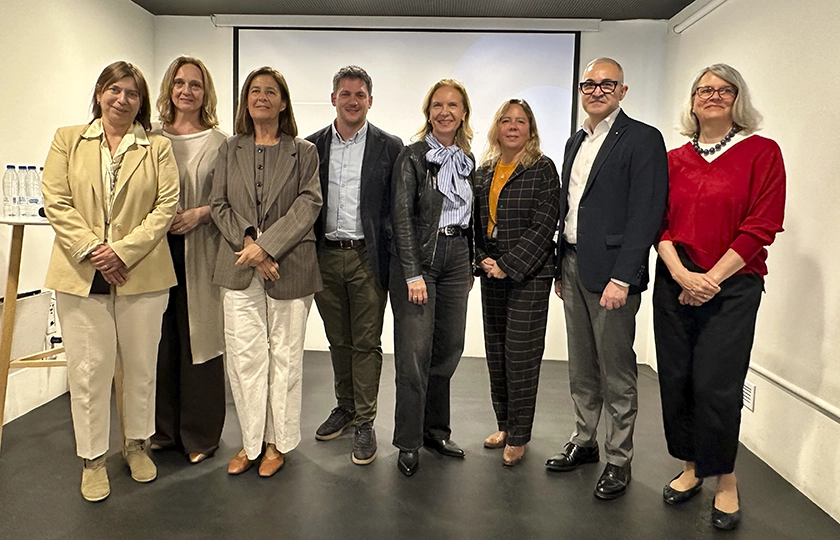
The Association of National Tourist Offices in Spain (ONETE) has organised a meeting with the press and tourism communicators, during which they exchanged views on experiences, challenges and ways of collaborating in line with current needs.
The National Tourist Offices in Spain (ONETE) are resuming their public activities as an association with a meeting aimed at gaining a better understanding of the current media landscape and other tourism communicators. The organisation, currently comprising Germany, Andorra, the Czech Republic, Great Britain, Norway, Poland and Switzerland, presented itself as an entity open to direct dialogue and willing to collaborate.
Following the presentation by ONETE’s president, Eugenia Fierros, who stated that “collaboration with the media is an essential part of tourism communication for tourist offices”, there was a talk by Javier Zori del Amo, a journalist and communications consultant with extensive experience in the sector and former editor of National Geographic Traveller magazine. During his talk, Zori offered an overview of the evolution of the media and tourism ecosystem, addressing both new trends among travellers and the challenges faced by specialist media outlets.
In his presentation, he highlighted how travellers have changed over time, adapting to technological shifts whilst increasingly organising their trips independently. This paradigm shift has led destinations and communicators to develop valuable content and forge a more direct connection with audiences.
Zori also focused on the transformation of the media, marked by digitalisation, audience fragmentation and growing competition for attention. In this context, he emphasised the importance of building more fluid relationships between tourism boards and journalists, based on mutual benefit and an understanding of each other’s internal workings.
The talk also addressed opportunities in the relationship between destinations and the media. It highlighted the need to move beyond one-way communication models and towards a more strategic collaboration, where both parties work together to generate relevant content aligned with the interests of today’s traveller.
The event was regarded by attendees as an enriching opportunity to share concerns, compare perspectives and rethink standard practices. Both the organising bodies and the professionals present agreed on the importance of such initiatives for strengthening the tourism ecosystem and adapting to a constantly changing environment.
The press calls for more personalised communication
As part of this event, the results of a survey of 50 professionals directly involved in tourism and travel (journalists and tourism communicators) were also analysed, with the aim of better understanding their needs, preferences and expectations in their dealings with tourist offices.
A clear snapshot of tourism communication
The sample consisted mainly of specialised profiles: 28% were from travel media, 25% were freelance journalists, 22% were from the tourism sector media, 16% were from travel sections in general-interest media, and 9% were content creators.
One of the most significant findings of this survey is the preference and frequency of contact with tourist offices. The majority of respondents (59%) prefer to receive information on an ad hoc basis, depending on its relevance, compared to 31% who opt for a weekly frequency and only 9% who prefer monthly communications. This data reflects a shift in relationship dynamics: journalists prioritise the quality, timeliness and relevance of content over regularity.
As for the preferred formats for receiving information, the results show a clear preference for personalisation. Personalised emails rank as the most highly rated channel, with an average score of 3.3/5 and 84% of ratings in the highest categories. Close behind are well-crafted press releases, also scoring 84% in the top two. However, it is striking that a very high percentage of respondents (81%) state they prefer to seek out information themselves, indicating growing autonomy among professionals and the need for content to be easily accessible and well-structured.
In contrast, social media emerges as the least highly rated channel, with an average of 2.5/5, suggesting that, whilst they may be useful as a supplement, they do not constitute a primary source of information for tourism journalists and communicators.
Regarding the most useful types of information, the ranking is clear. Itinerary suggestions top the list with an average rating of 4.2/5, closely followed by inspirational stories and local contacts or experts, both with an average of 4.1/5. Practical information remains at an intermediate level (3.9/5), whilst statistical data is clearly lagging behind, with an average of 2.9/5. These results show a clear preference for content that combines practicality with narrative appeal, capable of becoming engaging stories for the end audience.
As for the most highly rated initiatives in relation to Tourist Offices, press trips and face-to-face meetings share the top spot, with an average rating of 4.4/5 and 88% of high ratings. These are followed by in-person events, with an average of 4.2/5. At the opposite end of the spectrum, online events and webinars receive a very low rating (2.4/5) and barely 10% positive ratings, reflecting a clear rejection of the virtual format as a substitute for direct contact.
This preference for in-person interaction is reinforced when analysing sources of inspiration. Press trips are established as the main source of inspiration, with an average of 4.5/5, well above the rest. Next come presentations and events (4.0/5) and official websites (3.7/5). Once again, social media comes last, with an average of 3.0/5.
As for topics of interest looking ahead to 2026, exclusive destination experiences clearly stand out, mentioned by 84% of respondents, along with content related to lifestyle, gastronomy and charming accommodation, at 78%. Cultural events and new trends also generate interest. In contrast, sustainability (38%) and accessibility (31%) attract more moderate levels of interest, which could indicate a certain saturation in the discourse surrounding these topics.
Finally, the open-ended responses from professionals provide a particularly valuable level of depth. Journalists are calling for greater direct and personalised contact with tourist offices, avoiding, as far as possible, the involvement of agencies. They also call for quicker responses, easier access to image banks and better integration into destination databases.
Furthermore, several participants point out that, at present, they mainly receive generic newsletters that do not meet their specific needs, and they miss more concrete proposals for collaboration, tailored to their editorial lines.
New models and challenges for ONETE
Both the meeting held in Madrid and the survey results highlight the need to evolve towards a more personalised and value-oriented relationship model. In an environment where attention is a scarce resource and competition for the narrative is increasing, collaboration between Tourist Offices and communicators is proving to be a key element in building more relevant and inspiring narratives for travellers.
Through initiatives of this kind, ONETE is a key player in this process, fostering dialogue, active listening and continuous improvement in tourism communication.
Source: ASSOCIATION OF NATIONAL TOURISM OFFICES OF SPAIN (ONETE)