Quebec’s cultural richness is evident and invites us to immerse ourselves in it. Here, creativity has its harmonious space in a captivating heritage context, while our spirit travels from museums to exhibitions, from evocative to avant-garde venues and from art galleries to workshops in a welcoming and serene atmosphere.
“Where the river narrows” or “Kebec” in the Iroquois language spoken by the indigenous Huron people, meaning the narrow stretch of what is now called the St. Lawrence River, Quebec City was founded in 1608.
Undoubtedly, it is a purely French-speaking city, and thanks to its indigenous, French and British past, Québec culture is reinvented and expressed through its art and history. Falling in love with Quebec is easy and an almost immediate feeling, as the warmth of the old world combines perfectly with a cosmopolitan way of life. Walking through the cobblestone streets feeling the old-world romanticism and European ambience of Quebec City is the first experience to be enjoyed upon arrival, but after that many more await.
Four hundred years of history and culture literally fill the walls of Old Quebec, the UNESCO World Heritage Site and cradle of French civilisation in North America, a little taste of Europe with all the architecture, cuisine and charm that goes with it. In just a few hours’ walk, it is possible to visit the site of the wars that changed the world, enjoy an authentic Canadian meal along the cobblestone streets or the St. Lawrence River, and seek out the works of generations of local artists. Every corner, staircase, entrance and alleyway hides some unique feature or attraction that you might not be able to see except on your own two feet.
Outside the city walls, under the protective gaze of the cannons that once defended the city, stands the iconic Parliament building. Completed in 1886, it is inspired by the Louvre Palace in Paris and is a masterful exercise in art and architecture. The floor of the Parliament is decorated with twenty-six bronze statues commemorating the main figures of the province’s history.
From Parliament you can easily walk to the Plaines d’Abraham. It was here, in 1759, that French and British troops clashed for control of the city. It’s like Quebec’s Central Park and every day it’s filled with Quebecers on their bikes, strolling, picnicking, cross-country skiing or snowshoeing in winter. This green lung is also the setting for Quebec Summer Festival, a huge musical event that takes place every summer and attracts bands such as The Rolling Stones, Foo Fighters and Lady Gaga, to name but a few.
The Musée National des Beaux-Arts is the city’s fine arts museum with a collection of thirty-eight thousand works from the last four centuries, as well as a special interest in local artists and their work.
The intramural universe
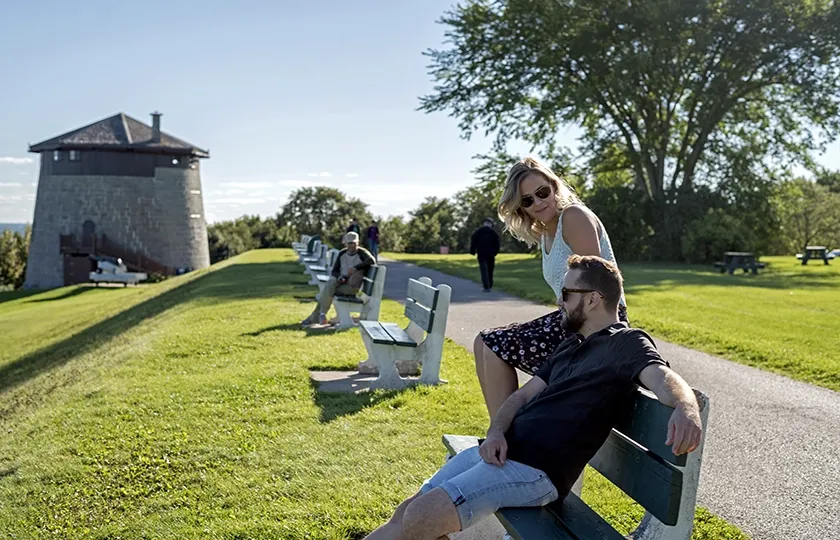
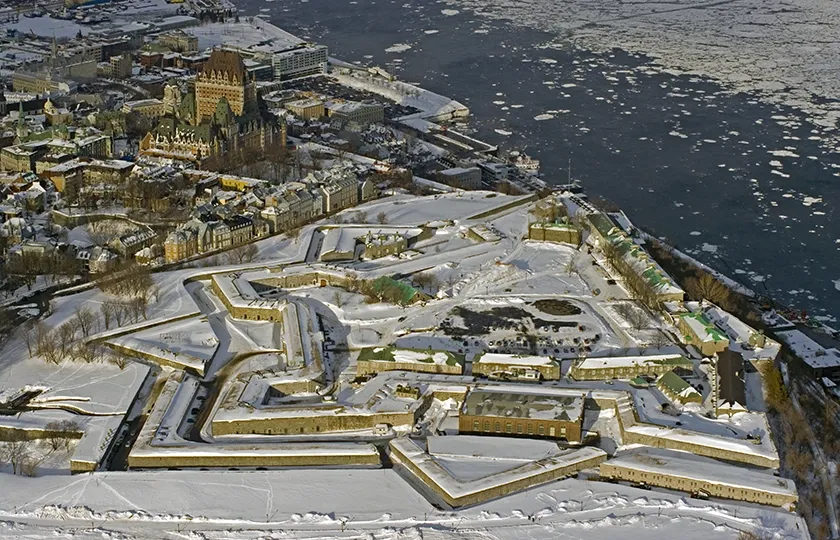
The fortified enclosure that surrounds Old Quebec, more than four kilometres long, makes the city the only walled city in North America. They are part of a defence system created between 1608 when Samuel de Champlain founded the town, in 1871 by the French, then by the British and eventually by the Canadians. They are ideal for a leisurely stroll, while enjoying excellent panoramic views of the old town on one side and the San Lorenzo river on the other.
Inside the walled enclosure is a picture postcard image for history buffs. At the top of Cap Diamant stands a star-shaped fortress built in 1812. It is now the home of the 22nd Royal Regiment, the only French-speaking infantry regiment in the Canadian Forces, whose Changing of the Guard ceremony is an emotional and visual spectacle.
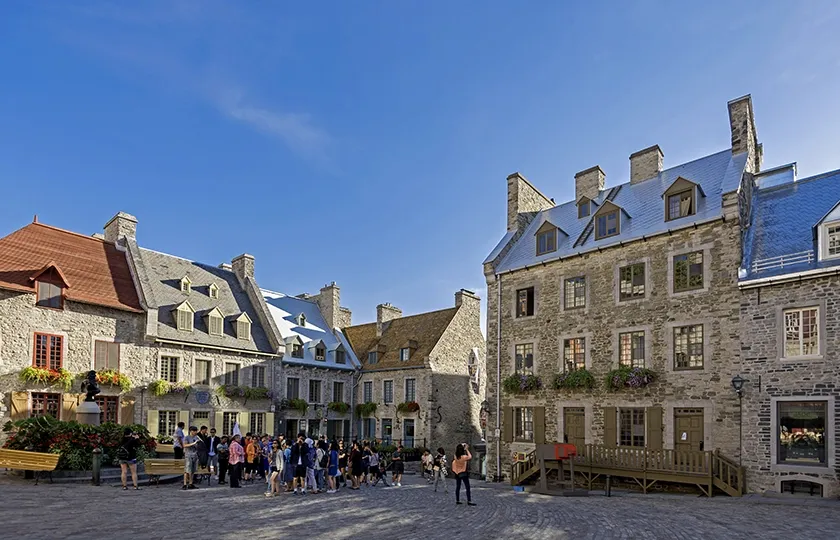
From Dufferin Terrace, a funicular railway runs along an old vertical railway to the Petit Champlain district, one of the oldest neighbourhoods in North America. Its narrow cobbled streets, lined with old stone houses, are home to many boutiques and souvenir shops, as well as a number of French-style restaurants and bistros. A stroll through this neighbourhood should end with a taste of one of the exquisite local desserts, La Petite Cabane à Sucre.
Within walking distance is the Place Royale, a small urban space with a lot of history, where Samuel de Champlain founded the city. A glimpse into the past featuring the oldest stone church in North America and a huge mural depicting four hundred years of Quebec’s history.
In the east of the city lies the Old Port as one of the best views of the St. Lawrence River. In the winter it is fun to listen to the ice breaking up as it floats on the water, but on summer evenings you can enjoy the light shows of the Aurora Borealis projected on the harbour’s grain silos. For gourmets, it is highly recommended to buy some of the fresh local produce, cheeses and other foods at the Marché public de Québec or opt for a tasty snack at one of the many nearby restaurants.
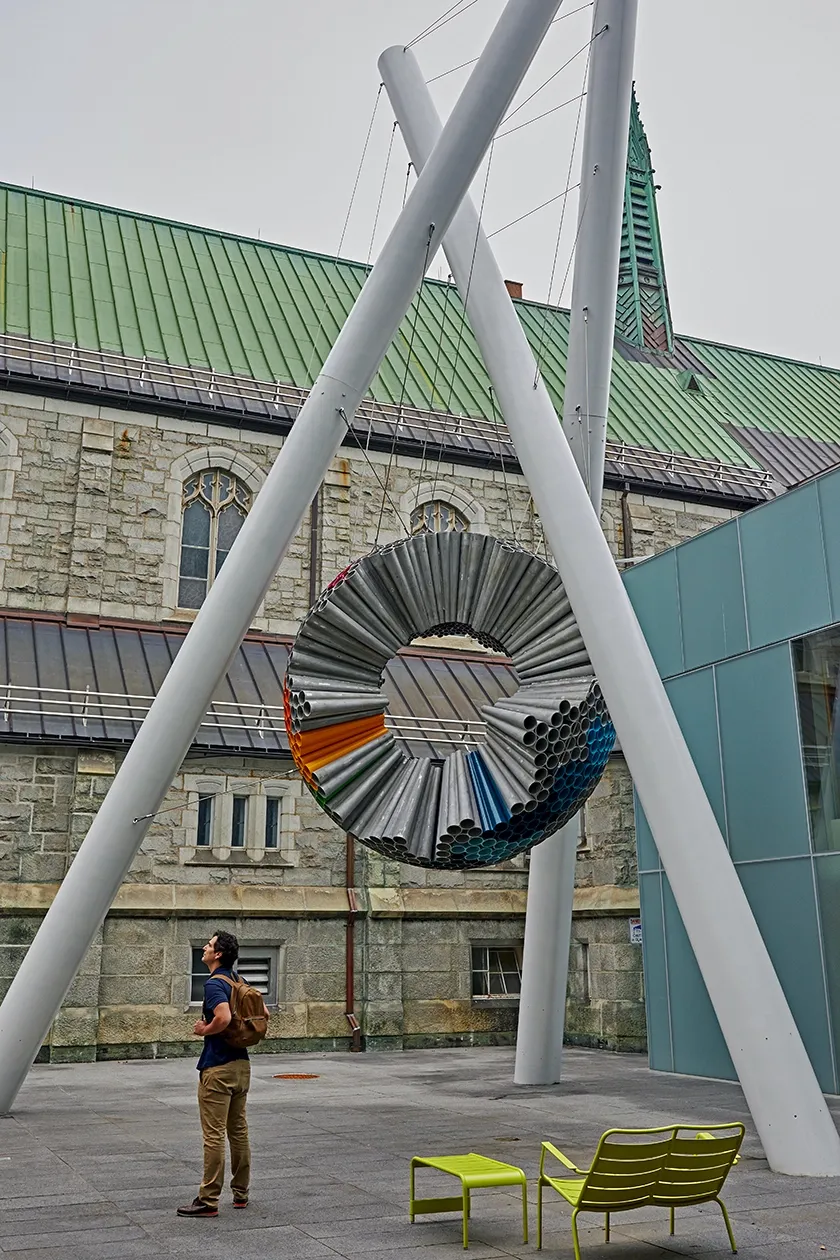
Returning west of the historic centre and following the Rue Saint-Jean which leads to a district popular for cultural events, mainly in the summer, we can stop and skate at the Place d’Youville before arriving at the Cathedral-Basilica of Notre-Dame de Québec. This World Heritage site is a magnificent work of architecture built in 1647 and the finest neoclassical example in Quebec, bearing some resemblance to the church of Sainte-Geneviève in Paris. Its interior was richly decorated with impressive works of art: the baldachin, the episcopal throne dais, the stained glass windows, the paintings and the choir lamp, a gift from Louis XIV, the Sun King.
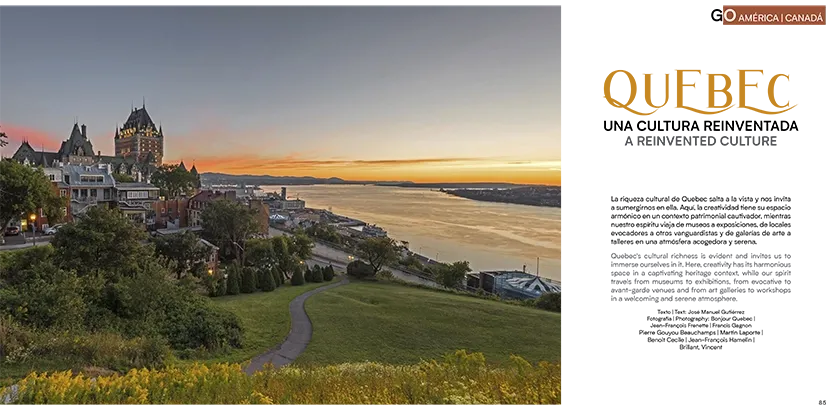
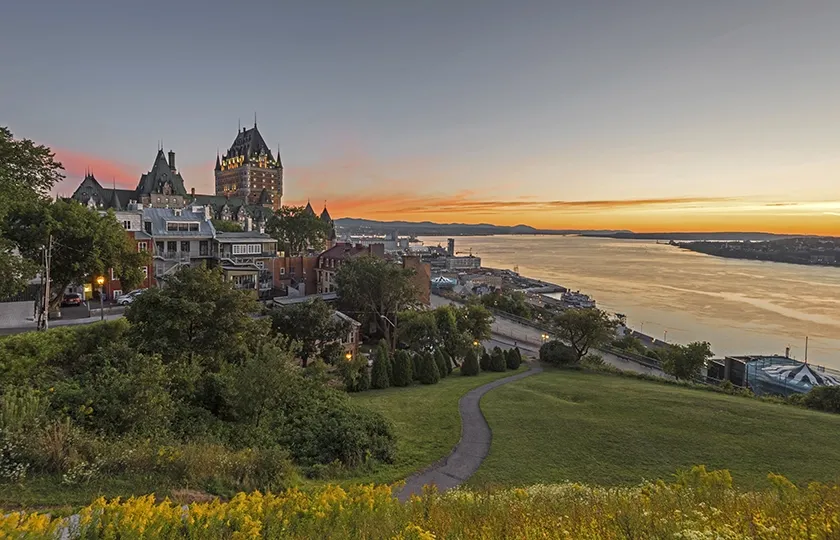
The Château Frontenac is home to the most photographed hotel in the world. Designed by the architect Bruce Price at the end of the 19th century, its rooms have been silent witnesses to historic moments such as the Quebec Conference where the top Allied leaders met to define the strategy to be followed in the Second World War. Il est possible de suivre une visite guidée dans les couloirs et les salles du château, afin de découvrir les secrets de ce bâtiment emblématique.
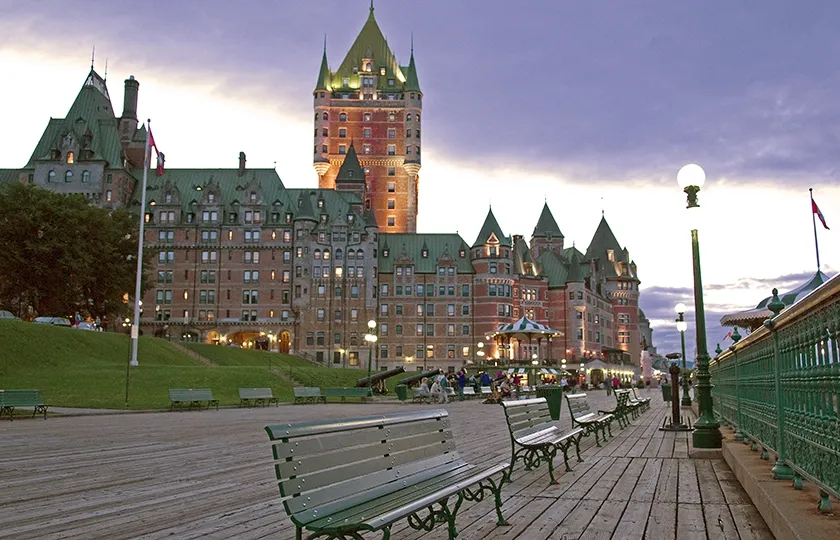
The Dufferin Terrace, inaugurated in 1838, stretches from the foot of the Citadel to the Château de Frontenac, providing breathtaking views of the Ile d’Orléans, the St. Lawrence River and the lower town. The four hundred and twenty-five metre long wooden promenade is a popular gathering place throughout the year where street performers enliven Quebec’s daily life. The Tobogan on the Dufferin terrace, built in 1884, nine years before the opening of the famous Château de Frontenac, is one of the most popular winter activities. Sliding down one of the three icy lanes at speeds of up to 70 km/h is an unforgettable source of adrenaline.
One of the most evocative streets in the historic centre is known as rue du Trésor, also known as the street of artists. It functions as an open-air art gallery and attracts a large number of artists who display their work on the walls lining the narrow street. With its European flair, this cobblestone street linking the Château de Frontenac and the Basilica-Cathedral of Notre-Dame de Québec is one of the best places in the city to buy a souvenir. During the French period, the colonists came to this street to pay their taxes into the royal treasury, hence the name du Trésor. In the 1960s a couple of artists decided to exhibit some of their paintings, which changed the atmosphere of the street forever.
At the top end of the rue du Trésor, across it is the rue Sainte-Anne, also an artistic centre in its own right. Here, numerous caricaturists and portraitists practice their trade in a picturesque setting.
The rue Saint Jean is another must-see. It’s a perfect combination of culture, religious heritage and good food in a totally eclectic atmosphere.
The Cathédrale de la Sainte Trinité is the first Anglican cathedral built outside the British Isles. Known for its excellent stained glass windows, religious objects and an exceptional chamber organ, it is also a concert venue.
Another must-see is the Morrin Center, which occupies the building that more than two hundred years ago was the first prison in Quebec City and later a medical school. Today it houses the Quebec Historical and Literary Society, as well as a beautiful Victorian library.
Established by the Augustinian Sisters in 1639, the Monastère des Augustines was the first hospital on the North American continent. Today, it is an award-winning health and wellness retreat with the interesting Augustine museum and heritage centre with over a thousand documents from the monastery’s collection and forty thousand objects.
A fascinating environment
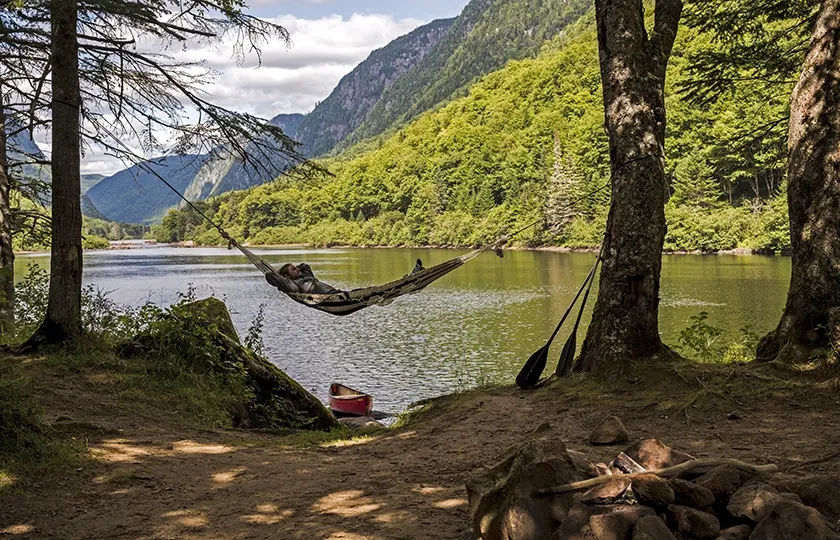
If Quebec is already captivating in its own right, its surprising surroundings are no less so. Fifteen minutes from the town centre, a thirty-metre waterfall cascades down into the Parc de la Chute-Montmorency with via ferrata and zip-line.
The Jacques-Cartier National Park is one of the most beautiful glacial valleys in Quebec, comprising a mountainous plateau intersected by deep valleys and rivers for canoeing, kayaking, hiking, snowshoeing, fishing or simply camping in the wilderness.
The Ile d’Orléans provides the opportunity to meet the region’s craftsmen and market gardeners and to taste the many local delicacies. It is a re-encounter with the rural Quebec of the last centuries through its villages, farms, churches and centuries-old houses.