

Bathed by the wild waters of the Atlantic, the Azores archipelago is a land of unusual beauty, a gift from Mother Nature that I don’t know if we deserve, but it is there for us to discover, admire and love.
The Andes have revealed a new wonder: Pallay Punchu, Peru’s newest Rainbow Mountain. Its name, “Punchu,” comes from the word “poncho,” as its features resemble this traditional Andean garment, now seemingly woven into the landscape itself. Rising to over 4,700 meters above sea level, Pallay astonishes with its geometric lines and vibrant colors.
The Azores are made up of nine islands: Flores, Corvo, Terceira, Graciosa, São Jorge, Pico, Faial, Santa Maria, and São Miguel — the latter being the largest of the archipelago and home to more than half of the population of this Portuguese autonomous region.
Probably discovered between 1427 and 1431, after Santa Maria, the first settlers of São Miguel arrived on the island in 1440 from the northern regions, Extremadura, Algarve, and Alentejo. They were later joined by Muslims, Jews, as well as French and English settlers, all drawn by the island’s fertile soils and a few safe bays. Over time, it became an important trading center.
Three cities share the status of capital of the Azores: Horta, Angra do Heroísmo, and Ponta Delgada, which, after the 1522 earthquake that almost completely destroyed the former capital Vila Franca do Campo, took on a key role and was granted city status in 1546.
Historic center of Ponta Delgada
A small fishing village in the past, Ponta Delgada gained city status in the 16th century, when King João III granted it such distinction. It was during the 19th century that the city experienced its golden age, thanks to the export of citrus fruits to the United Kingdom and the settlement of foreign merchants, among them several Jewish families.
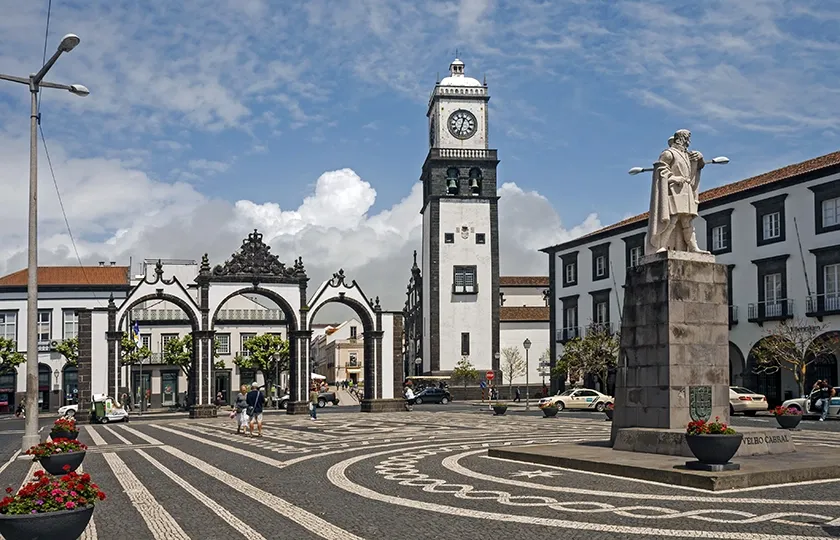
In the heart of the city — a venue for festive and sporting events such as Christmas celebrations and the Azores Airlines Rally — Gonçalo Velho Cabral Square hosts Ponta Delgada’s most iconic monument, the Portas da Cidade (City Gates). Clearly inspired by Baroque art, they were built in 1783 next to the old pier, and later, in 1952, were moved to their current location following the construction of the main avenue, known as Avenida Infante Dom Henrique or Avenida Marginal.
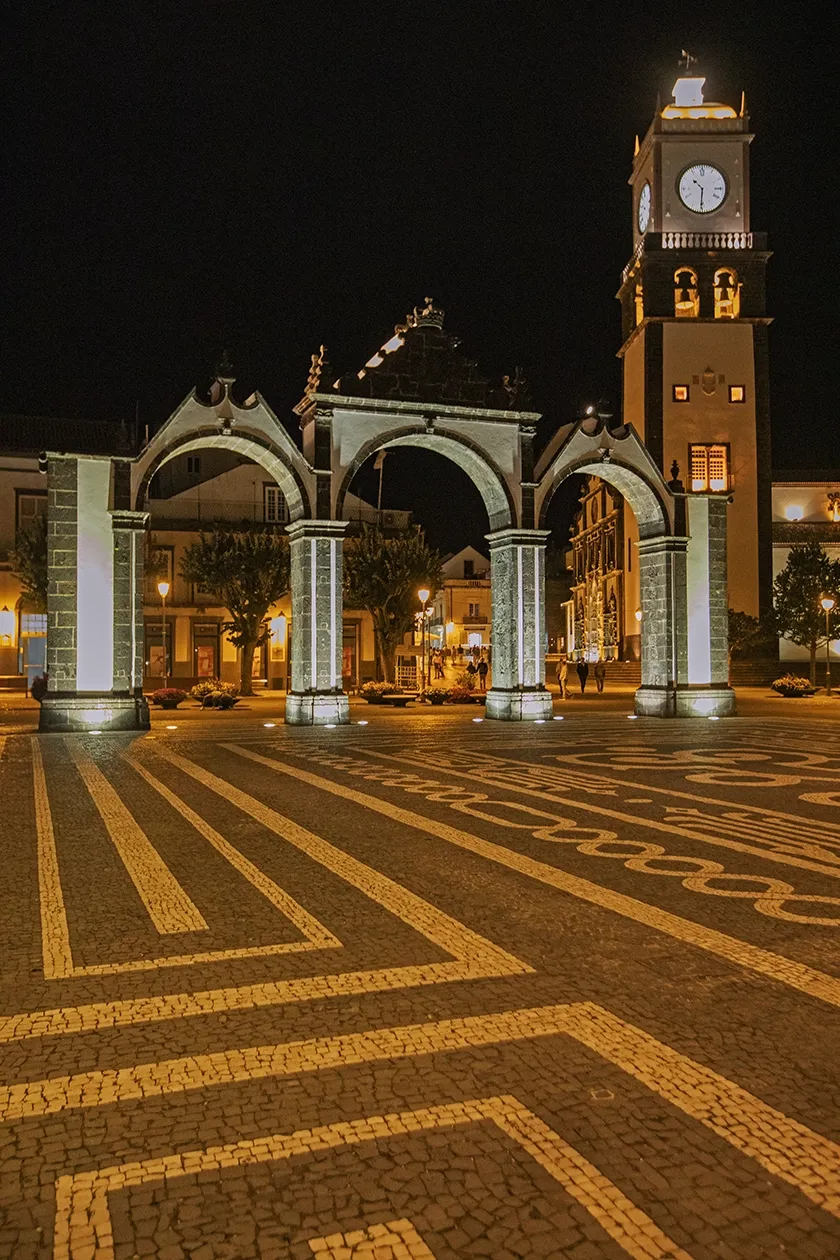
From here, narrow cobbled streets lined with whitewashed houses lead us to churches, convents, museums, Jesuit colleges, fortresses, theaters, markets, and terraces where one can truly soak in the authentic Azorean atmosphere.
Very close to the Portas da Cidade, in Largo da Matriz, stands the Igreja Matriz de São Sebastião, the city’s main church. Built in the 15th century on the same site where a small chapel once stood under the patronage of the same saint, its architecture reflects its Gothic origins, Manueline influences, and Baroque ornamentation. Next to it, the Torre Sineira, built in the 18th century, rises nearly thirty meters high and offers a wonderful panoramic view of the city.
Among Ponta Delgada’s notable religious buildings are also the Church of São Pedro, considered one of the most beautiful in the Azores — where each July 29 the medieval parade known as the Cavalhadas concludes — and the Mãe de Deus Chapel, whose privileged position atop Ladeira da Mãe de Deus Hill provides unforgettable views of the city. The experience at this temple is completed by the adjacent Mirante Garden.
Museos de la ciudad
Museums also play a prominent role in Ponta Delgada, with the Carlos Machado Museum standing out as one of the most prestigious in the archipelago, its origins dating back to 1880. What began as a collection of zoology, botany, and mineralogy was later expanded to include ethnographic and regional art pieces. From 1930 onward, when the museum moved into the 17th-century Convent of Santo André, the collection grew to feature jewelry, traditional art, tiles, porcelain, and paintings.
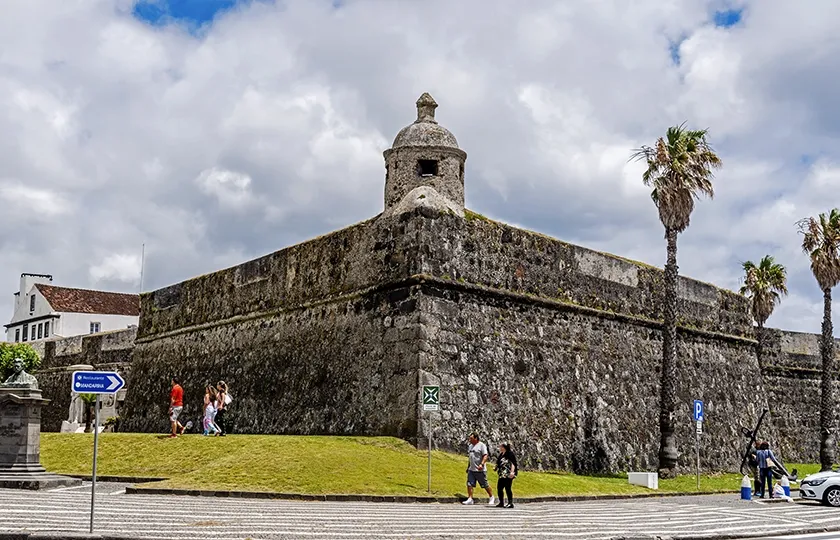
Meanwhile, the Azores Military Museum offers an overview of the region’s military history through a collection of antique weapons and other artifacts. It is housed in the Fort of São Brás, a defensive structure built in the 16th century to protect against corsair and pirate attacks — the only remaining fortification still standing in the city.
Gardens, a pineapple plantation, a grotto and the most appealing beaches
José do Canto, one of the wealthiest men on the island, created one of São Miguel’s natural treasures — a botanical garden considered an oasis of diversity, home to more than three thousand species of exotic plants, many of them centuries old. Sharing this lush space are the Palácio de Santana, a majestic 17th-century neoclassical residence, and the Chapel of Santa Ana, a small sanctuary from the same century.
Another of Ponta Delgada’s most significant gardens — and one of the most remarkable on the entire island — is the Jardim António Borges. This 19th-century private estate was acquired by the City Council in 1957 to create a municipal park. In addition to its extensive collection of plants and trees — among them the Ficus macrophylla or Moreton Bay fig, a colossal tree with aerial roots — the garden is the ideal place for a stroll, to enjoy a delicious coffee at the café, read a good book by the small ponds, or wander along the paths that lead to artificial tunnels and small caves built from red lava rock.
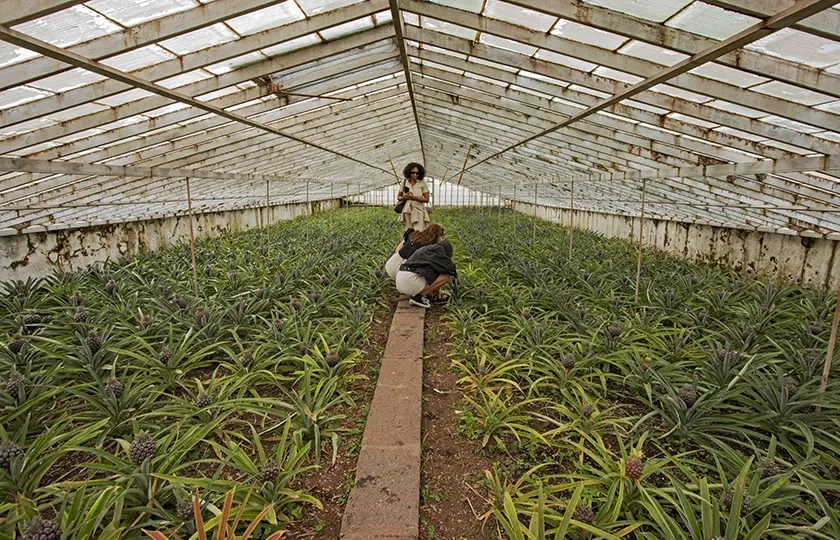
A fascinating and must-see attraction on the island is the Augusto Arruda Pineapple Plantation, where a unique variety of pineapples is grown using a cultivation method found nowhere else in the world — passed down from generation to generation. The Azorean pineapple, sweeter than those typically found in Spain or the rest of Europe, is originally from Central and South America and was introduced to the island in the mid-19th century. No visit to the plantation is complete without stopping by the gift shop for a souvenir and tasting its delicious fresh juice.
Very close to Ponta Delgada lies the Gruta do Carvão, an ancient lava tube that has become one of the most fascinating natural attractions near the city. Stretching for almost two kilometers and divided into four sections — Paim, Secadores de Tabaco, João do Rego, and José Bensaúde — only the first is open to the public. It stands out as another of São Miguel’s remarkable natural wonders.
If, after exploring Ponta Delgada and its surroundings, you feel the need for a moment of peace, you’ll find it at some of the beaches near the city. Just a ten-minute walk along the seafront, Milícias Beach and Pópulo Beach sit side by side, serving as a refuge for both tourists and locals. Their dark volcanic sand, contrasting beautifully with the lush green scenery, creates a stunning natural setting. Both beaches offer parking, nearby restaurants, and lifeguard services, with Milícias Beach being the favorite spot for those eager to ride the waves on their surfboards.
Dolphin and whale watching
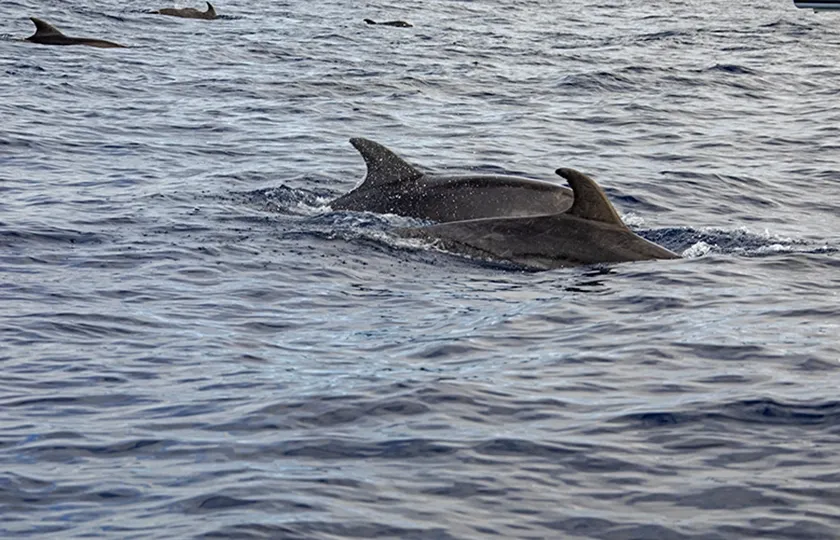
Facing the sea, we head toward the Ponta Delgada Marina, the city’s port area and the most popular spot thanks to its wide range of restaurants and leisure options. It is here that visitors can book activities that take them out into the Atlantic Ocean to swim with dolphins or spot whales. From this point, boats also depart for excursions along the southern coast of São Miguel, offering another way to experience the island’s natural beauty from the water.
Lugar elegido por los turistas para degustar la gastronomía local, destacando los pescados y mariscos, al caer la noche la zona se transforma y el ambiente se anima, y tanto locales como visitantes se acercan aquí para dar por finalizado el día.
What you shouldn't miss on the island
We leave the city behind to discover corners of the island that are true natural gems. São Miguel’s nickname, “the Green Island,” comes from its vast meadows and the large forests that blanket valleys and remote areas. Native and endemic species such as heather, faya, laurel, and holly create a palette of rich green tones stretching across the horizon — the perfect habitat for a very special bird, the Azores bullfinch (priôlo).
Another of the island’s signature landscapes are its large lagoons, formed within ancient volcanic craters and impressive in their size and beauty. The most famous are those of Sete Cidades, among which we find Fogo, Santiago, Rasa, Canário, Éguas, Empadadas, Congro, and São Brás, as well as the iconic Green and Blue Lagoons, which offer a breathtaking view from the Vista do Rei viewpoint — making it an unmissable stop for anyone visiting the Azores.
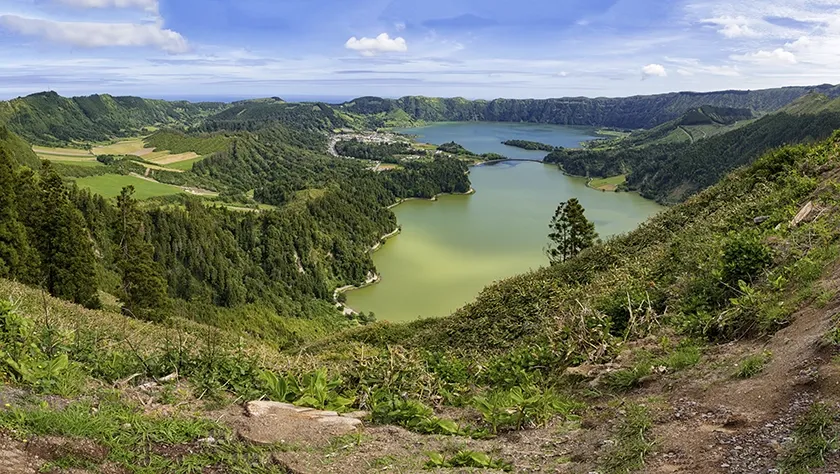
A different perspective of these lagoons can be enjoyed from the small village of Sete Cidades, where, in addition to admiring the unforgettable scenery, visitors can take part in various outdoor activities such as hiking, electric bike routes, or kayak excursions across the lagoons. For those seeking something more cultural, the Church of São Nicolau is worth a visit — a neo-Gothic temple built in the 19th century, reached by walking along a charming path lined with cryptomerias, a tree species native to Japan.
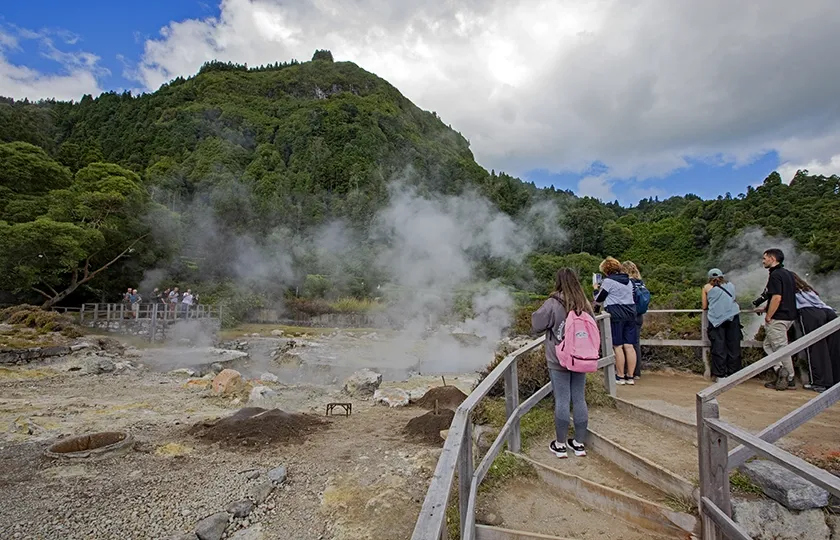
Another famous lagoon is Furnas Lake, notable for its size and the lush vegetation surrounding it, which has earned it the nickname Vale Formoso (“Beautiful Valley”). One of its main attractions is the presence of fumaroles and hot springs, especially the well-known Caldeiras das Furnas, where visitors can see and smell the steam and sulfuric gas emissions. Along a nearby trail, it’s also possible to witness how locals use the geothermal heat from the caldeiras to prepare the island’s iconic dish, the “Cozido das Furnas.”
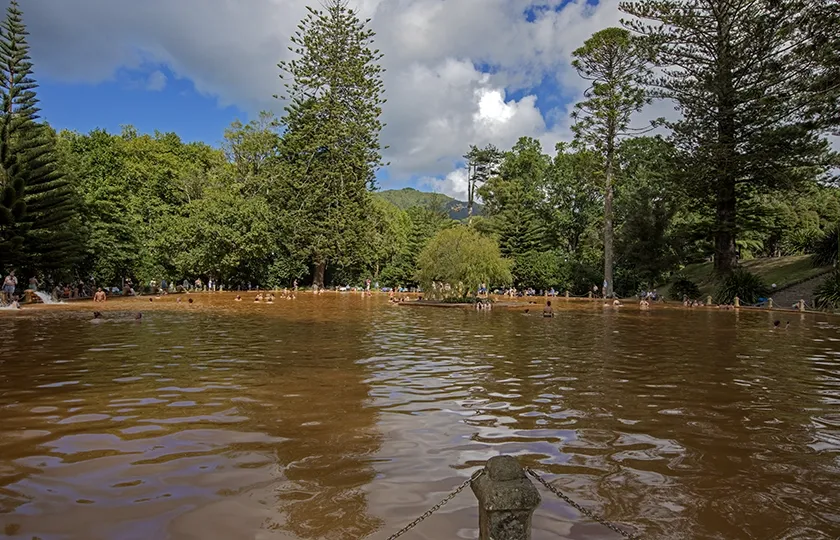
No visit to the area would be complete without exploring the village of Furnas and, in particular, the Terra Nostra Park Botanical Garden, considered one of the most beautiful in Europe and the world, boasting a remarkable diversity of plant species. After wandering through the gardens at a leisurely pace and admiring their beauty, visitors can head to the thermal pool, whose waters are renowned for their therapeutic and medicinal properties. The pool’s distinctive brown color, caused by a high concentration of iron, along with its temperature ranging from 38 to 40 degrees Celsius, make it the perfect place to relax — and why not, rejuvenate.
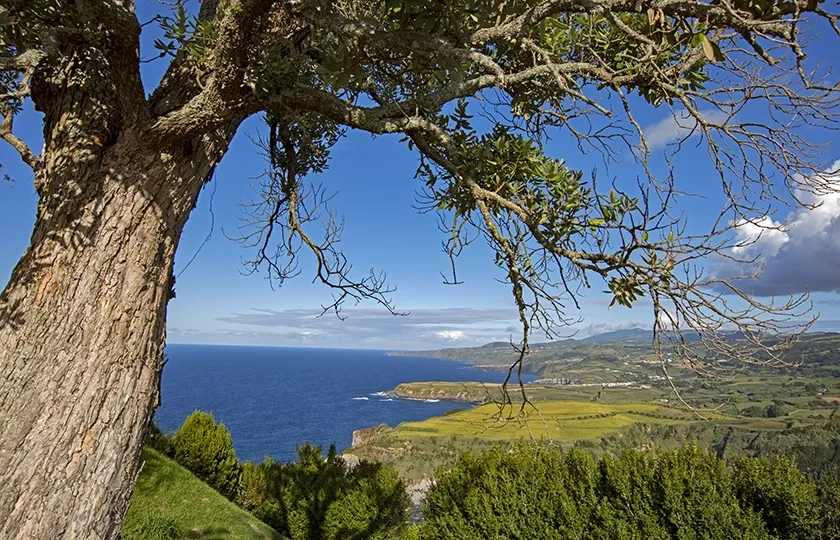
The coast is well worth a leisurely visit.
Cliffs adorned with lush green forests, basalt rocks jutting into the sea like blades, gentle coves, and tongues of land extending into the ocean, known locally as fajãs, along with stunning volcanic sand beaches — this is how the coast of São Miguel reveals itself to our eyes.
Traveling along roads that, in the summer months, are dressed in the colorful blooms of hydrangeas, visitors reach the island’s countless viewpoints, such as Santa Iria in Ribeira Grande, one of the most iconic on the island. It’s a must-stop where time seems to stand still while admiring the striking contrast between the deep green of the cliffs and mountains and the intense blue of the Atlantic. Another essential viewpoint is Miradouro da Lomba do Cavaleiro, offering a panoramic view of the picturesque town of Povoação, and Ponta do Escalvado, from where one can see the islets of Vila Franca do Campo and Mosteiros.
One of São Miguel’s natural wonders is its hot natural pools. In Caloura, a small fishing village, the natural pools are considered among the most iconic on the island. Located in the fishing harbor, one of the oldest on the island, they offer excellent facilities such as accessible entrances for people with reduced mobility, free parking, restrooms, showers, and a restaurant — considered by many the best place to taste the region’s fresh fish.
Other remarkable natural pools on the island include Caldeira Velha, simply spectacular; Poça da Beija, with its crystal-clear waters and toning muds; and the Caldeiras of Ribeira Grande, surrounded by trees and steaming fields.
This is just a small glimpse of what São Miguel Island has to offer visitors. The archipelago’s natural, cultural, heritage, and gastronomic treasures could fill many more reports. Therefore, it is essential to return calmly and leisurely to fully appreciate all its endless details. And we will be here to tell you all about it.