

The Soteno family is one of the most prominent pottery families in Mexico, with a tradition of craftsmanship spanning five generations.
The programme of Christmas activities includes guided tours, pastorelas (traditional Christmas plays) and folk art workshops.
Belenes de México will be open to the public free of charge from 28 November to 11 January 2026.
The Casa de México Foundation in Spain, in its mission to promote Mexican folk art and traditions, presents the Christmas exhibition Belenes de México (Nativity Scenes of Mexico), an artistic installation that seeks to spread Mexican traditions and folk art. On this occasion, it highlights important dates such as Christmas and the custom shared by Spaniards and Mexicans of setting up nativity scenes, known as belenes in Mexico.
This edition pays tribute to the Soteno family, a lineage of master craftsmen from Metepec. The exhibition will be on display from 28 November 2025 to 11 January 2026.
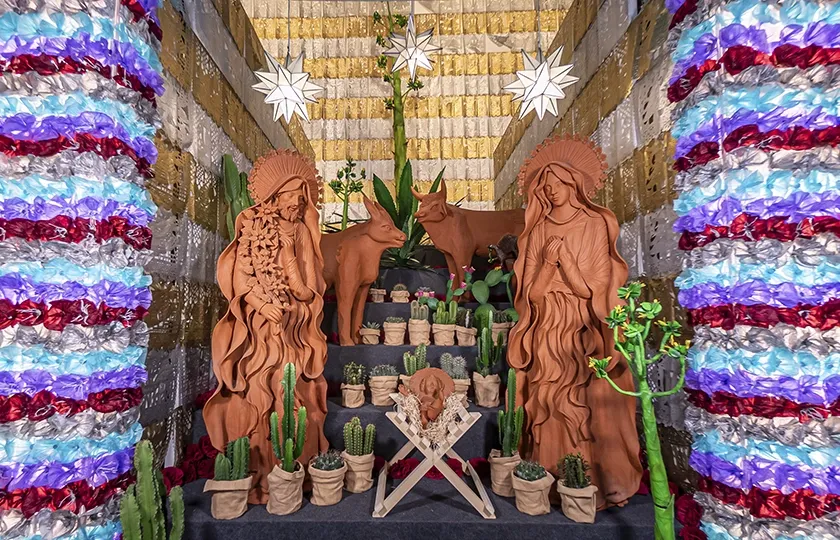
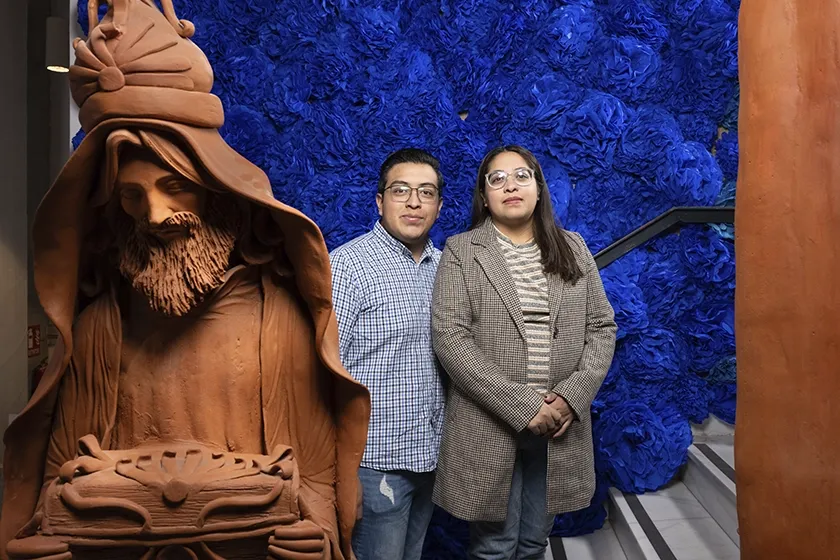
The main nativity scene, created by Alfonso Soteno Fernández, consists of nine red clay figures measuring over 170 cm in height, representing the traditional scene of the birth of Christ: the Holy Family, the three wise men and the animals that accompany them.
Conceptualised by Cristina Faesler, designer, storyteller and writer, this project includes around thirty nativity scenes made using various folk art techniques such as glazed clay, woven palm, modelled clay, polychrome wood and cardboard, among others. It is complemented by a Christmas tree over 4 metres tall decorated with cacti and succulents. The blue-toned atmosphere, simulating night-time, is achieved with over 25,000 paper flowers decorating the entrance.
The Soteno family is one of the most prominent families in Mexican pottery, considered great masters of Mexican folk art, the highest distinction in the field of crafts. Originally from Metepec, State of Mexico, they are known mainly for their mastery in the creation of trees of life, tree-shaped figures that traditionally tell biblical stories.
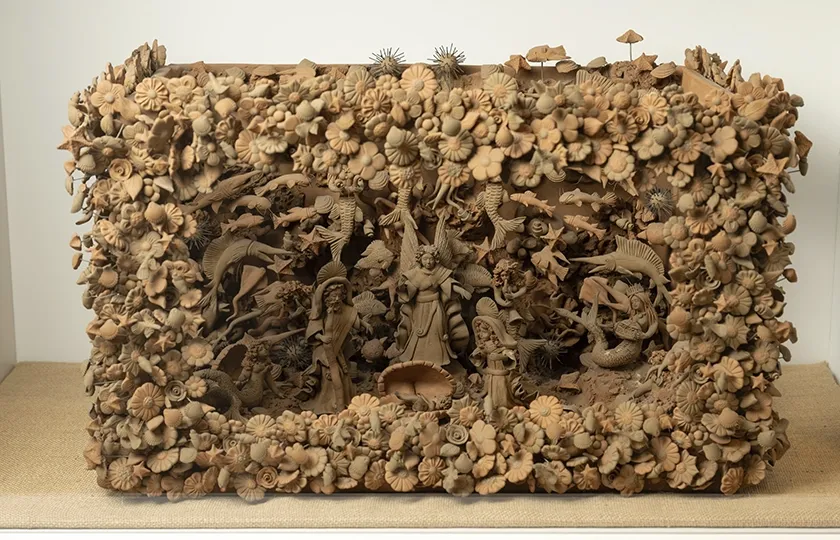
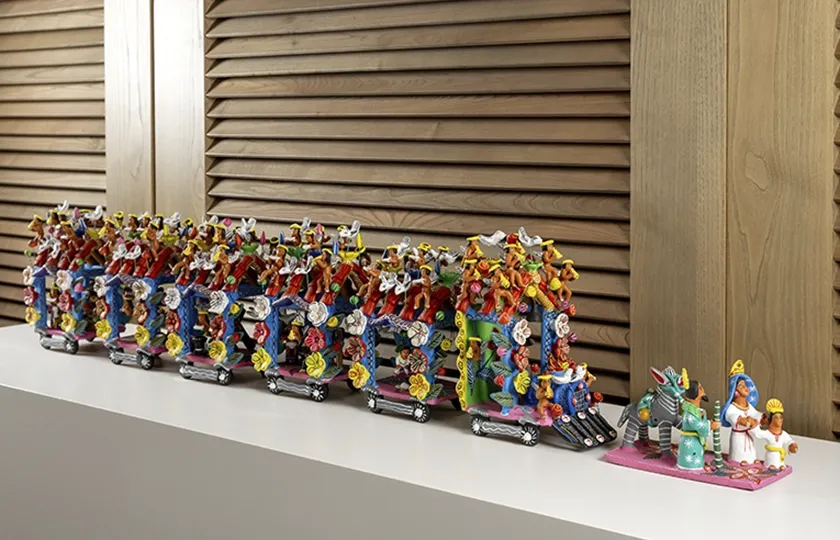
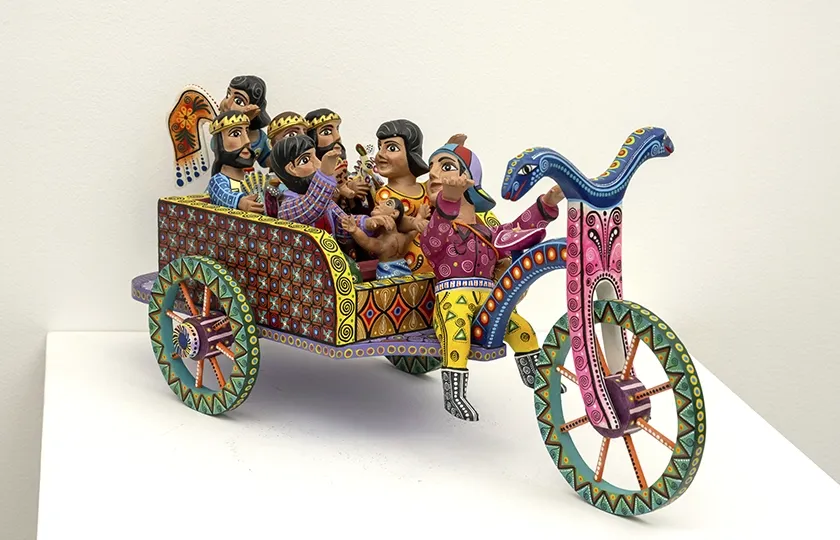
Clay is the most commonly used material for making nativity scenes, which reflect the variety and mastery of the various techniques developed by Mexican potters. Generally, moulds that have been preserved for generations are used, most of which correspond to conventional figures, but also, inspired by the desire to identify the figures in the nativity scenes with Mexican culture, the characters are decorated with indigenous clothing or motifs.
Folk art is an art form in constant change, but it is also a mirror of our history. The craft is learned within the family, passed down from generation to generation. Artisan families honour the communal values of teaching, sharing and contributing.
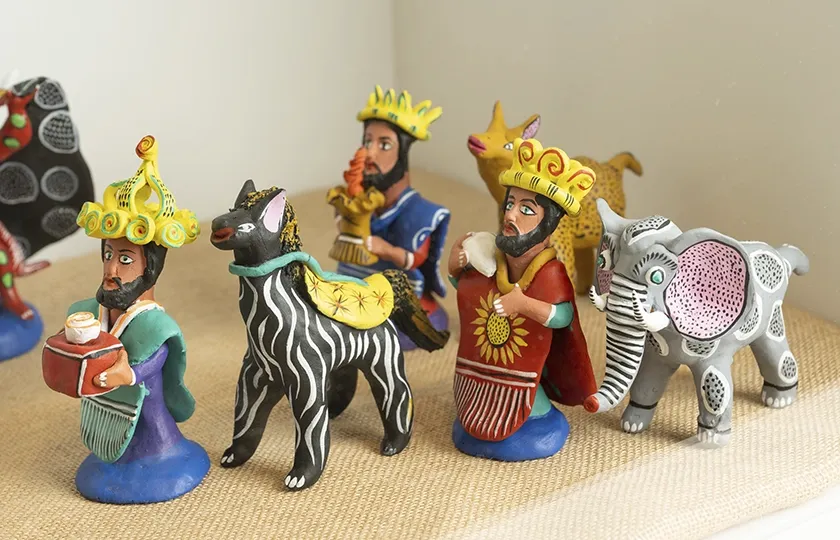
The work of artisans is necessarily linked to the place where it is produced. Thus, artists draw inspiration from their surroundings, allowing the landscape and context to influence their work. That is why every piece of folk art is unique, varying in production depending on the territory in which it is produced, as this determines the techniques, style and materials used.
The vast Mexican territory is home to abundant and highly diverse types of fauna and flora that provide artisans with high-quality raw materials. In this way, it is possible to identify different branches of craftsmanship according to the raw material used: clay, wood, stone, textiles, metals, paper, leather or plant fibres, among others.
The Fundación Casa de México programme of activities includes free guided tours, folk art workshops: creation of trees of life and piñatas, children’s shows, posadas, theatrical performances of pastorelas, classical music concerts, distillate tastings and many other activities that the public can enjoy from 28th November onwards.
In depth
Modesta Fernández Mata was one of the pioneers in creating, initially, simple clay pieces with a central stick decorated with figures of Eve, Adam, the serpent, and small balls representing apples. Over the years, her sons, Mónico and especially Alfonso, continued and perfected the family tradition with more elaborate and complex forms that are now known worldwide. In addition, the brothers expanded the themes to include nativity scenes and other motifs from Mexican cultural traditions such as the Day of the Dead. Today, the Soteno family, with at least four generations of artisans, preserves its legacy while updating and evolving its creative process.
The Soteno family is known for its use of yellow and red clay, found in deposits near Santa María Magdalena Ocotitlán. The clay is mixed and placed in the sun, and over several days, pieces of the mixture are broken off and the material is stirred. When ready, the material is placed in a dry, well-ventilated area and then, as needed, quantities are ground into powder using a mortar. Water and plumilla (tule flower) are added to the mixture to soften and whiten it. This process takes a considerable amount of time, as the final quality of the pieces depends on it. The formed pieces are left to dry in a closed area inside the workshop and then placed in the sun to dry completely. They are rotated frequently to ensure that they dry evenly and to prevent the clay from cracking. Although most artisans use moulds to create the flowers and foliage of the ‘trees of life’, members of the Soteno family model all the pieces by hand and make very little use of wire to create structures.
José Alfonso Soteno Fernández
With over 70 years of experience in the craft of polychrome pottery, he continues his work and is considered one of the best in the country for his creations.
Originally from Metepec, State of Mexico, he is part of the legendary Soteno family, internationally famous for positioning Metepec as one of the most important places in Mexico for pottery and for their work on pieces known as ‘trees of life’.
Master Soteno, who began his work as a potter at the age of 8, is the creator of monumental ‘trees of life’ that require perfect mastery of technique and involve great complexity. His works are exhibited in cultural venues such as the National Museum of Popular Cultures, the Museum of Popular Art and the Casa de las Américas in Havana, Cuba.
He has received more than 120 awards and recognitions both nationally and internationally, including the 2011 National Ceramics Award, the 2003 State of Mexico Award, and the FONART Grand Prize for Popular Art (which he has received three times).
Daniela Soteno
A fifth-generation artisan from the Soteno family, she continues the pottery tradition started by her great-grandmother, Doña Modesta Fernández Mata. From childhood, she learned the techniques of clay modelling and painting from her grandfather Alfonso Soteno and her father Óscar Soteno. She has won the Special ‘Women Artisans’ Award (2018), first place in the National Tree of Life Competition (2022) and the Grand Prize for Popular Art (2023). She participated in the book ‘Great Masters of Mexican Popular Art. 20 Years Later’ (Fomento Cultural Citibanamex, 2019) and in Design Week Mexico (2022). Her work stands out for integrating artistic innovation with traditional polychrome clay techniques from Metepec.
Óscar Daniel Soteno Díaz
A craftsman from Metepec, State of Mexico, he represents the fifth generation of the Soteno family, renowned for their work in polychrome clay and the creation of traditional Trees of Life. His work combines family heritage with a contemporary vision of folk art. He has received several awards, including First Place in the National Mexican Nativity Scene Competition (2021), Second Place in the National Grand Prize for Folk Art (2022), and the State Youth Prize for Folk Art (2023). His work has been presented at the International Folk Art Market in Santa Fe (2024) and the Xcaret Folk Art Fair (2025).
Cristina Faesler
Designer, storyteller and writer; she lists her artistic pursuits by discipline. ‘I always say that I am like a tray, someone who proposes, who makes things happen,’ she said with a smile when asked how she defines herself. In short, Cristina is a cultural promoter; she has held government positions, directed productions, edited books, curated exhibitions and, above all, loved Mexico, the richness that floods its inhabitants and the thousand ways there are to do so. ‘What fascinates me most is doing things every day to make us realise that we truly live in a multicultural country.’
Source: Press FUNDACIÓN CASA DE MÉXICO EN ESPAÑA