

- An analysis based on microdata from the INE’s Egatur and Turespaña’s ESTI surveys.
- A tool to promote competitive and sustainable tourism, as part of the Spanish Government’s Tourism 2030 strategy.
- Segment analyses provide valuable data to help destinations and tourism companies design experiences that are better tailored to the motivations and needs of international travellers.
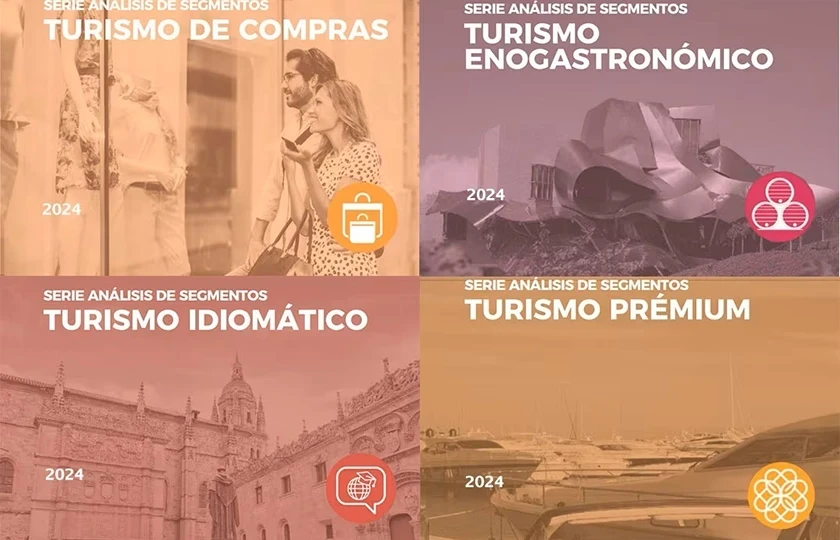
- The first four studies, focusing on the shopping, luxury, language and gastronomic segments, offer an up-to-date snapshot of how international tourists travel and what they are looking for in Spain.
- The four reports highlight Spain’s leadership as a leading destination and its high level of satisfaction (above 8.8 points out of 10).
- Available at: https://conocimiento.tourspain.es/en/segment-analysis/
The Spanish Tourism Institute (Turespaña), an autonomous body attached to the Ministry of Industry and Tourism, is launching a new series of studies dedicated to the analysis of tourism segments, based on microdata from the Egatur (Tourism Expenditure Survey) conducted by the INE and the ESTI (International Tourist Satisfaction Survey) conducted by Turespaña.
This first instalment includes four reports focusing on the shopping, luxury, language and food and wine segments, and is part of a series of publications that will provide a more in-depth understanding of the evolution and profile of the different types of international travellers who visit Spain. New studies dedicated to MICE, business and family tourism will be published shortly.
The reports provide estimates of the volume and evolution of each segment, as well as a detailed analysis of their profile—motivations, activities, seasonality, degree of knowledge of the destination, age, educational level, and satisfaction.
“These studies reinforce Turespaña’s role as a generator of high-value tourism knowledge, providing accurate data to guide the strategy and international promotion of Spain as a destination,” said Miguel Sanz, director general of Turespaña. This action is “part of the Spain Tourism 2030 strategy for the transformation of Spanish tourism towards a sustainable, balanced and inclusive model,” the director emphasised.
Some of the main conclusions
In these studies, premium tourists are those who spend more than three times the average daily expenditure of international tourists at their destination, and shopper tourists are those who spend more than three times the average daily expenditure on shopping of international tourists. These are segments that drive the local economy and position Madrid and Catalonia as epicentres of high-value tourism.
The language and food and wine segments are growing and consolidating their position as cultural and experiential travellers.
The four segments have in common, in their travel behaviour to Spain, less seasonality than other international tourists.
The lessons learned from these studies will give the Spanish tourism sector a deeper and more detailed understanding of international demand, which should contribute to a better adaptation of the offer to their profiles and, potentially, to sustaining and improving the high level of satisfaction observed in all of them.
The segments in detail
Shopping tourism: shoppers bring cities to life
In 2024, tourists who spend three times the average on shopping exceeded 2019 levels. The main source markets in this segment, in terms of spending volume, are the United States, Morocco, Mexico and the United Kingdom, with the Americas accounting for almost 38% of total spending. They are urban, cultural and first-time travellers in Spain, with a satisfaction rating of 8.99/10, and a younger and more affluent profile.
Premium tourism: exclusivity that drives the economy
They represent less than 2% of tourists, but their daily spending is four times higher than the average. Their favourite destinations are Madrid and Catalonia, with emerging markets such as Mexico and Colombia. They are predominantly men between the ages of 25 and 65, with high incomes and executive profiles. In terms of satisfaction, they score 8.82/10, reflecting the quality of Spain’s premium offering.
Language tourism: learning while travelling
This segment has an average stay that is twice as long and spends 67% more than the average. The main market in terms of value is the US, and in terms of number of tourists, it is Italy, with Madrid and Catalonia as key destinations.
Led by young students, with a majority of females, it is characterised by a more intense experiential profile and a seasonal pattern that is very different from that of other tourists. With a satisfaction rating of 8.95/10.
Food and wine tourism: the culture of flavour
In 2024, 23.4 million international tourists took part in food and wine activities, with a total expenditure of 34.021 billion euros. The main source markets for this segment in Spain are the United States, the United Kingdom, France, Germany and Mexico, and the most popular destinations are Madrid and the Valencian Community.
These travellers have an experiential profile, with a focus on urban tourism, shopping, cultural visits, nature and nightlife, and a high level of education. Their satisfaction rating is 8.99/10, with the culinary and cultural experience receiving particularly high marks.
Shopping Segment Report:
Premium Segment Report:
Language Segment Report:
Gastronomic Segment Report:
Visit the Turespaña Knowledge website: https://conocimiento.tourspain.es/en/
About the SPANISH TOURISM INSTITUTE (TURESPAÑA)
TURESPAÑA is an autonomous body under the Ministry of Industry and Tourism, through the Secretary of State for Tourism, whose objectives are to maintain and strengthen Spain’s leading position as a global tourist destination; contribute to improving the competitiveness and resilience of the Spanish tourism sector, and to consolidating a tourism model based on economic, social and environmental sustainability through the efficient management of international tourist demand.
Source: SPANISH TOURISM INSTITUTE (TURESPAÑA)