

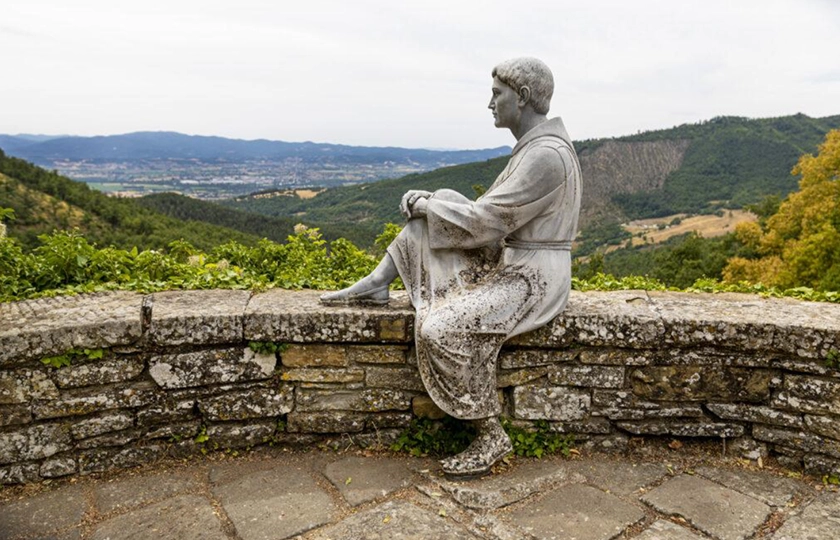
This year marks the 800th anniversary of the death of St. Francis of Assisi, patron saint of Italy and author of the Canticle of the Creatures, one of the most sublime texts ever written on the relationship between man and nature.
This anniversary offers the ideal opportunity to set out on the Way of St. Francis in Tuscany, passing through places deeply linked to the life of the saint. This is especially true in spring, when “creation” awakens.
In Florence, the first stop on the route, the Basilica of Santa Croce, the largest Franciscan church in the world, houses the famous Stories of St. Francis frescoes by Giotto in the Bardi Chapel, currently undergoing major restoration. Next to the basilica is also the Garden of Francis, a space of peace and beauty that evokes the tradition of convent gardens: a hymn to creation, created with historical and botanical rigour, which allows Santa Croce to be observed from a new perspective.
The journey continues to one of the most intense places of Franciscan spirituality: the Sanctuary of La Verna, immersed in the “sacred” forests of Casentino. Here you will find the evocative Corridor of the Stigmata, about 78 metres long, enriched with frescoes narrating the life of Francis and with walkways carved into the rock, such as the famous “precipice”, suspended above the mountainous landscape. The convent offers accommodation and meditation itineraries dedicated to lay people, but it is not the only one.
Along the Way of St Francis, there are numerous hermitages and monasteries that reinforce the link between the path, silence and nature: from the Hermitage and Monastery of Camaldoli or the Abbey of Vallombrosa to the Franciscan Hermitage of Le Celle. These are secluded and powerful places, still capable today of speaking to the soul of those who choose to travel slowly, step by step.
The Way of St. Francis in Tuscany: www.visittuscany.com/it/itinerari/via-francesco-d-assisi-toscana/
Franciscan spirituality and artisan craftsmanship
In Tuscany, Franciscan spirituality and artisan tradition have been intertwined for centuries, giving rise to a widespread cultural heritage. A significant example of this is the Franciscan Missionary Ethnographic Museum, located in the convent of Fiesole, which preserves missionary objects, ethnographic finds and artefacts collected by Franciscans around the world: clothing, musical instruments, porcelain, ivory and everyday objects used by the friars.
A visit to the convent complex of San Francisco also offers an authentic insight into Franciscan life and culture in the Tuscan context. In the Franciscan sites of the region – from La Verna to Arezzo, to the Val Tiberina – craftsmanship is closely linked to the spiritual history of St. Francis. Devotional objects, sacred works of art such as the frescoes by Piero della Francesca, sculptures and stained glass windows bear witness to how faith has inspired and nourished creativity over the centuries. This heritage is preserved in the sanctuaries and villages of the surrounding area and extends across several areas of Tuscany, from Greve in Chianti to Montauto.
In places such as La Verna or the Franciscan church in Barga, the dialogue between craftsmanship and religiosity finds one of its highest expressions in the glazed terracotta of the Della Robbia family; in Cortona, in the Le Celle complex, it is the essential architecture that reflects the ideal of monastic life; one of the first Franciscan sites in Tuscany, Colle Val d’Elsa, is one of the world’s capitals of glass. Along the Franciscan routes there are numerous examples of traditional local arts—ceramics, wood, glass, metals, textiles and embroidery—while historic convents and churches, starting with the Basilica of Santa Croce in Florence, offer a cultural context of great value, steeped in centuries of history and craftsmanship.
Florence brings its treasures together: the ‘Galleria dell'Accademia di Firenze e Musei del Bargello’ museum complex is born
An ambitious project that brings together seven of the city’s most iconic museums under a single vision, offering an unprecedented experience for those who wish to immerse themselves in the history, beauty and creativity that have made Florence famous throughout the world.
The system brings together the Accademia Gallery, the Bargello National Museum, the Medici Chapels, Palazzo Davanzati, Orsanmichele, Casa Martelli and, once its restoration is complete, the ancient church of San Procolo.
The result is an extensive itinerary that spans centuries of history, from Renaissance masterpieces to the refined taste of the decorative arts, from Michelangelo’s David to the works of Donatello, Giotto, Cellini and Ghiberti, revealing Florence through its most representative and memory-laden places, in an itinerary that combines architecture, sculpture and painting. Each museum retains its own identity, but together they tell a broader story: that of a city that has shaped culture and continues to thrill those who visit it.
In the coming months, it will be possible to explore themed routes connecting the different venues, enjoy integrated itineraries and discover the collections with cumulative tickets designed to allow for several days of discovery. Uniform opening hours and innovative accessibility solutions will make each visit simple, smooth and immersive, allowing you to fully immerse yourself in a unique experience.
This is a bold project that transforms Florence into a beating heart of art and culture, establishing it as one of the most extraordinary and evocative cultural capitals in the world. An invitation to be surprised, to lose yourself among masterpieces and stories, and to experience the city with new eyes, ready to discover every detail of a heritage that has been thrilling visitors for centuries.
Source: ENIT SPA