
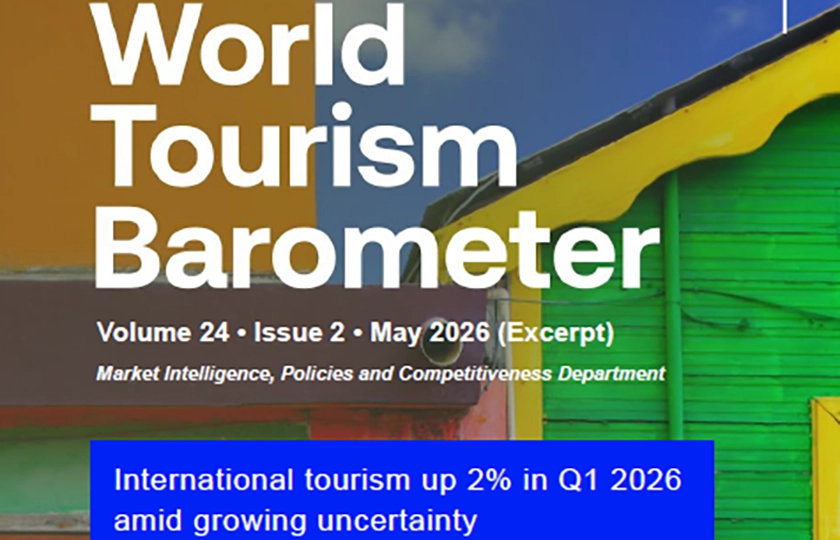
International tourism began 2026 on a positive note, demonstrating remarkable resilience in a context shaped by geopolitical tensions and economic challenges.
During the first quarter of the year, international tourist arrivals increased by 2% compared with the same period in 2025, reinforcing the sector’s recovery and confirming that travel demand remains strong despite growing uncertainty in several markets.
Between January and March, approximately 307 million international trips were recorded, representing around six million more travelers than during the first three months of the previous year. While growth was stronger in January and February, performance in March was influenced by a number of international developments that affected traveler behavior and disrupted air transport operations across various regions of the world.
The geopolitical situation in the Middle East has emerged as one of the main concerns for the tourism industry. Disruptions to air connectivity, rising operating costs, and growing uncertainty among consumers and businesses have had repercussions extending far beyond the region itself. Added to this are higher oil prices and fuel supply constraints in certain markets, factors that have contributed to increased travel costs and a reduction in available airline capacity.
Despite these challenges, many regions continued to post positive results. Europe once again stood out as the world’s leading tourism destination, welcoming more than 130 million international visitors during the first quarter. The continent recorded 4% growth, supported by robust demand and the redirection of some travel flows toward destinations perceived as more stable. Both Mediterranean and Northern Europe achieved positive results, while Central and Eastern Europe continued to advance in its recovery process.
Africa also reported a 4% increase in international arrivals. North Africa maintained particularly dynamic growth, supported by a strong rise in visitor numbers across several destinations. At the same time, Sub-Saharan Africa strengthened its positive trend thanks to improved connectivity and growing international interest in new travel experiences and emerging tourism markets.
In Asia and the Pacific, arrivals rose by 3%, although performance varied considerably between destinations. Some tourism economies continued to show strong recovery, particularly in Oceania and Northeast Asia. However, certain areas were more heavily affected by operational disruptions linked to changes in international flight routes and air transport networks.
The Americas recorded a moderate increase of 2%. Within the region, Central America delivered particularly strong results, while other markets experienced more restrained growth due to economic and demand-related factors. In contrast, the Middle East registered a decline in international arrivals during the period under review, reflecting the direct impact of regional tensions on tourism activity.
Among the destinations posting the strongest growth in visitor numbers were Paraguay, New Zealand, El Salvador, Mongolia, Palau, and Uzbekistan. At the same time, several countries achieved significant increases in tourism revenues, reflecting higher visitor spending and a gradual improvement in the sector’s profitability.
Looking ahead, prospects for the coming months remain positive, although tempered by caution. Tourism professionals believe that international uncertainty, transportation costs, and accommodation prices will continue to influence travel demand. There is also concern about the potential continuation of geopolitical tensions and their impact on global air connectivity.
Against this backdrop, travelers are expected to continue prioritizing destinations that offer good value for money, while also showing a growing preference for shorter and closer-to-home trips. Even so, tourism continues to play a vital role as one of the world’s leading economic drivers, generating employment, encouraging investment, and supporting the development of communities and destinations worldwide.
The results recorded during the opening months of 2026 demonstrate that, even in a complex and rapidly changing environment, the tourism sector continues to display a strong capacity for adaptation, resilience, and sustained growth.
Read the full report here.
Source: TOURISM AND SOCIETY THINK TANK