
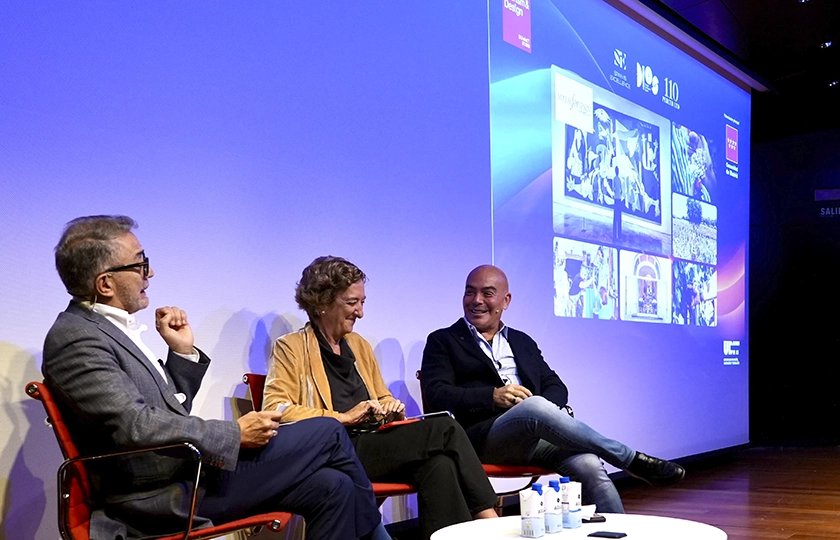
- At the Tourism & Design Summit, more than 200 professionals are examining how artificial intelligence, the pursuit of experiences and interaction with local residents are transforming tourism.
- Carlos Garrido, Kike Sarasola, Eduardo Prieto, Virginia Irurita and representatives from the Reina Sofía Museum and the Thyssen-Bornemisza Museum, amongst other experts, are calling for a shift from volume to value and for the preservation of destinations’ identities.
Spanish tourism is facing a paradigm shift: moving away from measuring success solely by visitor numbers towards measuring it by the economic, social and cultural value it generates in destinations. This was one of the main conclusions of the first edition of the Tourism & Design Summit 2026, which brought together more than 200 professionals from the fields of tourism, design, culture, architecture, the hospitality industry, destination management and academia in Madrid.
During the event, Eduardo Prieto, managing director of Visa Spain, pointed out that more than 50 per cent of tourist spending in Spain is now concentrated on leisure, culture and gastronomy – a trend that reflects the growing importance of experiences in travellers’ decision-making. Prieto also highlighted one of the changes that could transform the sector most rapidly: artificial intelligence agents capable of searching for and making bookings on behalf of the user could become commonplace “within one or two years”.
Held at the Reina Sofía National Art Centre Museum and organised by SIE, Spain is Excellence; the Design Institute of Spain (D!OS); and 110 PERCEB Ltd., the event brought together professionals from traditionally separate fields to analyse how design can help build more competitive, liveable and distinctive destinations. The Summit began on 5 October with a welcome reception at Brach Madrid and held its main session on 6 October at the Reina Sofía Museum.
From volume to value: another way of measuring tourism success
At the roundtable “Designing the future of tourism”, moderated by Ana Alonso, CEO of SIE, Spain is Excellence, Carlos Garrido, president of the Spanish Tourism Board; Eduardo Prieto, Managing Director of Visa Spain; and Carlos Jacoste, co-founder of Startups Factory and Managing Director of Discoolver, addressed the need to move away from a strategy based on visitor arrival figures towards one centred on the value generated by each visitor.
Garrido argued that business profitability must go hand in hand with quality employment, benefits for local areas and the impact on their residents, and called for a major tourism pact in Spain involving businesses, workers, destinations, public authorities and residents.
Coexistence with the local population was also a theme at the panel discussion “Educating for the strategic design of destinations”, moderated by Paloma Gómez Marín. Mª Concepción García Gómez, Vice-President for Continuing Education, Employability and Entrepreneurship at the Complutense University, argued that destinations must be designed with the people who live there in mind and summed up the challenge in a single idea: “never pit tourists against residents”.
At the same panel, José Ángel Díaz Rebolledo, director of the Faculty of Tourism and Gastronomy at Anáhuac University in Mexico, highlighted the link between education and competitiveness in tourism. According to a forward-looking study projecting to 2050, cited during his presentation, an additional year of schooling for the host population increased the likelihood of a tourist destination’s success by almost 9 per cent.
The day had begun with a talk by Elena Rubio, coordinator of the Centre for Tourism Innovation in the Sierra Norte de Madrid, who presented ‘Paredes que Hablan’ (Walls that Speak), an initiative that uses art and design to bring together the 42 municipalities of the Sierra Norte de Madrid, generate new tourism resources and redirect visitors to lesser-known towns.
Rubio argued for going a step beyond sustainability and starting to talk about regenerative tourism: tourism that is not limited to minimising its impact, but which helps to leave the area in a better state, generating economic activity, strengthening local identity and revitalising spaces.
Artificial intelligence will change how we discover and book trips
Technology played a particularly significant role in “Designing the Future of Tourism”.
Eduardo Prieto explained the progress of so-called ‘agent-based commerce’, in which artificial intelligence agents will be able to search for, select and even carry out transactions on behalf of the traveller — from booking a flight or a hotel to securing a table at a restaurant or buying a ticket — taking their preferences into account and always with their authorisation.
“This isn’t a matter of five or ten years; it’s a matter of one or two years,” said Prieto.
This transformation, in turn, poses a new challenge for businesses and destinations: being visible to artificial intelligence.
Carlos Jacoste warned during the same panel discussion: “If you don’t have an online presence, that artificial intelligence won’t find you.” The expert highlighted the need for destinations, hotels, restaurants and experiences to build a relevant digital presence, generate content and develop partnerships that enable new recommendation systems to identify and differentiate them, preventing the technology from always directing users to the same places.
The more technology there is, the greater the value of the human touch
One of the conclusions that recurred throughout various discussions was that technology can simplify processes and personalise the experience, but it will be people who continue to make the difference.
During “Educating for Strategic Destination Design”, Mª Concepción García Gómez summed it up as follows: “The more the technical aspects can be automated, the more important the human element becomes”. Empathy, leadership, negotiation skills, creativity and cognitive flexibility, she noted, will become increasingly important in an environment where technical skills are becoming obsolete at an ever-faster rate.
The same line of thinking was applied to the hospitality sector during “From Space to Emotion”, moderated by Manuel Díaz Cebrián and featuring Virginia Irurita, founder and executive partner of Made for Spain & Portugal, and Kike Sarasola, chairman of Room Mate Hotels.
Irurita explained that the concept of luxury is evolving from the material towards the ability to listen to the traveller, understand what interests them and design a bespoke experience for them. “An experience becomes a memory the moment it is designed just for you”.
Sarasola also identified people as one of the main assets of the hospitality sector: “I hire smiles, I hire attitude”.
The president of Room Mate Hotels also argued that hotels must connect with the cities in which they are located and avoid formulas that can be replicated indiscriminately in any destination. “We have to defend our roots,” he said.
Local identity versus interchangeable destinations
Identity was, in fact, another of the key themes of the conference. The session “Cultural architecture and reinvented heritage”, moderated by Maribel Hipólito, featured Carlos Urroz, director of the Institutional Office at the Reina Sofía Museum; Ana Cela, director of Publications and the Museum Shop and Bookshop at the Thyssen-Bornemisza National Museum; and Jesús Moraime, landscape architect, traveller and entrepreneur.
Urroz explained how the refurbishment carried out at the Reina Sofía Museum has made it possible to rethink not only its façades, but also its entrances, visitor routes, signage and services, as part of a vision for the museum that is increasingly connected to the city and to the visitor’s experience.
His recommendation for professionals in tourism and design was clear: “Don’t copy; innovate; seek out local talent.”
At the same round-table, Ana Cela demonstrated how the quest for uniqueness is even transforming the very concept of the cultural souvenir. Moving away from generic products, museum shops are increasingly focusing on design pieces, handicrafts and items specifically linked to their collections, working with creators and craftspeople to offer visitors something they know they can only find in that particular place.
For his part, Jesús Moraime argued that the restoration of historic buildings for tourist use must respect the history of the property and utilise art, craftsmanship, the landscape and local culture as part of the narrative that connects the visitor with the city.
The discussion on identity continued in the afternoon at the round-table session “Spaces that captivate”, moderated by Juan Mellen and featuring Sonia Prieto, managing director of Aylanz Hospitality Group; Álvaro Matías, director of the Madrid Design Festival; Lucía Urbán, vice-president of the González Serna Urbán Foundation; and interior designer Erico Navazo.
Prieto pointed out that hospitality has evolved from the product to the service, then to the experience, and is now moving towards the transformation of the guest, which requires a collaborative approach to the design of the space, operations, the team and their relationship with the community.
Navazo championed authenticity over spaces designed solely to impress: “Good décor does not impose itself; it is natural”.
Lucía Urbán presented the case of the Monastery of San Pelayo as an example of heritage restoration capable of generating employment, activity and opportunities in rural areas once again, whilst Álvaro Matías highlighted the role that the hotel and restaurant sectors, culture and design have played in the transformation and profile of Madrid over recent decades.
Designing destinations that remain distinctive
The presentations at the Tourism & Design Summit thus highlighted a common challenge: incorporating technology without losing a sense of humanity, prioritising value over scale, involving local residents in tourism development, and protecting the identity of regions in the face of the growing homogenisation of destinations.
Carlos Jacoste specifically pointed to a renewed interest in traditions, crafts, local trade and the unique culture of each place as one of the assets with the greatest potential to set destinations apart in the coming years.
Sonia Prieto closed the final panel by advocating a model in which tourism projects are not only attractive to visitors but also manage to generate a positive impact significant enough that the local community itself wants them to form part of their area.
“Today, design is much more than just an aesthetic issue: it is a tool for competitiveness in tourism. It helps us to build destinations with a distinct identity, improve the traveller’s experience and generate value for the region. With this Summit, we wanted to bring together professionals from the worlds of tourism and design who, until now, had not always had shared spaces for dialogue,” said Ana Alonso, CEO of SIE,
Spain is Excellence.
The event also featured a programme of reinterpreted cuisine linked to various municipalities in the Community of Madrid and concluded with a visit to the Reina Sofía National Art Centre Museum, reinforcing the link between architecture, art, culture and the tourist experience.
Sponsors and partners
The Tourism & Design Summit 2026 was supported by the Community of Madrid and UDIT, the University of Design, Innovation and Technology, as well as Mahou, Cobo Catering, Finca Vista Hermosa (Café Mixteco), Six Sens, Allmedo Catering and AGA Catering as partners. The Reina Sofía National Art Centre hosted the main conference, whilst Brach Madrid hosted the welcome cocktail reception.
About the TOURISM & DESIGN SUMMIT
The Tourism & Design Summit was created as a meeting point between tourism and design to connect professionals, companies and institutions from both sectors and to foster new forms of collaboration in areas such as hospitality, destination management, urban planning, culture, architecture and the creation of experiences.
It is organised by SIE, Spain is Excellence; the Design Institute of Spain (D!OS); and 110 PERCEB Ltd.
Full programme and participants:
Source: SIE, SPAIN IS EXCELLENCE