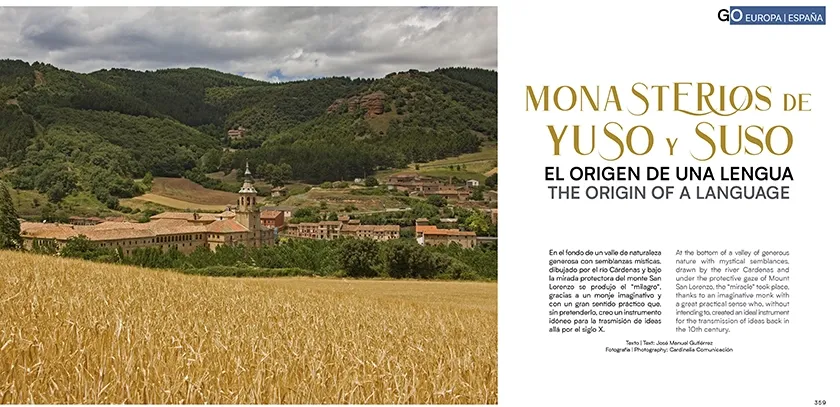
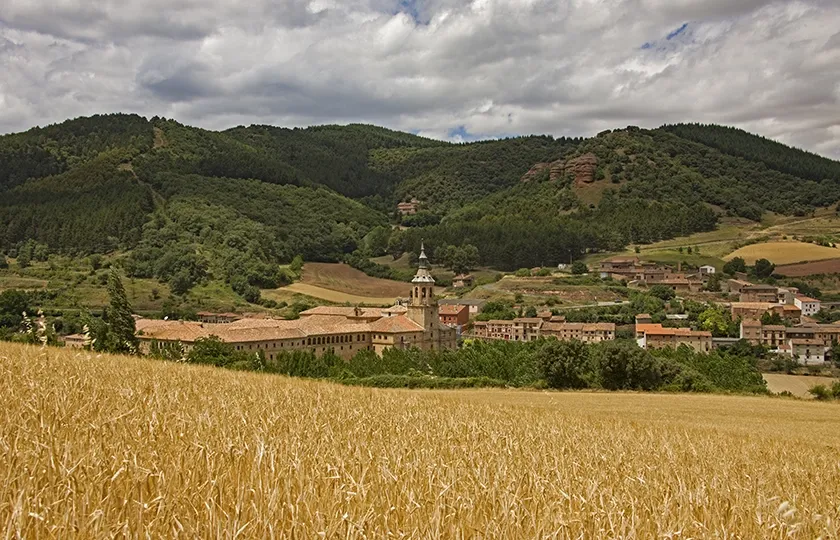
At the bottom of a valley of generous nature with mystical semblances, drawn by the river Cárdenas and under the protective gaze of Mount San Lorenzo, the “miracle” took place, thanks to an imaginative monk with a great practical sense who, without intending to, created an ideal instrument for the transmission of ideas back in the 10th century.
That language born from the corruption of Vulgar Latin, mixed with non-epigraphic Basque and with pre-Romanesque reminiscences, was never conceived as what has become Castilian, the language that is now spoken by more than half a billion people in the world.
It was in the 6th century when a Visigothic hermit who would later be known as San Millán decided to retire to some caves in the narrow valley floor, where he died at the age of 101 and was buried by his disciples in a tomb excavated in the same hermitage where he lived.
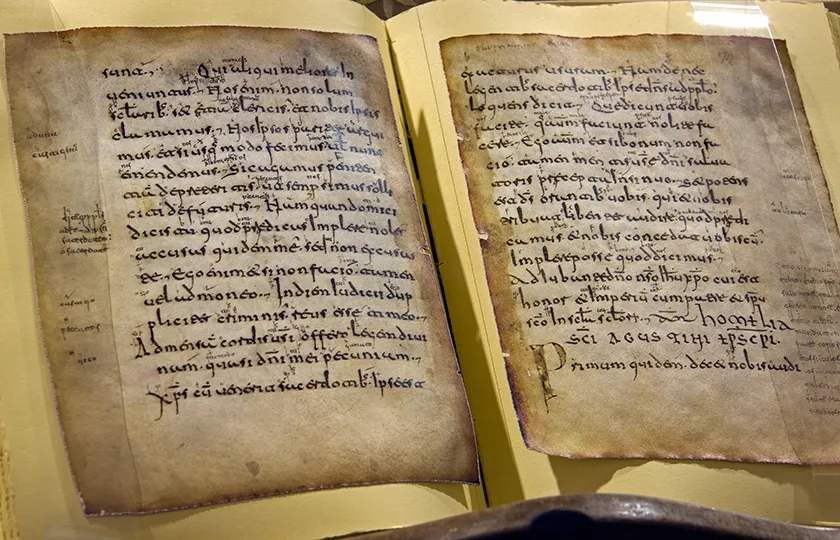
In the year 931, a modest Benedictine abbey was built there, of which the Mozarabic church has survived, and it was here that the historic event took place in the year 964, when the Codex Emilianense 46 was written, the first encyclopaedic dictionary of the Iberian Peninsula with more than twenty thousand alphabetically ordered entries and in which the new Romance language does not make up simple annotations, but already forms part of the general text.
Monastery of Suso
The setting in which the monastery is located, declared a World Heritage Site, is extraordinarily beautiful, so much so that in the 13th century Gonzalo de Berceo, the first poet in the Castilian language and one of the great architects of the medieval literary corpus known as the Mester de Clerecía, spoke of the place in his work Miracles of Our Lady. Throughout the centuries of use, from its beginnings as a Visigothic monastery in the 6th century, it underwent various transformations that left Mozarabic and Romanesque traces.
Its simple and austere exterior does not correspond to the mystical intensity of the interior, nor does it reflect the cultural importance of the production of extremely valuable manuscripts and codices that came out of its walls, such as the Bible of Quiso in 664, a copy of the Apocalypse by Beatus of Liébana in the 8th century or the Emilianense Codex of the Councils in 992, making it one of the main early medieval Spanish writing collections, if not the most notable.
It was in this monastic context that the above-mentioned Codex Emilianense 46 was created, followed by Codex 60 in the 11th century, already written in the monastery of Yuso and considered to be the germ of a universal language.
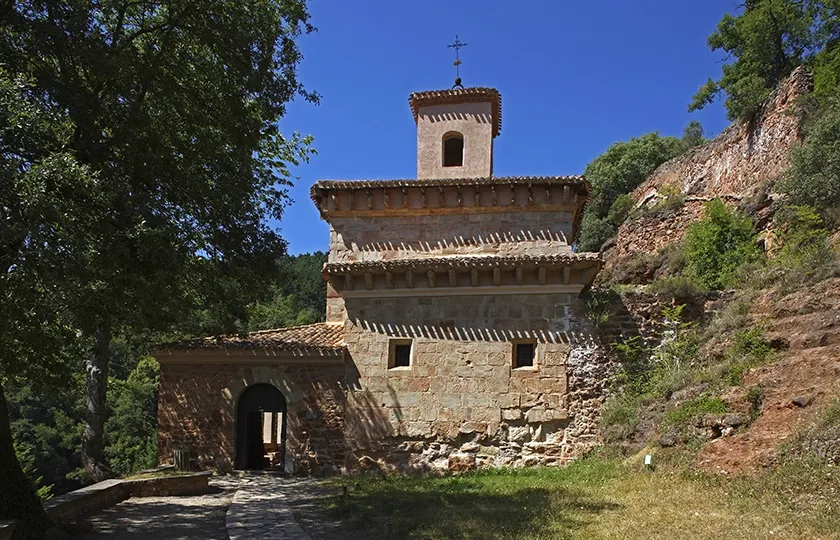
In the gallery at the entrance to the monastery of Suso, “arriba” in old Castilian, you can see the tombs of the seven Infantes de Lara and that of their tutor, Nuño Salido, and those of three Navarrese queens, Toda, Elvira and Jimena.
A Mozarabic horseshoe arch supported by two Visigothic capitals of the Corinthian type carved in alabaster outlines the entrance to the church. The two identical square chapels are also in the 10th-century Mozarabic style with a clear influence from the Caliphate period in Córdoba. In the background we can see the rest of the primitive Visigothic construction.
Another interesting element is the altarpiece with the Gothic illustrations known as the Tablets of San Millán, which narrate the life and miracles of the saint following the account written by Gonzalo de Berceo in the 13th century.
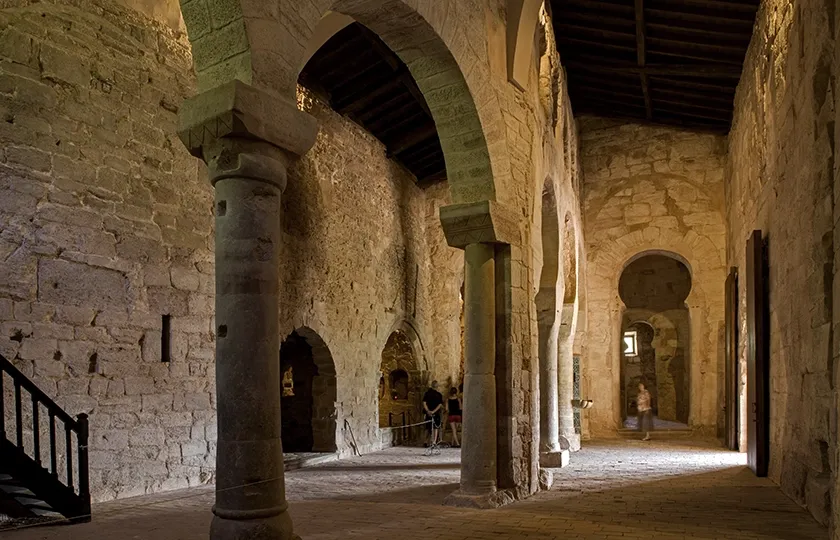
The caves are part of the primitive monastery and contain unidentified tombs which, due to their proximity to the saint’s tomb, are thought to have belonged to people of some importance. San Millán was buried here until 1030, when Sancho III el Mayor decided to move it, but his tomb is preserved with the tombstone of the founder carved in black alabaster and decorated with his recumbent sculpture, dressed in priestly vestments, alb, chasuble and stole with a cross carved on his chest decorated with numbers and plants.
Monastery of Yuso
A little more than a kilometre along a pleasant path, in the bed of the valley, stands this monumental monastery of Romanesque origin, declared a World Heritage Site, although it was rebuilt in the 16th, 17th and 18th centuries, so that other architectural styles such as Renaissance and Baroque can be recognised.
Now consecrated as the first stable monastery in the Peninsula, a monk occupied in translation work and faced with the difficulty of establishing an accurate parallelism between the speech of the people and Latin, began to write annotations in the margins of the homilies, giving rise to the Glosas Emilianenses, humble manuscripts in origin that have gained universal value as they are considered to be the first texts in Spanish. The originals of these jewels are now in the Academy of History, but an extraordinary facsimile copy is on display in the monastery.
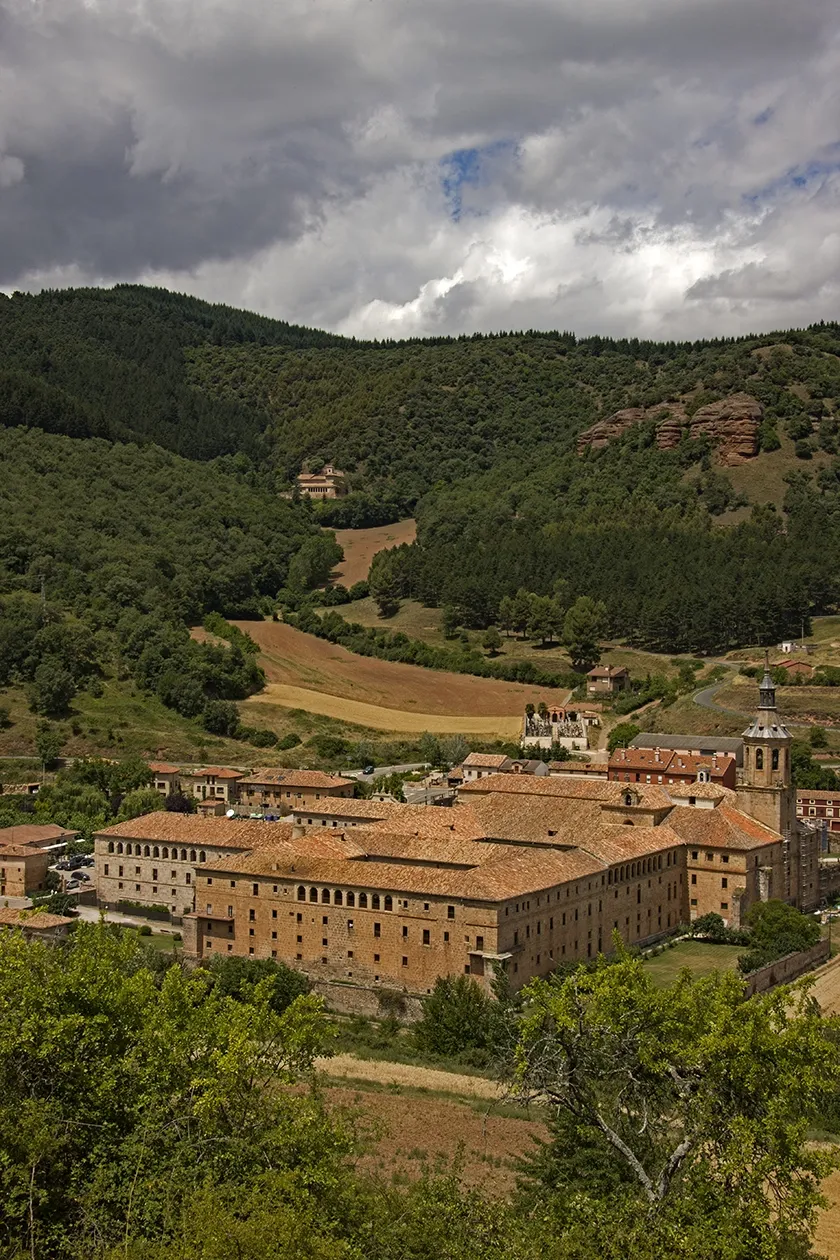
Legend has it that the Navarrese king García Sánchez III, nicknamed the Nájera, ordered the transfer of the remains of San Millán from the monastery of Suso to the monastery of Santa María La Real de Nájera. The oxen pulling the cart stopped in the valley, which was interpreted as a message from the saint indicating his refusal to abandon it. The present-day monastery of Yuso was built on this exact spot.
Seen in perspective, the monastic enclosure is of grandiose proportions, creating an unavoidable vanishing point in the panoramic landscape.
In addition to its solid exterior, the main façade, built in the mid-17th century by Pedro de Basabe and Diego de Lizárraga, is particularly noteworthy, with a semicircular arch and an elevation reminiscent of a triumphal arch, topped by a pediment with several pinnacles and a central ovolo. A relief of San Millán on horseback in the battle of Hacinas stands out in the upper part.
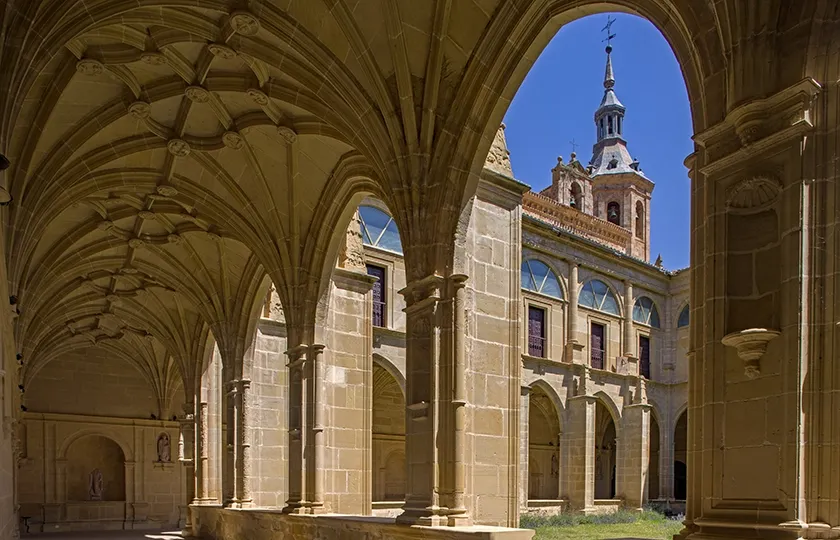
In 1689, the hallway was built as a preliminary step to the Hall of the Kings, named after the four great canvases of the monastery’s benefactor kings such as Fernán González, Sancho el Mayor, García de Nájera and Alfonso VII of Castile. The lower cloister was begun in 1549 and although its vaults are Gothic, the design is Renaissance, while the upper cloister is Classicist and is notable for its twenty-four paintings by José Vexes, whose main scenes deal with the life of San Millán written by San Braulio, archbishop of Saragossa.
The interior of the monastery is a cultural universe in itself with a wealth of works of art. In the museum alone there are a large number of paintings and pictures from the 17th, 18th and 19th centuries, including twenty-two canvases by Juan de Rizzi, considered the best of the Spanish cloister painters, as well as magnificent 17th century coppers. The chest containing the relics of San Millán, covered with ivory, gold and precious stone plaques and narrating the life and wonders of the saint through its Romanesque reliefs, is of great historical and artistic value.
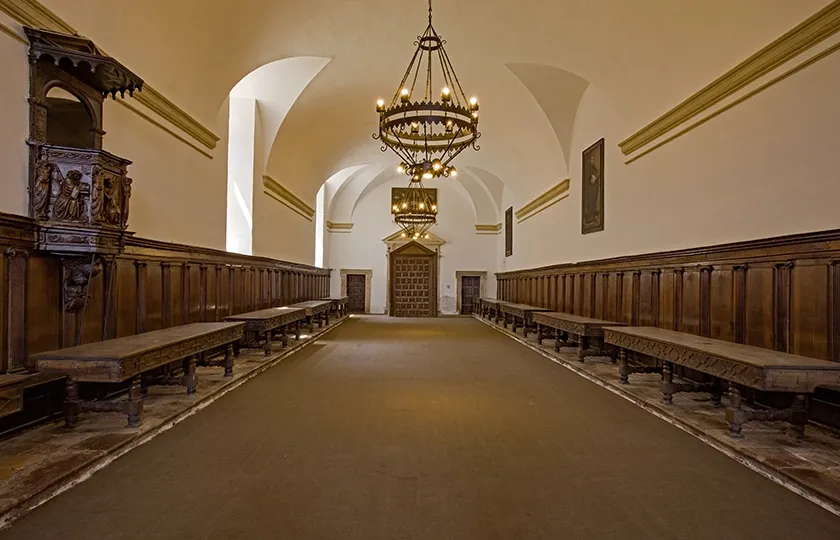
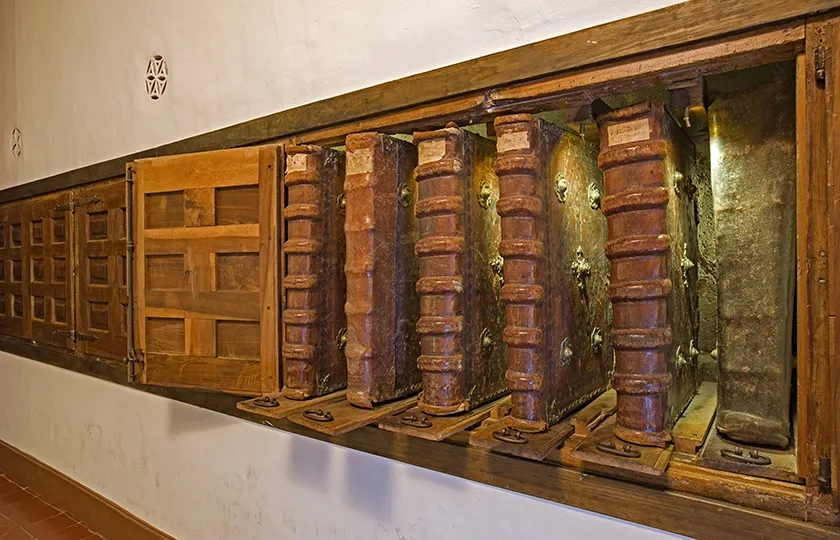
The medieval library and archive form one of the best documentary collections in Spain. The second essentially consists of two cartularies, the Galician and the Bularium, and around 300 original documents.
The library is furnished as it was in the 18th century. It does not even have electricity or lighting, and its importance transcends the more than ten thousand works of art, among which some curiosities stand out. One of these bibliographical rarities is Hieronymus Nadal’s Gospel Book printed in Antwerp in 1595 with all the plates polychromed one by one. Another surprising discovery was the Summa Casuum of Bartholomeus de Sancto Concordio, an incunabulum from 1475, found in perfect condition and of which only five copies remain in the world.
The church, classified within the so-called decadent Gothic style, is the first Spanish church with a hall plan, having been designed by Tomás Rodi at the beginning of the 16th century. Of particular note are the altarpiece with a canvas by Fray Juan Ricci, from the school of El Greco, the choir grille, the excellent walnut pulpit from the end of the 17th century, the sculpture in the transept with eight of the finest Spanish carvings and the sacristy, one of the most beautiful in Spain, the old chapterhouse transformed in 1693 and whose 18th century ceiling frescoes preserve all the richness of the original colour intact.
San Millán de la Cogolla, in the heart of La Rioja, is the name given to the ensemble formed by a population centre which, over the centuries, grew together with the two monasteries of Yuso and Suso, making it an exceptional and unique part of Spain’s cultural and historical heritage, today declared a UNESCO World Heritage Site.