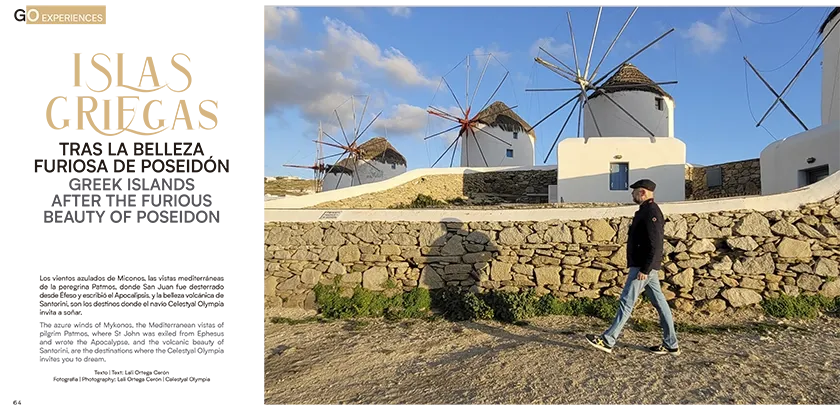
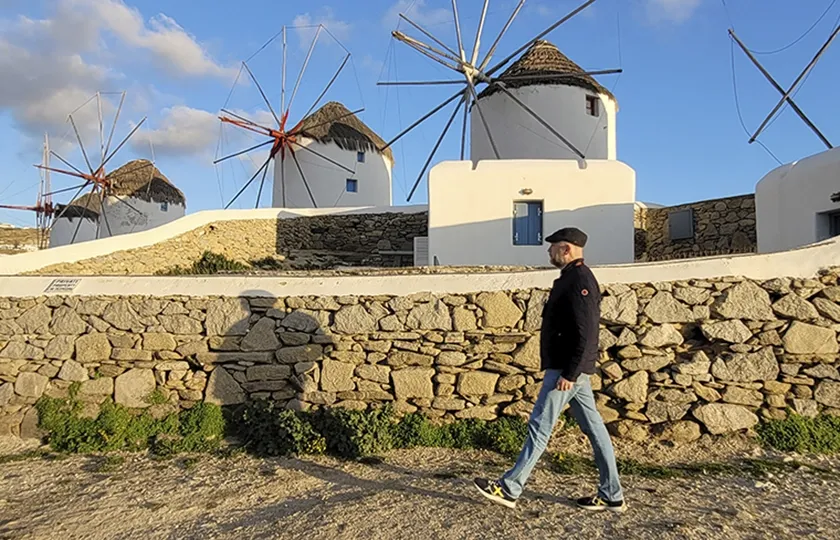
The azure winds of Mykonos, the Mediterranean vistas of pilgrim Patmos, where St John was exiled from Ephesus and wrote the Apocalypse, and the volcanic beauty of Santorini, are the destinations where the Celestyal Olympia invites you to dream.
Mythology tells us that Poseidon, son of Cronus and Rhea, ruled the seas. In his calm moments, the Mycenaean god created dream islands in the calm waters. But when the “Agitador de la Tierra” unleashed his wrath and drove his trident into the earth, the forces of nature told of his titanic power amidst raging waters, earthquakes and shipwrecks.
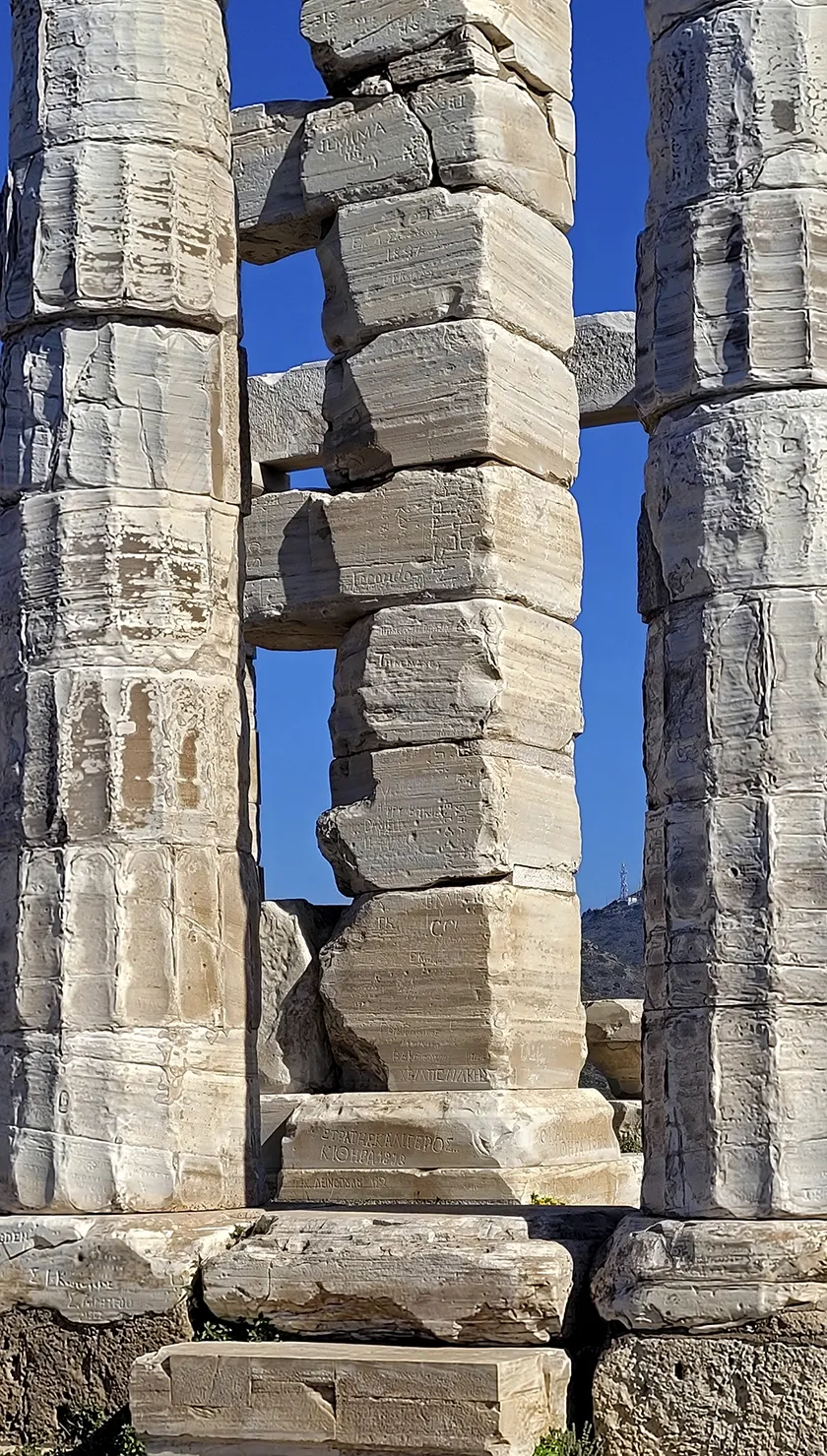
At Cape Sunion, the Doric temple erected by Pericles on the remains of an earlier one, and where Lord Byron initialled his signature, without edge or modesty, on one of its stone shafts, remains undisturbed. The human smallness is evident under its marbled skeleton and, in the distance, the perspective continues to mutate: at the edge of the promontory, its 60-metre figure is haughty in front of the calm water and fragile when the sea is rough. Here Poseidon was worshipped and the sailors implored his restraint. And here, as Homer’s Odyssey recounts, Aegeus threw himself desperately into the sea he named when he believed that his son Theseus had died at the hands of the Minotaur. Halfway between Athens and the port of Lavrio, where the Greek shipping company Celestyal Olympia begins and ends its cruise to some of the fascinating islands and ports of the Eastern Mediterranean, this geographical feature penetrates the splendour of the cradle of Western civilisation.
From the madness of Mykonos to the five calls near Ephesus
The arrival on rocky Mykonos lives up to its nickname as the Island of the Winds: the Meltemi blows with gusto amidst a riot of beauty that winds through its mills converted into hotels or museums (Geronymos Mill and Bonis Mill are open to the public), the terraces of its charming restaurants where you can sample delicacies such as fried cod with mashed potatoes and garlic, or the relaxed views that splash into its Little Venice. It is also a pleasure to wander through its labyrinthine streets, whose rounded corners dominate the air, to observe its houses with flat roofs like cisterns and to gaze at its nearly 800 battles fought at sea. When sailors and captains returned alive after shipwrecks or pirate attacks, they erected a small chapel in honour of their favourite saint and as a sign of gratitude. Before embarking for the next dock, it’s a good idea to lose yourself in the Castle Quarter, whose medieval houses make up the oldest part of the island and a dreamy Venetian lookout point. This charm is also shared by the five churches of Paraportiani, which have been declared national monuments.
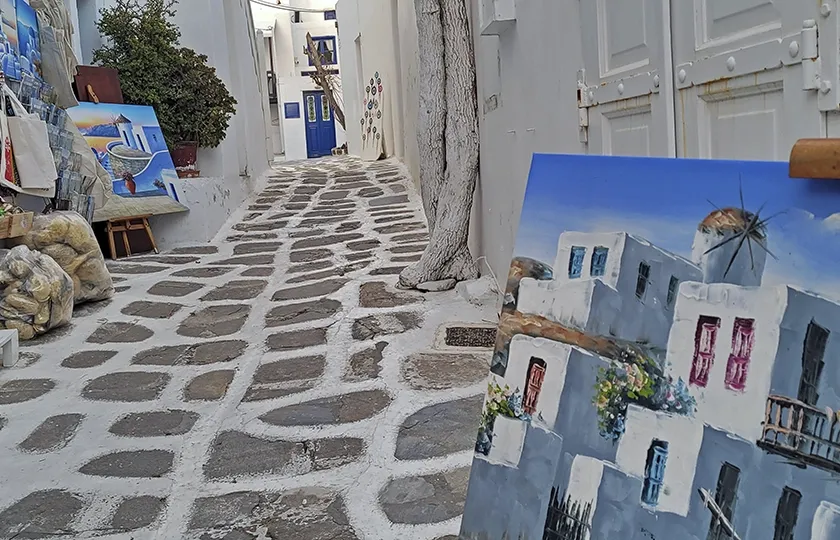
The street life of this treasure of the Cyclades, which holds indigo corners for those who are not just looking to party, can be felt on the first night aboard the cruise ship. Before and after the culinary moments, there are music shows (from Latin rhythms to, of course, classes of the suggestive Sirtaki) or music with the Poseidon Band. However, it is a good idea to leave a few hours to rest because, on the second day of the journey, the alarm clock goes off when it is still dark and the spirit has not yet fallen in love with the stony grandeur of Ephesus (Turkey) and the Mediterranean character of Patmos, the smallest and most pilgrim island of the Dodecanese. Both are, indisputably, an impression to behold and to remember.
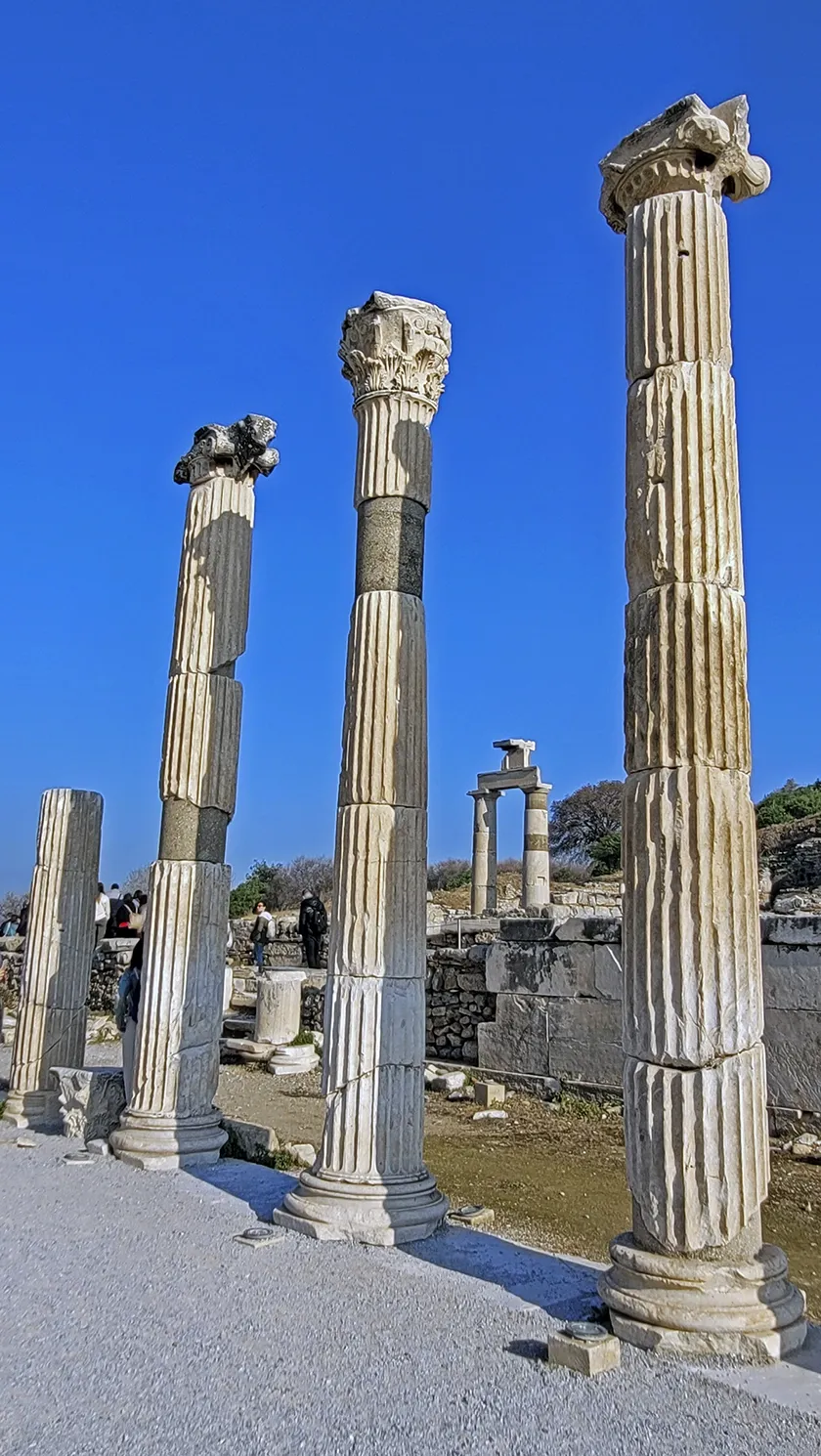
After dropping anchor in the Turkish port of Kusadasi, where the bustle of its bazaar mingles with the rhythmic sound of the five calls to prayer, one of the seven Wonders of the Ancient World awaits. Close to the remains of the temple erected in honour of Artemis, the Avenue of the Curetes is reborn in the imposing façade of the Library of Celsus: it was here that Gaius Julius Aquila Polemianus erected this impressive monument to bury his father and immortalise knowledge, with around 12,000 manuscript scrolls that it housed. The day continues, after a few hours on the boat, ideal for lunch or a dip in the pool, on Patmos: this small Aegean island was the site of St John’s exile from Ephesus and of his vision of God. In a small granite cave, where candles are never extinguished and flowers and olive branches frame the icons, he wrote the Apocalypse. From the neighbouring Monastery of San Juan, the view is lost in a green Mediterranean forest on a bed of blue.
Swallows among the saffron of Santorini
The island of Santorini is a raging beauty that is hard to forget. Perhaps Poseidon was fascinated by the volcanic rage that, about 3500 years ago (dates range from 1639 to 1500 BC), shook its entrails and concealed its roundness. From that episode, one of the most violent eruptions in history along with Krakatoa (Indonesia), emerged the current caldera and some disturbing facts: the ashes were deposited in Greenland and, much closer, the tsunami caused by the infernal roar contributed, along with previous seismic movements and explosions, to the decline of the Minoan civilisation in neighbouring Crete. The blinding light of the Mediterranean was shrouded in darkness for days.
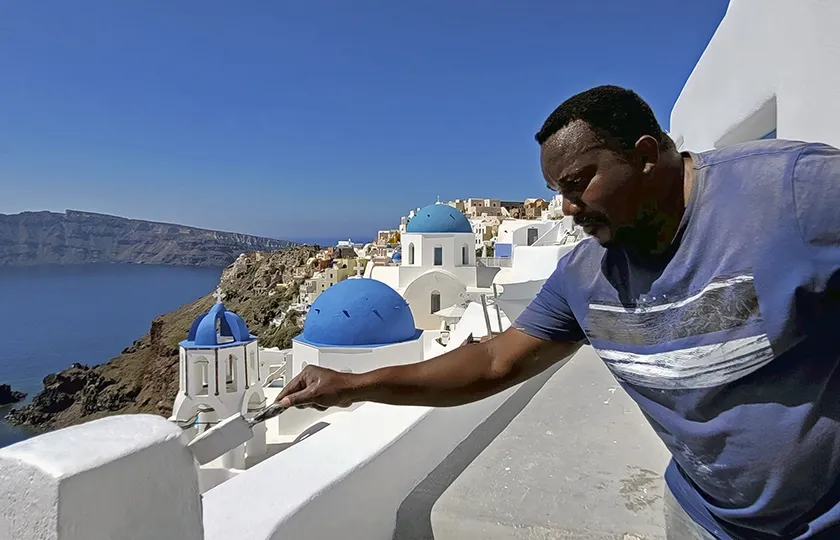
Thera in Greek, this Cycladic delight owes its present-day name to the Venetians and the island’s patron saint, Saint Irene of Thessaloniki. Much has been written about this wonderland where indigo blues dance between electric and aquamarines; about the red and white cliffs that have christened, with both colours, some of the busiest beaches of its islands. Also of the unique walks in little Oia, with its narrow, winding streets, boutique hotels amidst bougainvillea and its domes embossed on the Aegean: however much we resist, this is still the quintessential postcard of this Cycladic beauty. However, there are other equally, if not more, suggestive places to take a selfie at any age. Don’t forget that the ruined castle of St. Nicholas offers one of the most idyllic sunsets in the Aegean: it’s worth climbing up to this Venetian bastion to unwind an evening of red poetry.
A perfect manicure among anti-seismic olive trees
The burial of Akrotiri under the pumice and volcanic ash could be reminiscent of the tragedy of Pompeii and Vesuvius. However, one of the differences, apart from the incomparable magnitude of the eruption in the first case, is that no trace of any of its inhabitants has been found to date, perhaps because nature was benevolent and gave warning signs prior to the catastrophe. The olive wood in the openings was, in fact, intended to mitigate the telluric effects.
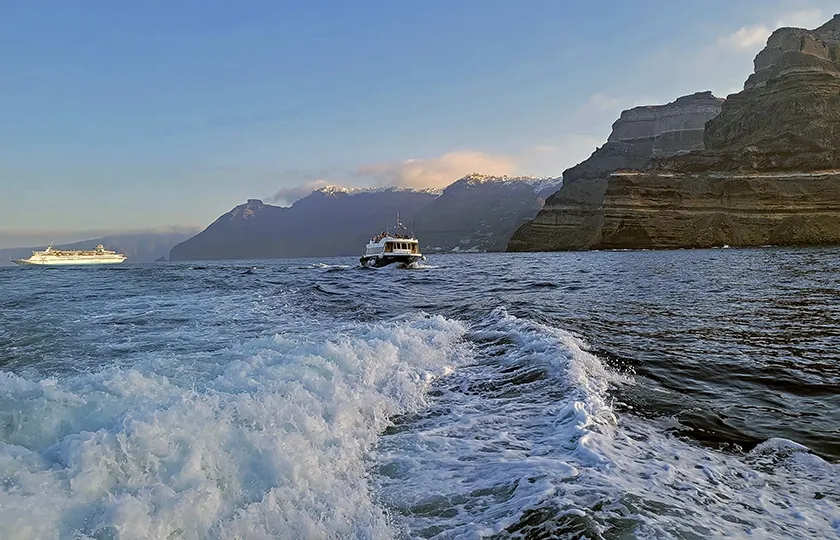
This important prehistoric settlement, which was one of the most important urban ports in the Aegean between the 20th and 17th centuries BC, is now an archaeological destination for travellers landing on Santorini. Although only 10% of this prosperous city that was frozen in time has been uncovered, the percentage has been sufficient to determine its evolved architecture, its drainage system (here we find the first bath in history, which was covered with stucco to make it cleaner) or that the villas were decorated with frescoes: an author’s photograph that portrays the magnitude of its flourishing era. Women, for example, wore make-up, had their eyebrows tweezed, tended to their red manicure and adorned their bodies with gold jewellery that, in the 21st century, is just as tempting. Their bare breasts were a sign of their fertility, and the red skin of the men with the stocky bodies, shaved heads and crazy dreadlocks (we can see that the hair fashion of the present day brings nothing new) was a testimony to their labours under the sun.
The travelling and merchant nature of this Minoan civilisation is also evident in the plants depicted in the paintings, many of which were not indigenous to the area. Some of them have been found in the so-called Xeste 3, a large building with two floors and fourteen rooms per floor. The most interesting frescoes that ornamented the interconnected rooms are those of the Altar and the Saffron Gatherers. In the first, three women are framed by a field of flowering crocuses and an altar. In the second, female figures are busy collecting them to offer them to a goddess guarded by a blue monkey and a griffin. Even today, this valuable spice can still be collected in Santorini, from which they obtained the red dyes to complete a graphic testimony in which some swallows are flying overhead.
Celestyal Cruises, RSC on the sea
The importance of the destination is part of the philosophy of this Greek shipping company and its various cruises in the Eastern Mediterranean, where the ancient culture of Greece blends naturally with cities where the 5 calls to prayer purr in the air. Both the smaller 1,200-passenger Celestyal Crystal and its bigger brother, the 1,450-passenger Celestyal Olympia, offer a classic style and functional ambience for those seeking a cruise among ancient cultures rocked by the sea light of the Mediterranean. Its Spanish-speaking crew, recognised as one of the most hospitable in the sector, is one of the advantages appreciated by the many passengers from Spain, the USA and South America. Also the ease of the destinations visited, as the small size of the ships allows them to dock in the smaller ports and islands of Greece and Turkey.
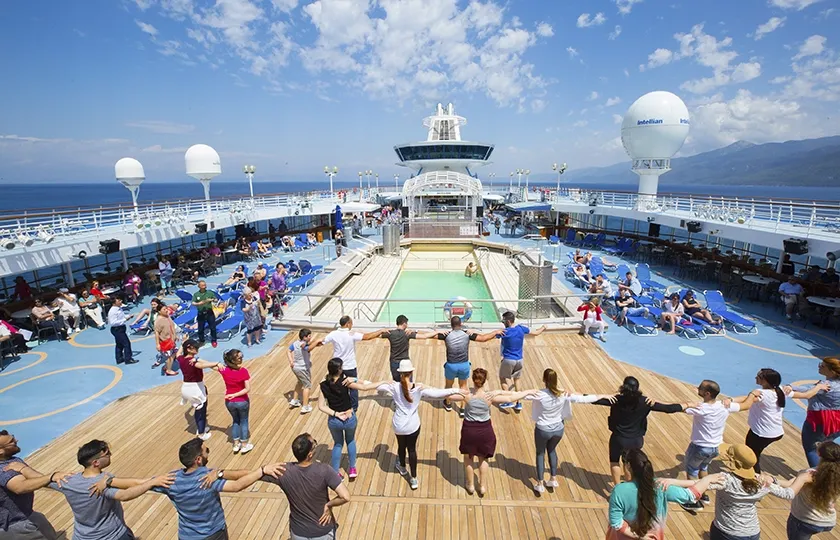
This is the case of the so-called Eclectic Aegean, a 7-night cruise which, after visiting Istanbul (Turkey), Çanakkale (Turkey) and, once on Greek soil, gems such as Volos, Heraklion, Santorini, Mykonos, docks in the port of Piraeus. If we are talking about an Idyllic Aegean crossing, the week-long cruise allows you to take the pulse of Kusadasi, on the Turkish coast, and mythical Greek islands such as Rhodes, Heraklion, Santorini, Milos and Mykonos. For those who want a shorter, but equally interesting itinerary, the Iconic Aegean is the option to discover, over 4 days and 3 nights, why the Cyclades islands remain one of the most sought-after destinations in the world. In this case, Mykonos (Greece), Kusadasi (Turkey), Patmos (Greece) and Santorini (Greece) are the chosen temptations. An atmosphere akin to bliss.