Publicada en agosto 2024
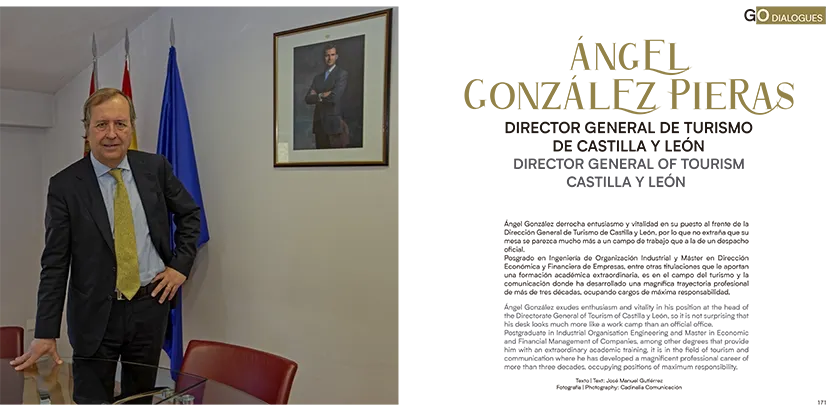
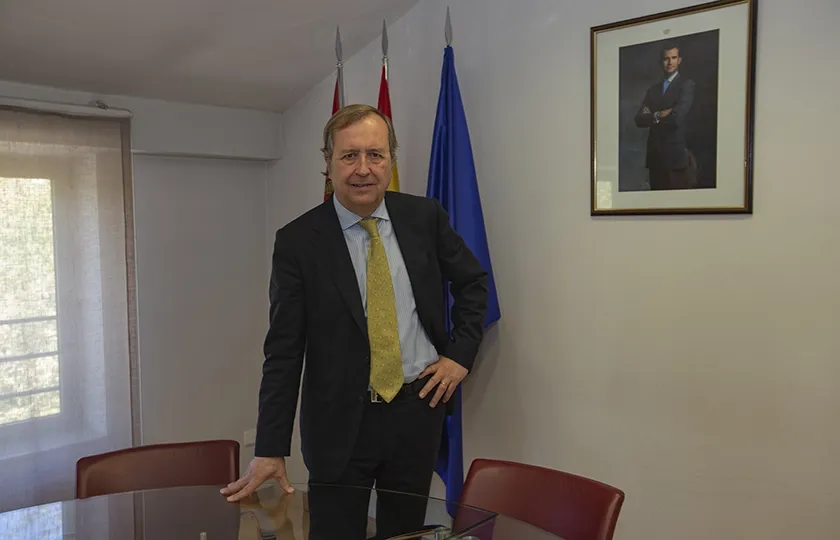
Ángel González exudes enthusiasm and vitality in his position at the head of the Directorate General of Tourism of Castilla y León, so it is not surprising that his desk looks much more like a work camp than an official office.
Postgraduate in Industrial Organisation Engineering and Master in Economic and Financial Management of Companies, among other degrees that provide him with an extraordinary academic training, it is in the field of tourism and communication where he has developed a magnificent professional career of more than three decades, occupying positions of maximum responsibility.
González Pieras recognises himself as a great lover of the region’s culture and a fervent defender of the different singularities of Castilla y León, those that make this extensive territory one of the most attractive in Europe, with special emphasis on its heritage, natural and enogastronomic values.
Since his arrival at the helm of the Directorate General of Tourism of Castilla y León in May 2022, one of the main objectives that mark his roadmap is not to lower his guard and not to relax because of the good figures that place Castilla y León above the national average. Consequently, it works tirelessly to consolidate the region’s position as a leading national and international destination for inland and rural tourism, listening to all the players on the tourism scene, actively participating in the design of new promotional strategies and being present at all the events that influence the decision-making process of the target tourist.
Q.- Castilla y León is one of the largest and most heterogeneous administrative units in Europe. What lines of work are being followed to combat clandestine activity, intrusion and unfair competition in such an extensive territory?
A.- The Junta de Castilla y León has two fundamental tools, which are its own regulations and administrative police.
The first is to regulate tourism activity itself, understood as any professional service aimed at meeting all external demand and with an economic consideration, thus contributing to the creation of wealth in the territory.
The administrative police is understood to be the group of inspectors who provide their services from each of the territorial delegations of the Junta de Castilla y León. In addition, we have recently asked local councils with local police to help us in the tasks of surveillance against the scourge of intrusion, as this practice harms both the economy of professionals and the Administration’s own coffers. We hope that this initiative will be well received by local administrations.
Q.- Insofar as tourism can generate a transversal development of the rural economy of Castilla y León, what steps are being taken in terms of infrastructures to combat depopulation?
A.- Our main objective is to help the provision of services and the creation of infrastructures that improve external demand, generating an impact on the internal economy, and then there are other derivatives. This is what I call destination creation.
I don’t really like to talk about rural territory or rural tourism. I prefer to talk about inland tourism, although it is true that the former is already a highly developed brand. Well, our action to promote infrastructure will be developed along several lines:
- We have an Order for aid for tourist infrastructures aimed at local entities with less than 20,000 inhabitants.
- As a novelty, we have launched a call for applications, which ended on 27 March with great success, for the creation of products of regional tourist interest of all kinds, both primary and complementary.
- We are keeping alive our Caltur programme for the promotion of tourism quality for for-profit entities, i.e. commercial companies seeking to improve the quality of their services. In this call we have focused a lot on one of the issues that we consider fundamental, as it has a direct impact on operating costs, namely energy efficiency. I encourage all businesses in the sector to read the call, especially in the hotel and catering industry, as it means changing towards a positive energy balance, such as replacing an old energy-intensive refrigeration system with a new energy-efficient one, implementing a more efficient energy management system, and so on. or installing alternative sources, such as solar panels.
- A few days ago the order was published for the call for grants for something that seems to us to be very important. We are talking about the management of tourist destinations or products, because we put a lot of emphasis on quality, which is very good; on cost reduction, which is great; on infrastructures, which is also very good, but we often forget about management and we have realised that non-profit organisations play a very important role in this, that is to say, associations and foundations that carry out their work in the field of tourism in an excellent way.
In this way, with this new call for applications, we are closing the circle of aid to all those involved in tourism in Castilla y León. This is our way of helping to ensure that the quality of supply and management is in line with the changing and particular demand that we have been seeing since last year and after having overcome a pandemic as decisive as the one we have had to suffer.
Q.- What is your assessment of the current situation in terms of tourists' rights?
A.- I am very proud to say that Castilla y León is one of the autonomous communities in which tourists are most protected in all respects. Coming from the other side, i.e. as a product provider and manager of tourism companies, I am happy to recognise how protective the regulations are of the customer.
Q.- What role do security and digitalisation play in the tourism framework?
A.- For us, as an Administration, it is essential to know where we stand in a very international and open tourism market, in which Castilla y León has to play its trump cards. The starting point is to make an analysis to get to know the demand perfectly. At the moment we see that the trend is towards a selfish tourism, very individual and to the detriment of mass tourism. Even the concept of leisure tourism is now being superseded.
That is why we are committed to unique tourism, that type of traveller who values the experience, which leads us to value a model of sensory tourism that is very much in line with the quality of what Castilla y León has to offer. We are international leaders in heritage tourism and national champions in food and wine tourism, something that harmonises perfectly with the sensory expectations of our customers.
Tourists visiting Castilla y León place a high value on security, both physical and legal. Proof of this are the latest crime reports, which place the region among the lowest in Spain for the commission of criminal acts. On legal certainty, one of our legislative commitments is to change regulation, something we are already working on, with the drafting of up to nine pieces of legislation to enhance the safe customer experience.
In terms of digitisation, we have a programme with three territorial plans, 21-24, 22-25 and 23-26 financed by Next Generation funds with a chapter exclusively dedicated to digitisation. In addition, together with Segitur, we are also promoting the consolidation of smart destinations.
In this digital scenario it helps us a lot to establish a feedback between supply and demand. A few days ago we presented a new highly interactive website and we are working on the creation of an ambitious digital platform with a budget of nearly five million euros, which aims to connect supply and demand in an efficient way, as well as to be an advanced tool that allows a permanent prospective analysis of future trends and to anticipate the evolution of the issuing markets themselves.
Q.- The Camino de Santiago is the backbone of Castilla y León. How does this secular milestone affect the region with the most kilometres in Spain and what actions are being taken by the regional government to consolidate the upward trend?
A.- As Commissioner for the Pilgrims’ Routes to Santiago de Compostela and, even before that, as a pilgrim, I would point out that a pilgrim is someone who goes to Santiago de Compostela, as a “romero” is someone who goes to Rome or a cruiser is someone who goes to Santo Toribio de Liébana to venerate the “lignum crucis”, a relic closely linked to our region, as it was taken by a monk from Palencia from Astorga to its present location in San Martín de Turieno in the Cantabrian valley.
I think that the Way of St. James is the spiritual and cultural soul of Europe, along with that of St. Martin of Tours and Rome. From this point of view, I believe that we are destroying the Camino if we forget its essence as a pilgrimage route for spiritual growth, but from my position I must ensure that today’s tourist is tomorrow’s pilgrim or that today’s pilgrim is tomorrow’s tourist. This should not divert us into misuse of terms or into the excessive commercialisation that is taking place in other regions dear to our hearts. What we should not do is let something lose its essence and if the Camino de Santiago loses its essence as a pilgrimage route it will have lost all its fundamental value.
In Castilla y León there are fourteen other pilgrimage routes, both traditional and historical, which we should not forget.
When I arrived at the Directorate General for Tourism, the first thing we did was to analyse the French Way of St. James and the Master Plan was presented with our conception of what should be the lines of work to safeguard the essence of this important pilgrimage route.
In relation to the other Caminos de Santiago, I have regular meetings with the members of all of them, to whom I have suggested that they become a single association to work towards a common goal and avoid disintegrating efforts towards individual interests. The creation of this new association has been a great joy for me, as well as the fact that they are echoing the competitive calls for applications to obtain the subsidy for non-profit organisations that I mentioned earlier. I also look forward to your collaboration in drawing up the new Master Plan for the other pilgrimage routes that cross Castilla y León. In line with what was mentioned in another question, regarding the signposting that these roads may need, there is a line of aid for local entities with less than 20,000 inhabitants, which can apply for this infrastructure improvement on a competitive basis, without the need to wait for the Master Plan to be completed. It should be clarified that this line of aid is also applicable to other recognised tourist routes and all those that make up a tourist product approved by the Administration.
Q.- The Junta de Castilla y León has recently launched an initiative to promote 14 tourism sustainability plans. What do they consist of and to what extent are they a further step towards a global concept of sustainable tourism?
A.- Within the territorial plans 23-26 that I mentioned earlier, the Junta de Castilla y León is firmly committed to sustainability and sustainability. From my professional experience of many years, what scares me is that we get lost in the concepts. A tourism offer has to be sustainable and sustainable in a real and practical way. What interests me is that there should be tourism companies, offers and tourist destinations that are coherent with the market, that respect heritage, culture and nature, which is already “per se“ sustainable and that, in addition, is sustainable through good management. If this pairing does not become a reality, everything will remain empty and demagogic.
Q.- In quantitative terms, what are the tourism forecasts for 2024 in terms of both turnover and job creation?
A.- We can describe 2023 as a very good year, beating even some historical records, such as in the creation of tourism employment, for example. Here I would like to make a reflection: let us not get lost in the numbers, in the number of travellers, although I am concerned about some nuances, such as average stays in tourist accommodation, and we must continue to work on this. However, it is quality rather than quantity that should be the main focus of our efforts. The quality of service provision implies a certain critical dimension towards attracting tourists with higher purchasing power, which has a direct effect on increasing the generation of income in the territory.
The key part of sustainability is the quality of service over a critical mass, targeted at a demand with a higher spending capacity. That for me is the obsession above absolute numbers and therefore it is just as important to be clear about what a critical mass in supply and demand means, as it is to not miss the opportunity to develop important tourism projects because of a shortage of qualified personnel or a shortage of housing in places that are spectacular for their primary resources. This reality is of particular concern to me and that is why we are attaching so much importance to projects of regional tourist interest. We must think in the medium and long term.
Q.- What role do the Posadas Rales play in the objectives of tourism excellence?
A.- When I first arrived at my post, the first meeting I had was with the Easter Week confraternities. Then it was on to the Posadas Reales and I found a disappointed, divided and lacking in confidence, something I personally attribute to the past track record of the Directorate General for Tourism itself.
Posadas Reales is the Department’s own brand, and in view of the existing reality I set out to turn the tables, something I believe we are achieving. From the point of view of tourism in Castilla y León, it is one of the jewels in the crown for combining heritage tourism with our commitment to food and wine. This is achieved through its quality service, its contribution to heritage conservation outside the cities, by establishing a heritage and gastronomic brand image and by contributing to the consumption of km 0 products.
I am proud to think that very soon Posadas Reales will have a new website and that entrepreneurs will be able to do joint marketing. In addition, having been constituted as an association, they will be able to access the aids that we have already mentioned for management by non-profit organisations. However, in line with our clear commitment to quality, the quality standards applied to the Posadas Reales are non-negotiable.
Q.- Nature tourism is another of the region's assets due to its undeniable ecological value. How are you working to conserve the natural environment in harmony with the sustainability of this niche market and the development of rural tourism?
A.- First of all, I think that we need to define what Nature Tourism is and what the requirements are for making an offer and providing a service in this field, as until now it has been confused with what we understand as Active Tourism. We are going to be the first autonomous community with an exclusive decree to regulate Nature Tourism. The aim is to clearly differentiate the requirements that companies must meet in order to provide a Nature Tourism or Active Tourism service, especially now that activities such as Observation tourism and Star tourism, for example, are becoming so fashionable.
By the way, Nature Tourism, Active Tourism and Rural Tourism have been the protagonists of the reflection on the sector in the first Conference on Active and Nature Tourism that took place last May in Cervera de Pisuerga with the sponsorship of the Regional Ministry of Culture, Tourism and Sport of Castilla y León, in collaboration with the Provincial Council of Palencia. In this same report, we highlight our firm commitment to the relaunch of Naturcyl, the nature tourism fair to be held at the Real Sitio de la Granja de San Ildefonso next September with a very international character.
In addition, the new website offers a virtual tour of the thirty-four Park Houses spread throughout the region’s natural areas.
Q.- Looking to the medium and long term, where would you like to see Castilla y León in the global context?
A.- Tourism is the union of tourist destinations formed by tourist products, which in turn are the result of the combination of primary and complementary resources. Having said that, we must recognise that Castilla y León is a region very rich in impressive primary resources: we have nearly five hundred castles, fortresses, oppidum, watchtowers, four hundred monasteries, more than 20% of our territory has some kind of environmental protection, one hundred and thirty urban centres declared Historic Sites, nine World Heritage Sites, fantastic gastronomic resources, the best Wine Routes, the best Easter Week in Christendom. All of this together puts us in a position of undisputed leadership, so my greatest wish is that all these resources are well managed and that the quality complementary offer accompanies our heritage treasure in harmony and proportionally in an experiential, sensorial, digital, sustainable and sustainable way. And, of course, that everyone’s efforts contribute to alleviating depopulation and that so many marvellous places do not simply remain on a nostalgic level.