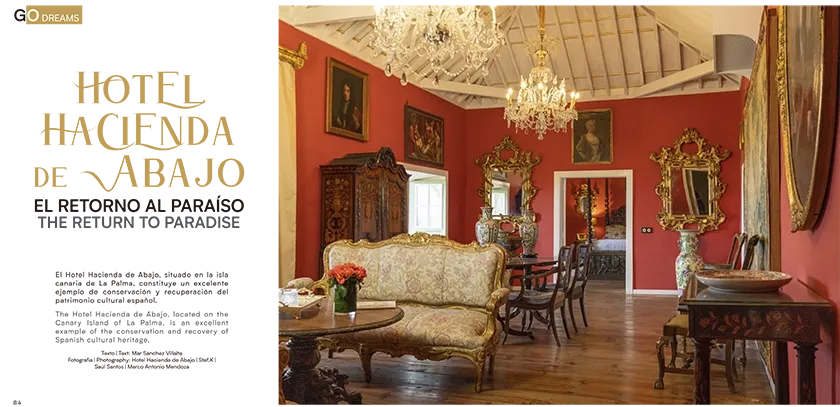
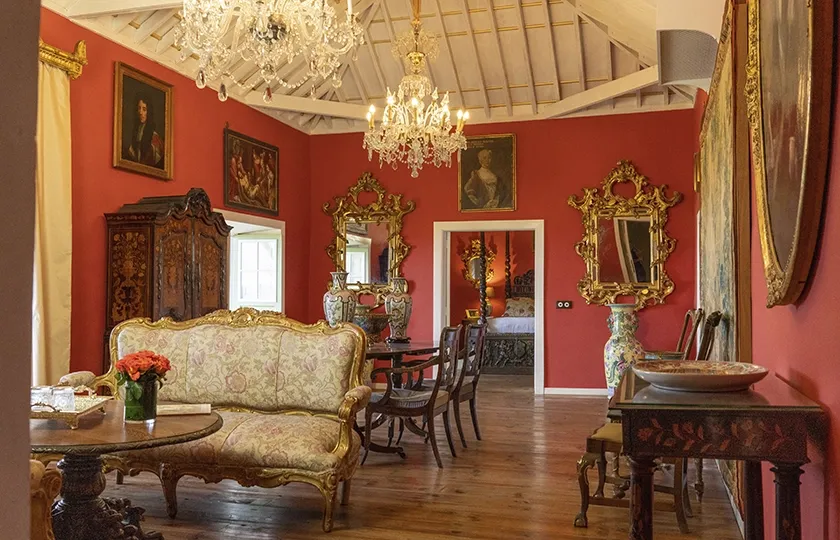
The Hotel Hacienda de Abajo, located on the Canary Island of La Palma, is an excellent example of the conservation and recovery of Spanish cultural heritage.
With great enthusiasm, a very important part of one of the most important and oldest sugar estates in the Canary Islands has been restored, which is fundamental for understanding a model that was later transferred to Hispanic America as part of the Atlantic sugar route, which from the 16th century onwards had the ports of Santa Cruz de La Palma and Antwerp as unavoidable points of reference.
This is an integral and very singular intervention, which is not limited to an old ancestral home, the Main House of Tazacorte, but also to its extension and to the newly constructed buildings, their contents and their exterior, ensuring that the new tourist use enhances respect for a cultured traditional Canarian architecture that was integrated into the surroundings and whose sumptuous objects and carefully tended gardening were the hallmark of its most prestigious houses.
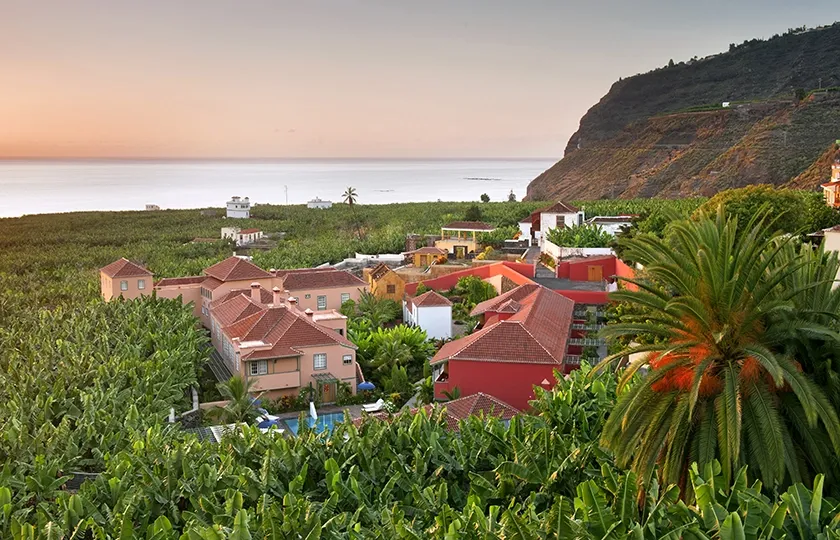
The Main House of Tazacorte is a property that is part of the historical heritage of the Autonomous Community of the Canary Islands and is located in Tazacorte, on the west coast of La Palma, very close to the port and the sea.
Built in the 17th century, it is still owned by the descendants of Mrs. Catalina Cecilia de Sotomayor Topete y Alzola.
The house of the bond founded by this lady forms an important part of the so-called Hacienda de Abajo, the first and oldest sugar plantation on the island of La Palma, as well as the richest and most productive and one of the most important in the Canary Islands since its formation after the conquest of the island in 1492 and the definitive purchase of the property by the Flemish knight Don Jácome de Monteverde in 1513, with whom it began its period of greatest splendour.
Careful refurbishment for the first emblematic hotel in the Canaries
The careful restoration of the old hacienda, the magnificent collection of works of art and the garden of botanical rarities stand out, as well as the fact that in 2013 the Council of Ministers awarded its owners the Medal for Merit in Tourism in Sustainability and Quality and one of the Hispania Nostra Awards for Best Practices in the Conservation of Cultural Heritage in the category of Heritage Conservation as a factor in economic and social development.
The Hotel Hacienda de Abajo becomes the first emblematic hotel in the Canary Islands with thirty-two rooms, chapel, restaurant, bar and small spa. It generates an important economic activity in an environment that has seen the birth of many small businesses related to this hotel. Indeed, it generates employment, sometimes very unique and qualified, such as that required for the conservation of the collection of works of art, attracts residents to a municipality whose obvious charms are being discovered more and more each day, stimulates investment in buildings that are part of our cultural heritage and seduces a visitor of a high economic and cultural level who wants contact with art and nature in a unique environment far removed from mass tourism. It is a hotel that has placed La Palma on the routes of international quality tourism and has made it possible, with its Main House, its works of art and its botanical rarities, to create a destination in itself and to show that cultural heritage can be maintained and increased and can complement the wonderful landscape-generating element that is banana growing.
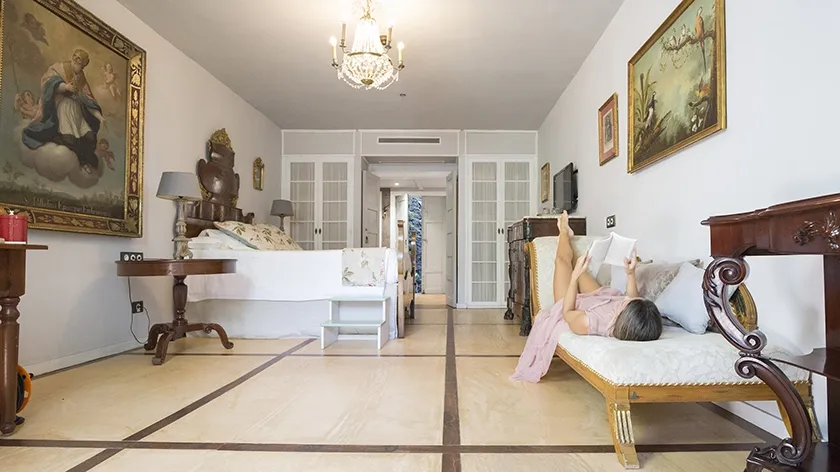
As one of the best examples of a sugar plantation in the Canary Islands, its rehabilitation also meant the materialisation of a pioneering project in our archipelago of converting historical heritage into a factor of economic and social development, as demonstrated by the fact that it is the first emblematic hotel in the Canary Islands, one of the most important autonomous communities on the international tourist scene. But it is also a hotel project that is being carried out on La Palma, an island with a rich cultural heritage and such a rich landscape that it has deservedly earned the name of Isla Bonita (Beautiful Island). The island’s rugged terrain (the third highest island in the world in relation to its surface area) and its pronounced smallholdings, with small estates that are as beautifully tended as lush gardens, prevent conventional mass tourism development on the island, but do allow for exclusive establishments such as the one in question, as it has a rich history and an important architectural heritage.
Hacienda de Abajo, a museum in itself
In addition to saving from destruction and oblivion one of the few remaining examples of the urban fabric linked to the cultivation of sugar from the 16th to the 18th century, and which would have such an influence on Hispanic America, this hotel, with its collection of more than 1,300 works of art, has brought about the greatest contribution of artistic heritage to La Palma since the 17th century and the creation of jobs related to its conservation, something truly unique in a tourist establishment.
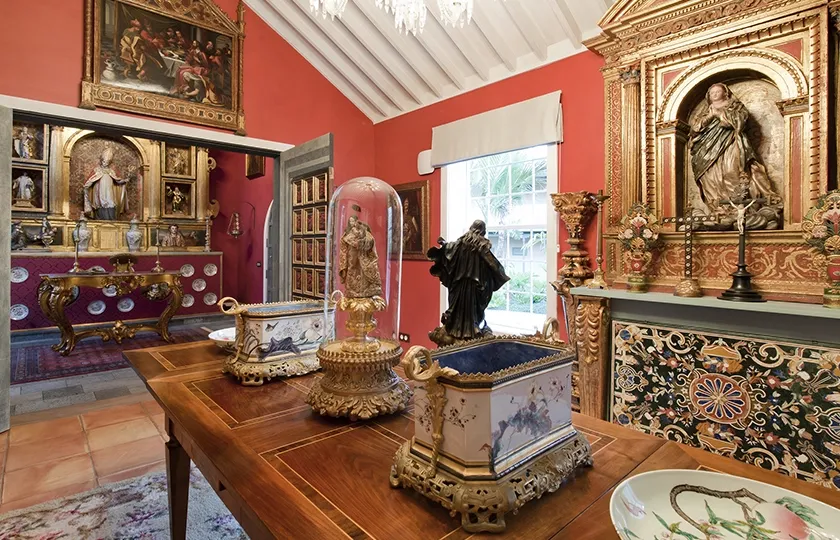
The Hotel Hacienda de Abajo has recovered the rich contents of the houses of the lords of the hacienda. From the 16th century onwards, sumptuary objects were imported for ornamentation from trade with different parts of the world. Thus, tapestries, furniture, devotional imagery, mirrors, paintings, carved silver and even delicate Chinese porcelain came from Antwerp, the international centre of the sugar trade, Seville and the Indies via the voyage that began with the Manila Galleon and continued with the Indies Fleets. Valuable French and Flemish tapestries from the 16th, 17th and 18th centuries (the best collection in the Canary Islands), an excellent art gallery with works dating back to the 15th century, Chinese porcelain and statues from the Tang, Ming and Qing dynasties, European religious carvings from the 16th to 18th centuries and all kinds of other sumptuary objects constitute an incomparable contribution of artistic heritage. For this reason, Historic Hotels Worldwide listed its collection of works of art among the top twenty-five in the world.
Respect for the environment is fundamental at Hacienda de Abajo
This is also a project with a strong environmental concern. The reuse of old materials, a very small building footprint, the adaptation of the building to the climatic conditions of the environment, the extent of ecologically treated green areas and the use of clean energy (biomass) are good examples of this.
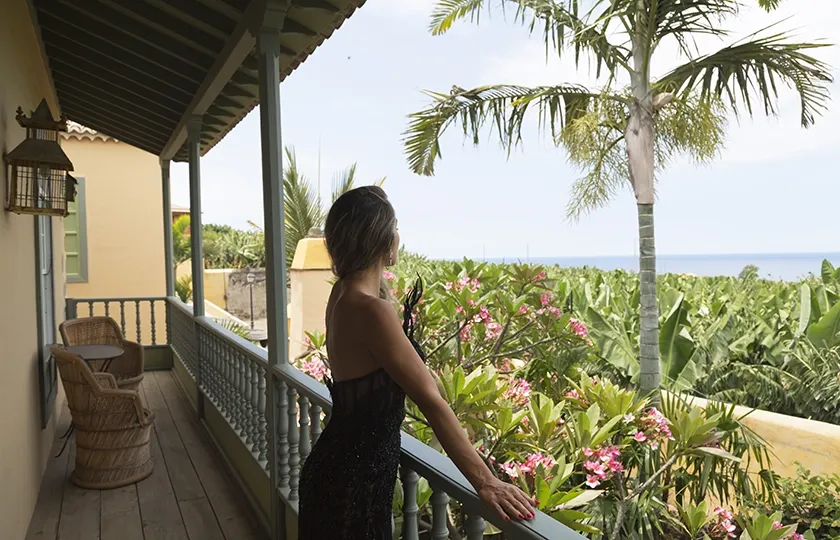
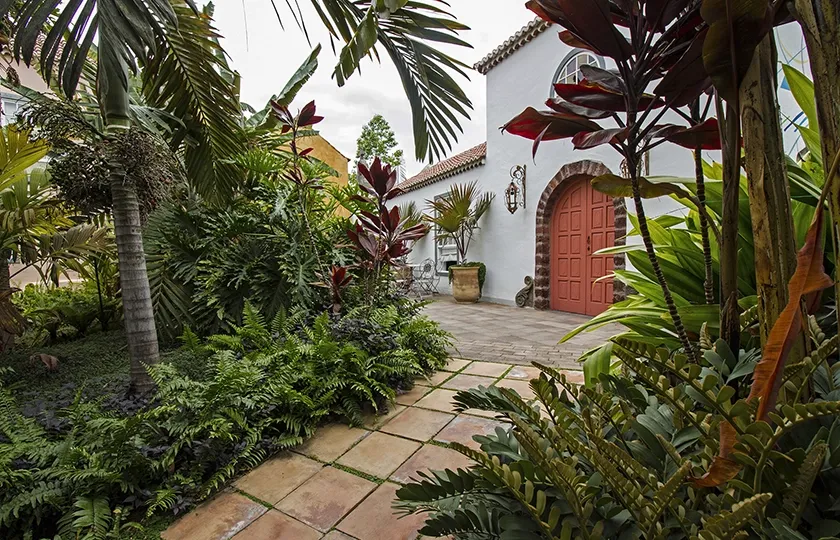
Recovery and inspiration in a traditional architecture that for centuries allowed man to live in perfect harmony with an abundant nature and in the insular tradition of love for flowers and plants to create the best private garden made in La Palma since the 19th century. This garden occupies the former orchard of the hacienda, a famous acclimatisation garden where the existence of banana trees on the island is first documented in the Partición Grande of 1613. In fact, at that time, different types of trees, vegetables and banana trees protected by a wall delighted the inhabitants of the neighbouring houses, while at the same time satisfying their needs. With the passage of time, the orchard has become a garden where exotic species from all over the world acclimatise in one of the best climates in the world, irrigated with water from La Caldera de Taburiente, now a national park, which flows through an ingenious system of canals, aqueducts and irrigation channels that is still in use today.
Gastronomy, another artistic manifestation
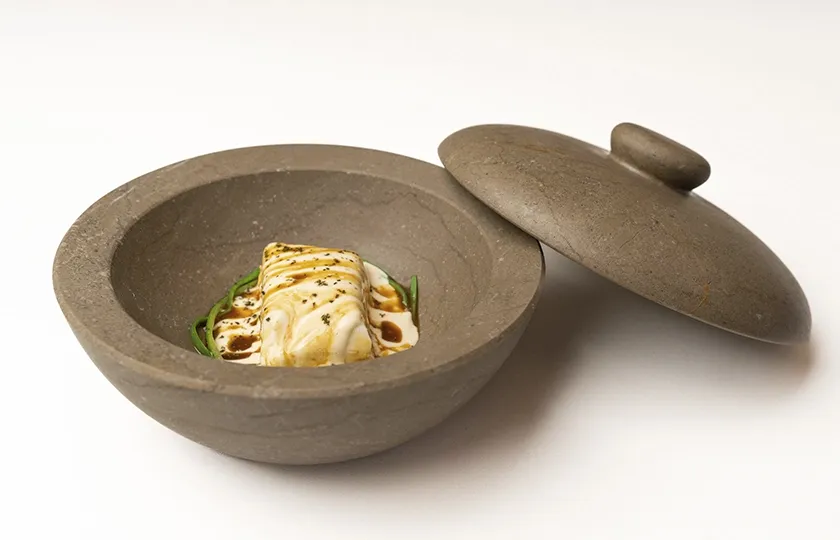
The Hotel Hacienda de Abajo could not forget one of the great artistic facets, which is gastronomy. His restaurant, El Sitio, is considered one of the great restaurants of the archipelago, awarded with a Sol Repsol. Its head chef, José Alberto Díaz, offers a menu based on regional cuisine with strong international influences, as it could not be otherwise on an island as multifaceted and multicultural as La Palma. The products of the land and of our Atlantic Ocean are masterfully blended to produce a varied offer designed to be enjoyed.
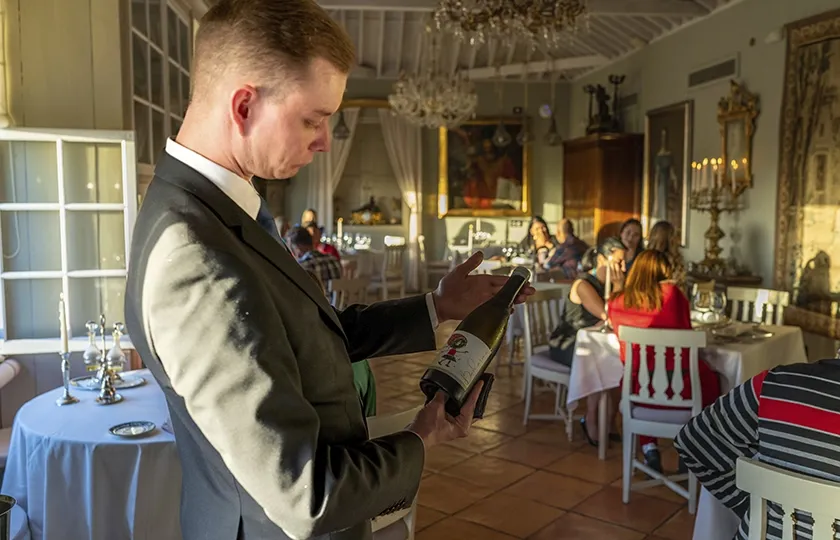
Dishes such as roasted carrot salmorejo, pickled vegetables and palmero cheese or ceviche with mango parchita (exotic fruits grown on the island), as well as creamy saffron grouper casserole with black potato and crispy sweet potato strips and the irresistible marriage of chocolate and hazelnut are perfect examples of a cuisine that boasts of making the most of all the influences that have arrived on La Palma since the 16th century. And for the most sybarites, the restaurant has a surprising tasting menu in which in nine courses you can try fifteen different preparations, paired with a carefully chosen selection of wines and other drinks carefully chosen by the head waiter Daniel Sánchez, a real explosion of flavour and sensations that cannot be adequately described without first having enjoyed them.
The Hotel Hacienda de Abajo is a dream on a dream island, the best historic hotel in Europe for Historic Hotels Worldwide in 2021, which can hardly be described, because how can you describe in simple words the beauty, the tranquillity, the calm, the joy and the affection of an island, our beautiful island, of which Hacienda de Abajo is a true reflection? What this island is: a pine forest, a profusion of palm trees and a blanket of banana trees under an indescribably starry sky and an ocean so blue it will never leave you indifferent.