Stunning landscapes, unforgettable hikes, a captivating colonial heritage, and sublime cuisine. This eternal paradise offers all this and more.
Just a ninety-minute flight from Lisbon lies the Madeira archipelago, which comprises two inhabited islands (Madeira and Porto Santo) and two uninhabited islands (the Selvagens and the Desertas). The island of Madeira, which gives its name to the archipelago, is the largest – roughly the same size as Menorca – and is home to virtually the entire population.
When the island of Madeira comes into view through the aeroplane window, it feels as though we’re about to land in paradise. Located less than 500 kilometres north of the Canary Islands, its geomorphology is reminiscent of the Fortunate Islands. Once at Cristiano Ronaldo Airport, named after the city’s favourite son, the wonderful weather with very mild average temperatures gives us a taste of what the rest of our trip will be like.
To get a feel for what the island is like, we set off from its capital, Funchal, and headed for Madeira’s third-highest mountain: Pico do Arieiro. Perched almost in the centre of the island, the views are breathtaking. From here, you can walk along some of the attractive trails, such as the one leading to Pico Ruivo. Just off this peak, although you have to take a long detour along the road, lies: the Paredao Viewpoint. From this vantage point, you can see a curious village down in the valley: Curral das Freiras, or the Valley of the Nuns, which owes its name to a group of nuns who, in the mid-16th century, chose this secluded spot as a refuge, fleeing the pirates who were constantly raiding Funchal; as a result, the sisters from the Convent of Santa Clara sought peace and quiet in this remote valley.
Winston Churchill lived here
Next, we head to another charming spot, the village known as Cámara de Lobos. It remains the island’s fishing port par excellence. It’s well worth a visit to the little harbour, where you’ll see colourful boats beached on a tiny pebble beach, whilst a few fishermen wander about. Others wander through its quiet streets or stop to chat by the fountain. It is hardly surprising that Winston Churchill used to come here for a while to relax and fully indulge his passion for painting.
Just a stone’s throw from Cámara lies another of the island’s landmarks, Cabo Giráo. It is one of the highest cliffs in Madeira and features a viewing platform with a glass floor that juts out over the edge of the cliff. It’s quite an imposing sight, and more than a few people will find it hard to look down. Another way to enjoy these views is to head to Fajá dos Padres, where you can take a cable car that spans the nearly 600-metre-high cliff, before descending at a leisurely pace – whilst taking in the scenery – to the small village of Fajá dos Padres, which has become a tourist destination, ideal for those seeking solitude and a close connection with the sea. It is also worth noting that, thanks to the excellent climate in this area, various types of fruit are grown here, such as bananas, mangoes, papayas and passion fruit, also known as maracuja.
From this part of the south of the island, we head north along the Serra da Água road, which, like almost all roads in Madeira, is characterised by its bends; however, in recent years, some fantastic tunnels have been built, and the motorways have significantly shortened the journey and provided an excellent transport network across the island. We stop at Madeira’s oldest and most iconic inn: the Posada dos Vinháticos. From here, the views are spectacular, particularly of the hill known as Lomba du Morro, which could well resemble a huge shark’s tooth.
The “levadas”: a UNESCO World Heritage Site
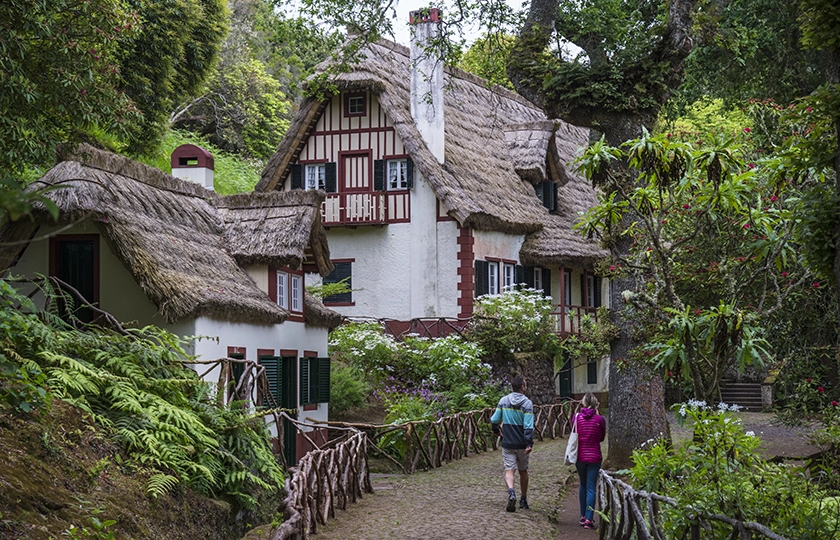
Once we arrived on the north coast of São Vicente and after visiting the stunning volcanic cave of the same name, we headed to Porto Moniz to enjoy the natural pools at Aqua Natura and the islands of Ribeira da Janela. Continuing eastwards along the coastal road, we approach one of the island’s most popular tourist destinations: Santana. The reason is that here you’ll find colourful, triangular houses with thatched roofs that bear a resemblance, albeit a distant one, to the huts of the Albufera in Valencia.
If there’s one reason why everyone wants to visit this Atlantic island – quite apart from its cliff-top views, its festivals, its cuisine and the colonial heritage of its capital, Funchal – it’s to go hiking along the famous ‘levadas’. The “levadas” are irrigation channels built over the centuries, which were constructed to carry water from the mountain peaks down to the valleys and hillsides. Thanks to these trails, which cover more than three thousand kilometres of protected areas, walking tours offer one of the best ways – both culturally and environmentally – to enjoy Madeira’s lush natural surroundings. We chose a trail that is exceptionally beautiful: the levada that runs from Queimadas to Pico das Pedras. What makes this trail special is that it is not only easy to walk, but also runs largely through a laurissilva forest. These forests, whose leaves resemble those of the laurel tree, are one of the island’s treasures and have been designated a World Natural Heritage Site, as they are the only forests to have survived the last ice age in South America and Macaronesia – that is, in Madeira, the Azores, the Canary Islands and Cape Verde.
Funchal: a capital city to delight in
All that remains is for us to say goodbye with a visit to the capital, Funchal. A magnificent Portuguese colonial city, with its Zona Velha – a former fishing district that has become the city’s most chic area – where tourists flock to its many restaurants for dinner.
During the day, don’t miss the Mercado dos Lavradores, a real institution in the city, as well as a visit to the Bordal embroidery shop or a tour of the most famous Madeira wine cellars: Blandy’s. It is hardly surprising that the people of Madeira have a particular fondness for their wine, which is renowned throughout the world and was also chosen to mark the celebration of US independence in 1776.
Another must-do is to take a stroll through the colonial quarter, admiring the Sé, the Praça do Município, with its magnificent Jesuit Church, the Palace of São Lourenço and the fortresses of Do Pico and Nossa Senhora da Conceição, situated right in the harbour, where we’ll take a boat to spot dolphins and, if we’re lucky, a monk seal.
To round things off, we took the funicular right in the city centre, which took us up to the Monte Palace Tropical Garden, considered one of the ten best botanical gardens in the world. All that remains to round off our visit is to step inside the Baroque Church of Monte, one of the most spectacular in Madeira, from where you can take in the whole city. It is worth noting that this church houses the tomb of the last Habsburg, Charles I, the Austrian emperor who went into exile here and did not wish to be buried in Vienna.
We’re off now, but not before sampling a “espetada” – grilled beef skewered on a laurel stick – accompanied by sweet potato bread “bolo do caco” and finishing with a “poncha”, the island’s most typical drink. And we said our goodbyes whilst enjoying the famous “Toboganes” or basket carts.
Traditional wicker carts with padded seats for two or three people, driven by two men known as “Barreiros”, offering a thrilling two-kilometre descent – adrenaline guaranteed. Hemingway said as much, describing it as the most exhilarating experience of his life. A unique experience we’ll never forget on this enchanted island.
Practical Guide
How to get there
There are direct flights to Funchal from Madrid and Barcelona in the summer.
There are also direct flights to Madeira from Lisbon all year round.
Where to stay
Hotel: Cliff Bay 5*, Funchal.
Perched on a cliff with fantastic views. The hotel boasts – and rightly so – of being one of the best on the whole island.
https://www.portobay.com/es/hoteles/hoteles-madeira/the-cliff-bay