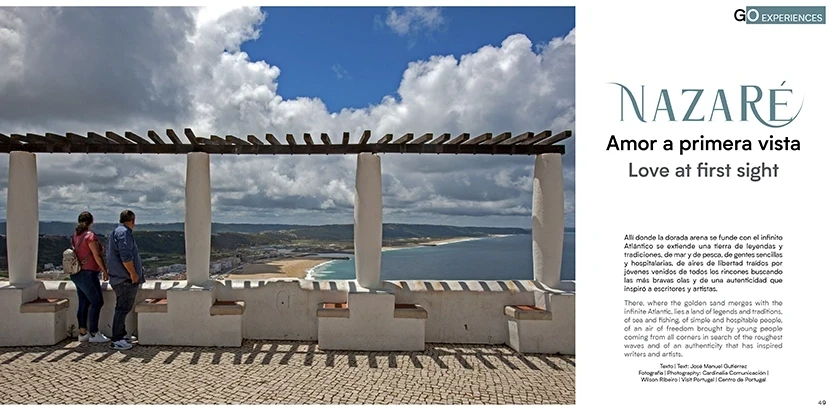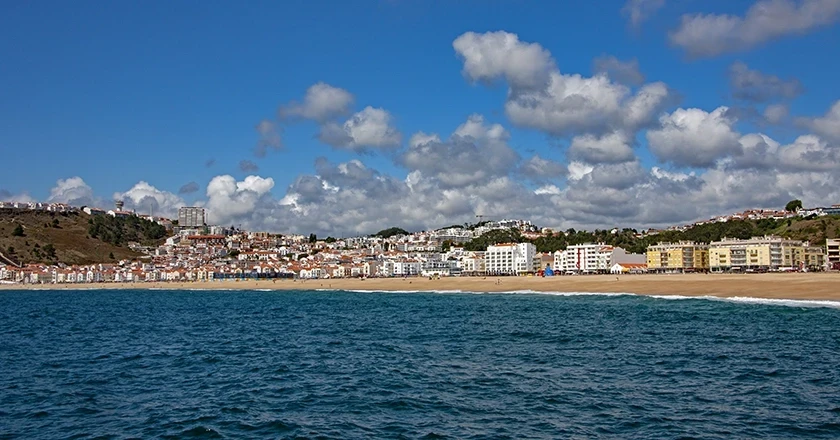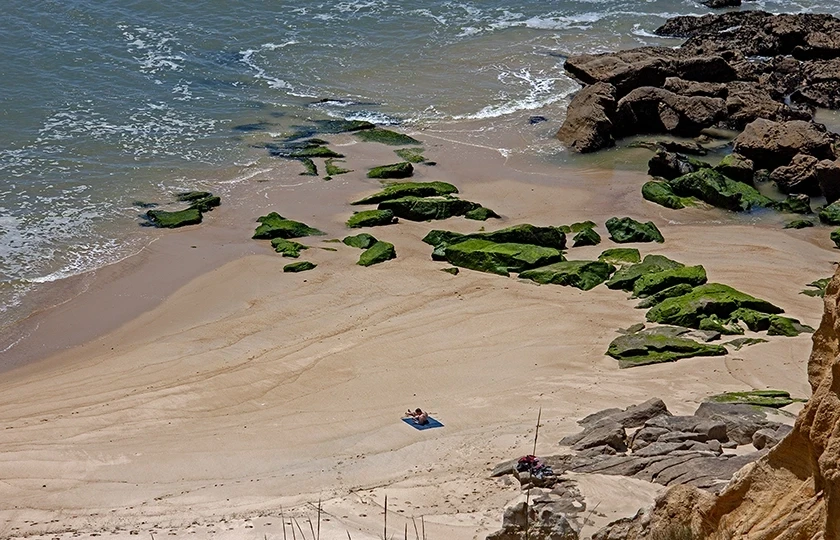
There, where the golden sand merges with the infinite Atlantic, lies a land of legends and traditions, of sea and fishing, of simple and hospitable people, of an air of freedom brought by young people coming from all corners in search of the roughest waves and of an authenticity that has inspired writers and artists.
Legend has it that back in the 12th century, D. Fuas Roupinho, a nobleman and warrior, possibly a Templar, was chasing a deer on horseback, but before giving chase he lost sight of it, only to suddenly come across an imposing cliff. With no time to slow his mount and in despair, he prayed to the Virgin for salvation. Miraculously he and his horse were unharmed and in his honour the knight had a chapel built at the top of the cliff, which later gave rise to the birth of a hamlet around it that would be the seed of Nazaré.
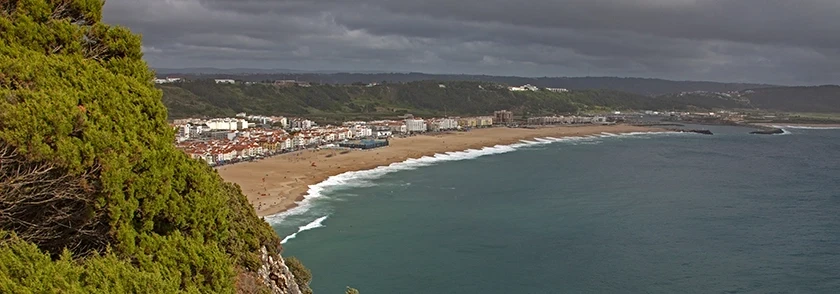
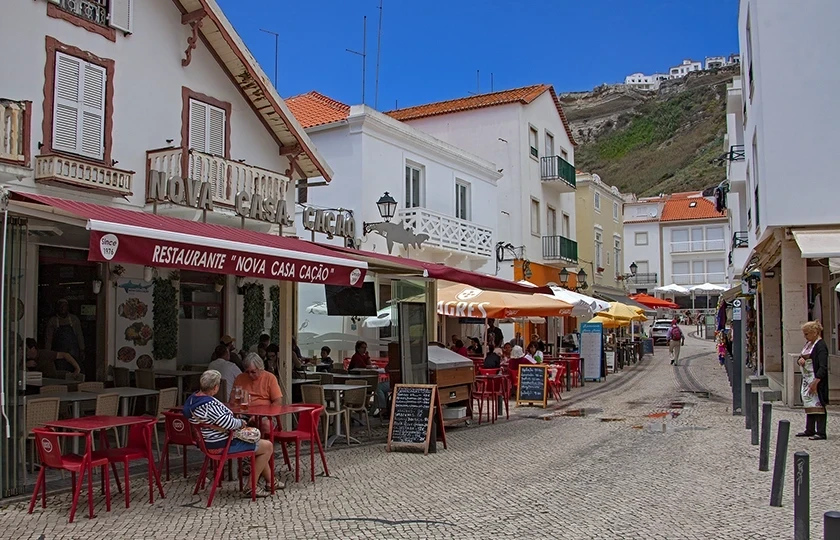
Considered by many artists as the “tenth muse”, the villa has a special charm that transcends the material. Strolling through its secluded streets, sheltered by the serene climate and accompanied by a gentle sea breeze, is a unique dreamy experience. The people greet you as you pass, even if they don’t know you, and even today it is still possible to see some women dressed in the unique seven-coloured flannel skirts known as “As sete saias”, something you will only see here and which further accentuates the sensation of being in a unique place.
To discover Nazaré is to abandon oneself to the magic of one of Portugal’s most typical villages, a place where the exotic is transformed into everyday harmony, with young people clad in modern wetsuits carrying their surfboards and framed in corners where time seems to have stood still.
A village embracing the sea
Nazaré is divided into three areas, Praia, Sítio and Pederneira, each with a different essence, but which together recreate an atmosphere that seems designed to arouse passions.
The oldest human records date back to prehistoric times, when people settled around what was an extensive sheet of calm, sheltered waters, rich in fish, called “Lagoa da Pederneira”.
Already in the Middle Ages, this enclave belonged to the nearby monastery of Alcobaça, for which fishing was an important source of wealth. It was from the 12th century onwards that it became known as Pederneira and, due to its seafaring tradition, several Portuguese kings granted privileges that encouraged the development of an important shipping industry, thanks to the construction of shipyards for the manufacture of boats.
Everything changed in the 17th century when the lagoon disappeared due to the decrease in sea level, distancing the population from the new coastline, which together with the appearance of the new beach and the growth of Sítio thanks to the increase in pilgrimages to the Marian sanctuary, caused the population of Pederneira to fall substantially.
Little by little, under the protective promontory of Sítio de Nazaré and along a golden sandy beach that seems to have no end, the first fishermen’s houses were built until the first count in 1780 with a census of 58 dwellings.
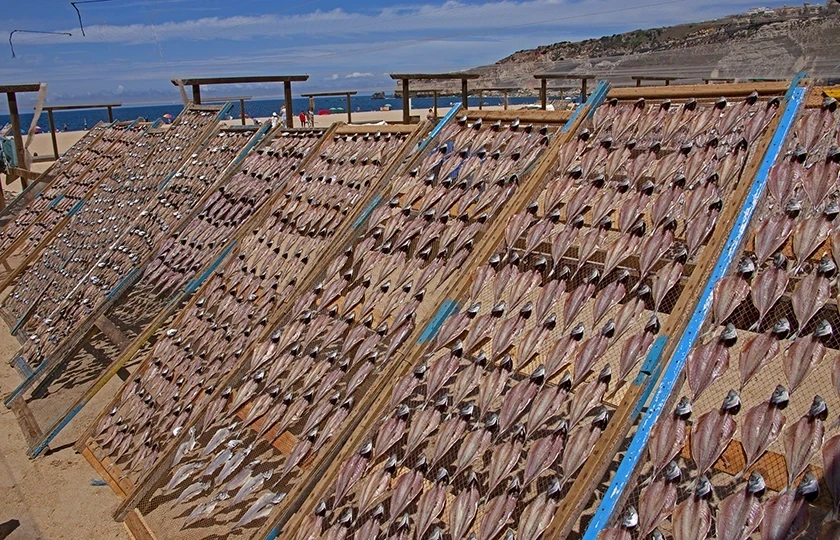
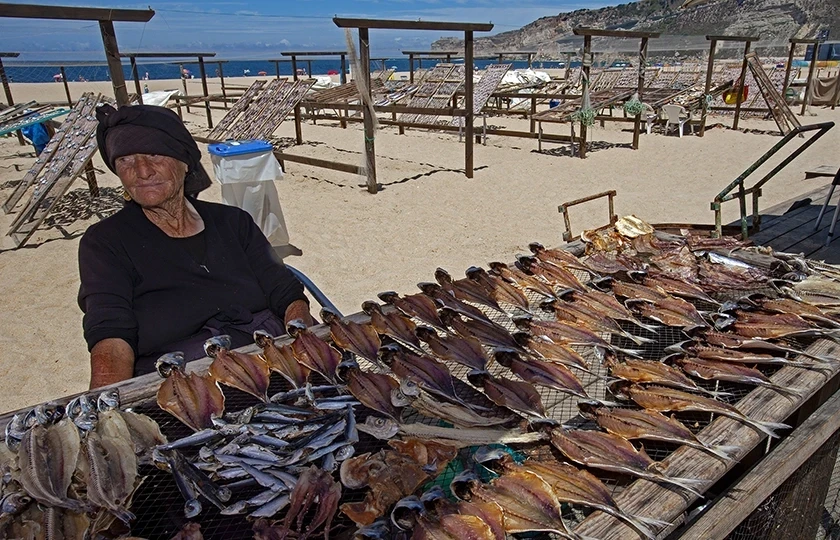
Without losing the seafaring essence with which it was born, in 1915 it was officially considered a tourist site, a new sign of identity that has been able to grow without eclipsing the original simple beauty. So much so that it is possible to stroll along the beautiful beach and contemplate the exhibition of traditional multicoloured fishing boats with inscriptions about life, as well as the fish drying sheds, mainly horse mackerel, and the stalls staffed exclusively by women, who are also in charge of cleaning and preparing the freshly caught fish on a daily basis. The fish drying rooms, the Interpretation Centre and the fish preparation area make up the Dried Fish Museum – Living Museum.
The origin of this preservation technique is not well known, but in Nazaré it consists of removing the viscera from the fish before washing it and placing it in a brine solution. It is then opened, spread out on supports and placed in the sun. This ancestral practice is visible every day, which adds a folkloric touch to the pleasant morning strolls overlooking the sea, not to mention the tempting visit to the market full of fresh fruit and vegetables or enjoying a delicious coffee and typical sweets.
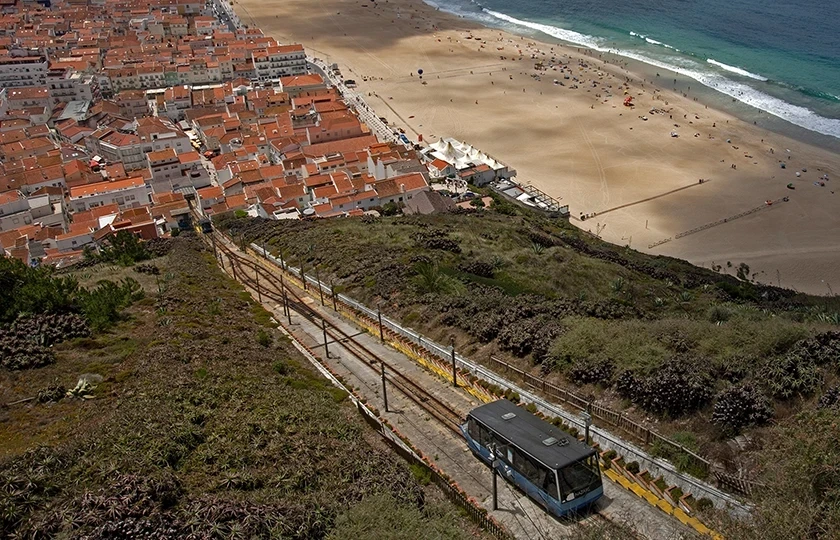
From Praia there is a hypnotic view that captures our attention, both because of the defiant mass on which Sítio sits and because of the constant flow of people who visit it. Inevitably the question is: how do I get up there? Very easy, just take the lift of “Nossa Senhora da Nazaré”, the iconic construction designed by one of Eiffel’s disciples and inaugurated in 1889. This ingenious solution, which covers 318 metres with a 42% inclination, put an end to the difficulty of reaching Sítio, favouring social and economic development, as well as the arrival of pilgrims to the sanctuary of Nossa Senhora da Nazaré.
Sítio, an enclave of faith and tradition
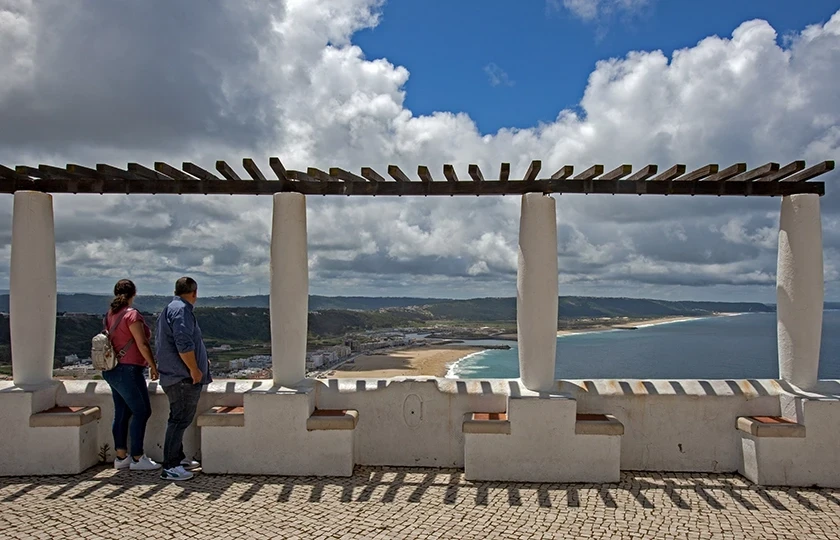
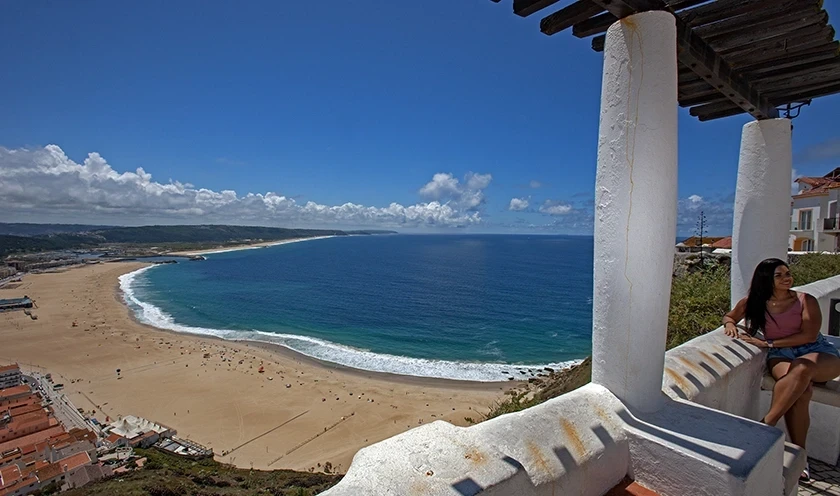
Situated at the highest point of the town, it is the best viewpoint imaginable and to walk around it means succumbing to the temptation to photograph a thousand and one details, hundreds of frames and to play with the changing light throughout the day. Up here everything revolves around the sanctuary, one of the oldest Marian places of worship on the Iberian Peninsula and the second most important in Portugal after Fátima.
The cult of Mary, whose image, found on the slopes of Sítio, is said to have made a long journey from Galilee to a monastery in Mérida and from there to the Atlantic village, is associated with the legend of the rescue of D. Fuas Roupinho, who ordered the construction of what is known today as the Chapel of Memory, located at the other end of the square overlooking the sanctuary. It was built in the 14th century and after many alterations, in 1691 it was given the configuration of a Latin cross plan similar to its current appearance.
In 1709, commissioned by the rector Antonio Caria, the interior was decorated with six thousand five hundred and sixty-eight tiles made by a Dutch firm and designed by the ceramist Williem Van der Klöet. This decorative ensemble is considered to be the best example of Dutch ceramics in Portugal, representing biblical episodes of Joseph and David and two scenes from the life of Jonah.
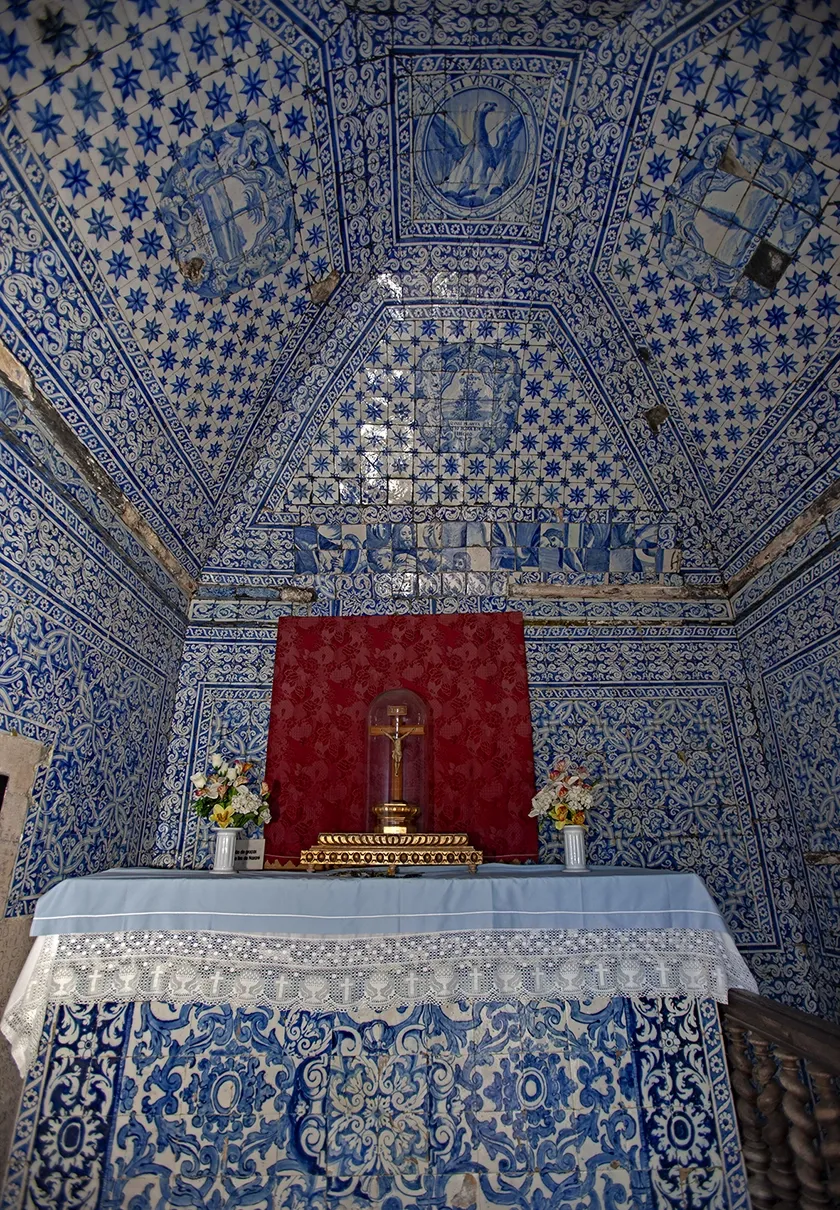
The main altar is presided over by a late 17th century altarpiece with gilded carvings and Solomonic columns carved in marble. On the throne is the venerated image of the Virgen de la Leche with the Child in her arms, a carving made of dark olive wood surrounded by a gold-embroidered knob.
Behind the sanctuary and in a very discreet plane stands the Chaby Pinheiro theatre, possibly the most representative civil building in Nazaré. Built at the beginning of the 20th century by Ernesto Korrodi & Thierega, it stands out for the sublime woodwork of the auditorium and the galleries, as well as the pictorial work of Francisco Aires who signed the ceiling frescoes and the screen that opens the stage.
The generously sized square in front of the sanctuary, in the centre of which stands a romantic bandstand, is a constant coming and going of pilgrims and tourists, filling with life and colour the antechamber to the natural views offered by the enclave.
Leaving the square heading west, a pleasant walk with incredible views of the sea and the mythical North beach of Nazaré, we arrive at the “Fort of São Miguel Arcanjo”, where the boards offered by the surfers are displayed as a sign of respect for the waves on which they ride. Built in the 16th century on a rocky breakwater, its defensive character of the beach and the village against the attacks of Algerian, Moroccan and Norman pirates is still palpable in each of its rooms.
From the sea the waves and a new pilgrimage
In the last few decades Nazaré has become the dream destination of every surf lover in search of giant waves, those that between November and February exercise a unique choreography in the world.
The origin of this exceptional natural phenomenon is to be found many metres below the surface of the sea. The Nazaré Canyon is an underwater depression in the shape of a funnel descending towards the coast, five thousand metres deep and two hundred and thirty kilometres long. Through this underwater highway, water rushes in from the open sea towards the coastline in front of the cliff on which the fort of San Miguel Arcangel rises, emerging and meeting the Peniche wind to form huge tubular waves that make Nazaré a world-renowned surfing destination.
Praia do Norte is a scene of contrasts, going from its paradisiacal golden sand and crystal clear waters outside the surfing season, to the fearsome and beloved waves of almost thirty metres high.
In this setting of extreme beauty on 29 October 2020, German Sebastian Steudtner set a world record on the biggest wave ever surfed with a height of 26.21 metres.
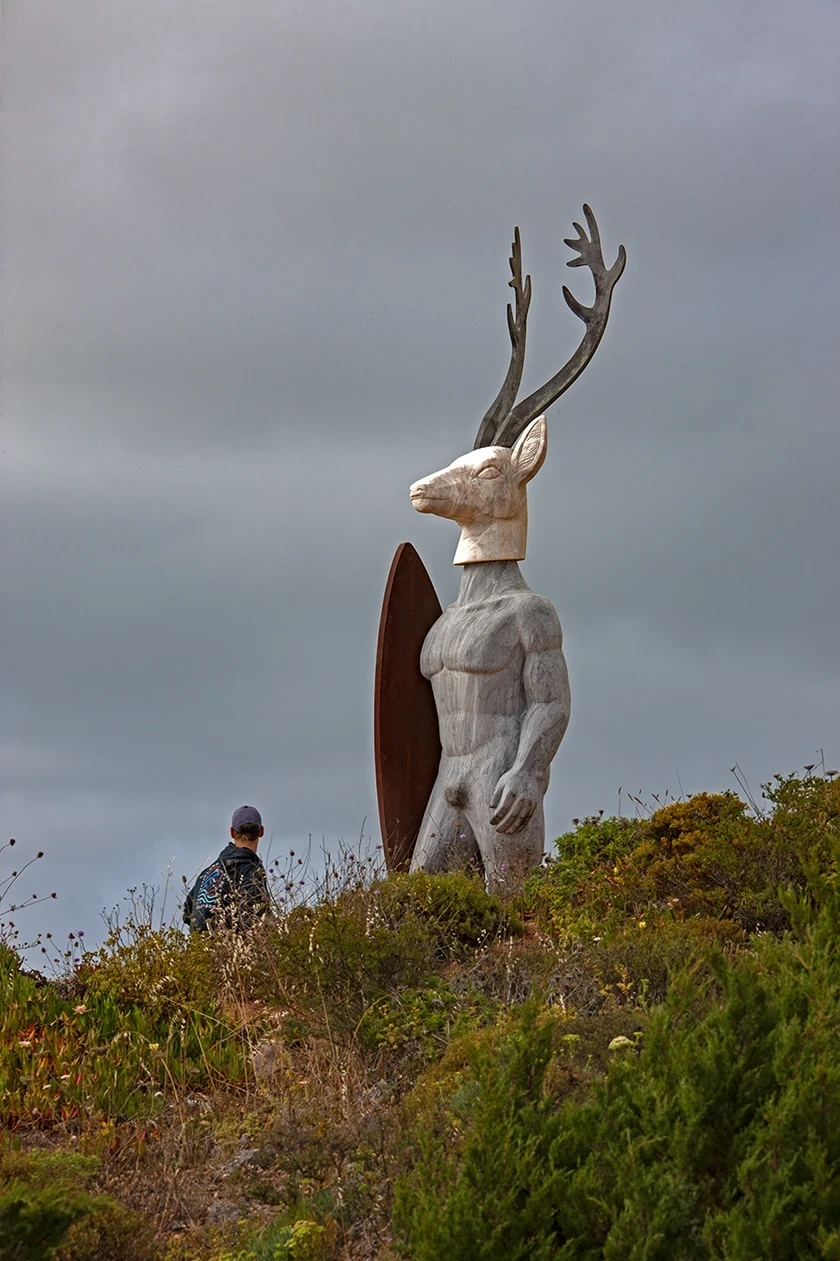
But the sea is much more than surfing in Nazaré and there are plenty of activities to explore it in a more leisurely way. The seabed here is a universe of flora and fauna, in many cases, unprecedented and ideal for diving, without forgetting sport fishing. From the fishing port there are boats adapted for dolphin watching, which also provide beautiful panoramic views of the coast.
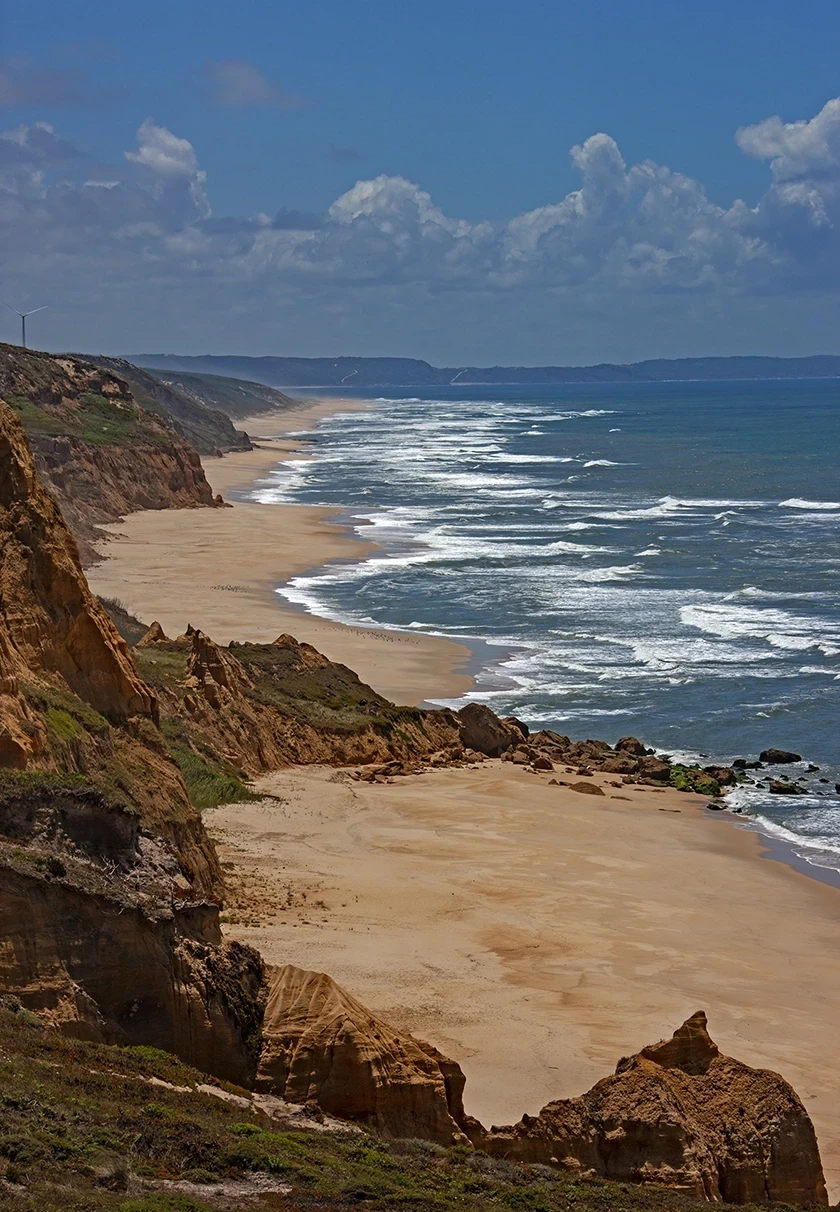
On both sides of the town stretches a coastline of almost insulting beauty, where virgin beaches stretch as far as the eye can see between the swaying waters and natural areas of native plants growing on the dunes.
To the south of Nazaré is the Pescaria mountain range with a maximum altitude of 177 metres, where the oldest rocks in the area can be found. This geological formation is what allowed the existence of the “Lagoa da Pederneira” and on its slopes grow species such as the beach juniper, mastic, kermes oak, heather, maritime pine and stone pine, as well as being a refuge for birds such as the black-capped warbler, among others.
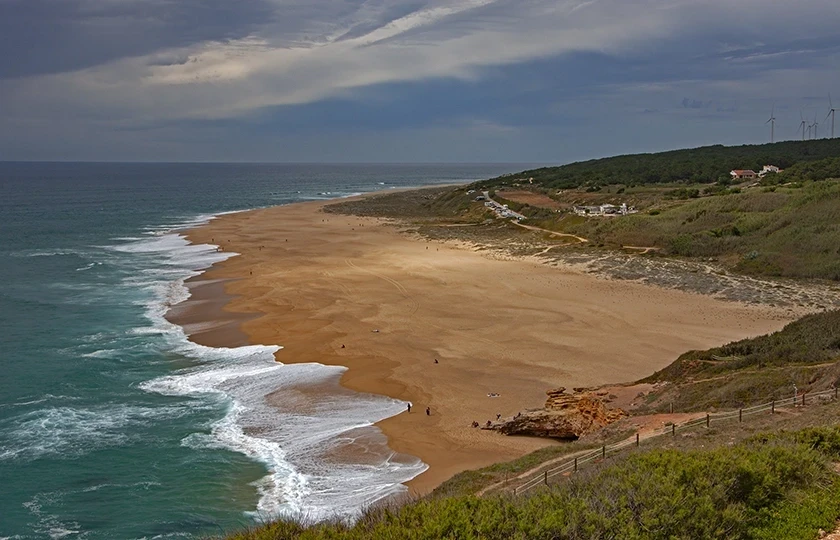
In the opposite direction, towards the north, we reach San Pedro de Moel, the heart of small beaches sheltered by steep rocky walls. To get here means crossing an impressive green corridor that crosses the “Pinhal do Rei”, following the route of the Atlantic road that links Porto with Lisbon along the coast.
Next to the town centre stands the imposing lighthouse of Penedo da Saudade, which with its fifty-five metres of height has been illuminating the sea since 1922. It is a sign of identity of this town with a marked tourist character, but which has managed to maintain a moderate growth to guarantee the privacy and well-being of the inhabitants.
Nearby, the “Praia das Conchas” and the “Praia das Velha”, both in the beautiful natural area of “Pinhal de Leiria” are two contrasting worlds thanks to the succession of spectacular cliffs and long beaches of fine golden sand. In this pair, the San Blas mountain rises up, an exceptional elevation of magmatic origin that emerges in the middle of the dunes.
Following the coast, the “Furado valley” is a haven of peace between striking reddish cliffs eroded by the action of the wind.
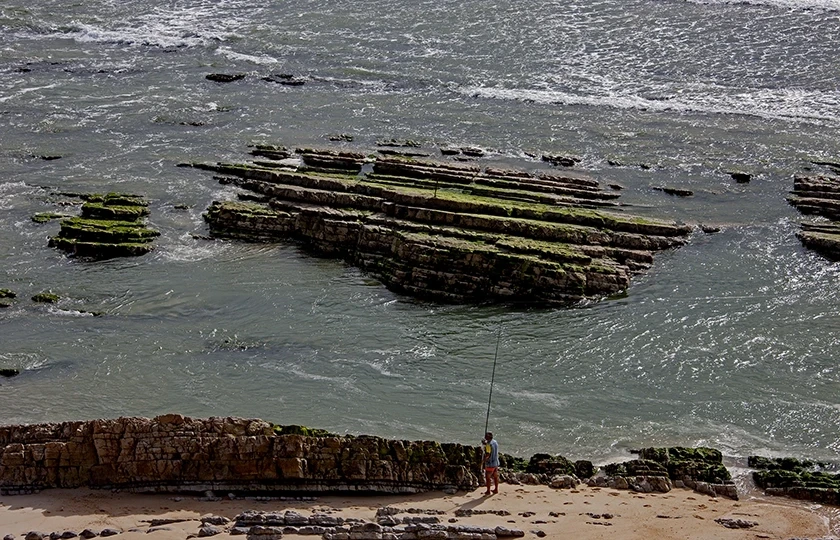
Following the coastline in the direction of Nazaré, the beach of Paredes de la Victoria opens out as an immense stretch of fine sand, interrupted only by a small freshwater stream. The northern end is delimited by the “castle”, a curious rock formation which the wind and the sea took a fancy to sculpt what could be a lion resting looking out over the Atlantic.
In the final part of our trip we return to Nazaré to enjoy its interesting culinary culture based on fish and seafood. Faithful to their seafaring tradition, they know very well how to handle the excellent and varied raw material and tasting a caldeirada or a massa de peixe becomes an unforgettable experience.
With a fond memory ends this amazing trip, which more than fulfilled my most optimistic expectations. Nazaré never disappoints.