Live life as when you go out to the mountain, look at the top, be aware of everything at every moment, what matters is the road travelled and with whom you share it, the summit will give you the satisfaction of the goal reached, although the real gift is the experience lived.
F. Beltrán
That pilgrimage route, which was already recorded in the 15th century in Palencia Cathedral’s Book of Acts, is today much more than just a way to reach a sacred place and fulfil a promise or to spy on sins, as was the motivation for walking it at the time.
Following in the footsteps of the prehistoric settlers who sought a way to connect the Cantabrian coast with the demanding Northern Plateau has become a route of faith, whether travelled for religious or purely secular reasons, but it will always bring a growth in our deepest selves.
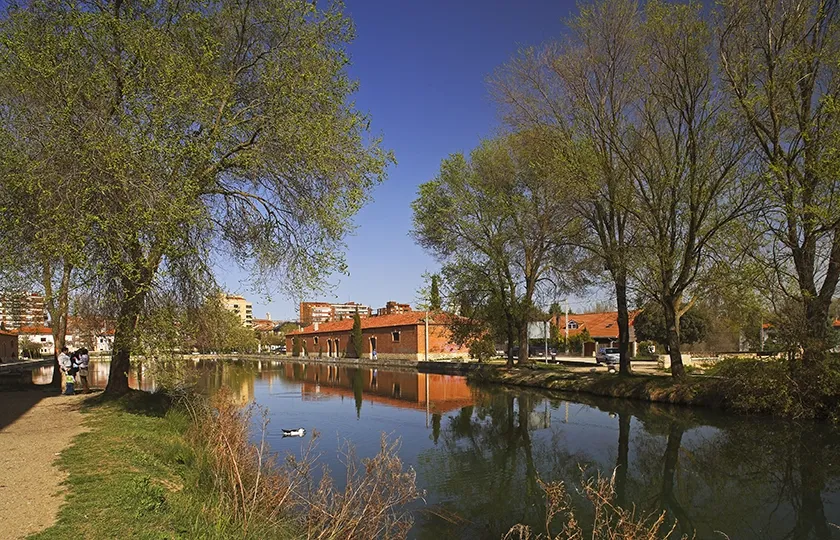
It is absolutely impossible that, beyond the spirituality of some of the scenery along this itinerary that links the city of Palencia with the monastery of Santo Toribio de Liébana in Cantabria, the changing landscape from the Castilian steppe to the greenery of the Palencia mountains, dotted with many of the best examples of Romanesque architecture in Europe, should leave any walker indifferent. Especially when a large part of the route follows the towpaths that mark the Canal de Castilla, the masterpiece of the Enlightenment with its torrent of innovative ideas and a unique cultural landmark in our country. To know its history is to delve into Spain’s own idiosyncrasy, into the needs and concerns of a people who were struggling to become great again and into the titanic effort used to build one of the most important hydraulic works in Spanish history.
Step by step, the pilgrim or “cruceno”, as those who go to the monastery to venerate the relics of the Saint and his famous Lignum Crucis are called, enters into communion with nature, with the different ways of life determined by the climate and with a genuine cultural legacy.
The Camino Lebaniego Castellano, designed for walking or cycling, has been divided into eleven stages, each one more suggestive than the last, and this Jubilee Year is an ideal time to discover it.
From Palencia to Calahorra de Ribas/Amayuelas
Tras visitar la Catedral de Palencia, el majestuoso templo gótico del siglo XIV, iniciamos el camino por los caminos de sirga del Canal de Castilla hasta su nacimiento en Alar del Rey, punto de arranque de esta insigne obra de ingeniería.
A partir de la dársena de la capital palentina, el Camino sigue por la margen derecha cerca de Grijota hasta alcanzar El Serrón, lugar donde se encuentra la secuencia que forman las esclusas 25, 26 y 27, y desde donde parte el Ramal de Campos del Canal de Castilla hacia la dársena de Medina de Rioseco. Continuamos por la margen derecha hasta Calahorra de Ribas, lugar donde un monolito nos recuerda el inicio de las obras del Canal, el 16 de Julio de 1753. Apreciaremos en toda su magnitud el cruce del Canal con el río Carrión y el maravilloso conjunto de las esclusas 22, 23 y 24.
From Amayuelas to Frómista
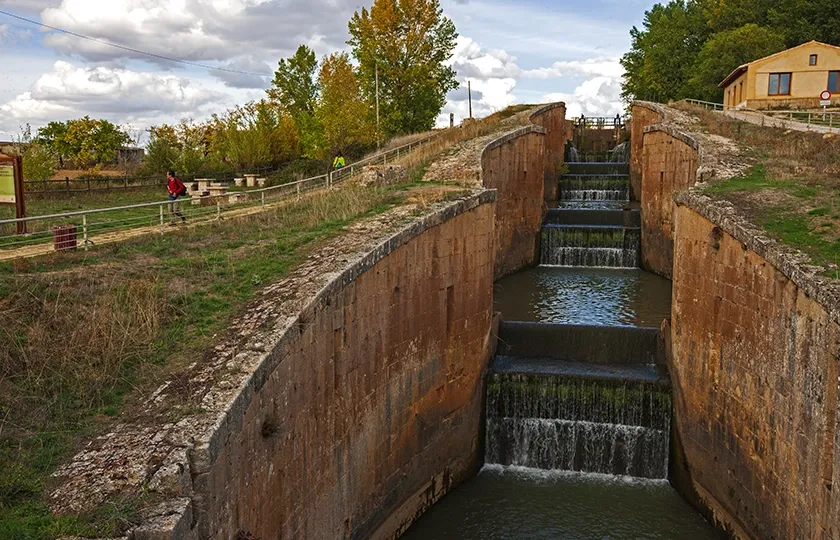
We return to the Canal de Castilla by the same route by which we arrived at Amayuelas. Now with our steps facing north again, we continue to Frómista, where we will meet the pilgrims on their way to Santiago on the French Way. From here we walk in the middle of the watercolour of the cereal fields of infinite horizons in which the temples of San Pedro in Amusco, San Juan in Santoyo, San Hipólito in Támara or San Miguel in Piña de Campos stand out. This is not a mirage, but the Renaissance fruits of the wool trade with Flanders, which made the area rich at the time. Before we know it, we enter Frómista, where another pearl of enlightened engineering awaits us, the quadruple jump of locks 17, 18, 19 and 20, where the Canal de Castilla and the Camino Lebaniego intersect with the great pilgrimage route of Europe: the French Way to Santiago de Compostela.
From Frómista to Osorno la Mayor
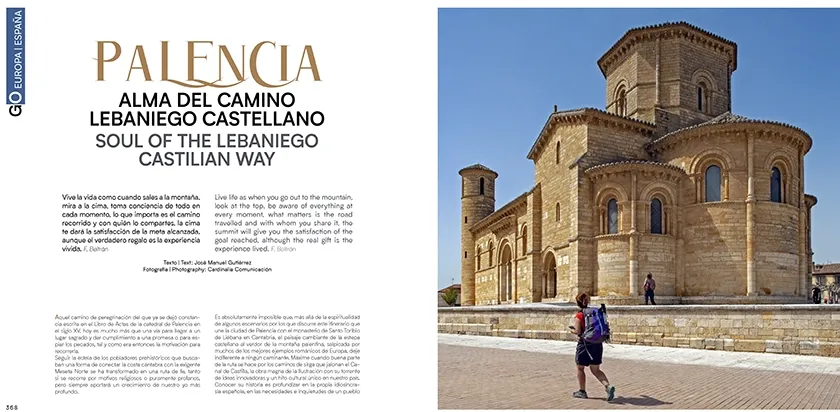
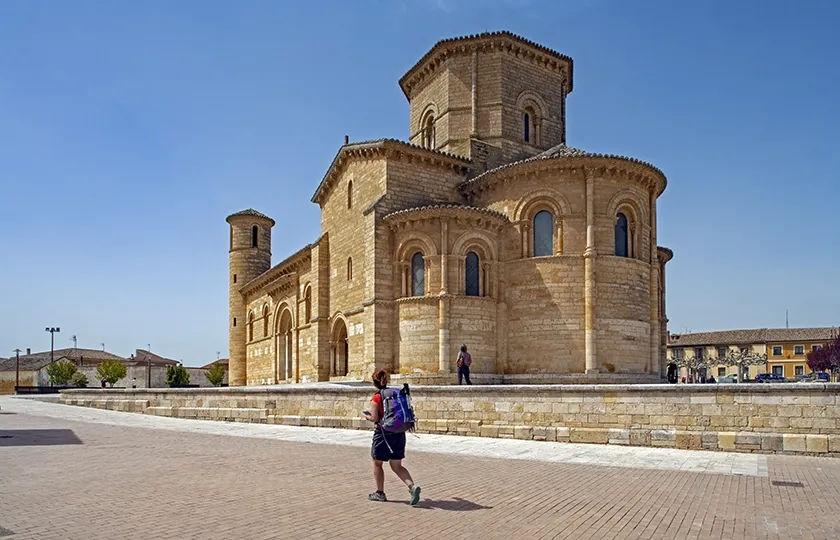
Frómista is rich in cultural heritage, with the Romanesque church of San Martín, one of the icons of the French Way, standing out.
We continue along the right bank of the Canal on a very special stretch where we will come across the pilgrims to Santiago de Compostela.
The landscape is somewhat more arid, but it is enlivened by the proximity of the water, the contemplation of nearby towns such as Requena de Campos and the frequent bridges and aqueducts that allow the streams to flow under the Canal.
Finally, Osorno la Mayor provides a stopover.
From Osorno la Mayor to Herrera de Pisuerga
We return to the Camino along the right-hand towpath and the first surprise will be the magnificent Abánades aqueduct, the longest of the whole Canal, which flies over the river Valdavia.
From here we must be careful, because at lock 14 we must cross to the towrope on the left, until lock 13, where we will return to the right bank. But this will not be the last surprise of this section, as after passing the locks of Naveros and Olmos de Pisuerga we will reach the magnificent masonry work of the Retención de San Andrés, crossing over it to the Presa del Rey at its confluence with the River Pisuerga. This is where the Marqués de la Ensenada boat mooring, the Interpretation Centre and a recent footbridge that allows us to comfortably reach the crossing of the river and the canal coincide. But now it’s time to rest in the welcoming town of Herrera de Pisuerga.
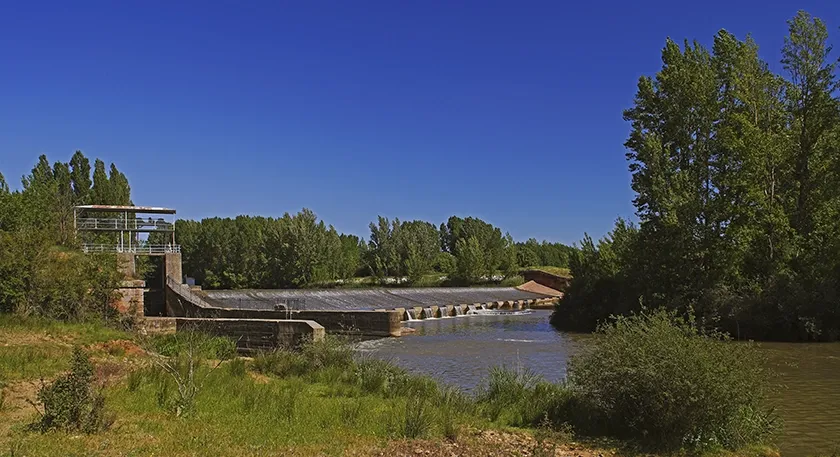
From Herrera de Pisuerga to Alar del Rey or the Monastery of San Andrés de Arroyo
In this last stage along the Canal de Castilla of our Camino Lebaniego Castellano it is advisable to return to the Presa del Rey and visit the Canal Interpretation Centre and then enjoy a pleasant and educational ride on the Marqués de la Ensenada boat.
Walking back through the lock of the Barrio de San Vicente, the heart races as we glimpse the buildings of the first retention, before admiring the great Dársena de Alar, the gloomy dungeons of the prisoners forced to work in the works of the Canal and the monolith that marks the source from the river Pisuerga.
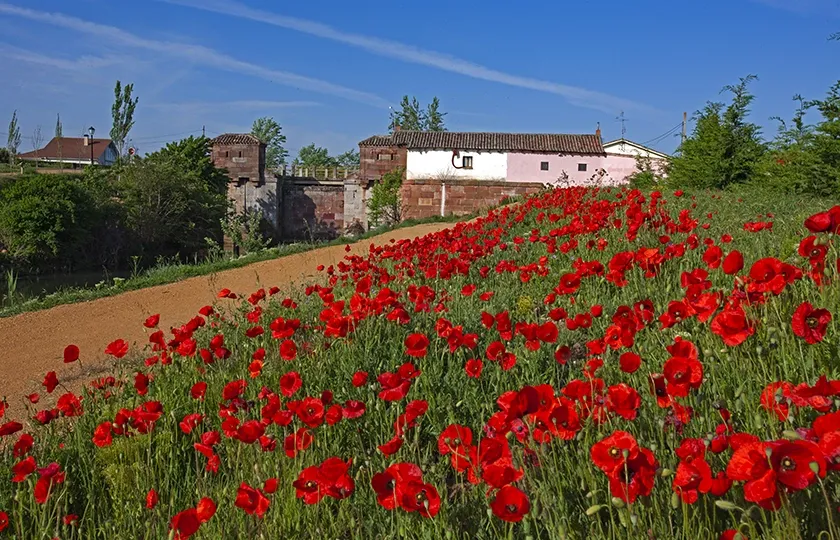
From Alar del Rey to Perazancas de Ojeda
We start the stage at the large dock, where cock coal used to be loaded years ago. We continue along the Puente las Monjas bridge and between crops along a farm track that crosses under the A-67, towards Prádanos de Ojeda.
Through a landscape of gentle hills dotted with pines, holm oaks and crop fields, we reach Santibáñez de Ecla between small ravines. From here it is worth visiting the Romanesque monastery of San Andrés de Arroyo, a cloistered monastery dating from 1181. Back on the road we head for Cozuelos de Ojeda, to continue along the Romanesque Way to Perazancas.
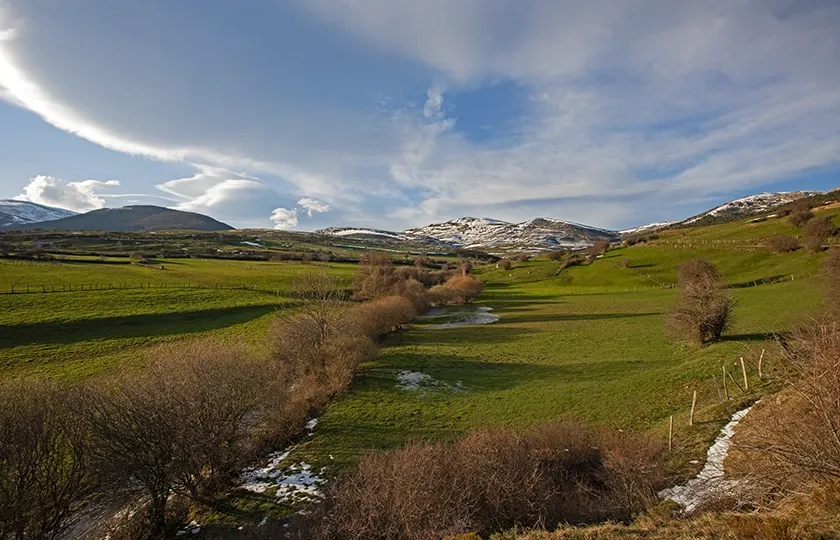
From Perazancas de Ojeda to Cervera de Pisuerga
Once the body has rested, in the sacred place of San Andrés de Arroyo or in a rural location, after seeing the Romanesque hermitage of San Pelayo, we can refresh ourselves in the Fuente de los Tres Caños, where we can see the bell tower of the Church of La Asunción and continue along the so-called “Old Way” to Dehesa de Montejo, from where we can enjoy spectacular views of the peaks of the Montaña Palentina.
For ten kilometres we will walk through mountainous landscapes where we will feel the ideal solitude to reflect and seek personal enrichment in contact with nature.
This is how it will be until we reach the Peña de Umona, where we rejoin the Romanesque Way, descending to Vado where the Way has another surprise in store for us, the cave hermitage of San Vicente and its necropolis dating from the 8th and 9th centuries. Shortly after, the most mountainous town in Palencia awaits us: Cervera, with its emblazoned houses and porticoed streets, where we cross the Forgotten Way to Santiago de Compostela. We cannot leave Cervera without discovering what is perhaps its best kept secret: the majestic panel painted by Juan de Flandes, the Adoration of the Kings, in the Church of Santa María del Castillo.
From Cervera de Pisuerga to San Salvador de Cantamuda
Pisuerga upstream we enter the Natural Park of Montaña Palentina and respect for nature must now be maximised. After Arbejal the route joins other paths, whose names suggest the presence of animals such as bears, deer or wolves. Bordering the Requejada reservoir, you reach Vañes.
Surrounded by thick oak groves and under the peaks of the Alto Pisuerga we reach Estalaya, where we head towards San Salvador de Cantamuda along a path that offers spectacular views. We will cross the Verdeña Fossil Forest, an incredible place that will tell us how once upon a time a coastal forest of tree ferns was dragged here.
Descending towards the Pernía Valley, San Salvador de Cantamuda displays its 12th century Romanesque collegiate church, not far from the place where the Mozarabs built the abbey of Lebanza in the 10th century.
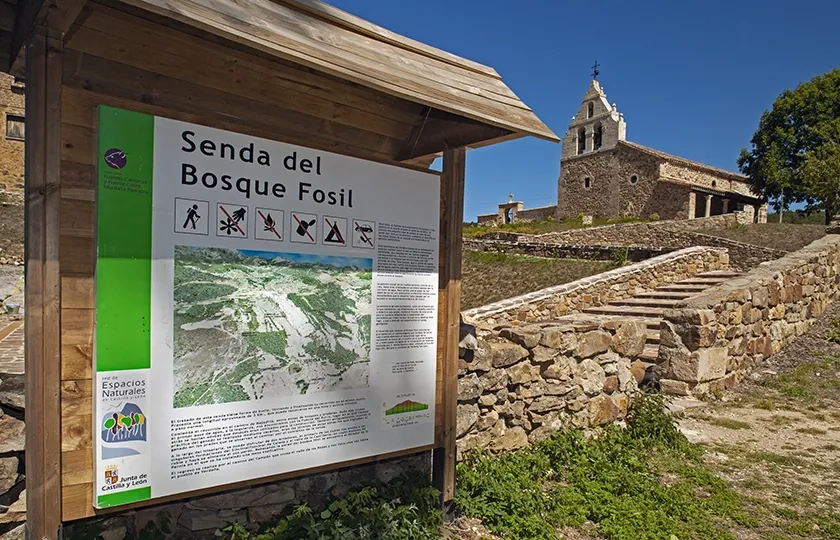
From San Salvador de Cantamuda to Camasobres
The excitement of the last stages mitigates the effort of the climbs and descents that, starting from San Salvador de Cantamuda, will take us to the town of El Campo. Shortly after, Lores welcomes us with the simple elegance of the Church of San Lorenzo and, crossing woods and meadows, we reach Camasobres, before ascending to Puerto de Piedrasluengas. It has been an intense stretch that has offered us incredible landscapes and the sensation of discovering a treasure that will fill our spirit and that we will never forget.
De Camasobres a Piedrasluengas y Pesaguero
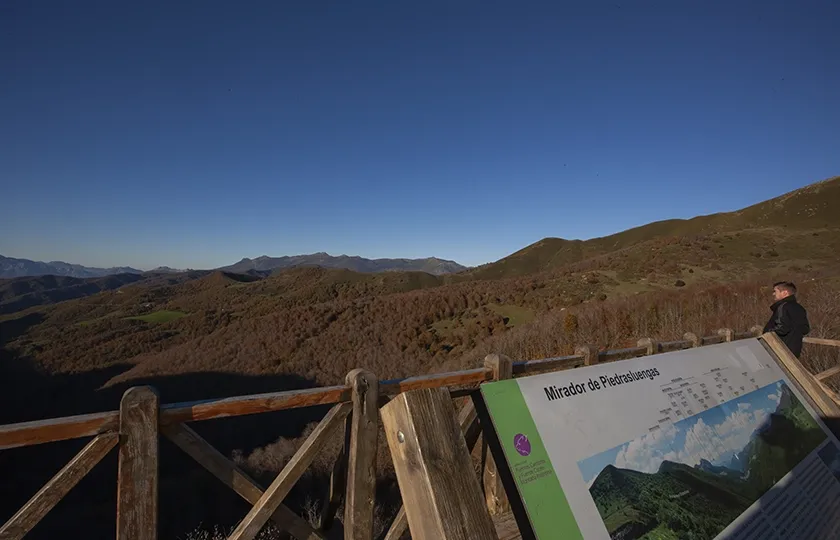
We leave the province of Palencia to enter the valley of Liébana and the Monastery of Santo Toribio. The descent with the rocky outcrop of the Picos de Europa in the background is reason enough to stop at the Piedrasluengas viewpoint and take a deep breath. Along a wooded track we reach Cueva and Avellanedo, where we can see its traditional architecture and, finally, we reach Pesaguero to rest before tackling our last stage.
From Pesaguero to Santo Toribio de Liébana
The Camino comes to an end, but first we reach Piasca, where we must visit the 12th century Romanesque church of Santa María La Real de Piasca. The next stop will be Potes, the geographical centre of Liébana and Historic Site before Santo Toribio.
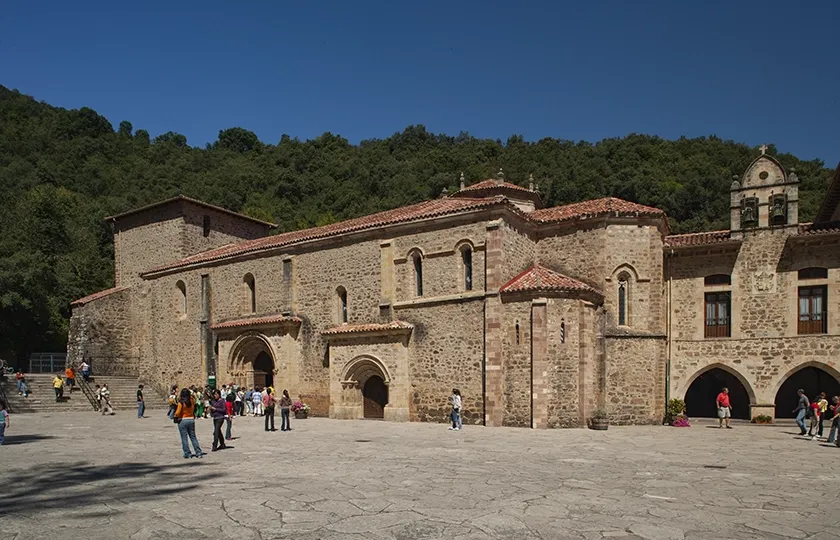
Once at the monastery, we will satisfy our curiosity by contemplating the Lignum Crucis, the goal of the Camino Lebaniego.
Sea and, without intending to, fulfil the dream of the Marquis of Ensenada and his Canal de Castilla: to reach the sea from Castilla.
“The end of a voyage is never an end, but the beginning of a new one“.