In the context of rapid industrialisation in which 19th-century European cities experienced spectacular growth, a new conception of art was born with a desire to reconcile nature, creativity and the human being through forms, colours and textures.
In the second half of the 19th century, a movement called Arts and Crafts emerged in England as an intellectual response to the uncontrolled increase of mass production in factories, which directly threatened the cultural and identity value of craftsmanship.
Here lie the roots of modernism, a concept of working towards a universal style and a statement of modernity coupled with the aesthetic sense of fluid designs. The English writer, designer and architect William Morris was a defining figure, rejecting the ordinariness of production and the dehumanising aspects of Victorian capitalism. His collective ideal of craftsmanship and his use of stylised organic and floral forms were a point of reference for many modernist artists.
With a speed more suited to modern times, this trend spread throughout Europe and its influence became palpable in all creative expressions. Modernism brought elegance and was everywhere from railway stations to department stores, residential buildings, bridges, markets, furniture designs or book illustrations, always with a remarkable use of organic forms. It was always an attempt to integrate art into the everyday through beauty and balance.
Despite the distance, Castilla y León was no stranger to the new creative trend, and throughout its vast expanse there are many beautiful examples of a modernism that arrived bringing creative freshness, further enhancing what is one of the largest heritage sites in Europe.
Salamanca, the city that enchants
The city of magical sunrises and sunsets when the light recreates chiaroscuros in its streets that awaken the imagination, to the point of making us believe that we have seen Lazarillo de Tormes or Calixto in search of his beloved Melibea, as well as being a World Heritage Site and cosmopolitan, is one of Spain’s monumental landmarks.
Faithful to its cultural atmosphere, as befits its university nature, the city of Tormes was no stranger to the influence of modernism and within its walls is one of the region’s finest exponents.
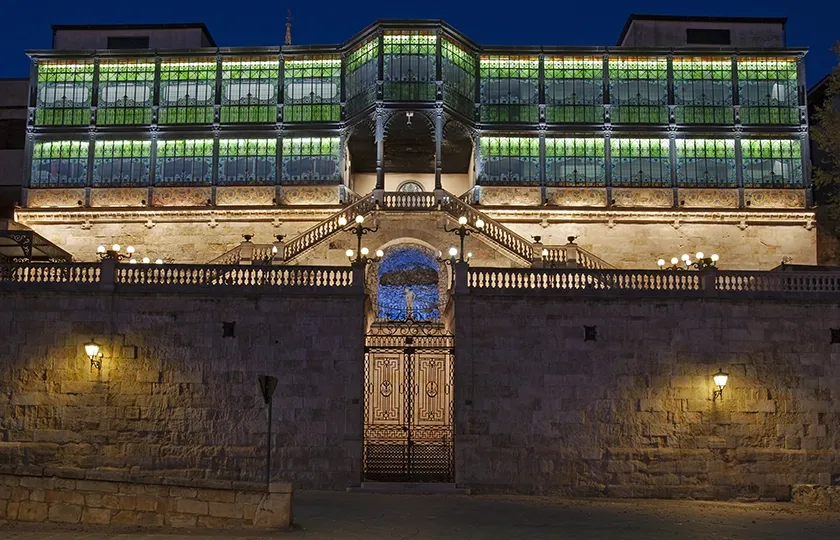
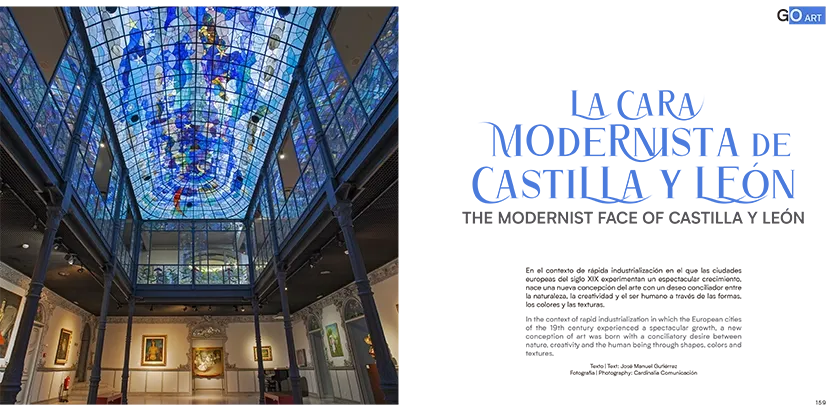
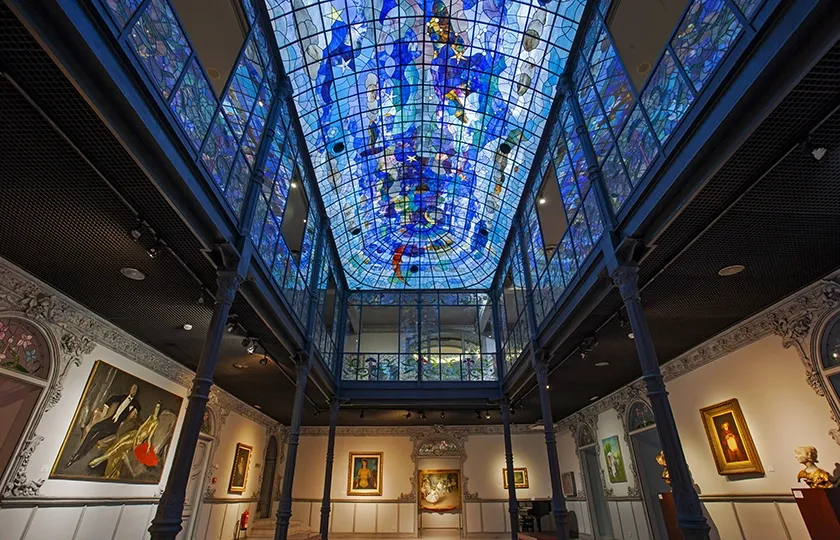
The Casa Lis, a small palace built in 1905 by Miguel de Lis, a prominent member of the Salamanca bourgeoisie, is a beautiful example of the modernist style and a masterful exercise in industrial architectural solutions adapted to residential use. Set on the old city wall on the south side of the city, the building shows innovative constructive solutions for the time and an astonishing style. The whole house revolves around a central courtyard and, facing the river, a beautiful iron and glass façade with a clear industrial inspiration rises above a stone staircase that creates landscaped terraces. The whole is sublimely beautiful. On the opposite side, the north façade clearly follows the precepts of Art Nouveau architecture, preceded by an iron gate in the purest Art Nouveau style. The interior is undoubtedly decorated in a modernist style with artistic stained glass windows, with the masterful leaded glass window that covers the central courtyard deservedly taking centre stage.
Thanks to the action of the Salamanca City Council, who intervened to prevent its deterioration, the Casa Lis regained its former splendour in 1995 and is now the headquarters of the Art Nouveau and Art Deco Museum, exhibiting in its rooms and rooms a number of collections that are unique in Spain.
Another good example of modernism in Salamanca can be found in the Borrego Building. Built at the beginning of the 20th century, it boasts a magnificent circular corner bay window, topped by a beautiful zinc dome in the attic.
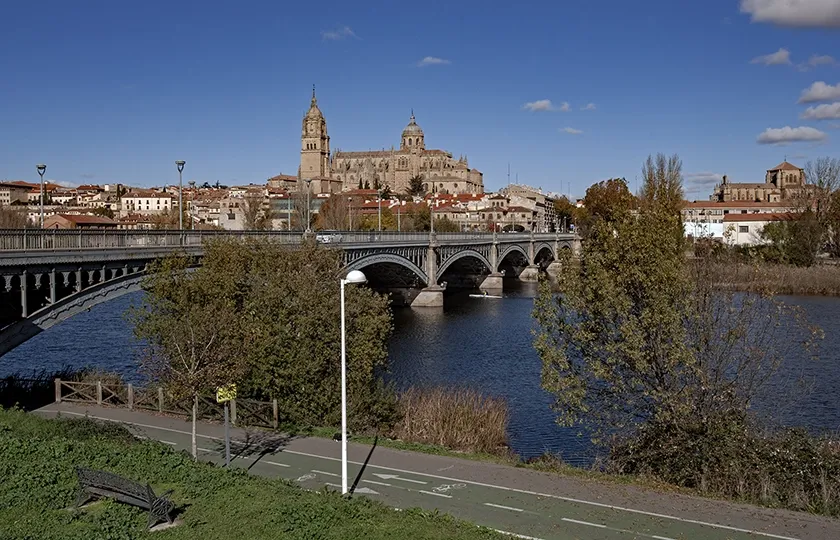
Modernism arrived in Salamanca also observing its primitive philosophy of preserving cultural values without renouncing modernity and improving people’s lives. The Enrique Estevan Bridge, also known as the Puente Nuevo or Puente de Hierro, designed by Saturnino Zufiaurre, a disciple of Gustave Eiffel, was built with this concept in mind. A complex 220-metre-long rolled steel structure stretches on gratin pillars at a height of 10 metres above river level. Its six arches feature an exceptional decorative display of eclectic historicism with lozenges and circles with floral motifs or the Star of David. Its photograph with the Casa Lis in the background is now almost a universal image of the city.
Leon, the birthplace of modern parliamentarism
The two thousand year old city that emerged from that Roman camp of the Legio VI Victrix set up at the confluence of the rivers Bernesga and Torio, the same cathedral that preserves the gothic stained glass windows, considered among the most beautiful in the world and which proudly displays the so-called Sistine Chapel of Romanesque art in the Pantheon of the Kings in the collegiate church of San Isidoro, the same setting in which the first democratic courts were held in 1188, for which UNESCO has recognised León as the Cradle of Parliamentarism, also has a modernist face.
The Casa Botines is one of only three buildings designed by the universal Gaudí outside Catalonia. In 1891, work began on a building intended for residential use and a commercial warehouse, with a design in the neo-Gothic period of the Catalan master, with a modernist stamp and totally breaking with the austere aesthetics of the city.
Thanks to the mastery of the stonemasons from León, the specialists brought in by Gaudí and their genius, the work was completed in eleven months, which aroused local admiration for the complexity of the construction and the solutions provided. The exterior and interior aesthetics were no stranger to anyone and are still admired today. In its robust appearance with historicist reminiscences topped by four corner towers, the tallest flanked by a weathervane in the shape of a Maltese cross and a moat with a wrought iron grille, doors and windows with lobed arches open out. In contrast to the regal exterior style, the interior features purely modernist finishes with virtuoso woodwork combined with wrought iron, stained glass and sgraffito. The end result is a harmonious combination of functionality and aesthetics that is very welcoming.
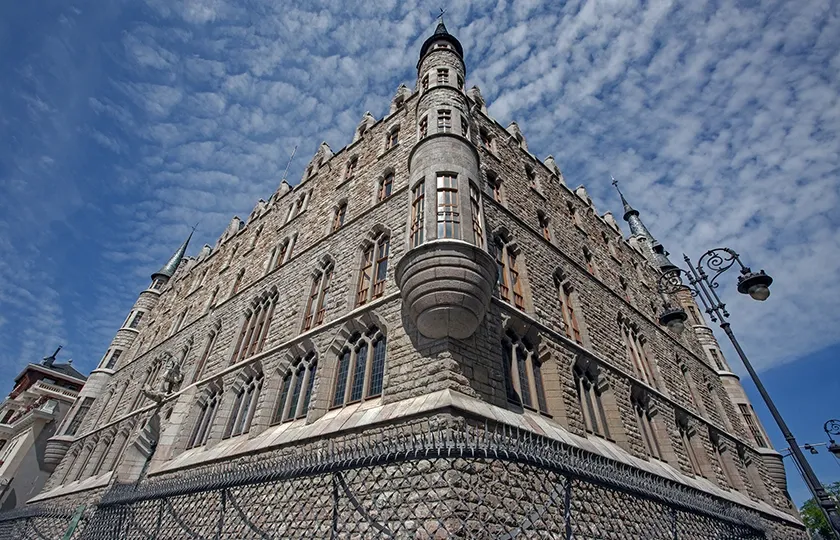
It is currently the Casa Botines Gaudí Museum, promoted by the Obra Social de Castilla y León Foundation, a reality that works as a centre for research, conservation and exhibition of historical and artistic heritage. Works of art spanning more than five hundred years of fine and decorative arts history, from the 15th century to the end of the 20th century, are housed and displayed here.
Beyond Gaudí’s mark, the capital of León conserves around thirty modernist buildings with a wide variety of decorative elements. Most of them are concentrated on the pedestrianised Calle Ancha, which leads to the cathedral and the surrounding area, but a good number are also located on Calle Ordoño II, the city’s main thoroughfare, including one, at number sixteen, clearly inspired by the work of Gaudí.
The mark in León of Daniel Zuloaga, considered to be one of the renovators of Spanish ceramic art, can be found in portal number three of Sierra Pambley Street. With great exquisiteness he transferred the qualities of oil and watercolour to the tiles, giving prominence to women and the work of the sea with great naturalness. This artistic exercise puts a suggestive and colourful perspective on León’s genuine modernist catalogue.
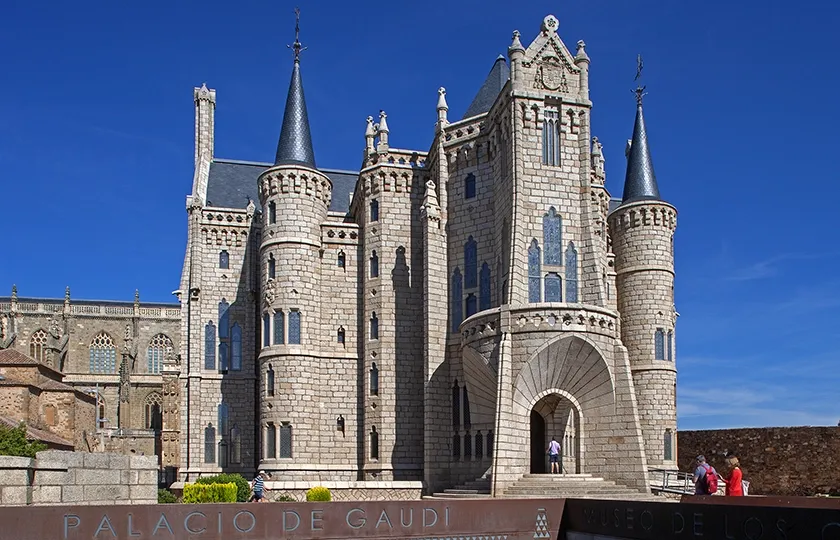
Without leaving the province, the city of Astorga proudly displays Gaudí’s second work outside his native land. Joan Baptista Grau i Vallespinós, bishop of Astorga between 1886 and 1893, commissioned his friend Antonio Gaudí to design a new bishop’s palace. Although construction was delayed for a long time due to disagreements between the architect and the chapter, after the death of Bishop Grau, Gaudí decided not to continue his work without finishing the upper floor and the roof, which did not prevent the ensemble from bearing the signature of the Catalan master. With four cylindrical towers at the corners and surrounded by a moat, it was built in masterfully placed granite from El Bierzo, maintaining a medieval air, although with some licences such as the arches at the main entrance that recall medieval Catalan farmhouses. Inside, wood, granite, stained glass, bricks, plasterwork, mosaics, sgraffito and ceramics harmonise perfectly to create a fluid and luminous atmosphere. The decorative richness is magnificent, with a virtuoso combination of Gothic and Mudéjar finishes, naturalistic motifs and columns with a variety of capitals that add to the palatial atmosphere.
It currently houses the Museum of the Pilgrims’ Route to Santiago, where valuable works of art from all over the diocese are exhibited and conserved.
Palencia, where the first university was born
At the foot of the Cristo del Otero lies a serene and green city, easy to walk around and rich in heritage. It was an episcopal see in the Visigothic period and the first university in Spain opened its doors here in 1212, but its origins go back much further. The Vacceans, the most cultured and militarily powerful Celtiberian tribe, already inhabited these lands and from then until today, all cultures have left an important monumental legacy.
The convulsive Middle Ages left their mark with buildings as noble as the cathedral of San Antolin, in whose crypt there are vestiges of an earlier Visigothic building, as well as a good catalogue of churches and monasteries.
Its good geographical location in the heart of what was called the granary of the Empire helped the economic development of the city, but it was in the reign of Fernando VI with the construction of the Canal de Castilla, the masterpiece of the Enlightenment and the important dock on the outskirts of the city that gave it a significant boost.
The 19th and 20th centuries with a stable and well-off bourgeoisie meant the opening of a new architecture, in accordance with the winds of modernity coming from Europe, and modernism made its presence felt.
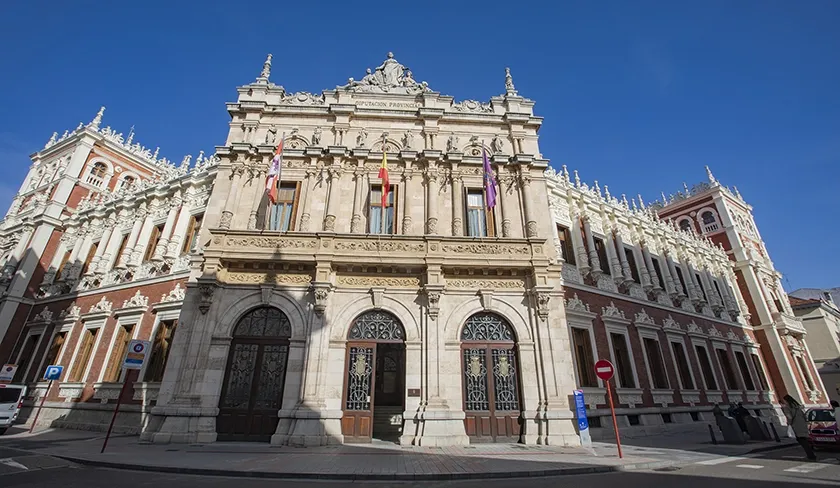
Undoubtedly the most representative buildings of this trend are those bearing the signature of the architect Jerónimo Arroyo. The Palacio de la Diputación, built in stone, brick, iron and glass with decorative touches inspired by Renaissance palaces such as the Monterrey Palace in Salamanca, is particularly noteworthy. Among its profuse decoration, the sculptures at the top of the building are striking, alluding to industry, commerce, agriculture, the fine arts, work and science.
Close by, and more than a kilometre long, is the Calle Mayor. Completely pedestrianised and almost entirely arcaded, as befits its centuries-old commercial character, there are other magnificent examples of modernist architecture, most of which are also the work of Jerónimo Arroyo.
In 1916, the construction of the building belonging to the García family was completed and it is currently used for residential purposes, being another of the modernist buildings of reference. The harmonious combination of red brick and white rendering, together with the wrought iron, rounded bay windows and hexagonal chamfer form a captivating ensemble.
A few metres further on is the Villandrando school, built by the Viscountess of Villandrando in 1910. The main façade is a good interpretation of Valencian Gothic and Catalan modernism, in which the floral decorations and the large ceramic frieze on the cornice, the work of Daniel Zuloaga, stand out.
The current headquarters of the Castile and Leon Audit Board is a building constructed at the beginning of the 20th century in which neoclassicism is harmonised with galleries, two towers with attractive stained glass windows, wrought iron balconies and modernist lintels, thus reinforcing its bourgeois appearance.
Other buildings signed by the illustrious architect are the Edificio Arroyo y Gallego, on the first and first floors of which he had his studio and a craftsman’s workshop. The current Jorge Manrique secondary school has a striking modernist floor plan designed by Jerónimo Arroyo in collaboration with the Madrid architect Lorenzo Gallego.
The city’s Calle Mayor preserves other beautiful modernist examples without the signature of Jerónimo Arroyo, but no less important. In the atrium of the Casino of Palencia there is a magnificent mural, the work of the Palencia painter Rafael. Another building that should not be overlooked, halfway between modernism and the crystallisation of the modern movement, is the current headquarters of the Unicaja exhibition hall, the work of the architect Jacobo Romero, who partly followed the legacy of Jerónimo Arroyo.
The food market built in 1895 was an architectural revolution in the city, incorporating the use of cast iron and glass as key elements that still attract attention today.
The modernist imprint in other cities
The modernist movement also reached other cities in Castilla y León, albeit in a more testimonial manner, where it left its mark on artistic modernity and promoted new forms of thought.
In Valladolid we find the Casa del Príncipe designed by Jerónimo Arroyo, with a spectacular cylindrical tower supported by cast iron supports and organic ornamentation. The rest of the building is built in brick in reference to the Mudejar tradition and concrete, with balconies arranged in an irregular way to gain in plasticity.
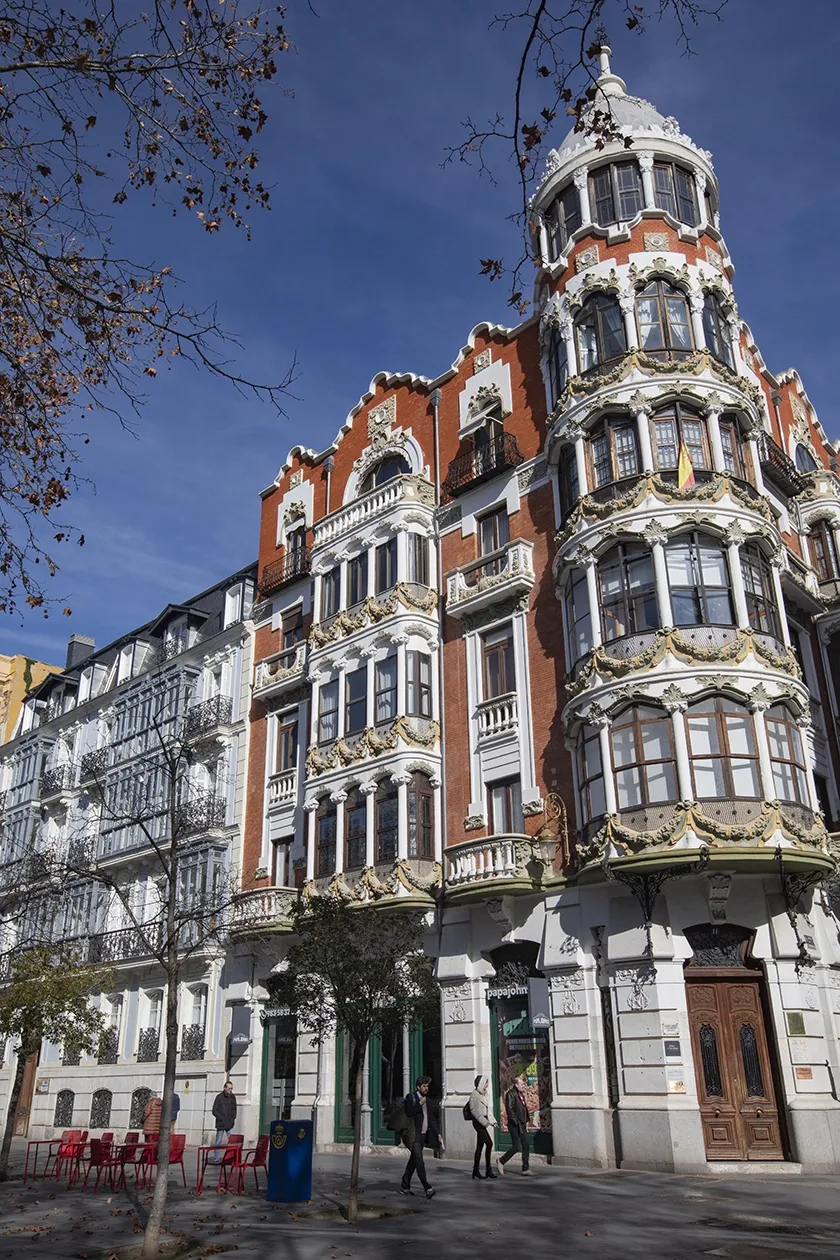
The Casa Luelmo is another unique example of modernism in the city of Pisuerga, built at the beginning of the 20th century as the residence of the businessman Rufo Luelmo. Today, after a thorough restoration to restore it to its original appearance, it is the headquarters of the Castilla y León Historical Heritage Foundation.
Zamora, in addition to its undeniable cultural value due to the Romanesque jewels it houses, was also witness to the Modernist influence, with the Ramos Carrión theatre, inaugurated in 1916, being its greatest exponents, not forgetting other interesting buildings such as the casino, the houses of Gregorio Prada, the Casa Gato and the Casa Tejedor, among others.
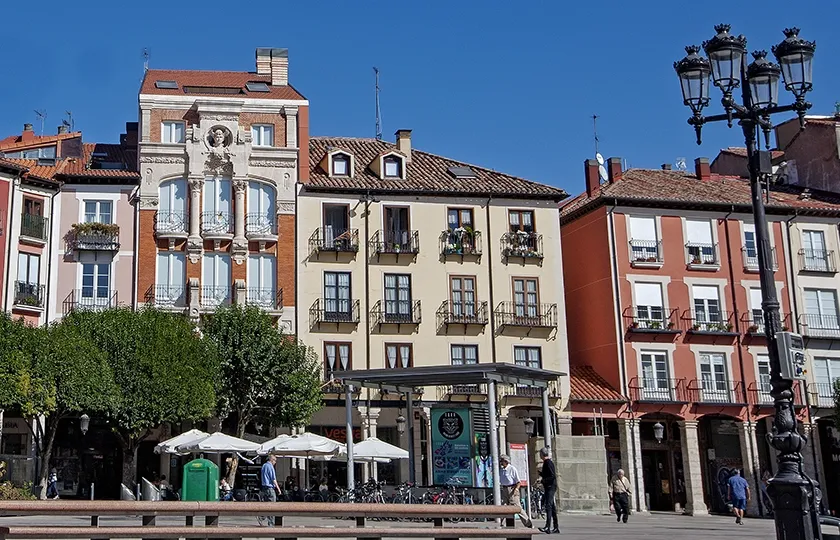
The Casa de Mercurio, in the heart of the Plaza Mayor in Burgos, is the best example of modernism in the city. Its five-storey structure is striking for its red brick, stone and iron, as well as for its columns with floral motifs.
Our journey to modernism in Castilla y León ends in the city of Segovia. On the delightful walk between the Aqueduct and the Plaza Mayor, opposite the Casa de los Picos, we find the Clementina Lanchares residential building, a magnificent example of this artistic style in the form of the extraordinary grilles on the bay windows.
Castilla y León is a heritage mosaic of immense proportions that invites to be experienced slowly and with the senses very active.