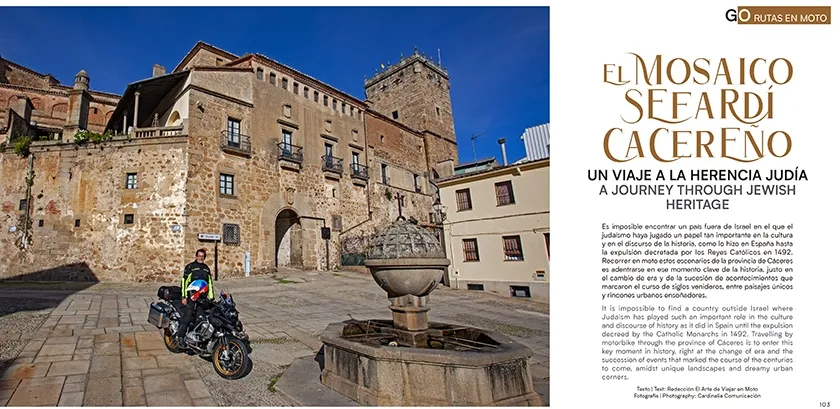
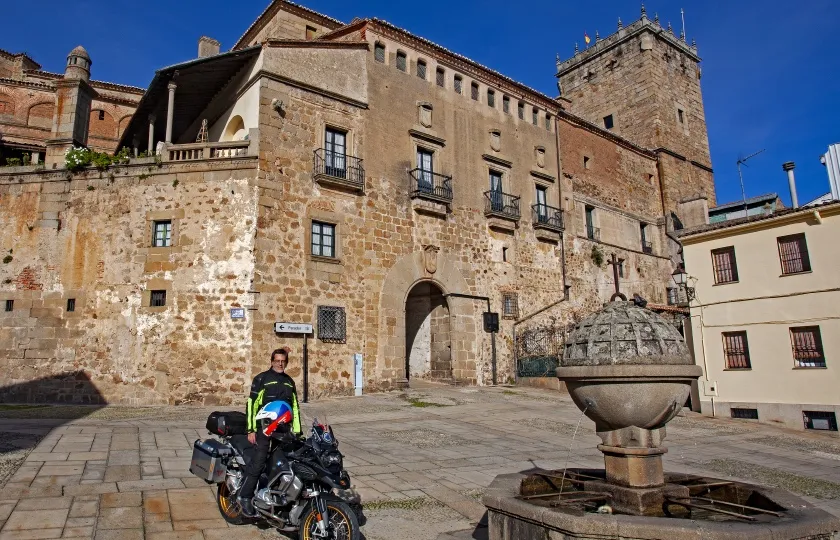
It is impossible to find a country outside Israel where Judaism has played such an important role in the culture and discourse of history as it did in Spain until the expulsion decreed by the Catholic Monarchs in 1492. Travelling by motorbike through the province of Cáceres is to enter this key moment in history, right at the change of era and the succession of events that marked the course of the centuries to come, amidst unique landscapes and dreamy urban corners.
Although the first references to the existence of Sephardic settlers in Extremadura date back to the 1st century AD after the expulsion of the Jews from Jerusalem ordered by the Emperor Titus, it was not until the 13th century that there is documentary evidence of the increase in these communities. Extremadura was one of the few regions that escaped the disturbances against the Jews in 1391 that began in Seville and spread to a large part of Spain. This led to their exile and subsequent settlement, mainly in what is now the province of Cáceres, with the “aljamas” of Cáceres, Trujillo, Plasencia and Hervás being of particular importance.
A Sephardic folk song says “what will become of me? in foreign lands I will die”, a nostalgic composition from 1492, when they were expelled from Spain, which was heard again in the German extermination camps during World War II. The dramatic gap that their departure meant for the social and economic development of the young Spain, mired in fundamentalism and the mediocrity of its rulers, was a step backwards for progress with a very long shadow.
Despite this, their cultural, craft, gastronomic and knowledge legacy, as well as the urban layouts of the neighbourhoods they were forced to abandon, the literary compositions of Lope de Vega, the Legends of Bécquer and the novels of Galdós and Blasco Ibáñez remind us that they shaped a part of our history that we cannot forget.
With absolute respect for history and admiration for those people who have not always been treated fairly, we set off on our motorbikes for a circular route of approximately seven hundred kilometres which, starting from Hervás, takes us to the most important landmarks of the Jewish presence in the province of Cáceres. But, although this is the main thread of this suggestive journey, made in winter to enjoy more of the intimacy that this land carries in its essence and to highlight the fact that the season of the year does not matter to enjoy the province of Cáceres, nothing prevents us from enjoying the many other attractions that mark the route.

A dream route begins
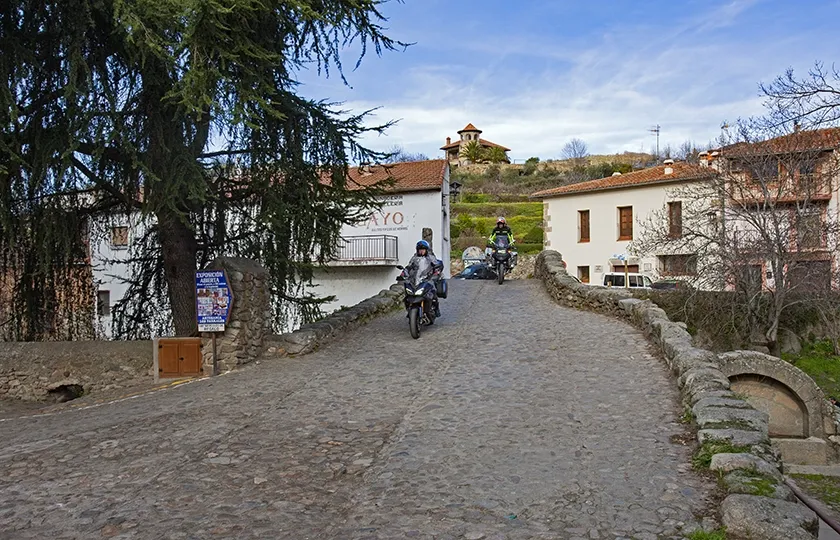
Hervás, at the foot of magical mountains and in the orchard recreated by the river Ambroz, which according to tradition was founded by the Templars, is the starting point of this incredible motorbike trip through the pages of history, giving no respite or option for the senses to relax.
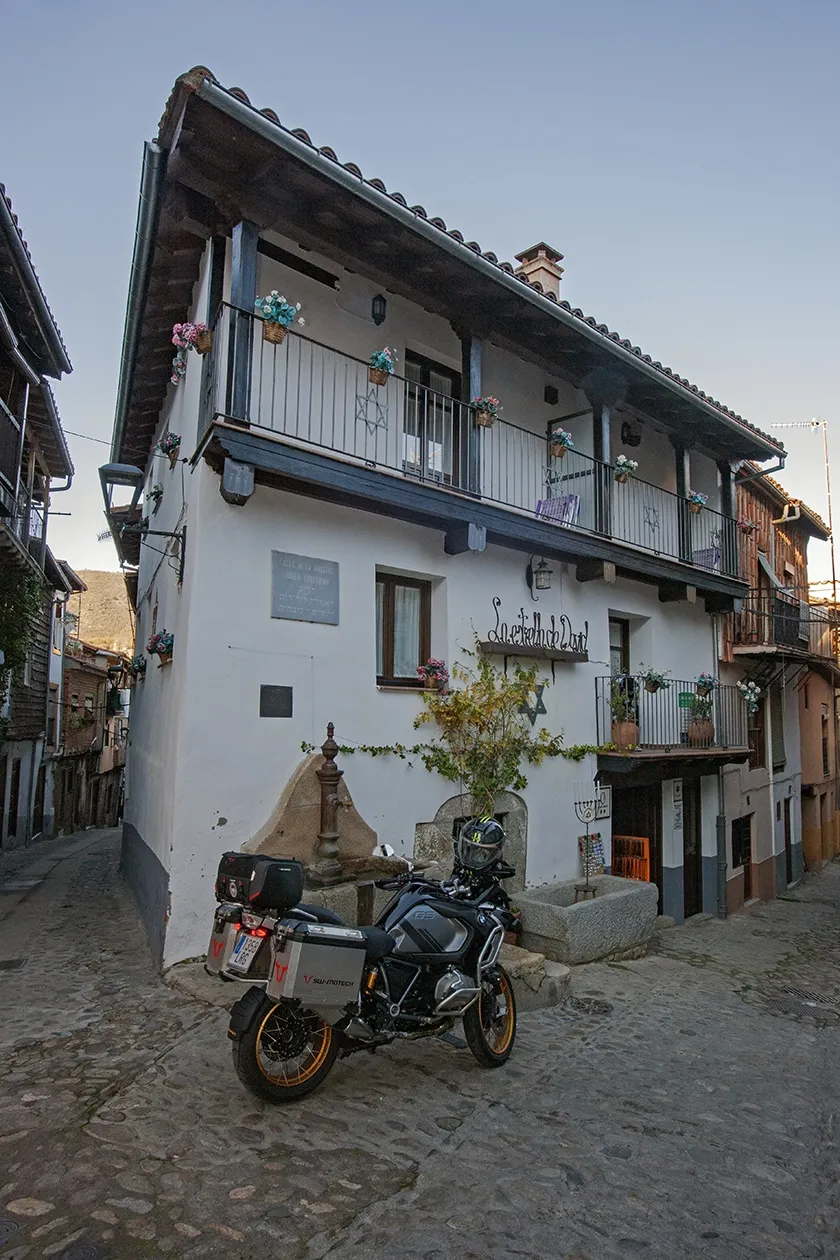
Its Jewish quarter, one of the most beautiful in the country, maintains the clear signs of identity of its past, even preserving the craftsmanship of the time based on the manufacture of leather, wood, wrought iron and glass.
Walking through its old town it is impossible to resist the exciting evocation of what it was and what it meant. Its streets and corners flanked by splendid traditional houses built with a chestnut and adobe framework are a masterful exercise in wisdom. Perfectly maintained for centuries, as the conversion here was massive, preventing the Sephardic exodus and guaranteeing the survival of their culture, the serpentine of houses catches the eye, especially in the current Calle Rabilero, where it is believed that the synagogue was located at number 19, and in the surrounding area, provoking a real journey back in time.
The Jewish quarter of Hervás has been declared a Historic-Artistic Site and is one of the best preserved Jewish quarters in Spain, even making an effort to pay homage to its Jewish past by dedicating a street to “Jewish-Christian friendship” and, above all, with an extremely careful recovery and restoration of the old quarter.
The entire medieval quarter of Hervás is decorated with symbols such as the Star of David or menorahs, a permanent reminder of its Sephardic past, but perhaps the most colourful moment is during the “Los Conversos” festival, which is held every year in the first days of July with various activities and, above all, a great theatrical representation of the historical moment of the expulsion that takes place on the banks of the river Ambroz, on the edge of the medieval quarter.
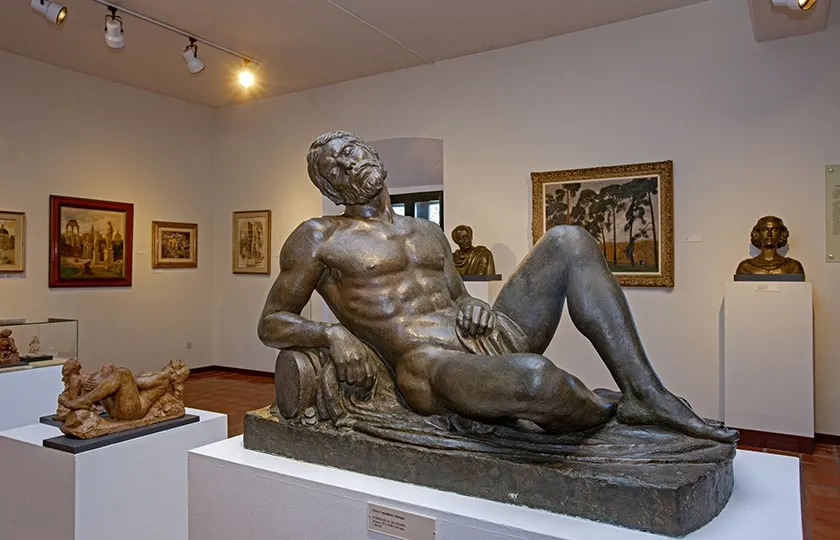
We cannot leave Hervás without tasting the delicious Jewish pastries that have been wisely recovered, nor should we forget to visit the Pérez Comendador-Leroux Museum, in whose rooms of the Casa de los Dávila palace we can enjoy a large part of the sculptural production of Enrique Pérez Comendador (Hervás, 1900-Madrid, 1981) and the paintings of his wife, the French painter Magdalena Leroux (Paris 1902-Madrid 1985).
Another of the surprises that the jewel of Hervás holds is the Motorcycle and Classic Car Museum, a dream of Juan Gil Moreno who, in love with his town, made this museum space a reality to house one of the best collections of European and American cars and motorbikes manufactured between 1920 and 1970.
Barely half an hour’s drive separates us from our next destination, the Noble, Loyal and Beneficent City of Plasencia, founded by Alfonso VIII of Castile in 1186. Shortly afterwards, the first Jewish community was documented with a certain degree of autonomy, rights and the administration of justice, which was administered in the court that met at the door of the church of San Nicolás.
For several centuries the Jewish community mainly inhabited the area known as de la Mota, specifically the space currently occupied by the Parador de Turismo, in the old Convent of San Vicente, around the synagogue, although other Jewish families lived in what are now Trujillo and Zapatería streets, as well as in the Plaza Mayor. Of the two synagogues that once existed, only a few remains are preserved under the Parador de Turismo and in what is now the beautiful Renaissance palace of Carvajal Girón.
Plasencia is so monumental that it easily overshadows the details, but as a whole it is enchanting, especially when strolling through its secluded streets and corners where you can breathe in the aromas of “aljama” coming from the kitchens of some of the restaurants that prepare Sephardic food.
The jewel of the Jewish quarter is undoubtedly to be found outside the walls, in the area known as El Berrocal, where the Jewish cemetery is located, with dozens of anthropomorphic tombs dug into the rock and perfectly visible looking towards Jerusalem.
Beyond the Jewish imprint, Plasencia is a cultural universe whose greatest exponent is the two cathedrals, one next to the other, whose façades transcribe the city’s Christian heritage, not forgetting the interior of the New Cathedral with its majestic altarpiece and the sublime carving of the Choir of the Catholic Monarchs.
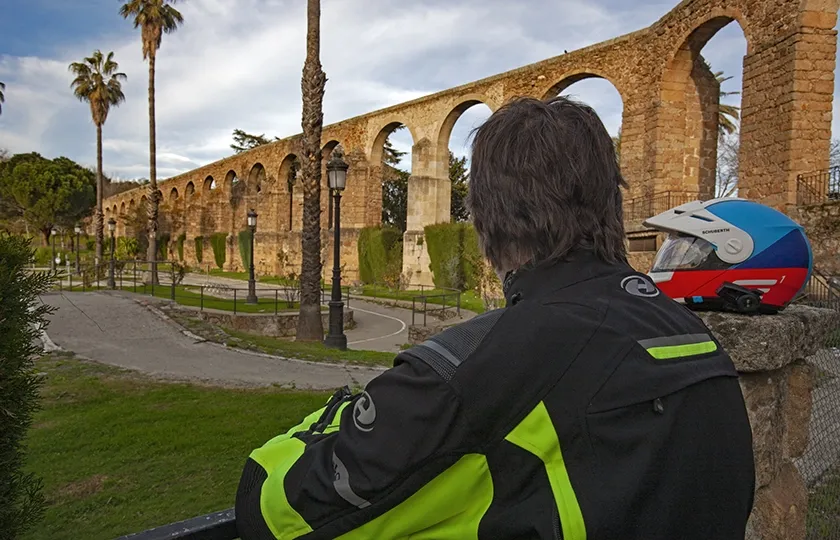
Palaces, stately homes, the city wall, the aqueduct and a thousand nooks and crannies, reached through charming narrow streets, are part of an urban ensemble that speaks of centuries of history that well justify the nickname of “Pearl of the North”.
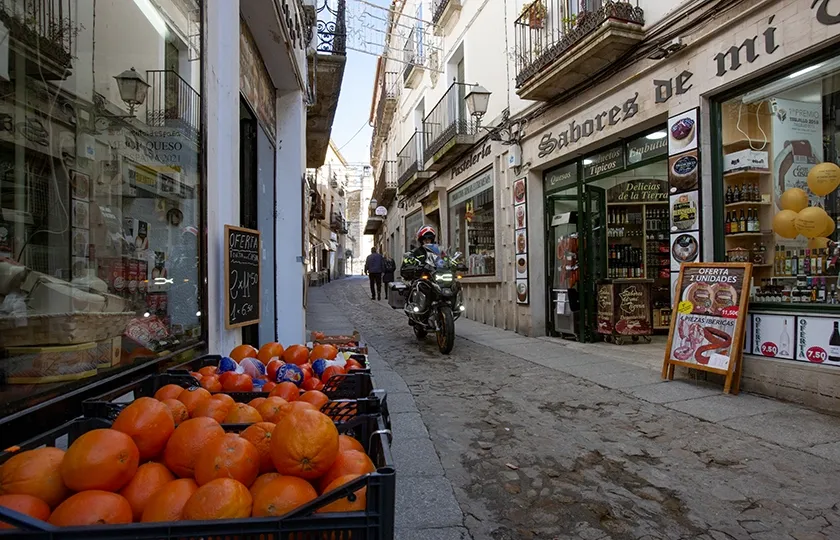
Before leaving Plasencia, it is worth going to the Plaza Mayor to visit Ana and Gloria, two enterprising sisters who set up Plasencia Sabores, a gourmet shop where you will find the best of Extremadura and some products from other regions; in addition to the most delicious flavours of the land of Extremadura, their display cases are full of cosmetics, souvenirs and handicrafts.
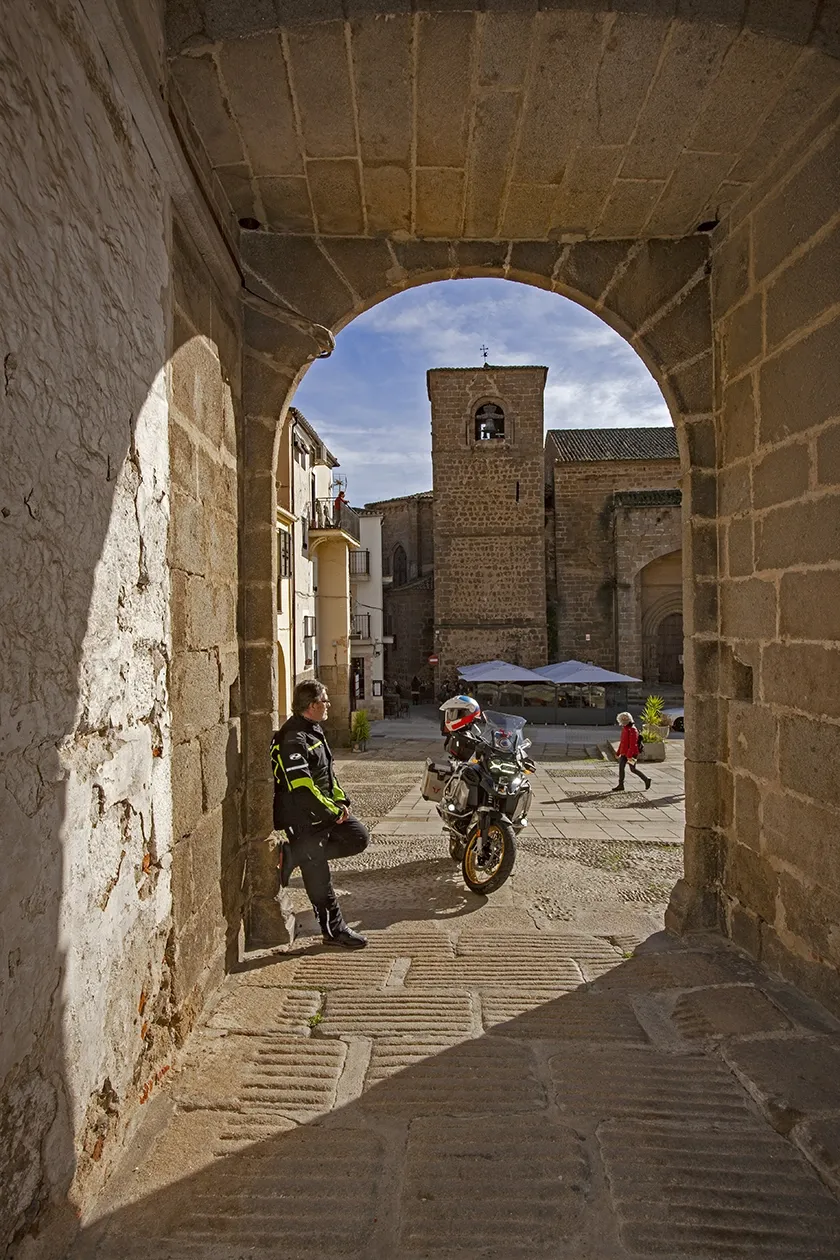
Coria is our next destination, the most important city in the northwest of Cáceres, treasures within its walls the suggestive legacy of two thousand seven hundred years of history.
“In the evening, he sat at table with the twelve” (Matthew 26:20) and on that table, a white linen tablecloth that held the food and delicacies with which Jesus Christ would celebrate the Passover and his Last Supper. Welcome to the place where one of the most important relics of Christianity is kept.
Born with the Vetton name of Caura, it maintained its culture until the Roman occupation and with it its new reality, becoming known as Caurium and becoming one of the most splendid cities in the province of Lusitania.
In the 8th century, already in Muslim power, it became known as Madinat Qüriya, a square which, due to its strategic enclave in the heart of the fertile valley of the river Alagón, was coveted for centuries by Arabs and Christians until it was definitively reconquered in 1213 by the León king Alfonso IX.
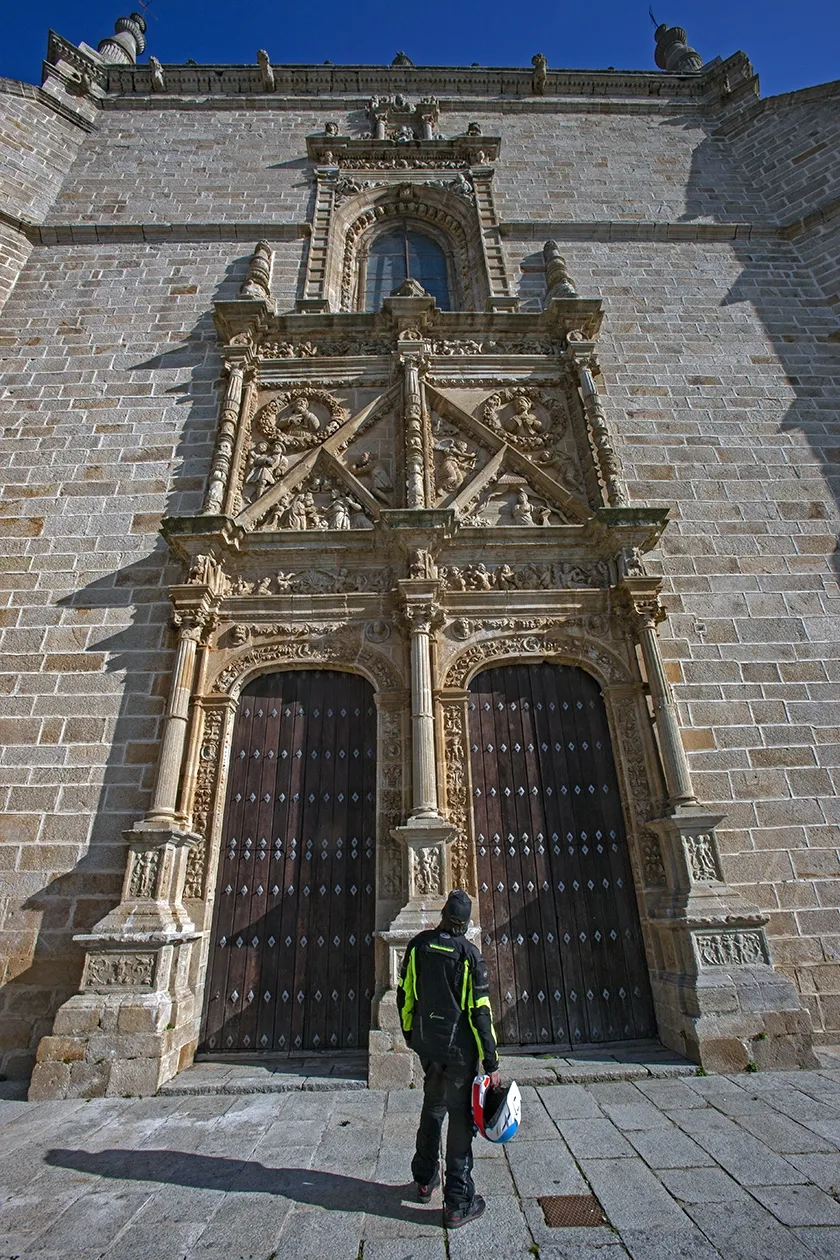
From all that legendary past, today the city of Coria conserves a rich heritage that shows all its splendour in the historic quarter, declared an Asset of Cultural Interest in the category of Historic Site. Both religious and civil and military architecture have magnificent examples here, such as the Gothic-Plateresque cathedral built between the 15th and 18th centuries, whose cathedral museum conserves the Sacred Tablecloth of the Last Supper, which according to tradition was used by Jesus and his apostles before the Passion, churches such as that of Santiago Apóstol and the convent of Madre de Dios. Military architecture finds its best examples in the Roman walls from the 1st century, preserving some original gates such as that of the Guía, which was later modified in the 16th century to place the coat of arms of the Dukes of Alba, and the Castle of the Dukes of Alba from the 15th century.
Interesting examples of civil architecture can be found in the 17th century Royal Prison, in the 15th century palace of the Dukes of Alba, as well as in the stone and iron bridges. Another interesting urban grid is the one that delimits the cathedral square with the streets Albaicín, Alojería and Las Cuatro Calles, as this is where the Jewish quarter was located, where the old house of the Inquisition and beautiful examples of classically Sephardic doorways are situated.
On imperial roads
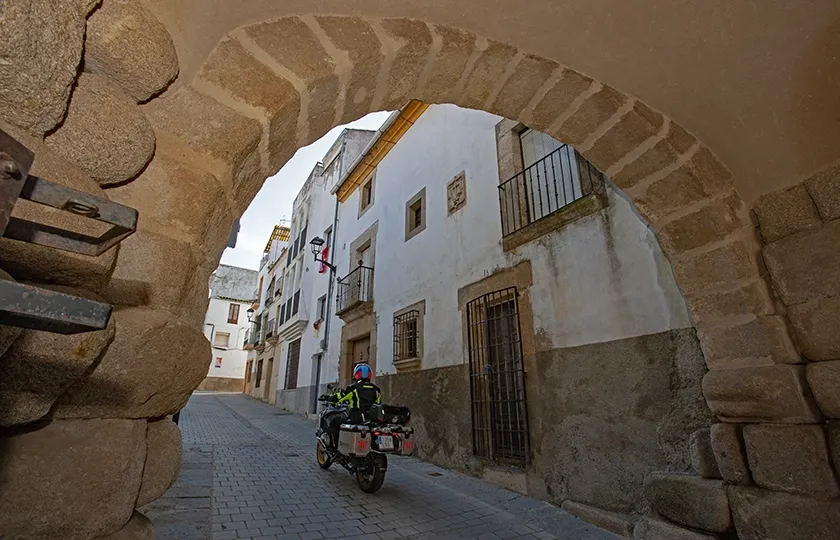
We continue our journey in the footsteps of the Sephardim in the province of Cáceres, leaving behind the city of Coria and heading south towards Valencia de Alcántara.
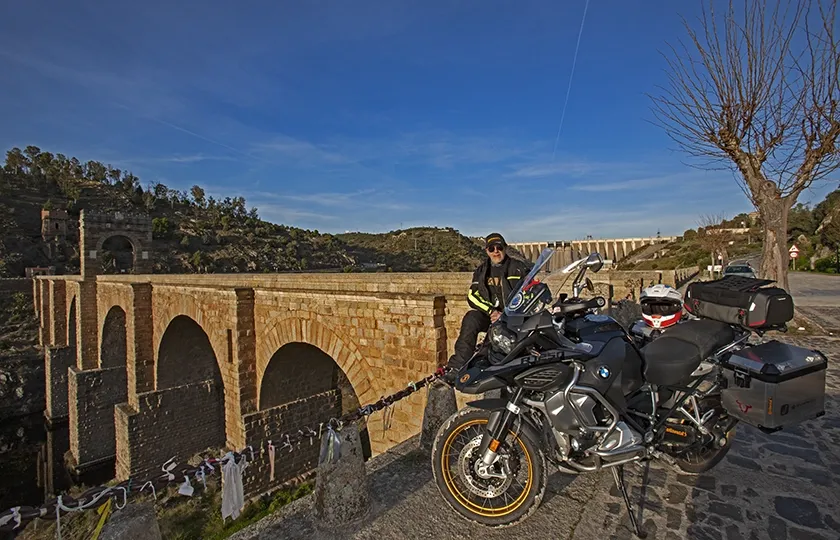
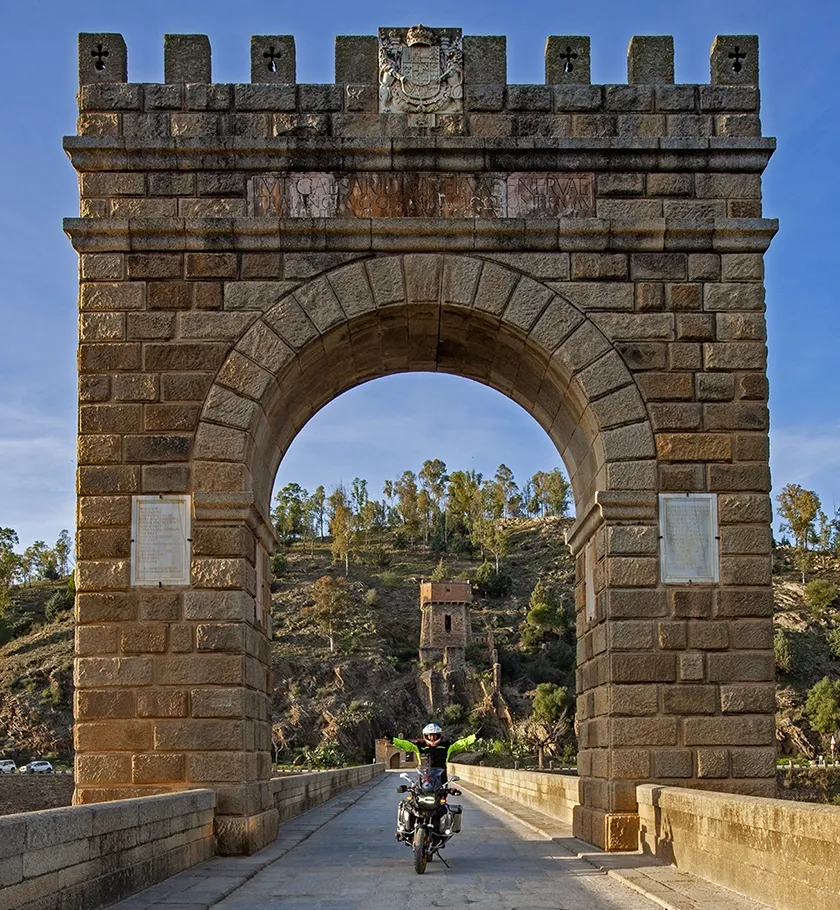
Under a deep blue sky of almost hypnotic beauty and an air that evokes frontier lands, between fields and pastures full of romanticism that keep magnificent examples of popular architecture, the curves follow one after the other maintaining the choreography that entertains us until, suddenly, the Roman bridge of Alcántara fixes our attention, making us let off the gas, with its powerful image.
This is undoubtedly one of the greatest examples of Roman civil engineering. “The bridge that will remain standing for the centuries of the world“, as the inscription on the small Roman temple that precedes the east entrance reads, could well seem like a prophecy. Built in the early years of the 2nd century AD in honour of the Emperor Trajan and spanning the Tagus River at a height of 58 metres, it connected the urban centres of present-day Cáceres with the ancient Roman city of Conímbriga in Portuguese territory.
The 194-metre-long building is supported by six ashlar arches built with exceptional skill and using construction techniques that were very advanced for the time, which again justifies the fact that it has survived to the present day almost intact.
n the centre of the bridge stands an original arch from the Trajan period, on the south side of which an imperial coat of arms was placed in the 16th century, commemorating the extensive restoration carried out on the orders of Charles V. The passing of the centuries and the traces of historical battles have left their mark on this distinguished work, both in the Middle Ages due to the battles between Christians and Muslims and during the struggle against the Napoleonic forces, but nothing could destroy its masterful conception and brilliant execution, which is why it has survived to the present day, maintaining the breathtaking image that it signifies so much.
Valencia de Alcántara, set in the midst of a natural environment of high ecological value in which the protagonists are the cork oaks and holm oaks, where the landscape takes on international tones between Spain and Portugal, is the nerve centre of a territory that has been inhabited for thousands of years. This is attested to by the more than forty dolmens built in stone in the Neolithic and Chalcolithic periods, constituting one of the most important megalithic complexes in Europe and declared an Asset of Cultural Interest.
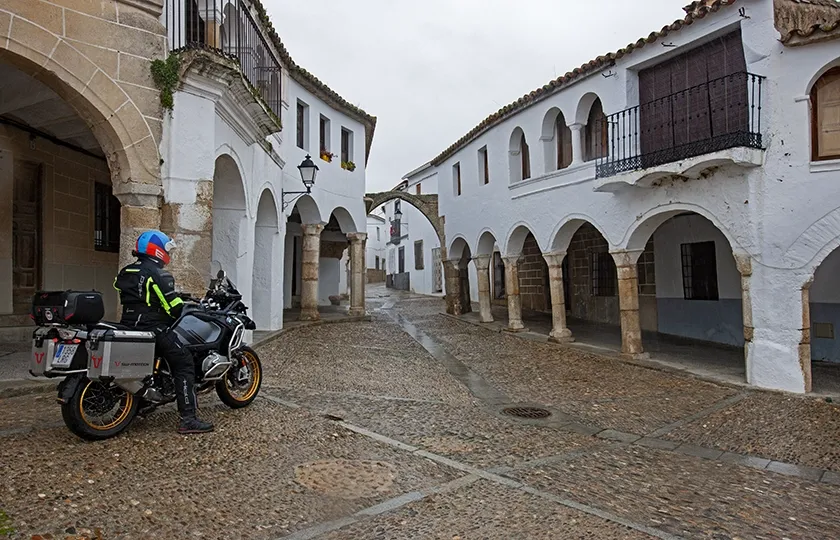
But the town centre of Valencia de Alcántara holds other interesting cultural gems such as the Jewish-Gothic quarter which stretches along nineteen streets punctuated by two hundred and sixty-six doorways, mainly in the Gothic style, although other styles can also be found here. Its long, narrow streets with a marked medieval character delimit the old “aljama”, populated since the 13th century, in which the imagination recreates past times with their lights and leftovers.
One of the curiosities of this neighbourhood is the synagogue that has survived to the present day, preserving within its walls many interesting testimonies of the importance it enjoyed until the expulsion of the Jews.
The heritage catalogue of Valencia de Alcántara is completed with beautiful examples such as the Archpriestly Church of Santa María de Rocamador, the temple where the Infanta Isabella, daughter of the Catholic Monarchs, married the King of Portugal Don Manuel “El Afortunado” on 7 October 1497; “; the Church of the Encarnación, from the former convent of Santa Clara; the Town Hall; the 13th century Castle-Fortress, the aqueduct, the Roman roads, the Stone Bridge and the Monroy Fountain.
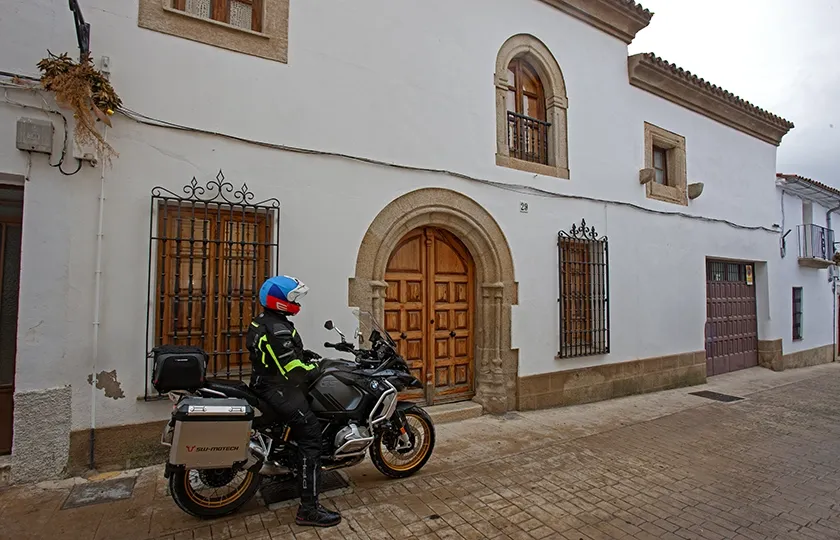
An obligatory stop on the Silver Route during the Roman Empire, Garravillas de Alconétar saw the light of day in the late Middle Ages when Garrovillas took in the inhabitants of another village, Alconétar, which was destroyed by Muslim troops. Recovered in 1167 by King Alfonso VIII, the castle was handed over to the Order of the Temple, who established it as the head of the Encomienda.
Crossed by the Tagus River, it “hides” in its streets and squares important treasures that bear witness to an important past that dates back to prehistoric times with the dolmens of Guadancil and Cerro Garrote.
On a visit to this land that once inspired the famous Calderón de la Barca, there are seven heritage sites not to be missed: : its marvellous square declared a Historic-Artistic Monument of National Interest; the churches of San Pedro Apóstol and Santa María de la Consolación, the Sanctuary of Nuestra Señora de Altagracia, the convents of San Antonio de Padua and that of the Hieronymite Nuns and the Palace of the Counts of Alba de Aliste. The visit is completed with the Corral de Comedias located in the same square and built in the Golden Age following the style of the Almagro playhouse.
And of course, the Jewish Quarter. Known as “Los Castillejos”, it has the typical typology of this type of neighbourhood, narrow, winding streets with houses with wooden doors, bars on windows and balconies and numerous elements that combine Gothic and Mudejar styles.
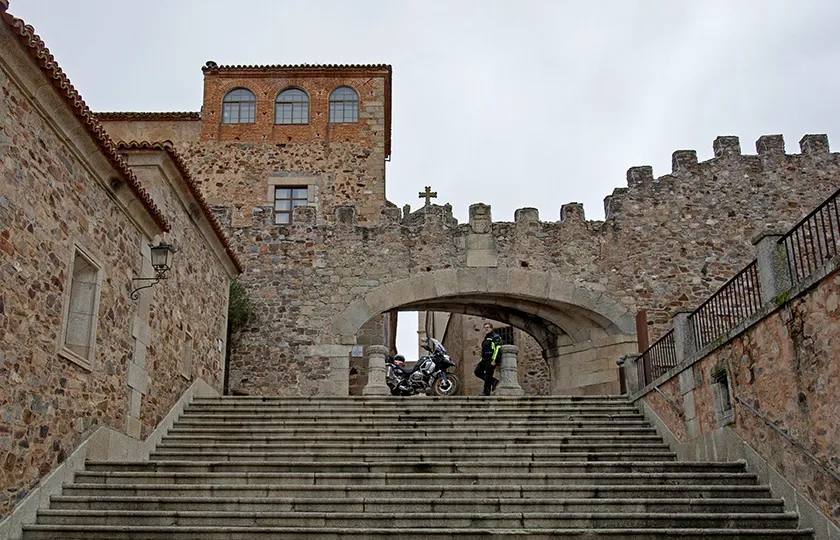
To enter the historic quarter of Cáceres, declared a World Heritage Site by UNESCO, is to immerse oneself in a host of sensations that take us back in time.
Steep streets flanked by suggestive buildings and secluded corners that unleash the imagination invite us to recreate, behind every corner, everyday scenes from another time. But what has brought us here this time is to get to know one of the jewels that the Sephardic culture left in Spain: its Jewish quarter. Documented since the early 13th century in the Charter of Cáceres, granted in 1229 by King Alfonso IX after the conquest of the city. But it is possible that a century earlier there was already a small Jewish community, as can be seen in various elements that can be visited in the Yusuf al-Burch Museum.
The first Jewish quarter spread over what is now the San Antón neighbourhood, where the community lived and grew quietly for two and a half centuries. The atmosphere that pervades the Old Jewish Quarter is still palpable today, where a small hermitage occupies the site once occupied by a large synagogue, maintaining a perfect harmony of modest beauty with the rest of the small whitewashed houses. This urban network of alleys, such as that of Don Álvaro, through which the Jews were obliged to leave and enter the aljama at dawn and dusk so as not to attract attention, is an exercise in reverie that is impossible to forget. Many relevant testimonies of those times have survived to the present day, such as the Arch of Christ which, although of Roman origin, was closely linked to the Sephardic community as it was the most frequented point for leaving and entering the city, as well as the Huerto de la Judería, a delightful garden that recalls the way of life of a powerful family of the time.
Very close to the Plaza Mayor, on the other side of the city, lies the Judería Nueva, which was once a provisional settlement, but where several Jewish families decided to stay after the expulsion of 1492. It had a synagogue on top of which the splendid Renaissance palace of La Isla was built in the 16th century.
After this wonderful experience through the old Cáceres and having satisfied our cultural cravings, we are going to satisfy another kind of appetite that our palate will be grateful for. Without leaving the Judería Nueva, specifically in Paneras street, we find Gadi Extrem, the paradise of Extremaduran flavours. A gourmet shop selling typical products from the land and pastures of Extremadura, the most delicious hams hang on its walls: D.O. Dehesa de Extremadura Iberian ham, acorn-fed Iberian ham, Iberian cebo campo ham; not forgetting the acorn-fed Iberian shoulder and all kinds of Iberian sausages. And its display cases are overflowing with goat’s and sheep’s cheeses, the famous torta del Casar, paprika from La Vera, as well as pâtés, jams, fig or cherry chocolates and oils from the Sierra de Gata. They also offer wine tastings and tastings of their products and if you go in a group, the tastings are free of charge.
There is so much to see in Cáceres that a single day is not enough time to discover it, so when looking for accommodation an excellent option is Moret 11 Tourist Apartments (Moret Street, 11). Located in the historic centre of the city, in a completely restored building and equipped with all the comforts, it has a lift, wifi, equipped kitchen, cot on request and free of charge, Smart TV in the lounges and offers breakfast included in the stays, tourist information and public parking within walking distance of the apartaments.
Trujillo, also known as the City of Conquerors, as this is where Francisco Pizarro and Francisco de Orellana, among others, were born, was also a Roman and medieval city, making a stroll through its intricate historic quarter a surprising cultural exercise.
Although it was already relevant during Roman times as an important tributary of Emérita Augusta (Mérida) and after the splendour achieved with the Muslim occupation, which brought with it the walling of the town and one of the greatest economic splendours, it was the Discovery of America that put Trujillo on the map.
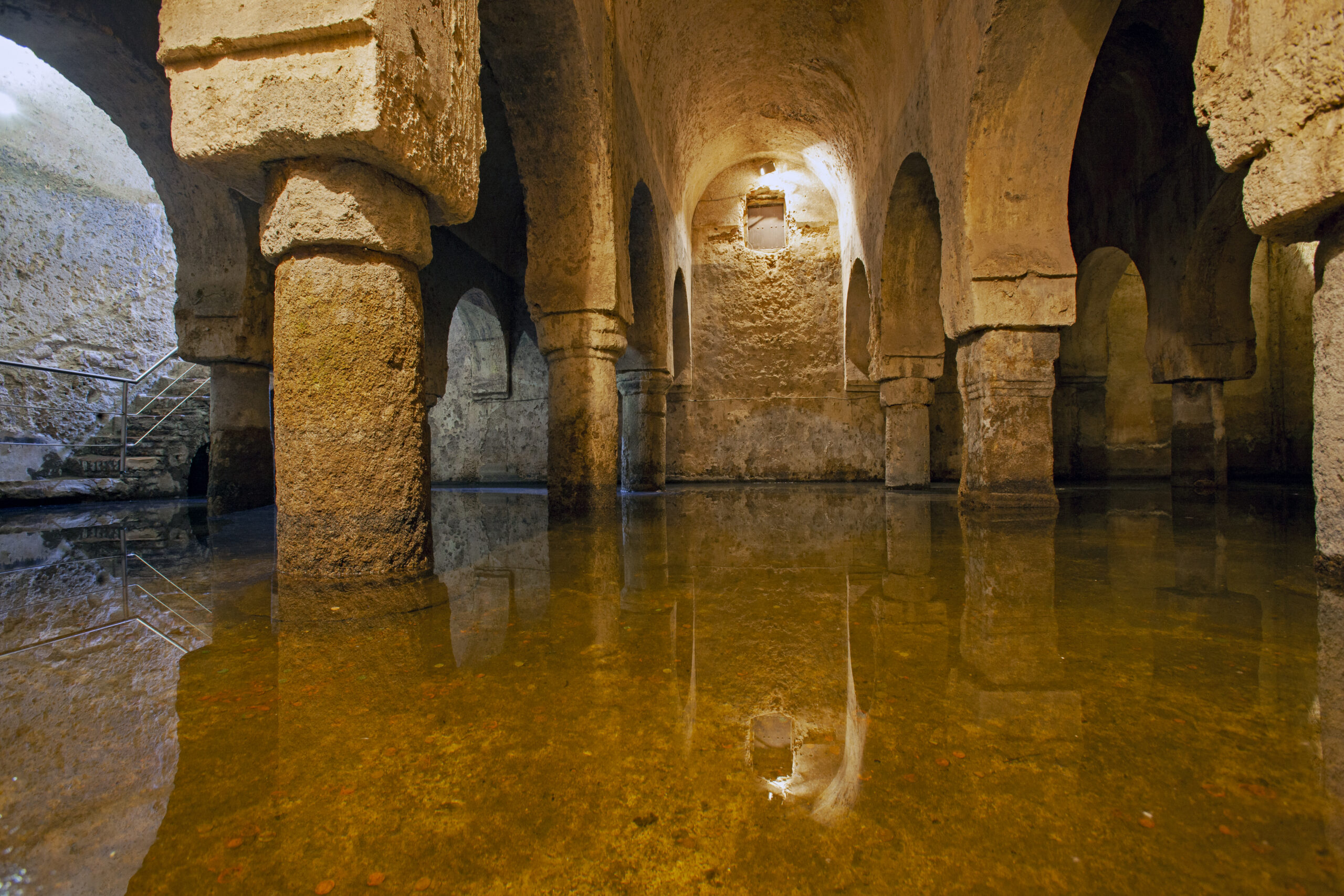
The castle is perched on the slopes of the hill on which the castle stands, built between the 9th and 12th centuries on the remains of an ancient citadel, inside which the hermitage of San Pablo, a pool and a Hispano-Muslim cistern are preserved, the urban layout is defined by secluded streets flanked by outstanding examples of civil and religious architecture such as the church of Santiago, as well as suggestive corners impregnated with the atmosphere of great overseas adventurers.
At the foot of the hamlet in the form of a torrent of history, the Plaza Mayor looks like a grandiose, Renaissance space. Presided over by the equestrian statue of Francisco de Pizarro, what was once a place for merchants and artisans is now an emblem of the town, on whose perimeter the palaces of the most important lineages of the time were built in the 16th century, such as the Casa de la Cadena, the Orellana, the Chaves-Cárdenas, the palaces of the Conquista, the Dukes of San Carlos, Piedras Albas and the Carvajal-Vargas, as well as the imposing church of San Martin de Tours.
Trujillo is a mosaic of surprises not only drawn in stone, but the cultural offer is completed with a good number of museums, festivals such as Semana Santa and events that make the visit an unforgettable experience, as well as the tasty gastronomy whose greatest exponent is focused on the National Cheese Fair.
In addition to admiring the many attractions of the town, what has brought us here is the Jewish heritage that is still preserved. Trujillo had one of the most important communities in Extremadura, of whose legacy some remains of the synagogue are preserved. The space occupied by the aljama extends along the streets that start from the Plaza Mayor towards the east, where it is possible to see the characteristic layout and some remains scattered in private spaces.
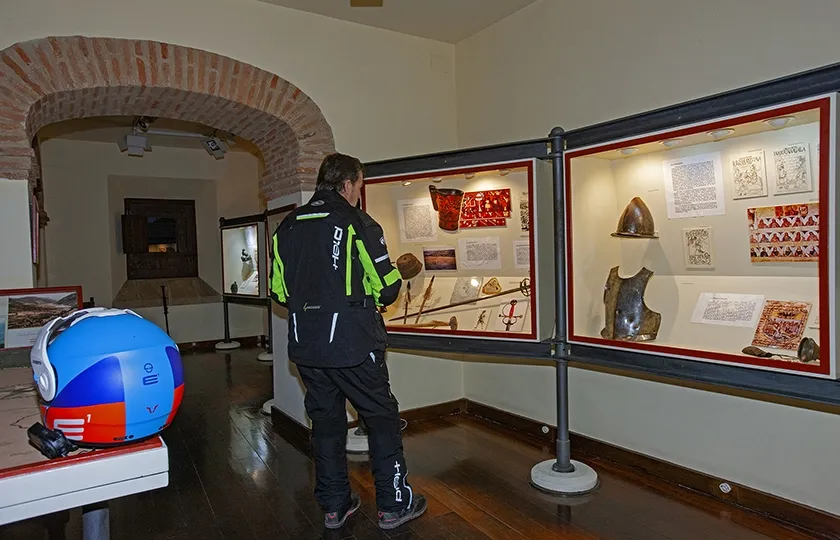
It is said that a shepherd, at the end of the 13th century, found a carving of the Virgin Mary by the river Guadalupe. A small hermitage was built there and a hamlet known as the Puebla de Santa María de Guadalupe, the origin of the present-day village, was built around it.
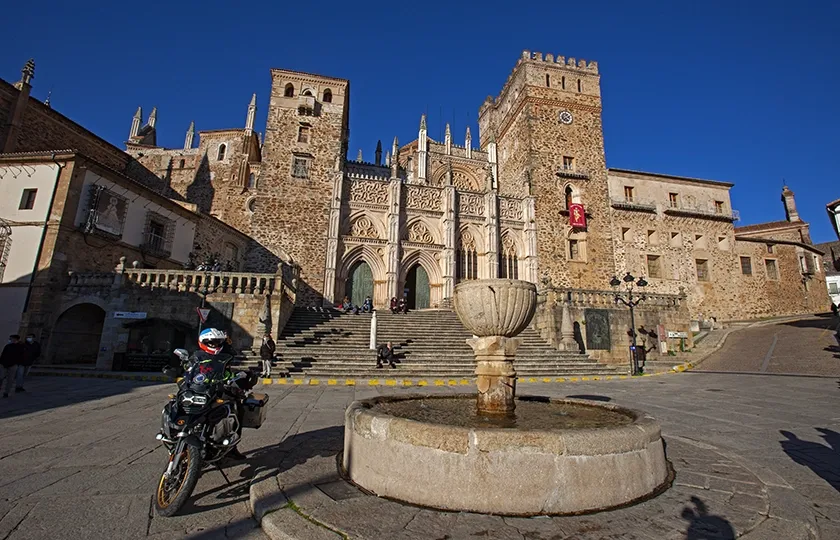
But if there is one thing that makes Guadalupe stand out, it is its sanctuary, declared a UNESCO World Heritage Site, which soon became the most important pilgrimage centre in Spain, along with Santiago de Compostela. Built in 1340 by King Alfonso XI of Castile, it has Mudejar, Gothic, Renaissance and Baroque elements. If its architecture is spectacular, no less so is the quantity of artistic treasures it houses, both in sculpture and painting, including works by Zurbarán, Goya, El Greco, Pedro de Mena and Juan de Flandes.
The hamlet of Guadalupe, declared a Historic-Artistic Site, recreates a dreamlike setting with its secluded corners and beautiful narrow streets lined with magnificent examples of mountain architecture, as well as magnificent monuments, both civil and religious.
This beautiful town in Cáceres, like many others we have visited, in addition to its exceptional heritage, has brought us this time its Jewish legacy, whose origins date back to the end of the 13th century. The strong anti-Semitic pressure from the ecclesiastical community and the arrival of the Inquisition marked a turbulent existence for the community. The vestiges of those times can be found in the old Veneno street, which is now a branch of the Plaza Mayor that ends at the Chorro Gordo arch. But they are not the only ones. The old baptismal font of the monastery which today presides over the square in the form of a fountain in front of the sanctuary or the Star of David on the Mudejar doorway of the old pharmacy, located in the north wing of the Gothic cloister, as well as others on the main entrance door to the temple are incontestable testimonies of the Sephardic legacy.
We leave the region of Los Ibores heading north following winding roads of good asphalt, but always accompanied by spectacular scenery until we reach Villanueva de la Vera.
The Jewish community in the valley of La Vera was one of the most flourishing in the kingdom, enjoying at first a good number of privileges, its own jurisprudence and a strategic social position until it fell into disgrace with the decree of expulsion decreed by the Catholic Monarchs in 1492.
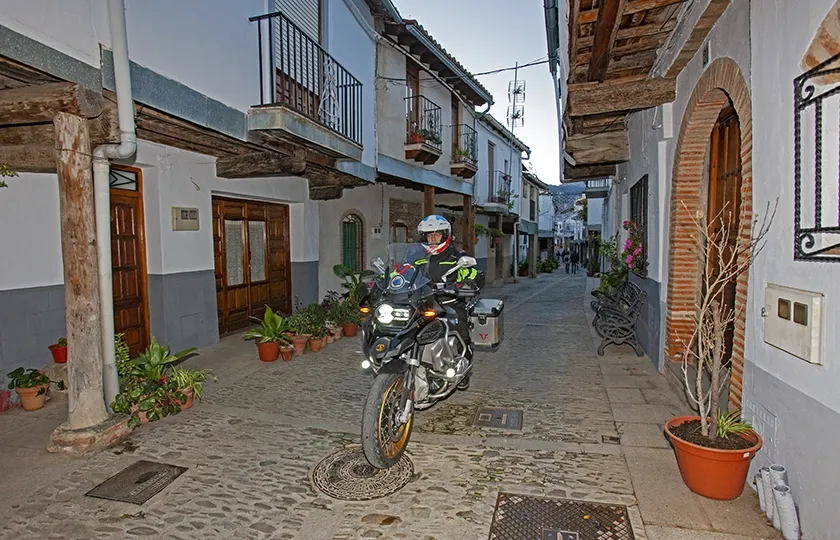
Villanueva de la Vera is the first town we stop at, as the popular architecture of its old quarter is a magnificent example of the region. Declared a historic-artistic site, strolling through its streets, flanked by masonry and wooden houses and all harmonised by a succession of overhanging cantilevers, is a real delight.
A short distance away Valverde de la Vera, also famous for its unique procession of Los Empalaos, which every Maundy Thursday overwhelms the hearts with its enormous emotional charge, surprises us with its popular architecture faithful to the lattice technique. Through its old quarter, which has been declared a historic-artistic site, run the “regateras”, irrigation channels built since ancient times to channel rainwater. In the 15th century, the Jewish quarter of Valverde de la Vera was one of the most emerging and populated centres in Extremadura, mainly dedicated to trades such as shoemakers, blacksmiths, tinsmiths, carpenters, goldsmiths, furriers, tailors, doctors and apothecaries, although it was also involved in financial services.
We continue our journey to our next destination with an obligatory stop at the Cuartos gorge to admire the sculptural and capricious work of nature and its natural pools. A little further on, Losar de la Vera surprises us with its topiary art, sculptures of whimsical shapes made from bushes. In the Middle Ages, this small and pleasant town had another important Jewish settlement and became a council with its own legislation.
Jarandilla de la Vera is one of those towns that emanate a special essence that can be appreciated as soon as you enter. Inhabited since prehistoric times, it is its environmental conditions, characterised by abundant water and a very pleasant climate all year round, together with its rich heritage, that give it that special touch. The town centre is dominated by the castle of the Counts of Oropesa, which has now been converted into a Parador hotel. Emperor Charles V stayed in this fortress for a time while awaiting the completion of work on the palace attached to the monastery of Yuste, which was to be his final resting place. Although the historical importance of Jarandilla, together with the many examples of architecture in a multitude of styles, may dazzle us, we must not forget that there was also an important Jewish community here, of which there are many testimonies throughout the old quarter.
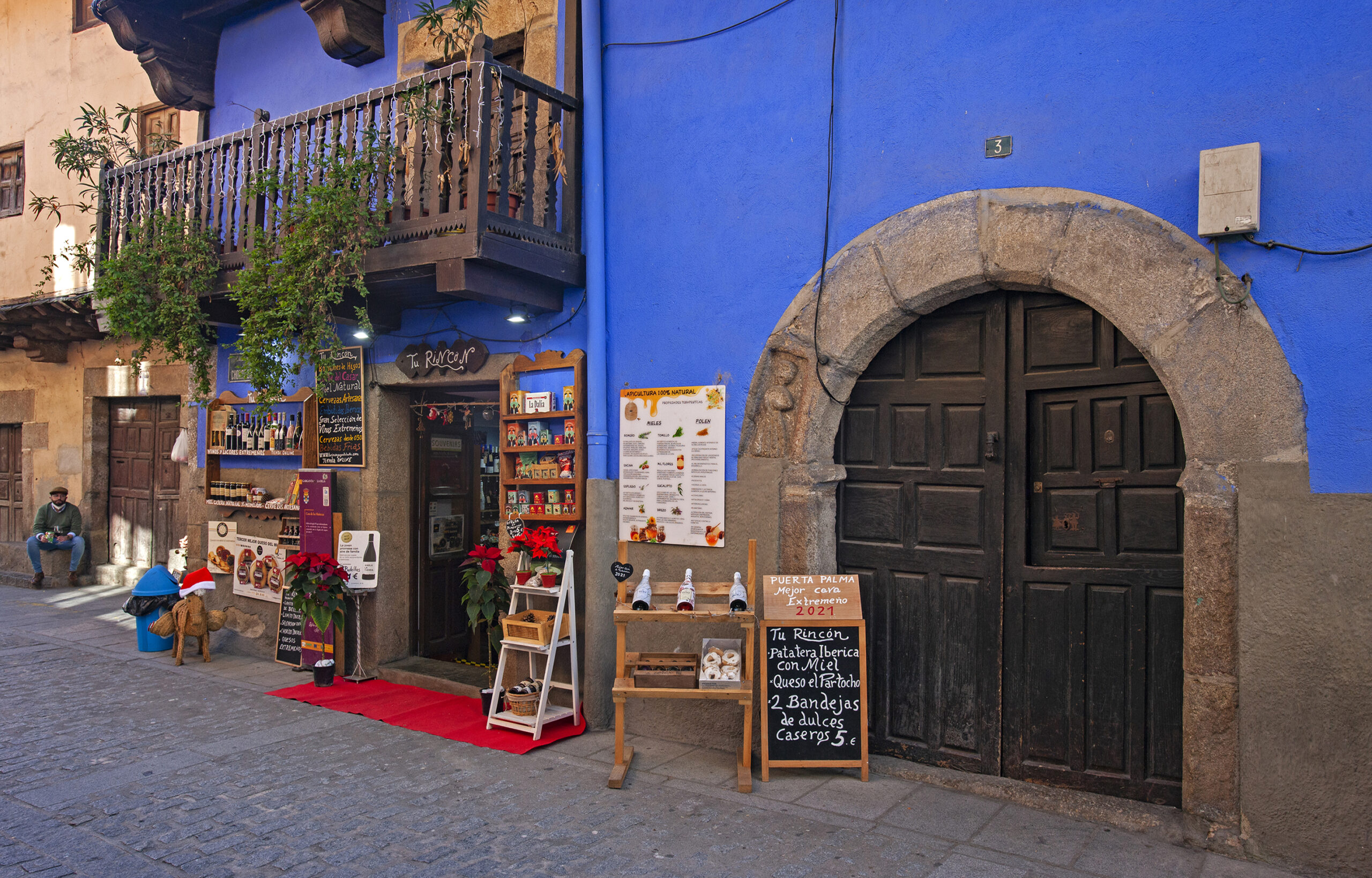
Protected from the north winds by the Gredos mountain range and enjoying the amazing scenery, we arrive at Garganta la Olla. Declared a historic-artistic site, it is a genuine catalogue of civil and religious architecture that compete in beauty, and a walk around it will allow us to discover some of its curiosities. Such is the case of the hermitage of the Santísimo Cristo del Humilladero, inside which there is an original 16th-century altar made of Talavera tiles. But if there is something truly unique, it is the Casa de Muñecas, the building that housed a brothel used by the entourage of Emperor Charles V when he was staying at the monastery of Yuste. It still retains its original blue colour, which made it easy to find. The Huerta neighbourhood is one of the best and most homogeneous examples of popular architecture that inherits the urban layout of the old Jewish quarter, as Garganta la Olla was home to an important community from the 12th century onwards.
Through lush natural surroundings bathed by the river Tiétar we arrive at Cuacos de Yuste, universally known for being the town in which the monastery of Yuste is located, which was the last resting place of Emperor Charles V. Declared an Asset of Cultural Interest, the town boasts beautiful popular and noble architecture, with the porticoed square and the church of La Asunción and its 16th-century organ made in Antwerp standing out.
Above all, the most important monument in Cuacos de Yuste is the monastery of San Jerónimo Yuste. Built in the 13th century, it underwent a profound transformation in the 16th century following the emperor’s wish to establish his last residence here, as the monarch was always accompanied by a large entourage. The result was the construction of a palace house attached to the monastery church with rooms designed and decorated in accordance with the importance of such a distinguished guest. This is also the end of the Route of Charles V, which connects the Cantabrian town of Laredo, the place where the monarch landed on his last journey, with Cuacos de Yuste.
On the way to the monastery it is interesting to stop at the German Cemetery, where the remains of 180 German soldiers from World War I and II are buried. They are crew members of planes, ships and submarines that fell on our territory or sunk in our waters. Until the early 1980s, the remains of the soldiers were scattered in different parts of Spain, at which point a German organisation for the preservation of cemeteries of the fallen in war decided to regroup the remains in a single place: Cuacos de Yuste.
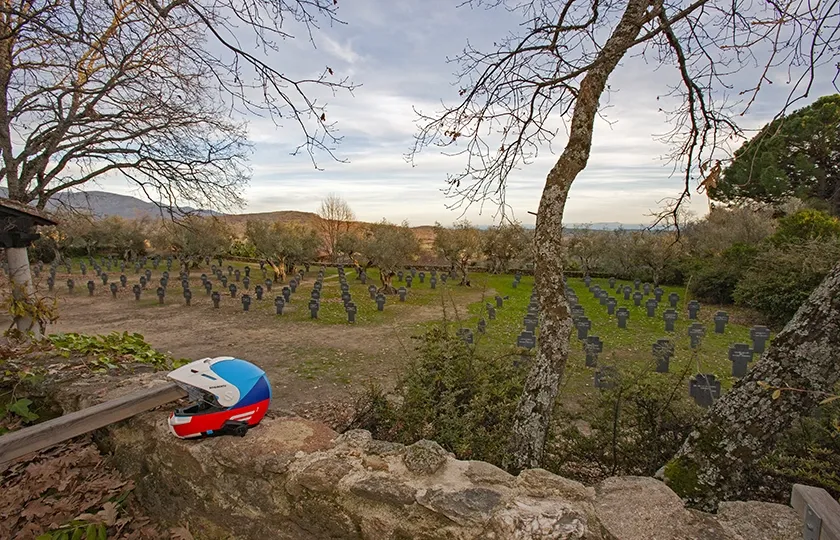
Jaraíz de la Vera, also known as the paprika capital of the world, is our next destination. Like its geographical brothers, it has an important civil and religious monumental heritage, with the church of Santa María de Altagracia declared a historic-artistic monument. A must-see and highly educational visit is the Paprika Museum, whose rooms offer an insight into the history of the valley’s star product and its characteristics and method of production. As soon as we leave the town, we stop for a few minutes at the Mirador de Gredos viewpoint to enjoy the incredible views of the mountain range, while paying homage to the fallen bikers in front of the sculpture in their memory.
The final point of this route is Pasarón de la Vera, another of the many historic-artistic sites that mark out this valley of prodigious nature. In addition to its magnificent examples of popular architecture and its beautiful monuments, the Pecharromán museum stands out for its originality. This is a space created in the mansion built by the Manrique de Lara family in the 16th century to house the work and bibliographic collection of Ricardo Pecharromán y Morales, painter, cultural promoter and patron of the arts.
We leave Pasarón de la Vera behind us and head towards the Jerte valley, where our route starts in one of the most photogenic valleys in Spain, especially when the two million cherry trees that populate it blossom in spring.
On the way to Piornal along the winding road that delights all lovers of curves, the landscape holds some surprises such as the Desesperá waterfall, a secluded spot where crystal clear water rushes down and from which there are truly spectacular views of the valley of La Vera.
We crown the mountain range in the municipality of Piornal and on the way out we cannot resist stopping at the Balcón del Valle viewpoint. In the evening light, the majesty of the Jerte Valley at our feet takes on a suggestive and romantic dimension that invites us to let ourselves be carried away.
From here the route gets interesting on the descent because of the steep slopes and fun bends. The road winds its way through chestnut woods offering unique views, but the most exciting surprise is to be found at the Bonal gorge and the Coazo waterfall, perfectly signposted on a sharp bend. After some six hundred metres of dirt track, the murmur of the water rushing down from a height of more than 30 metres overcomes our helmets. It is enough to walk a few hundred metres along an ascending path through a suggestive grove of oak, ash and alder trees to be amazed by the spectacle formed by the mad rushing torrent on its precipitous path along a granite wall.
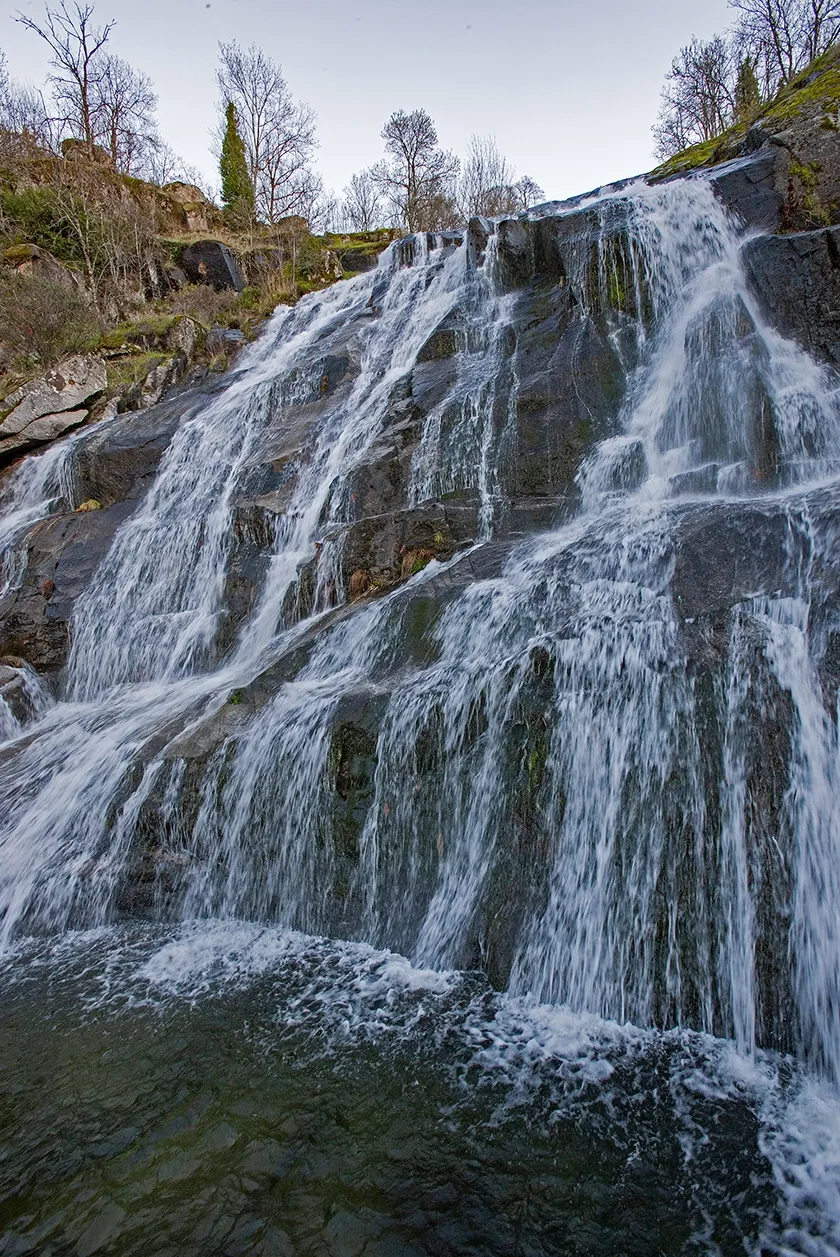
We retrace our steps in the direction of another highly symbolic and emotionally charged point. Continuing in the direction of the town of Casas del Castañar and continuing until we reach the N-110, we turn right for a few metres and then turn left again onto the CC-51, a beautiful road that once again awakens the fun sensation of curving. Suddenly, cutting through the mysterious light of the sunset, the sculptures that give soul to the Mirador de la Memoria stop us in our tracks and invite us to reflect. This sculpture field, created in 2009 by Francisco Cedenilla in accordance with the Law of Historical Memory, is made up of four naked human figures representing a woman, an old man and two young men, placed on large granite blocks to pay homage and remember the victims of the Civil War, as well as all the people who were imprisoned, tortured, exiled and displaced during the dictatorship.
Without being able to avoid this painful reflection on the unreasonableness of wars, we continue our route towards Cabezuela del Valle, right in the epicentre of the Jerte valley. Declared a historic-artistic site, its old town preserves the original medieval urban layout. The picturesque steep and labyrinthine streets are striking, as befits the characteristics of the medieval Jewish quarters. So much so that the church of San Miguel Arcángel was built on the site of what was once the Hebrew synagogue. Cabezuela del Valle also has an interesting heritage of popular and noble architecture, so it is easy to find all kinds of coats of arms and references to the nobility of the time, which testifies to the historical and cultural importance of this town that is well worth a leisurely stroll.
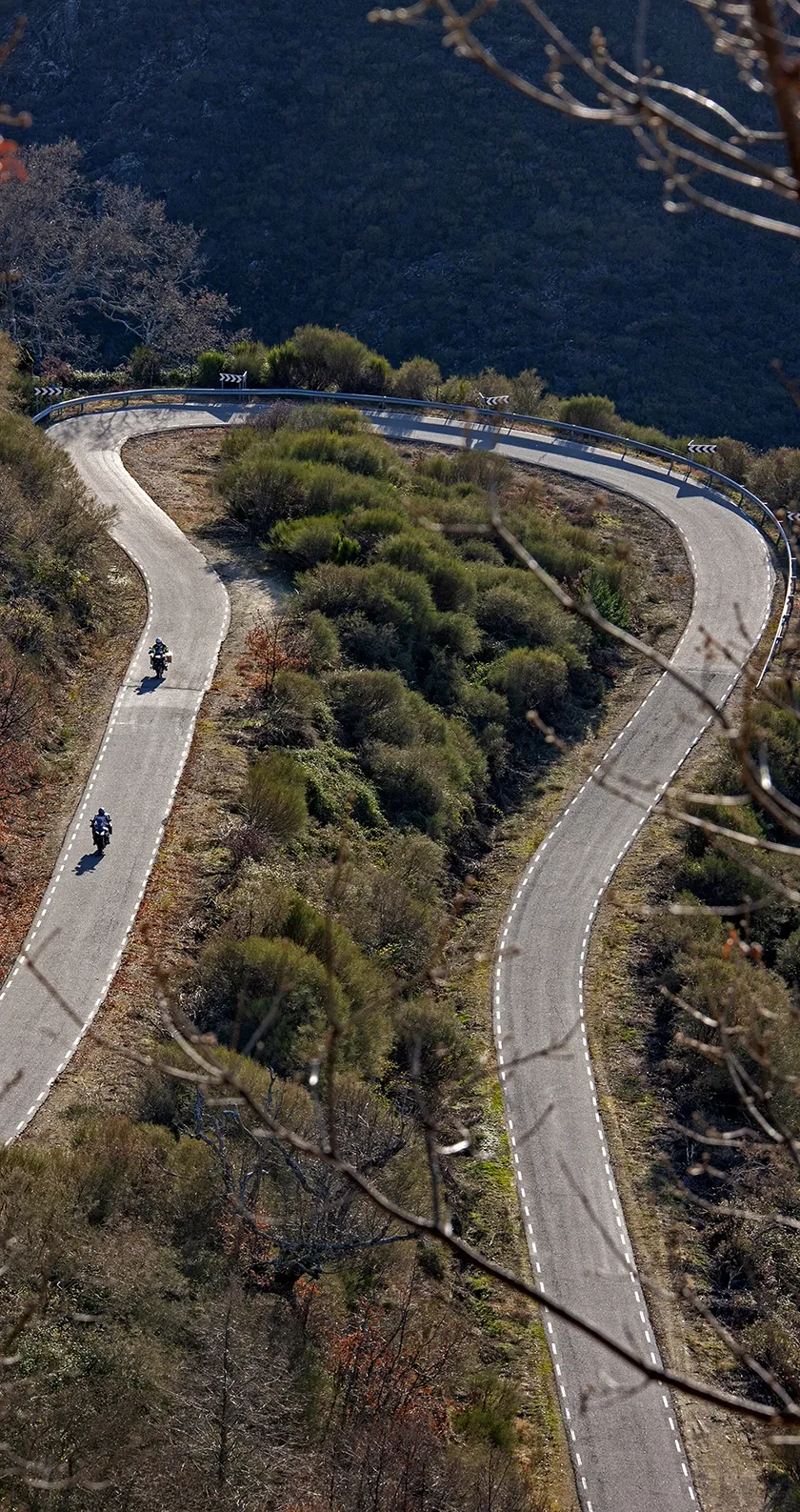
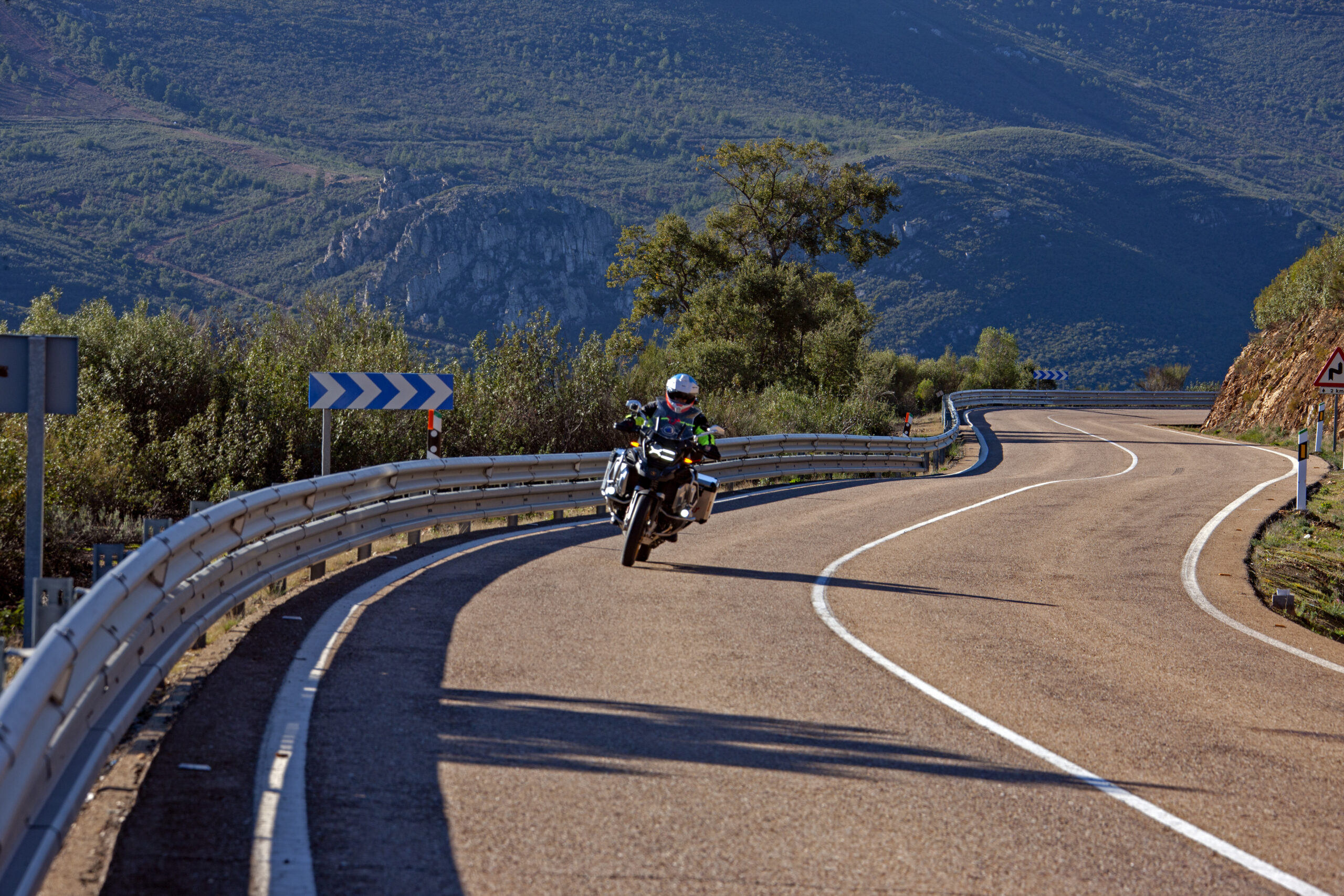
We return to the road to face the last stretch of the journey through the lands of Cáceres along one of the most attractive and evocative routes that every biker longs for. This is the CC-102, which connects the Jerte valley with the Ambroz valley via the Honduras pass. Both the seventeen kilometres uphill and the seventeen kilometres downhill offer some of the most colossal views of both valleys, successions of interlinked bends and good levels of adrenaline, both for the demands of riding and for the struggle not to be distracted by such a natural spectacle.
Finally we come to the end of our tour of the most significant Jewish quarters in the province of Cáceres, where it all began: Hervás, the best example of the Sephardic heritage in this part of Spain.