This land where Marco Polo set foot is a crossroads of civilisations straddling East and West. From Alexander the Great to the Tsarist era, from Genghis Khan to Tamerlane, the territory we know today as Uzbekistan has seen the birth, struggle, coexistence and death of some of the greatest empires in history.
Some of the great trade routes that linked China with the main Western markets passed through Uzbek territory, where legends were idealised, mythical cities were built and one of the most important channels of cultural exchange in history, the Silk Road, was consolidated. That road travelled by great travellers, caravans of merchants and artisans trading in gems, food, spices, gunpowder, silk and anything else that could be bought or sold, meant something much more important than the material and transported effortlessly, the exchange of knowledge.
For centuries, Uzbekistan was the centre of the world and the catalyst for the knowledge of Persia, China, India, Byzantium and Rome. It also witnessed an unprecedented prosperity that left its mark in fascinating monuments with an aesthetic and artistic sense in capital letters. Thus mythical cities such as Khiva, Bukhara and Samarkand were born, and were also the source of inspiration for the most exotic and desired reverie of travellers.
A legendary path
Much has already been written about the mythical journey that Marco Polo made at the age of seventeen accompanying his father and uncle, Venetian merchants, who were seeking to establish trade links with the Far East in the second half of the 13th century via a new route.
This fascinating journey took twenty-four years across the Middle East, the South Caucasus, Central Asia, Persia and northern China, but his passage through the territory we know today as Uzbekistan left a deep impression on him. In his work “The Book of the Diversity of the World”, Marco Polo gives a fairly detailed description of the Uzbek territory, with special detail on Samarkand, which he says is a large, very noble city with many orchards and bazaars. He says that not only Muslims but also Christians live in this land and that there is a climate of tolerance of all religions. Three iconic cities on Uzbek soil, all of them World Heritage Sites, have survived from that epic commercial and cultural feat we know today as the Silk Road.
Legend has it that Khiva was founded on the spot where Noah’s son Shem dug the Keivah wells, but what is indisputable is that it is considered the finest example of Arab architecture in all of Central Asia. Situated in the middle of an infinite desert landscape that was once an orchard, the former capital of the historic region of Khorasmia and birthplace of Al-Khwarismi, the father of algebra and creator of algorithms, stands as an oasis of permanent reverie. Here was believed to be the Garden of Eden and the reason is attributed to the fact that two and a half thousand years before Christ they had already developed a complex irrigation system that transformed the scenery from ochre to deep green.
Ravaged in the 18th century by the Persians, it underwent a subsequent renaissance in which most of the architectural gems that make it unique today were rebuilt, preserving the legendary magic of the past.
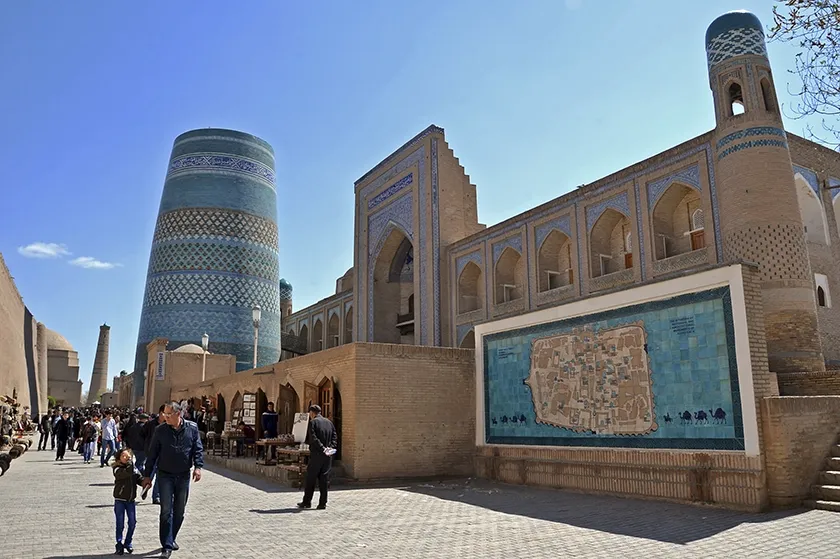
Strolling through its historic centre, called Itchan Kala, is like wandering through the pages of fairy tales and fiction, but the charm and extreme beauty of the ancient fortress of Kunya-Ark, its streets, minarets, madrasas, mosques, palaces and many other buildings is very real, preserving the most genuine charm of the Silk Road.
The mighty wall protects priceless cultural treasures such as the minarets of Kalta Minor and Islam Khodja, as well as palaces such as the impressive Tash Hovli, with its fine ceilings and tiled walls.
Bukhara, the capital of Islamic culture, is a magical oasis of golden domes and multi-coloured facades in a compositional exercise of wisely placed tiles, as well as an important centre of Uzbek culture. Thousands of students studied the Koran in their madrasas, as well as teaching medicine, philosophy, astronomy, poetry and other subjects.
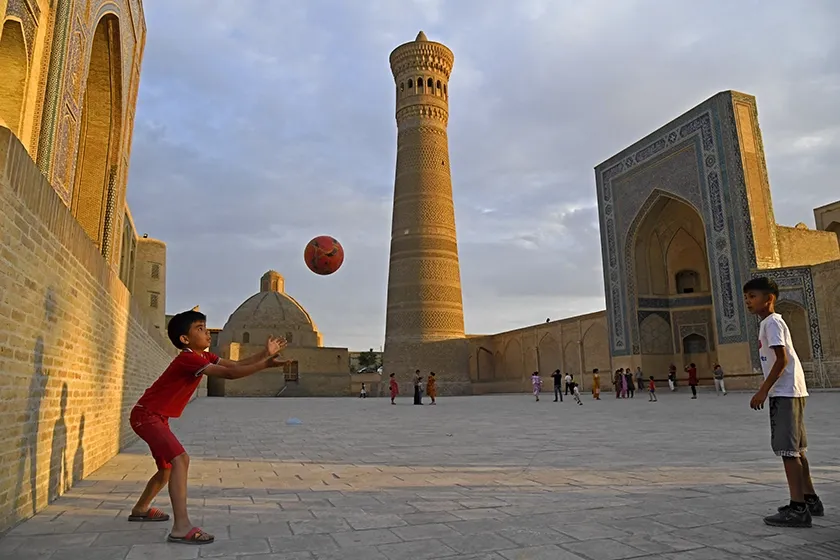
Genghis Khan’s troops razed the city to the ground in 1220, leaving only the Kalon Minaret, a beautiful structure that also served as a lighthouse to guide caravans crossing the desert. Next to it, the Kalon Mosque, with a capacity for 12,000 worshippers, is a fine example of religious architecture, with a remarkable set of 288 pillars supporting a roof of decorated domes.
Opposite, presided over by a large portico with vaulted and tiled niches, the Madrasa of Mir-i-Arab is still active in its mission and retains its one hundred and fourteen cells, the same number as the number of suras in the Koran. Together with the Kalon and Djuma squares, they form Poi-Kalon Square, one of the most beautiful squares in the city.
The life of the historic centre revolves around Lyabi-Huz square and at sunset it becomes magical with the warm refracted lights of the desert, when the tea rooms and restaurants set up their terraces around the central pond, where you can enjoy “patur”, a traditional dish made with flour, butter and water, or “plov”, a typical stew of veal, lamb, carrots and rice.
It would be unforgivable to leave Bukhara without visiting the citadel of the rulers until 1920, also known as Arq, built in the 5th century. The massive wall of conical turrets encloses a space filled with palaces, unique buildings and the Ul’dukhtaron Mosque, inside which a series of museums of 13th-century urban life have been opened.
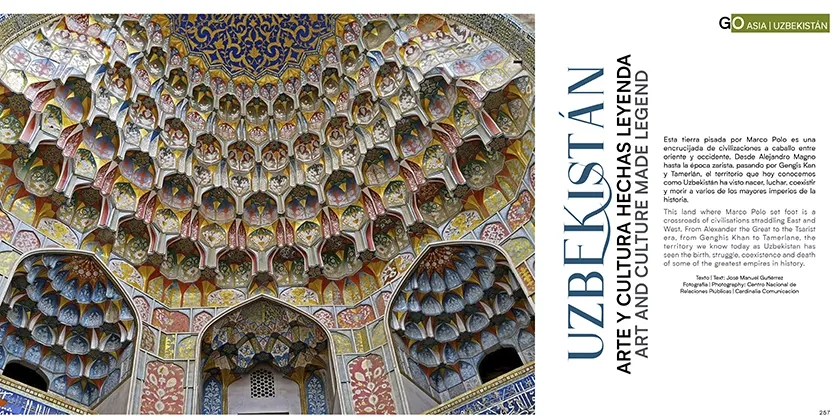
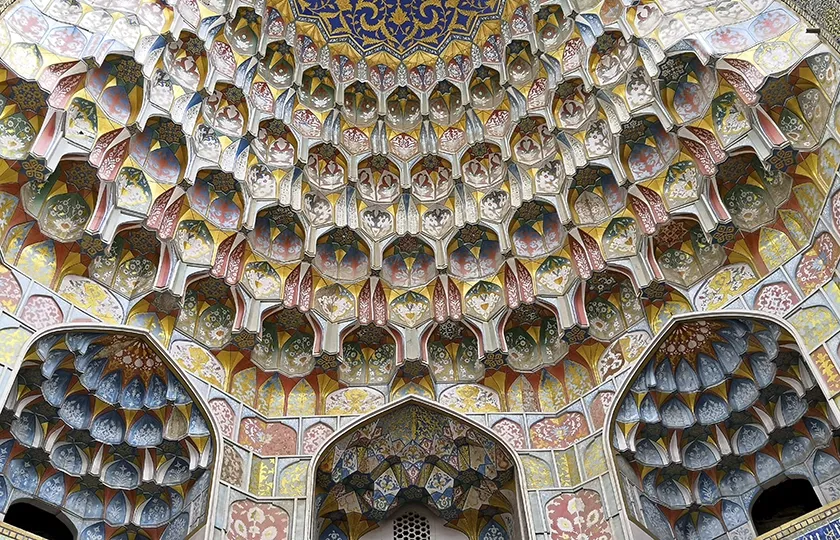
The Abdulaziz Khan Madrasa, undoubtedly the most beautiful in the mythical city, is particularly striking. Built in the 17th century with the intervention of the best architects and craftsmen brought from China and India, it has a splendid façade covered with muqarnas with figures of plants and animals such as dragons. No less striking is the monumental gateway with four towers topped by glazed domes by Char Minor, which gave access to a madrasa that no longer exists.
Two thousand seven hundred years of vibrant history make Samarkand a unique city. A crossroads par excellence in Central Asia and a living witness to the history of the Silk Road, it has traditionally been theorised that it could be one of the protagonists of a collection of tales from “The Thousand and One Nights”, as the magic it preserves and the beauty of its monuments invite one to justify such a reverie. The city of blue domes, where the spread of papermaking techniques began, is an archetype of artistic creativity because it became a melting pot of cultures.
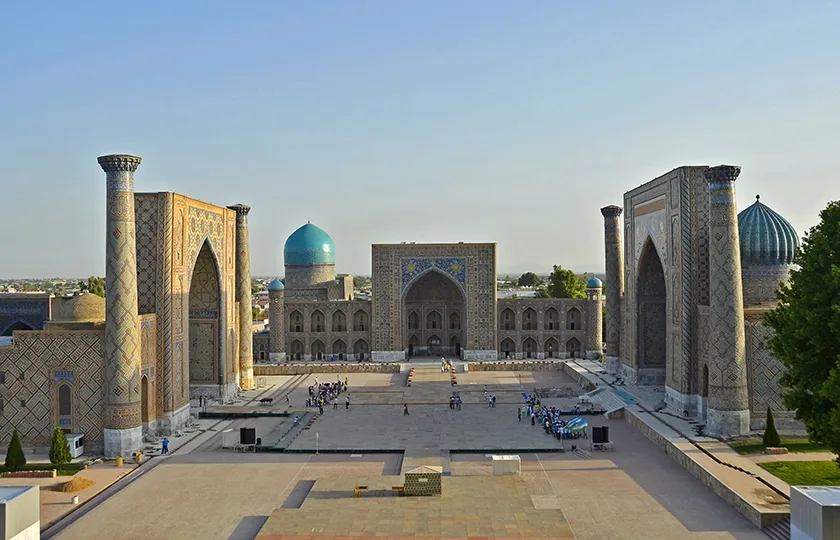
The most universal image and perfectly justified by its high cultural value is Registan Square, possibly one of the most beautiful squares in the world, located in the heart of the ancient medieval city. Flanked by the madrasas of Ulugh Beg, Sherdar and Tilla-Kari, they form an architectural and artistic paradise unique in the world, which alone justifies a visit to Samarkand. It was the capital of one of the great Asian empires between the 14th and 15th centuries, under the rule of Tamerlane, who had another of the best-preserved heritage landmarks built, the Gur-e-Amir Museum, which means Tomb of the King.
The Bibi Khanum Mosque is another must-see. Also built by order of Tamerlane with the intervention of the best craftsmen of the empire, it dazzles with its turquoise blue domes, its beautiful tiles, its gigantic gate and its grandeur.
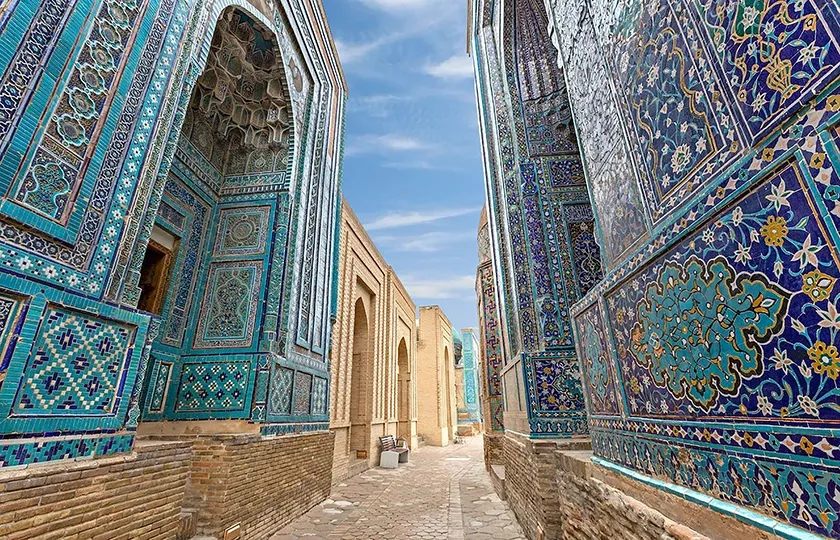
The Shah-i-Zinda necropolis is the largest in Uzbekistan and, according to legend, is the burial place of one of the first prophets of Muhammad. It is a complex of buildings constructed over the centuries forming a succession of beautiful mausoleums, among which there is a small part reserved for Madrid, since in Samarkand there is a district named after the capital of Spain in honour of the first European ambassador to Asia, namely Ruy González de Clavijo, born in Madrid and sent by Henry III at the beginning of the 15th century to create alliances with Tamerlane.
Beyond the Silk Road
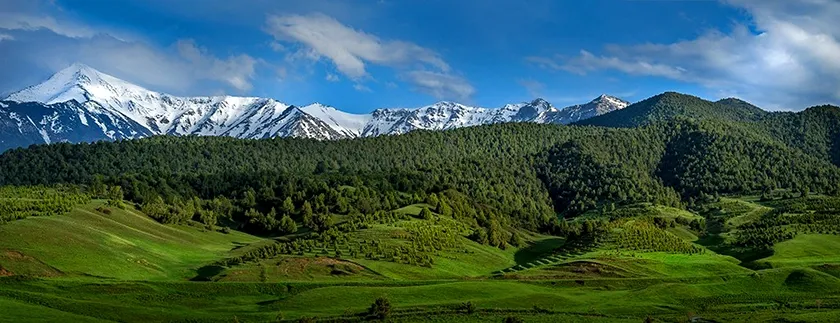
The desert cities of Khorasmia, the hill of Afriasiab, the remains of Buddhist temples in the south, the petroglyphs of the desert, the eternal steppe, the virgin mountains or the small citadels are an inexhaustible source of surprises, experiences and emotions.
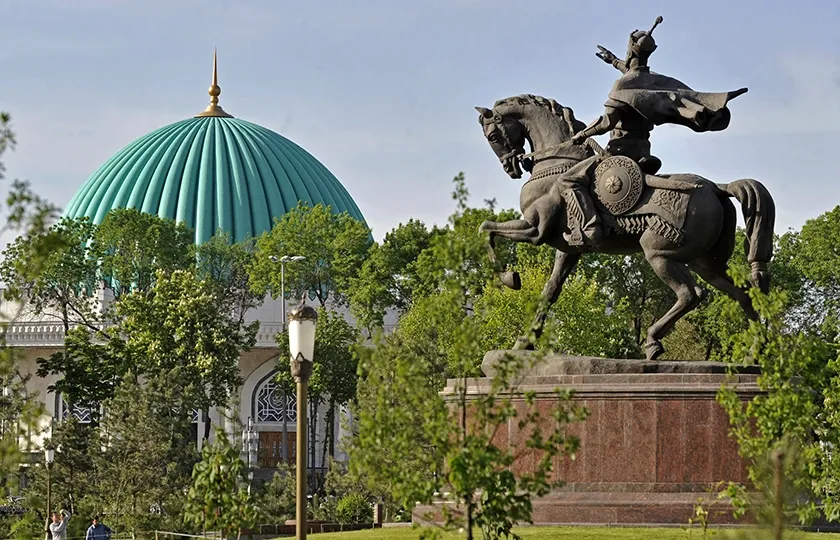
Uzbekistan is looking to the future with a well-calculated roadmap. One of its greatest exponents is its capital, Tashkent, which, while retaining much of its historical heritage, is now the country’s financial and administrative centre. It is a modern, cosmopolitan and very dynamic city, safe and welcoming with wide avenues and lots of green areas. In the historic part of the city, there are interesting monuments such as the madrasas of Kukaldosh and Barak Khan, the mausoleum of Kaffal Shasi and the library containing a very valuable 7th century manuscript, the Usman Koran. A visit to the central market is also highly recommended, both for its magnificent blue dome and to enjoy the endless variety of local produce, not forgetting a stroll through Independence Square and Amin Timur Square.
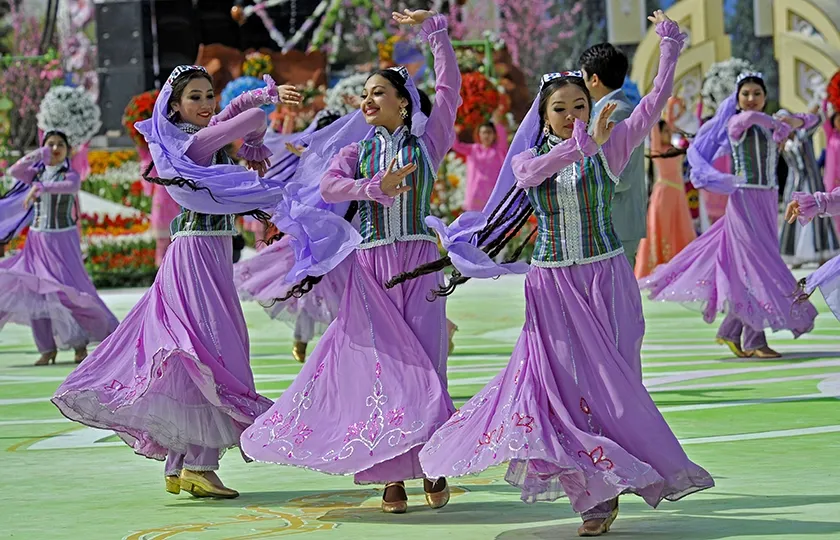
Another of Uzbekistan’s curiosities is its tradition of puppet theatre, which dates back to the 4th century, first in wood and then in ceramics. It is very common to find street performances in towns and cities, as well as craftsmen who make them, although one of the most suggestive to see is that of Iskandar Kharimov in Bukhara’s Lyabi-Huz Square.