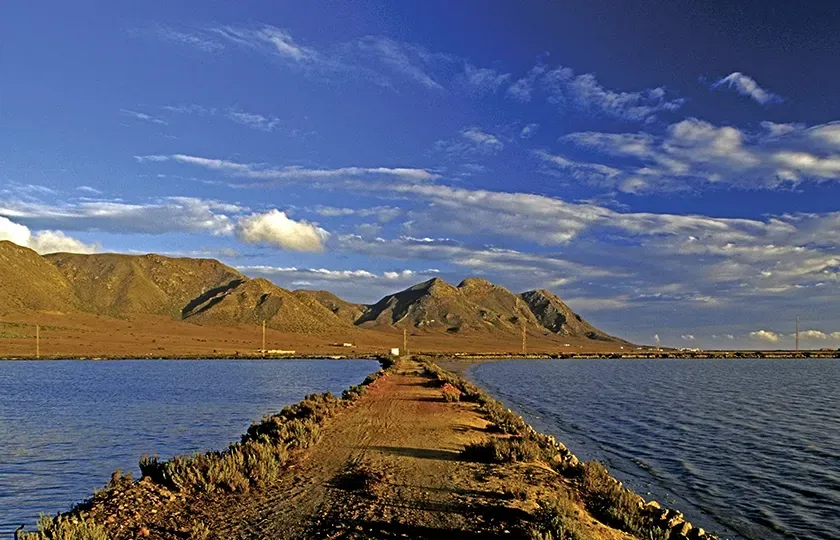
Apart from its fantastic beaches and unique landscapes, Almeria is universally known for being the setting for the filming of large and famous film productions. Stars such as Clint Eastwood, Sean Connery, Sophia Loren or Harrison Ford, among others, have passed through here and all of them have left their signature in sequence shots that immortalised the places we are going to visit today.
It was in the early 1950s when a Spanish director, César Fernández Ardavín, set his sights on the city of Almería to film “La llamada de África”. But it was the French film “Ojo por ojo” by André Cayatte, which portrayed the capital as a real African set thanks to the exoticism of neighbourhoods such as Las Perchas, Pescadería, Cerro de San Cristóbal, etc.
Since then, many kilometres of celluloid have been impressed in hundreds of productions, both national and international. Faraway cities such as Cairo in “Lawrence de Arabia“, Tangiers in “El viento y el león“, Iskenderun in “Indiana Jones y la última cruzada“, Palermo and Messina in the mythical “Patton”, Cape Town in “Dust”, Beirut in “Duffy, el único“, Mesa Verde in “Agáchate maldito”, Mexico City in “¡Quién sabe! “and even recreating dreamlike or fantastic cities where characters such as “Conan el bárbaro” would live out their adventures.
This was the starting point of an artistic career that would extend to many other parts of the province where the magical light of Almeria blends with the unusual landscapes, creating the best conditions for the exercise of the seventh art. Thus, places such as the Tabernas Desert, the village of Los Albaricoques, the Cabo de Gata Natural Park, the beach of Los Genoveses, the Rodalquilar mines and many others, each one more beautiful and full of symbolism, came onto the scene.
Silence, it rolls
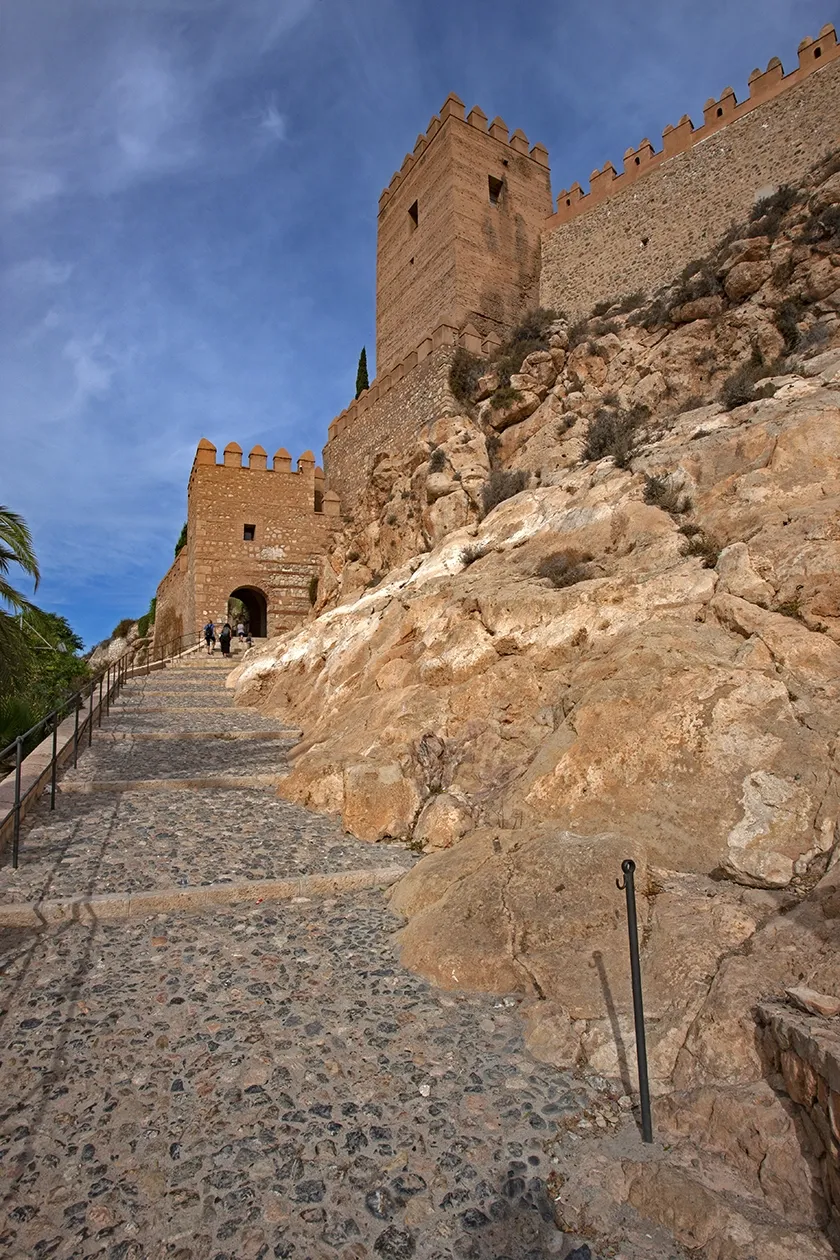
Etymologically speaking, Almería is a mirror that reflects the Mediterranean luminosity under a sky of eternal blue. Witness to the multitude of civilisations that have passed through it, today it presents itself as an eclectic and vibrant city with its own identity. It is in this melting pot of scenarios where we begin our route and there is nothing better than going up to the Alcazaba and enjoying it. Built more than a thousand years ago on the top of the San Cristóbal hill, from where the whole city and the coastline can be seen, it is the most important Andalusian monumental complex in Spain, complete with the castle and the robust walls. In the year 955, under the auspices of the Caliph Abderramán III, work began on its construction as a military fortress and seat of government, reaching its maximum splendour in the 11th century with the first king of the Taifa of Almería.
This huge monumental complex is well worth a leisurely visit where, as well as going over a bit of history, it will make us participate in the making of some films through our imagination and, thus, feel like actors for a moment in blockbuster productions such as “Indiana Jones y la última cruzada“, “Conan el bárbaro” or “Nunca digas nunca jamás“.
Passing through the Islamic layout of the picturesque Pescadería-La Chanca district we head for our next set, but on the way we come across the Nicolás Salmerón park, immortalised in the film “El viento y el león“.
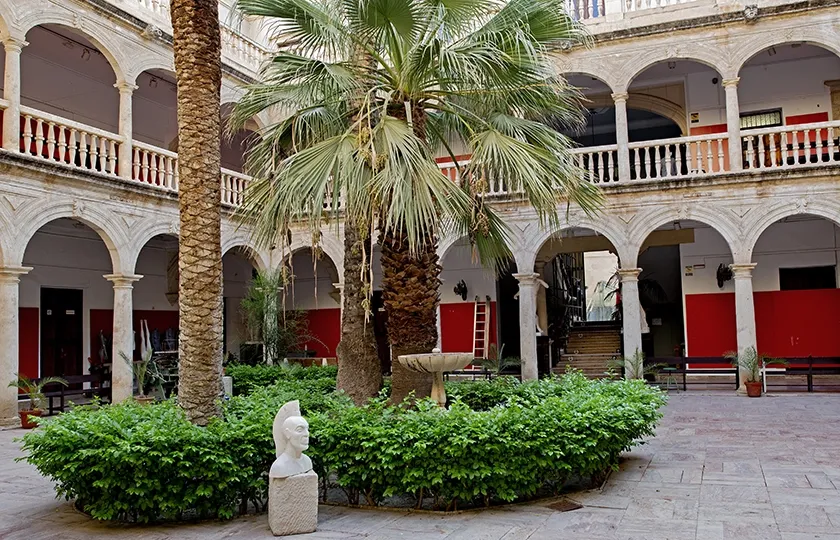
Walking down the street we arrive at the Escuela de Artes y Oficios de Almería. The exterior of this eclectic style building with classicist and neo-gothic features from the end of the 19th century is impressive from the start, but the interior already captivates the senses. Entering the porticoed courtyard brings to mind a scene from the film “Indiana Jones y la ´última cruzada” in which a Rolls-Royce Phanton II is shown, which, curiously, damaged several steps when it was introduced, leaving some noticeable traces that can still be seen today.
The catalogue of locations in the city is completed with the staircases of Calle de la Reina where some scenes of “Lawrence de Arabia” were filmed, the Plaza Vieja in the film “Mando perdido“, the Plaza Chafarinas in the production “El hombre de Marrakech“, the old railway station where part of “Agáchate maldito” was filmed, the Plaza de la Reina Regente next to the Gran Hotel Almería where some scenes of “800 Balas” were filmed, the Cathedral Square where some scenes of “Patton” were filmed as well as in the Bendicho-Casa de los Puche square where part of “El oro de nadie” was filmed or the Almeria promenade in the filming of “El reportero“.
Such is the relationship between the city of Almería and the seventh art that there is even a House of Cinema. It is a beautiful 19th century mansion-cortijo located on the outskirts of the city, where a magnificent exhibition space has been installed with every detail to guarantee the complete interpretation of the cinematographic history of the province. As a curiosity, John Lennon stayed in this house, who took part in the 1966 filming of the feature film “Cómo gané la guerra“, and was inspired by these walls for one of his most famous compositions: Strawberry Fields Forever.
While we are enjoying the city, a good option is also to discover the many other attractions by strolling through its streets, enjoying its lively gastronomic offer, “tapas” and nightlife, without forgetting the magnificent examples of eclectic civil architecture, its historic centre, its cathedral of the Encarnación with a fortress structure and Gothic, Renaissance, Baroque and Neoclassical elements and, of course, the genuine Cable Ingles, the impressive loading dock built at the beginning of the 20th century to transport ore from the Alfique mines to the port of the city. XX century to transport the ore from the Alfique mines to the port of the city.
European Hollywood
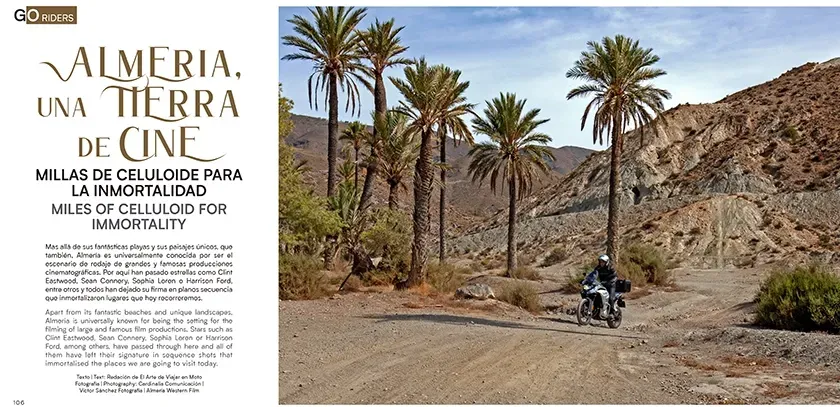
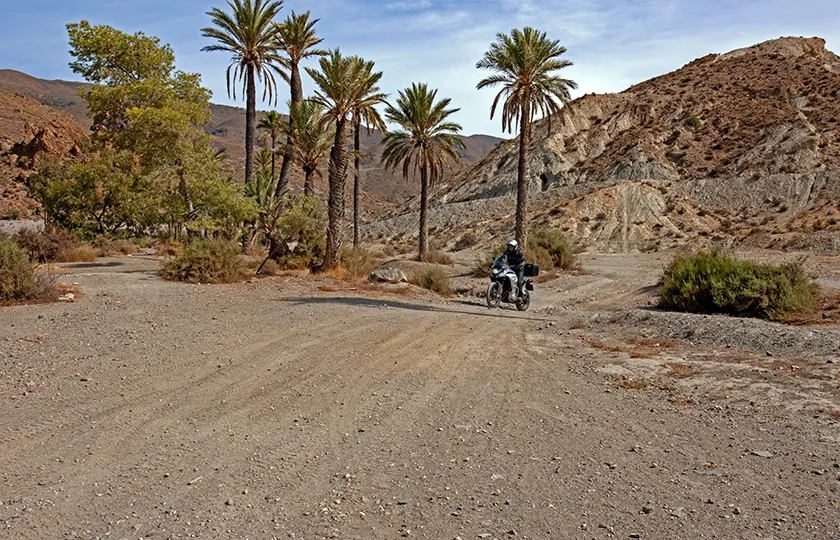
We leave the city for what is possibly the best-known film set in our country. With the focus on the Tabernas desert, inside the helmet, as if it were a trailer, the images of so many films shot in these unique places follow one after the other. But before reaching our destination it is worth turning off the AL-3100 in the direction of Sierra Alhamilla and keep an eye on our right. Soon we will see a huge watercourse with a row of palm trees. This is El Chorrillo, a place where the Jewish quarter of Pechina used to be and which still preserves the buildings of the abandoned railway station where the ore was loaded to be taken to the port of Almería. Until the arrival of “Exodus: Dioses y Reyes“, El Chorrillo had been the Taliban Afghanistan in the Danish film “Brødre”.
For the production of “Exodus: Dioses y Reyes“, more than 70% of which was filmed here, up to five different spaces were recreated, with large esplanades, open accesses, palm tree-lined roads, buildings already erected and an orography that fits any desert space. More recently it was converted into the village of Vaes Dothrak, territory of the Dothraki in “Juego de Tronos“, where some of the most impressive scenes of the series were filmed.
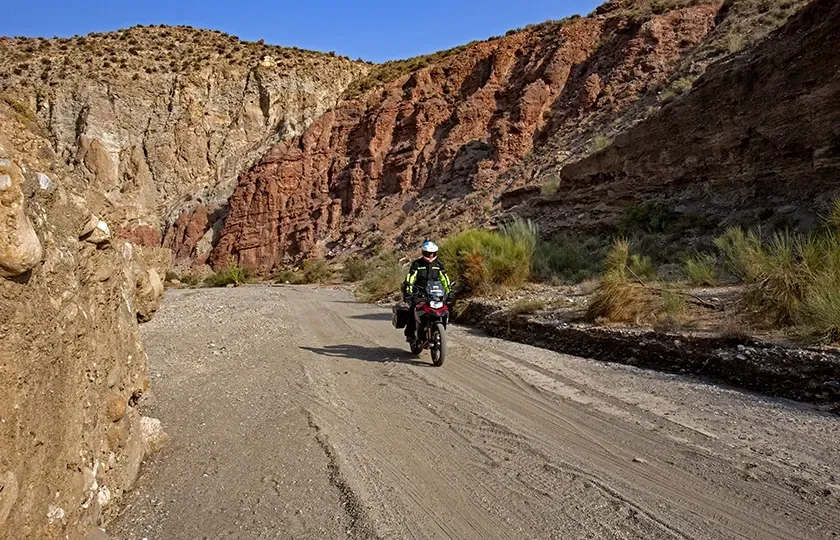
We retrace our steps back to the N-340a in the direction of Tabernas, but before we get there, shortly after passing the petrol station, on our right we come to a very interesting track. With care due to the abundant loose sand as we are already in the middle of the desert, we enter the El Cautivo wadi, a spectacular geological formation perfectly recognisable in scenes from films such as “Indiana Jones y la última cruzada“, “Lawrence de Arabia“, “La muerte tenia un precio“, “Cómo gané la guerra” and “El valle de Gwangi“, among others.
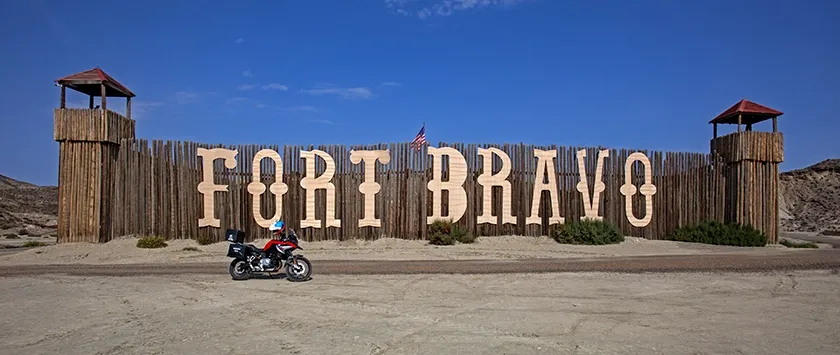
Retracing our tracks in the sand back to the national road, we head towards Tabernas until we come to a signpost on the left that invites us to visit Ford Bravo. We are now in the heart of the Tabernas desert, the only ecosystem in Europe with these characteristics where more than three hundred films have been shot, some of them Oscar-winning. Such is the importance of these places that the European Film Academy awarded the Tabernas Desert the distinction of Treasure of European Film Culture.
Continuing along the dusty track we enjoy a spectacular desert landscape under an almost unreal blue sky. In just a few hundred metres we come to the Benavides stream on our right, along which we continue through the enormous canyon to the natural set, which is breathtaking in its beauty. Once again, the landscape is recognisable and we are reminded of sequence shots from films such as “Indiana Jones y la última cruzada“, “Juego de Tronos” and the TV series “Mar de Plástico“, to name but a few.
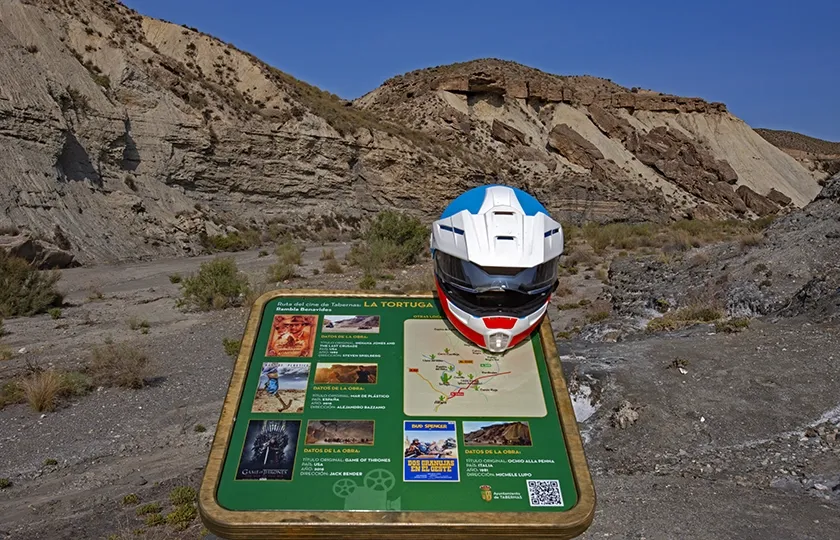
We head back to the main track and in the distance, at the top of the hill, a huge sign reading Texas Hollywood points in the direction of one of the legendary spaghetti western towns. Ford Bravo is home to the most important cinema sets in Europe and where most western films have been shot. They were built in the sixties when Sergio Leone discovered Tabernas and began filming here, and are still in their original state. As well as continuing to play its role as a film set, today it also offers western shows as a tourist attraction.
But it is not the only village that preserves the romantic essence of those cinematic times. Not far from the previous one is Western Leone, built by Sergio Leone to film “Hasta que llegó su hora”, but perhaps the most famous production made here was “Por un puñado de dólares“.
Some of the most prestigious actors and directors in the world of cinema have passed through the arid landscapes of the Tabernas desert, such as Steven Spielberg, Sergio Leone, Clint Eastwood, Sean Connery, Harrison Ford, Arnold Schwarzenegger, Sophia Loren, Henry Fonda, Charles Bronson, Jason Robards, Claudia Cardinale, Alex de la Iglesia and Sancho Gracia, among others. But that’s not all: in recent years, the area has once again been the backdrop for blockbusters such as “Assassin’s Creed”, “Los hermanos Sisters” and “Terminator: Destino Oscuro”, to name but a few.
Scenarios in front of the sea
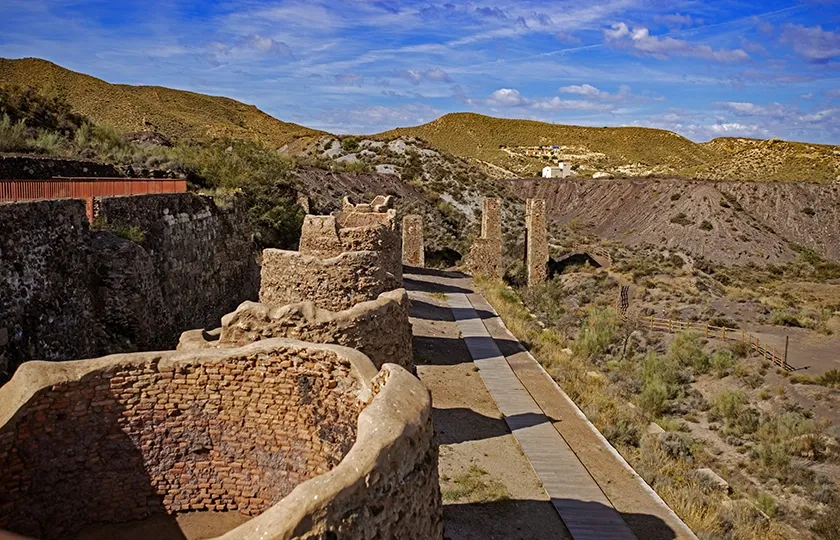
We leave behind the magical landscape of the desert to take as our destination those coastal places that have served, with their charms, as excellent film locations. On the way to the coast and after leaving the village of Tabernas we turn right onto the AL-3103 towards Turrilas, in whose church scenes from “La muerte tenía un precio” were filmed. On leaving the village we join the AL-3105 towards Lucainena de las Torres, a town that experienced an incredible economic boom in the 19th century thanks to mining, as can be seen in the magnificent example of industrial archaeology represented by the old smelting furnaces. Nearby is the hamlet of Polopos, where scenes from “Yo soy la revolución” and “El cóndor” were filmed.
We continue our route towards Níjar along the winding AL-102, which will put our curving skills to the test. For lovers of handicrafts, a stop in this beautiful town will be a delight, as there are many shops to enjoy, especially the colourful typical jarapas, which immediately catch the eye. Shopping aside, we continue along the AL-3108 in the direction of San José. Approximately halfway along the road, a road turns off to the left at a clearly signposted junction. We join the AL-3112 and soon reach the village of Los Albaricoques. Through the streets of this small village passed the cameras of “Tepepa” or “Los cuatro salvajes“, but without doubt its most significant point is the great threshing floor, at the end of a long street that preserves the flavour of the Wild West, where the final duel of “La muerte tenía un precio” took place.
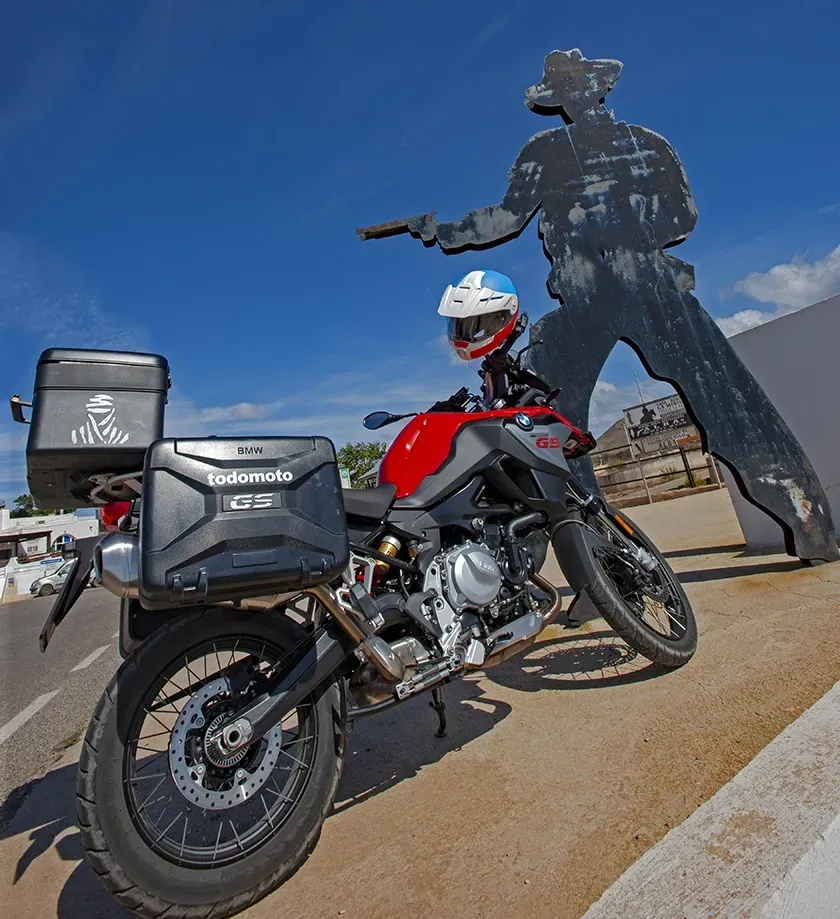
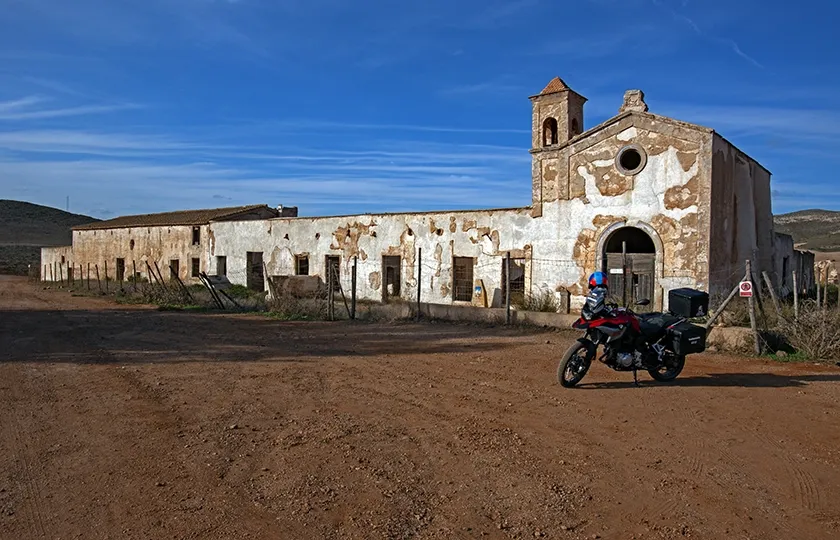
In the lower part of the village there is a well-signposted crossroads that points in the direction of another of those places that you will never forget. Along a dirt track that is great fun if you have mixed or country wheels, we reach the Cortijo del Fraile. Despite its semi-abandoned state, the farmhouse retains the enigmatic beauty of the old farmhouses and the mystery of what happened within its walls. Here took place the tragic love story that inspired Federico García Lorca to write “Bodas de sangre“. But the place is also immortalized for being the setting of several sequences of the films “El bueno, el feo y el malo” and “La muerte tenía un precio“.
We continue along the dirt track that brought us here between fields and a semi-desert landscape under the watchful eye of several extinct volcanoes until we reach the back of the large Rodalquilar smelter. The site is spectacular and is a beautiful example of industrial archaeology, even though it is not in a very good state of conservation. The Denver plant of the old smelter was transformed into a medieval castle and village in the film “El misterio de Wells” by director Paul McGuigan. Unforgettable scenes from “Indiana Jones y la última cruzada” were filmed in the surrounding tunnels and galleries, although the cinematographic history of this corner of Almeria goes back to the time of Sergio Leone, so the list of productions and artists who have passed through here is very extensive.
We are back on another fun road again. In this case the AL-4200 in the direction of San José, one of the most beautiful roads we can see in this coastal corner, with the typical landscape of the Cabo de Gata Natural Park on our right and the spectacular views of the Mediterranean on our left. All this following the curvy route that delights every biker. Before reaching the village of La Isleta del Moro, a stop at the Amatistas viewpoint is a must. The evening light brings a special magic to this balcony that looks out, almost from a bird’s eye view, over the sea, offering an unforgettable visual spectacle.
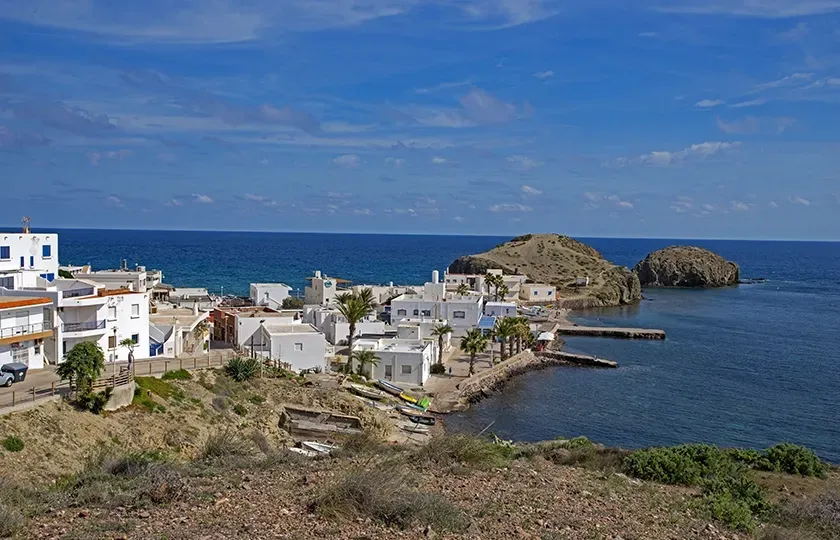
Our route continues towards San José, a typical village of white houses and incredibly beautiful seabed, where two natural sceneries of competing beauty await us, dotted with genuine windmills. On the one hand, the beach of Los Genoveses is a beautiful bay of fine golden sand dunes where Peter O’Toole walked in the role of “Lawrence de Arabia“.
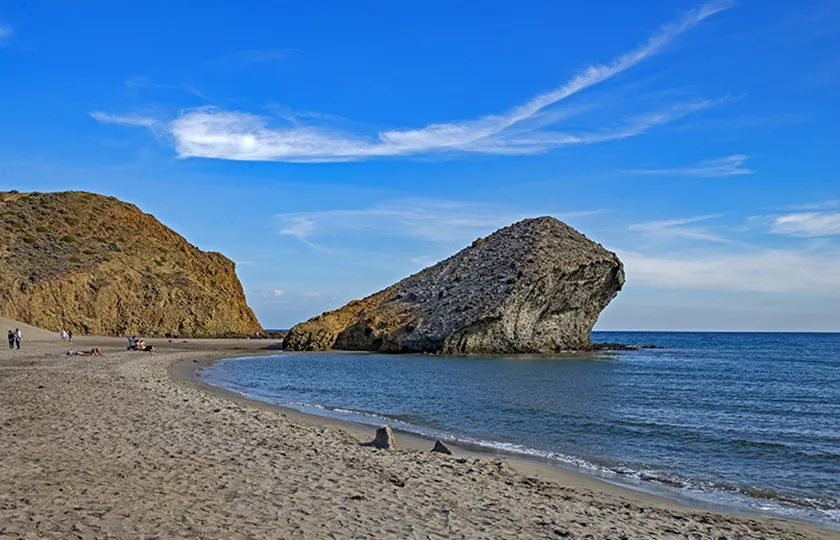
Very close by, following the only dirt track that brought us here, Monsul Monsul beach catches our eye with its impressive lava flow, petrified thousands of years ago, forming a portico over the sea. The scene of many video clips, we all remember the famous scene in which Sean Connery, with the help of an umbrella, scares away a flock of seagulls and manages to shoot down a Nazi fighter in the film “Indiana Jones y la última cruzada“.
Our journey through some of the most symbolic film locations in the province of Almería is coming to an end and on the way to the capital we cannot resist the biker charm of the road that connects the town of San José with the hamlet of Cabo de Gata. The ALP-822 is a spectacular road of curves and incredible views, viewpoints and paradisiacal coves such as Las Sirenas until you reach the lighthouse, located at the south-eastern tip of the Iberian Peninsula. From here the road descends until it becomes a straight road that runs between the beach and the salt flats on our right, where colonies of flamingos add a beautiful touch of colour. Between fishermen’s boats moored on the white sand and the evocative church of San Miguel, we drive through places where scenes from “Patton”, “Toro” or the third season of “La casa de papel“, to name but a few, were immortalised.
We end this cinematographic route once again in the city of Almería, thus closing a circular route through the province. Obviously these are not all the film locations, as there are other interesting places where films were shot, but we will leave those for another instalment.