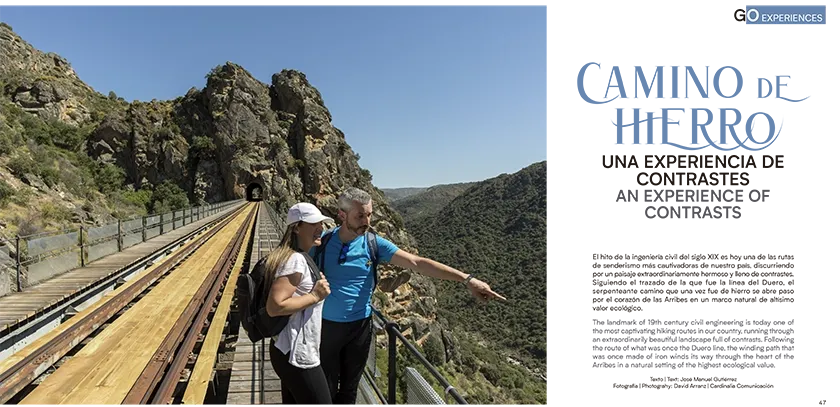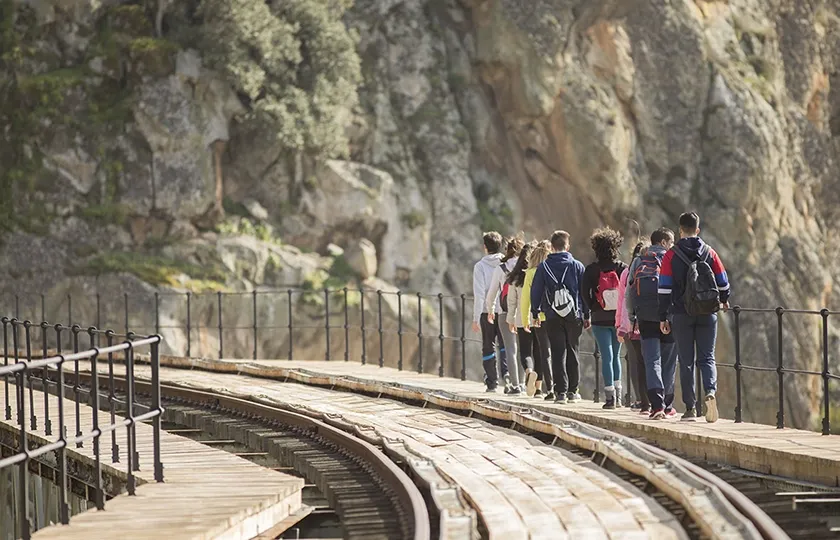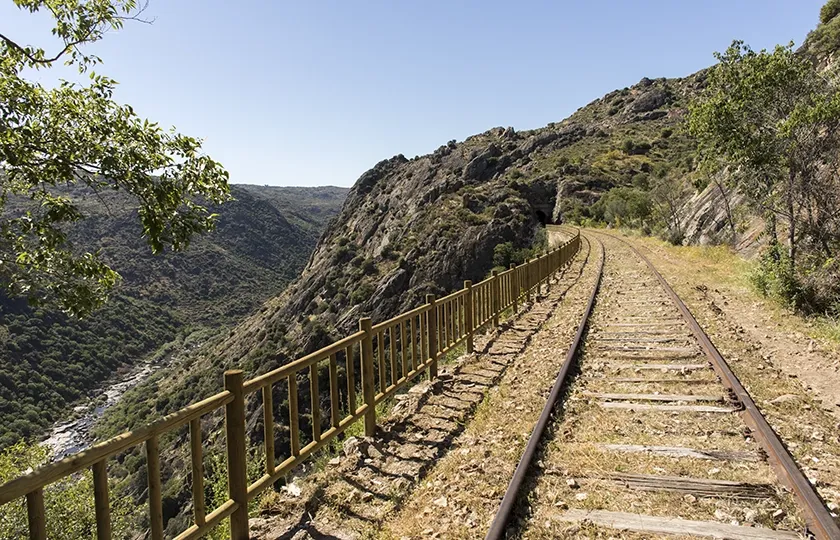
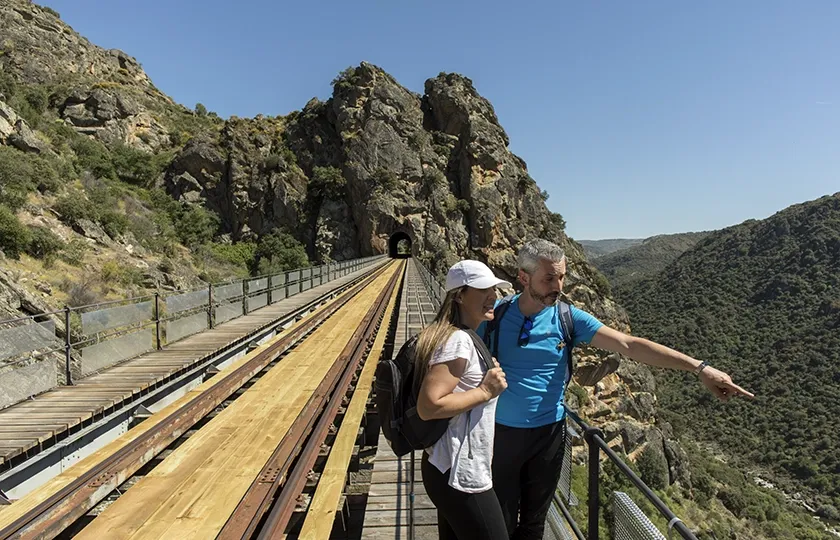
The landmark of 19th century civil engineering is today one of the most captivating hiking routes in our country, running through an extraordinarily beautiful landscape full of contrasts. Following the route of what was once the Duero line, the winding path that was once made of iron winds its way through the heart of the Arribes in a natural setting of the highest ecological value.
In the last third of the 19th century, Portugal urgently needed to open a commercial and passenger route to connect it with Europe, for which an extension of the Duero line, very close to the Spanish border and the province of Salamanca, was planned.
After solving the many technical problems arising from the complex orography of the border territory, now part Arribes del Duero Natural Park, work began on this pharaonic project in August 1883.
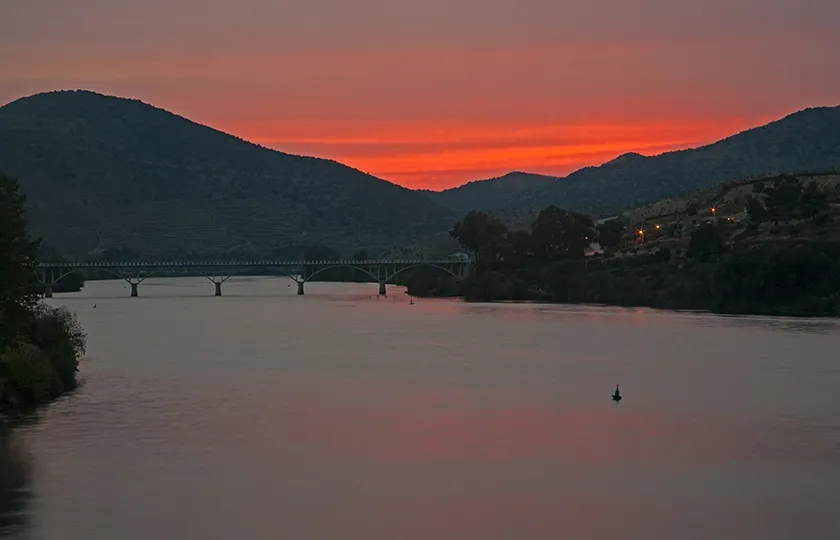
After four years of hard work and the construction of dozens of bridges and tunnels, the line was inaugurated with a symbolic act in which two trains, one Portuguese and one Spanish, meet in the middle of the Vega de Terrón International Bridge in La Fregeneda.
The passage of time was relentless with the railway line for its commercial use, so the 21st century brought initiatives to give it a new life, but this time aimed at the enhancement of the territory as a tourist destination, being this outstanding civil work one of its main resources.
The rebirth of a landmark
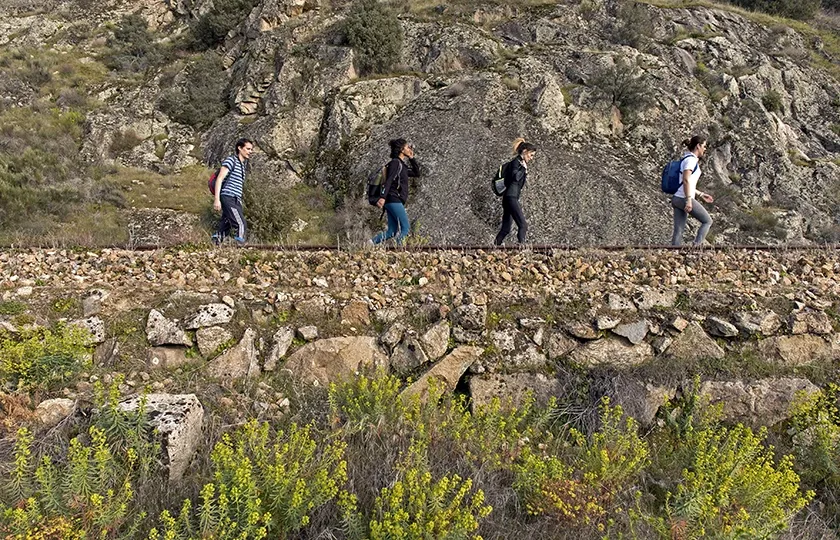
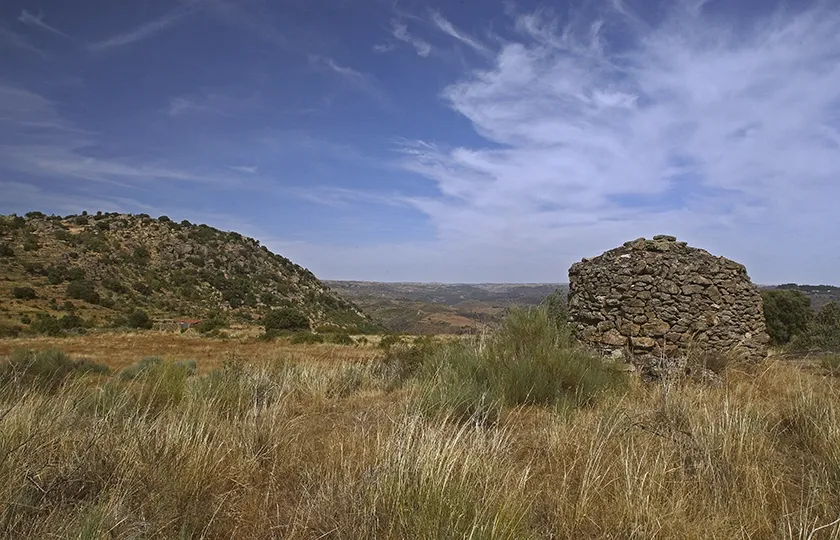
Thus was born the Camino de Hierro, a pedestrian route that runs along a section of the railway line that linked the stations of La Fuente de San Esteban in Spain and Barca d’Alva in Portugal, where fauna and flora merge with the grandeur of the civil engineering work. Although the spectacular nature of the last seventeen kilometres may overshadow the rest of the route, this route through the Salamanca peneplain runs through beautiful landscapes of pastureland, where abandoned stations dot the route as silent witnesses of what the arrival of the railway meant to this historically isolated area.
At the La Fregeneda station, the trail starts to discover the vertigo caused by bridges suspended in impossible gorges, the shadows of tunnels carved into the living rock and the vastness of landscapes that form part of a unique ecosystem.
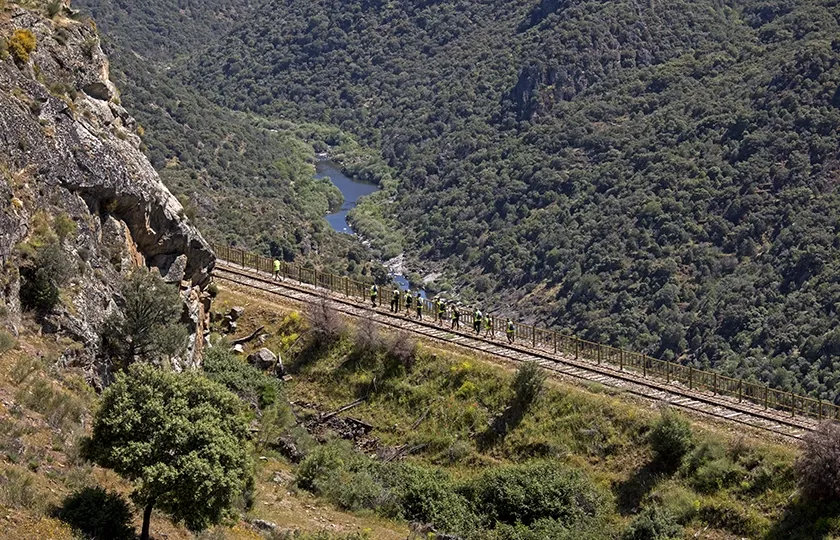
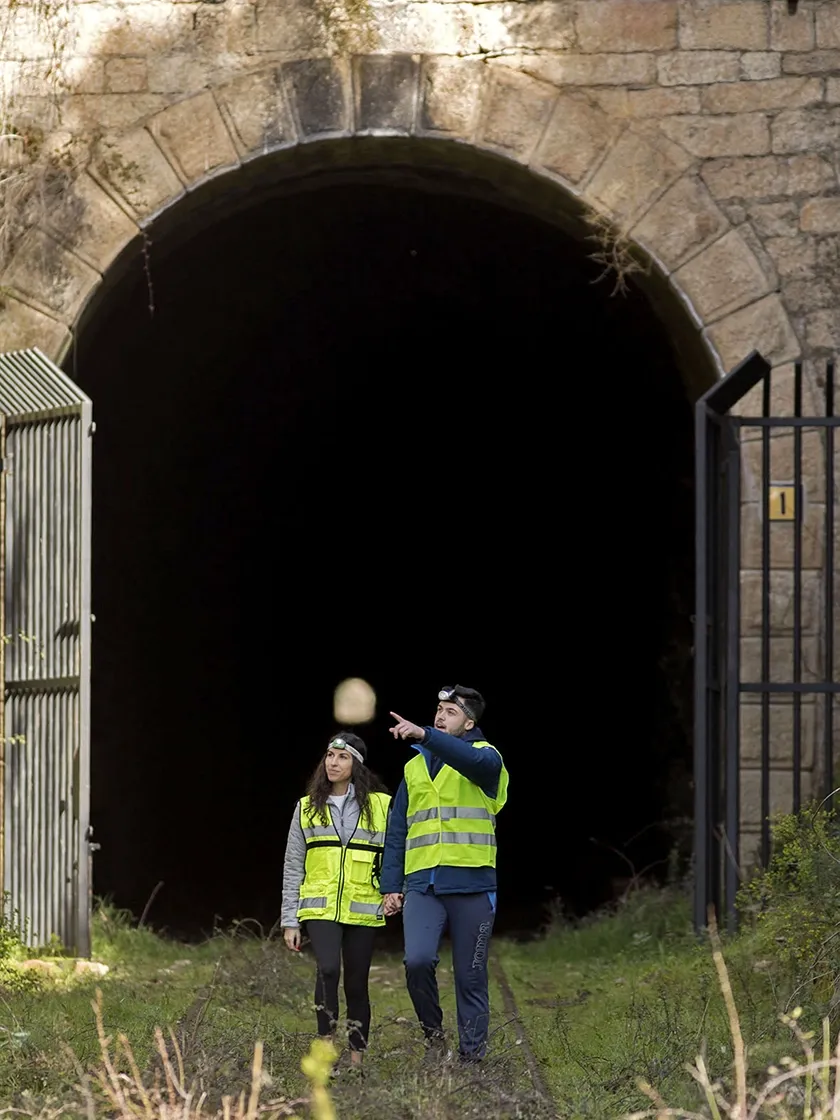
At the very beginning of the route is Tunnel 1, the longest of the route at more than one and a half kilometres long. At its exit, a succession of another ten and nine more with ten bridges mark the path on a gentle downward slope, following the impressive cliffs through which the Águeda River flows until it flows into the Duero, at the only river dock in Castilla y León, where this impressive route comes to an end.
The spectacular nature and value of this industrial jewel lies mainly in the technical solutions that had to be implemented to adapt the railway layout to the rugged geography of the Arribes del Duero.
This infrastructure has also been called the “Impossible Iron Road” for two reasons: the technical difficulty of the route and the need for the large financial resources that the project required.
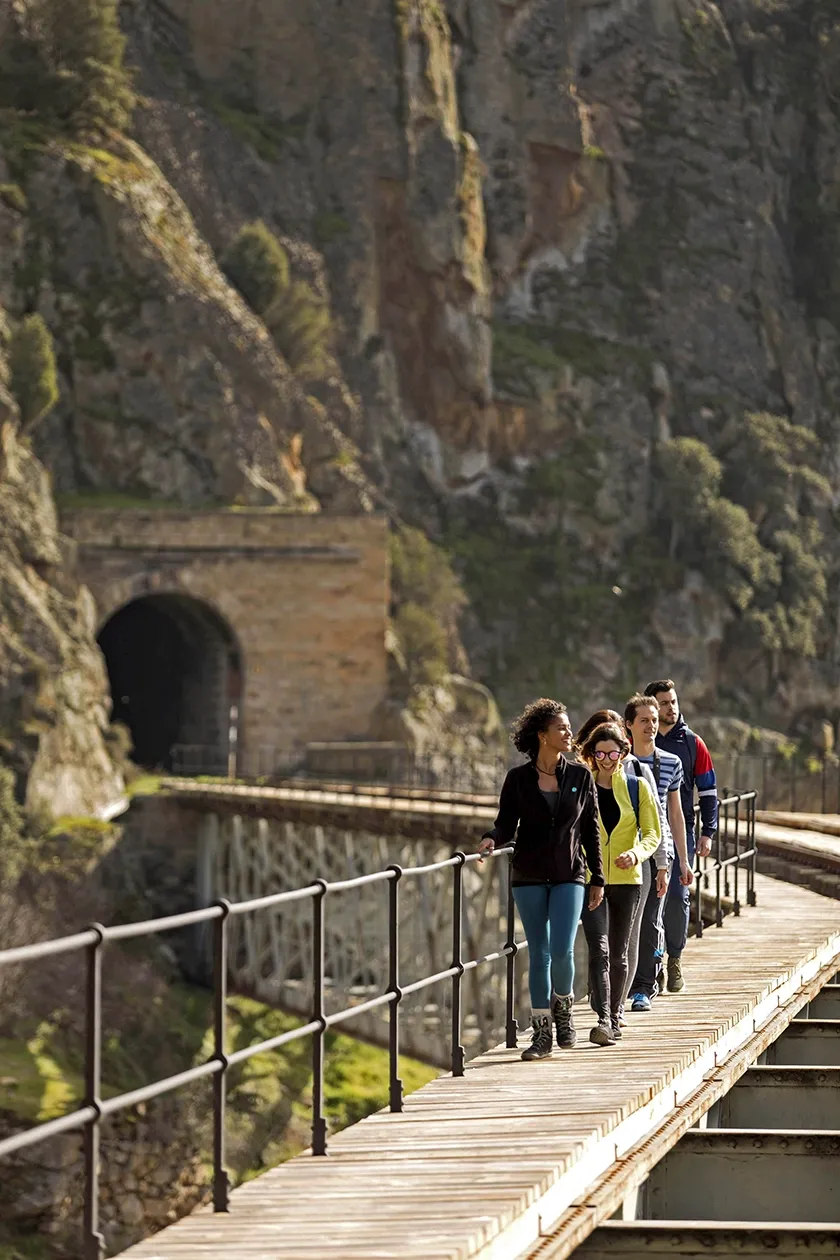
The complex and risky became a reality in a time of economic hardship and underdeveloped technology. The tremendous difficulties of the abrupt and broken terrain were solved with a succession of bridges and tunnels, authentic works of art that today give life to a unique tourist and cultural resource.
Passing through the twenty tunnels dug, using dynamite and picks and shovels, in this last 17-kilometre stretch of the railway, means walking more than four kilometres underground, adding up the length of all the tunnels. The typical section of the tunnels corresponds to a round arch vault and straight gables with masonry lining, while the ten bridges along the route have the main beams built in Cruz de San Andrés. Once the masonry, abutments and piers were completed, the framework was assembled in sections. It was designed and manufactured in Belgium and France; in fact, the metal part was shipped in pieces.
An exceptional natural environment
The Camino de Hierro is located in the Arribes del Duero Natural Park, where the river forms a border with Portugal, an enclave of exceptional environmental quality that earned it its declaration as a Biosphere Reserve in 2015. The Duero River and its tributaries have opened up impressive river canyons, with Mediterranean-type climatic conditions.
A large part of this route runs parallel to the riverbed of the Águeda river, a rugged area of cliffs and rocky outcrops, which is the habitat of birds of prey such as the golden eagle, Bonelli’s eagle, Egyptian vulture and griffon vulture.
Another environmental value is found in Tunnel 3. Some twelve thousand bats roost and breed there, forming one of the most important colonies on the Iberian Peninsula. During the breeding season, at the beginning of the summer, the tunnel is closed, although an alternative path allows you to continue your walk.
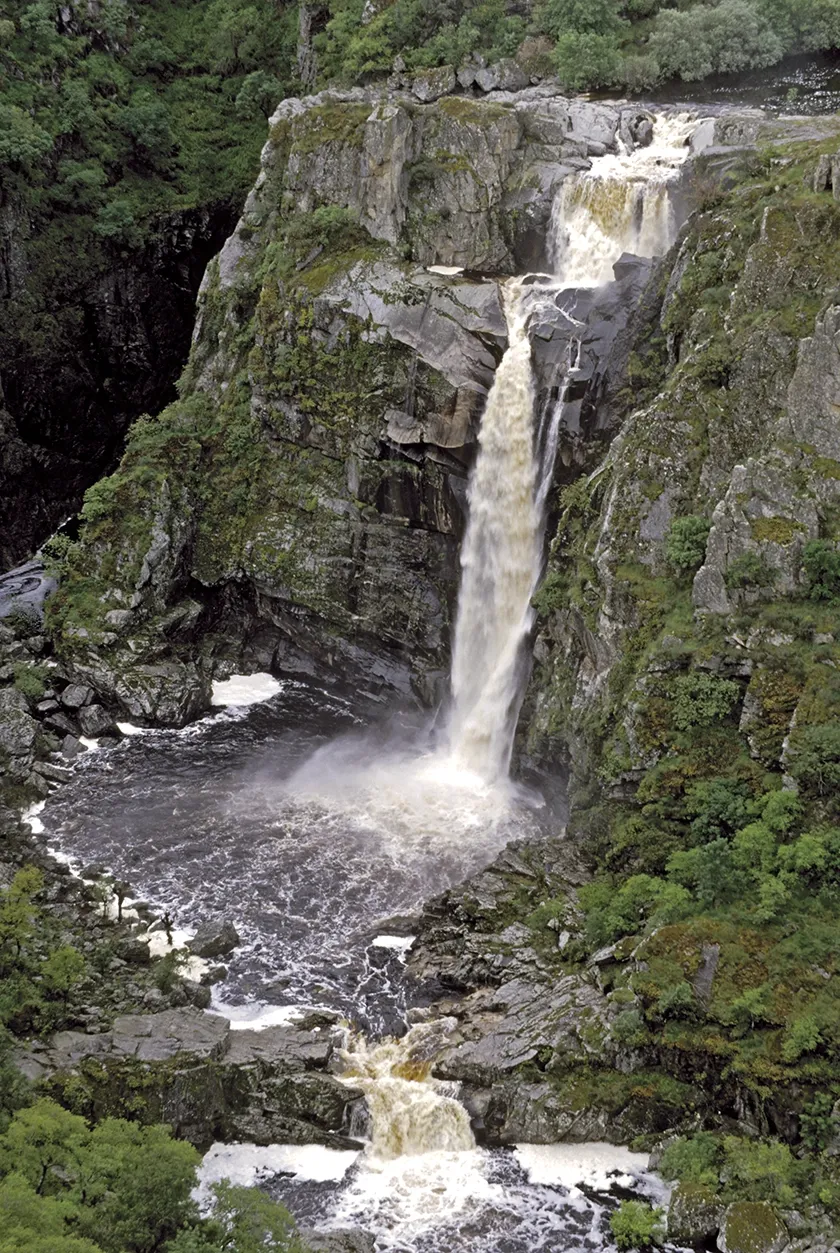
The Arribes relief is sculpted in granite, not only by the Duero, but also by the rivers Huebra, Tormes, Camaces and Uces. In the canyon of the latter is located one of the most beautiful and spectacular waterfalls in the whole Peninsula: the Pozo de los Humos, where the water falls from more than 50 metres.
Within the limits of the area there are interesting and beautiful localities such as the town of Fermoselle in the Zamora area or San Felices de los Gallegos in the Salamanca area, both of which have been declared Historic Sites. Although almost all the localities of Arribes del Duero have a rich cultural heritage in Vetonic vestiges, such as forts, anthropomorphic tombs, stelae, medieval fountains and a rich legacy of farming and livestock life such as mills, oil mills or “chiviteros”.
From the point of view of biodiversity, the natural area is characterised by its unique topographical features, corresponding to a sheltered valley, sheltered from the winds and with plenty of sunshine, which translates into a mild average annual temperature, the absence of frosts throughout the year, and certain humidity conditions. All these features give rise to a very rich plant community, characterised by the great abundance of typically Mediterranean species, with crops that are unsuitable for this latitude, such as olive trees, vines, almond trees and some fruit trees.
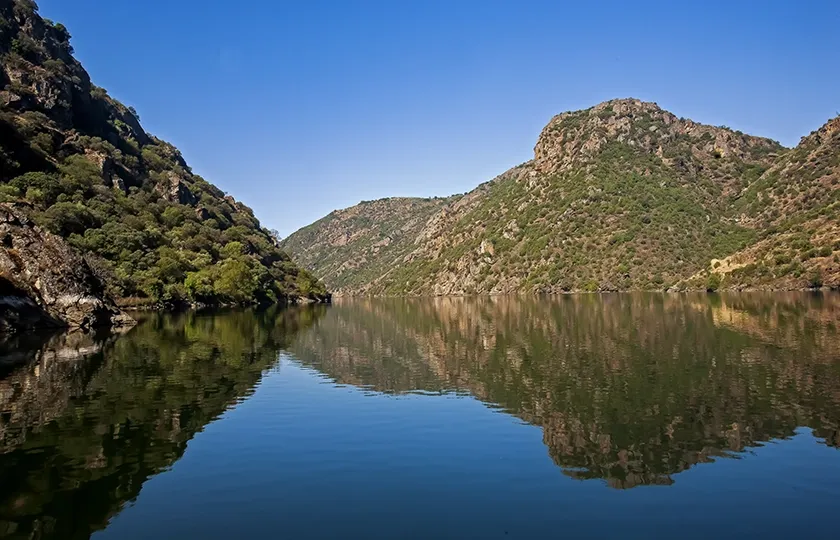
The cliffs and rock formations form the most characteristic biotope of this Natural Area, where the species of greatest faunistic value are found, corresponding to the birds. Of particular importance are the common vulture, golden eagle, Bonelli’s eagle, black stork, Egyptian vulture and peregrine falcon, not forgetting other species of interest such as the short-toed eagle, the booted eagle, the eagle owl, the red-billed chough, the Alpine swift, the solitary rock thrush and the wheatear, among other species, there is also a great richness of fish such as barbel, “carpines”, “bermejuela”, “boga”, beak, etc., reptiles such as the black-green lizard, the Iberian skink, the horseshoe snake and the red-tailed lizard, for example, and emblematic mammals such as otters, martens, genets, wild boar and foxes. The amphibian community has species such as the marbled newt, Iberian newt, common frog, common toad, common bullfrog, common bullfinch…
This is the natural universe through which a dreamy hiking route follows the traces of what more than a century ago were the rails of the longed-for progress. That economic dream was never fulfilled, but its legacy was not forgotten and it was reconverted so that today there is a way to escape from the daily hustle and bustle and enjoy the peace of a magical environment.