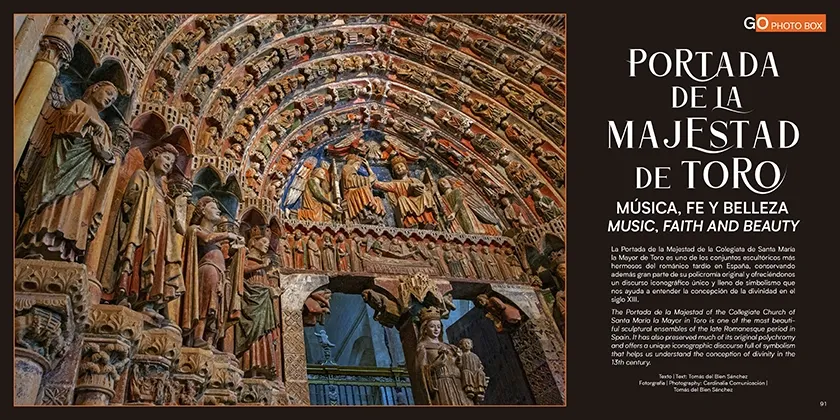
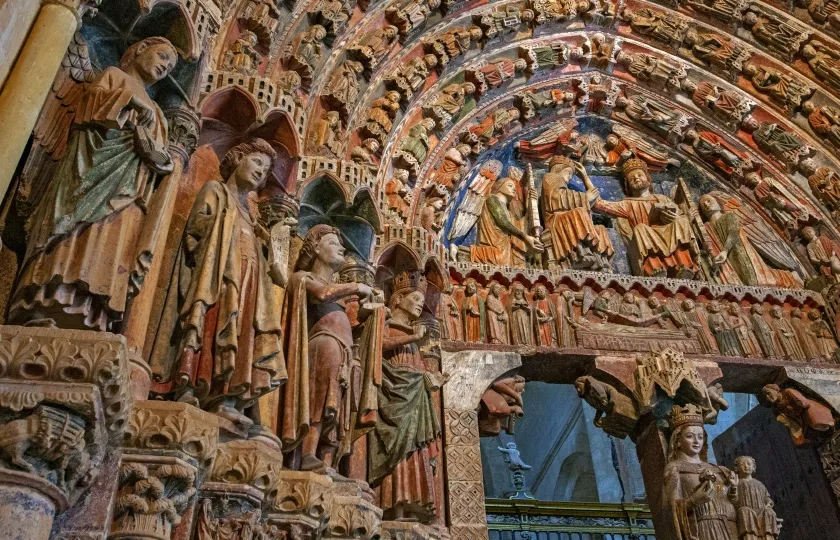
The front of the Collegiate Church of Santa María la Mayor in Toro is one of the most beautiful sculptural ensembles of the late Romanesque period in Spain. It has also preserved much of its original polychromy and offers a unique iconographic discourse full of symbolism that helps us understand the conception of divinity in the 13th century.
The Collegiate Church of Santa María la Mayor, located in the centre of the city of Toro, dominates the entire Duero Valley from the vantage point it occupies in the city and houses a true treasure of medieval art within its walls: the Portada de la Majestad (Gateway of Majesty).
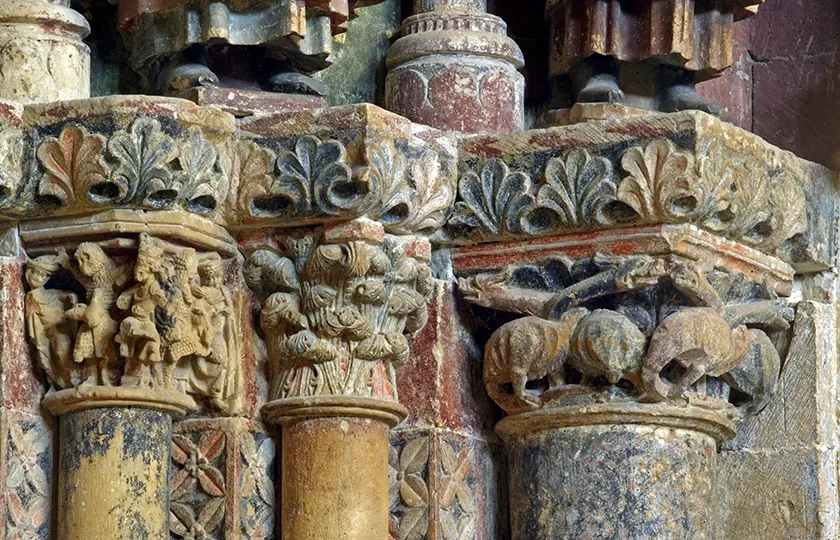
Its construction began in the second quarter of the 13th century, with a fully Romanesque design, a period to which the columns of two different orders and the capitals belong, with a variety of sculptural representations: six with plant motifs, another depicting two dragons with their necks intertwined, one with a moralising theme, representing two men who have pulled the tail off a donkey, and another six with scenes from the childhood of Christ, rich in detail and sculptural vigour, dynamism and many details. They are as follows: the massacre of the innocents, the presentation in the temple, the journey to Bethlehem by the Three Wise Men, the Epiphany, and Jesus among the doctors, which occupies two capitals. Specifically, iconographically, we highlight a small detail in the capital of the massacre of the innocents, where a devil advises Herod in his ear to plan the crime.
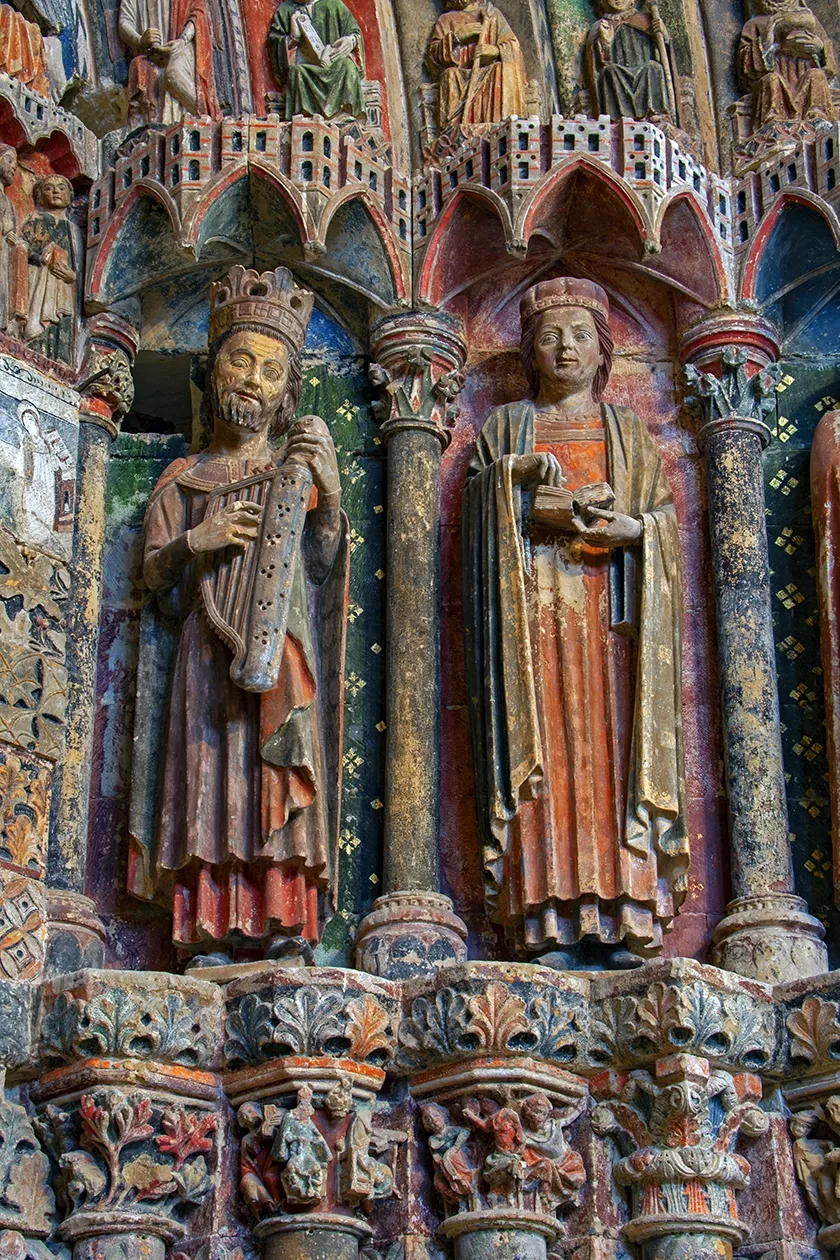
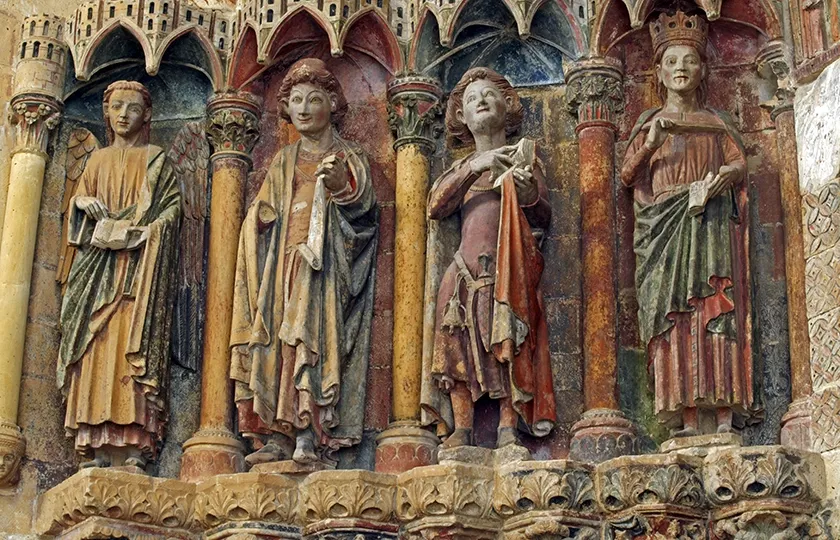
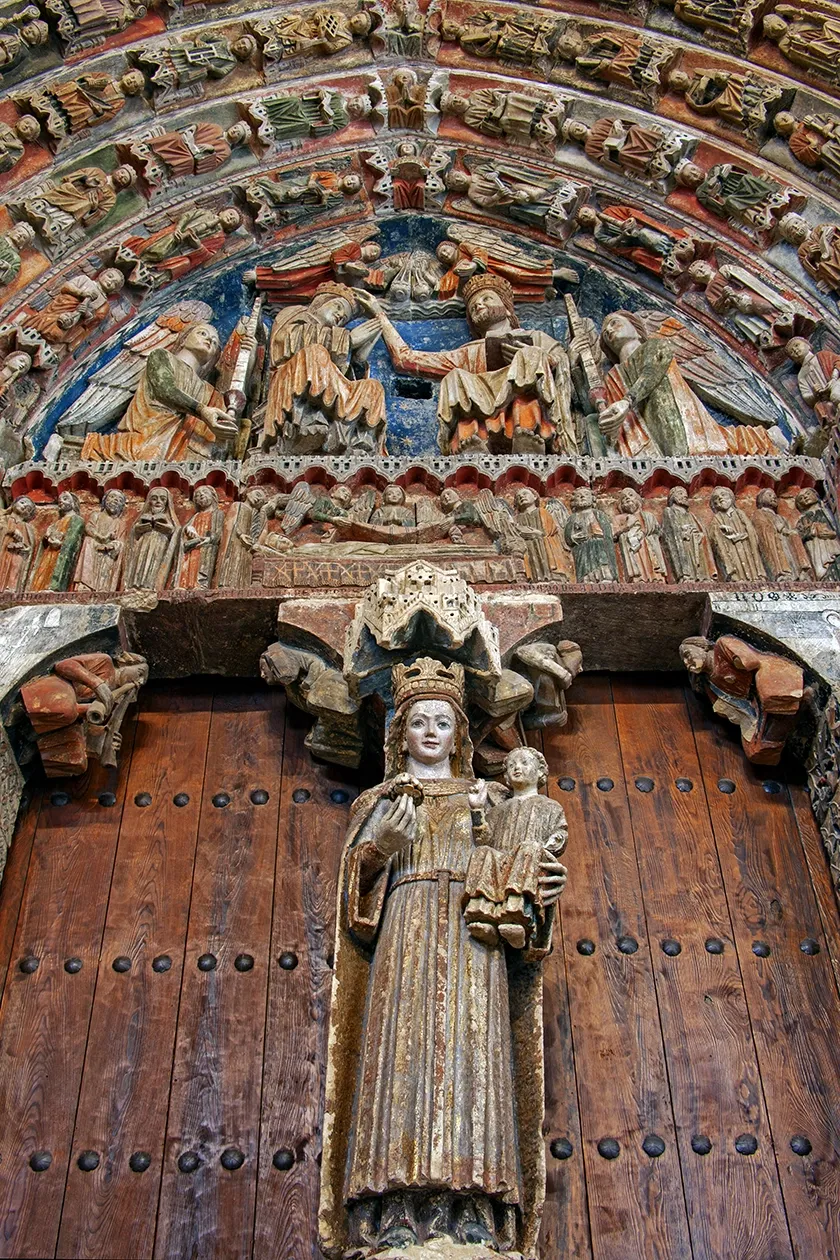
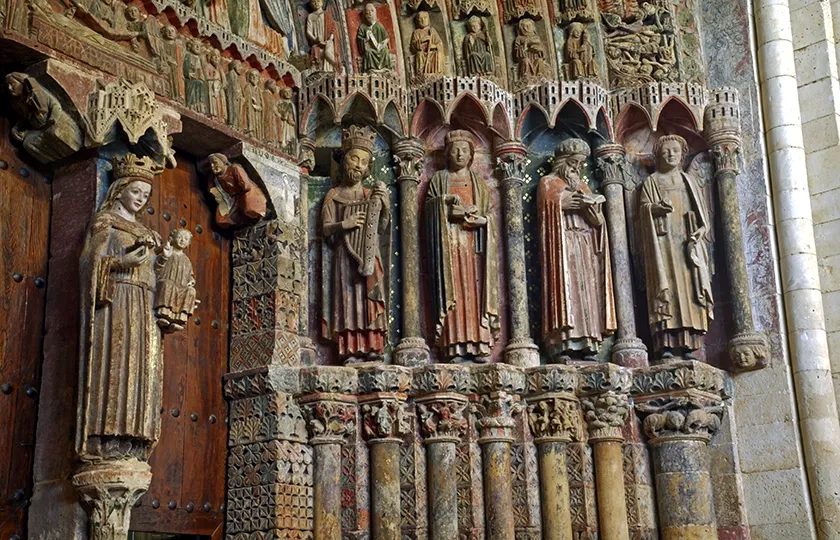
At this point, the Romanesque project was suspended and, from what we have seen, the sculpture dates back to the time of Sancho IV, at the end of the 12th century, and was completed at the beginning of the 14th century; from that moment on, the project would be entirely Gothic. On the columns, the iconographic cycle of the Exaltation of the Virgin Mary begins. Escorted by large figures in round relief on the jambs, which are the Archangel Michael, the prophet Isaiah, Daniel, King David, King Solomon, the prophets Jeremiah and Ezekiel, and the Archangel Gabriel, the Virgin is positioned in the mullion, with a humanised expression and a smiling countenance, holding a child in her left hand and a flower in her right hand.
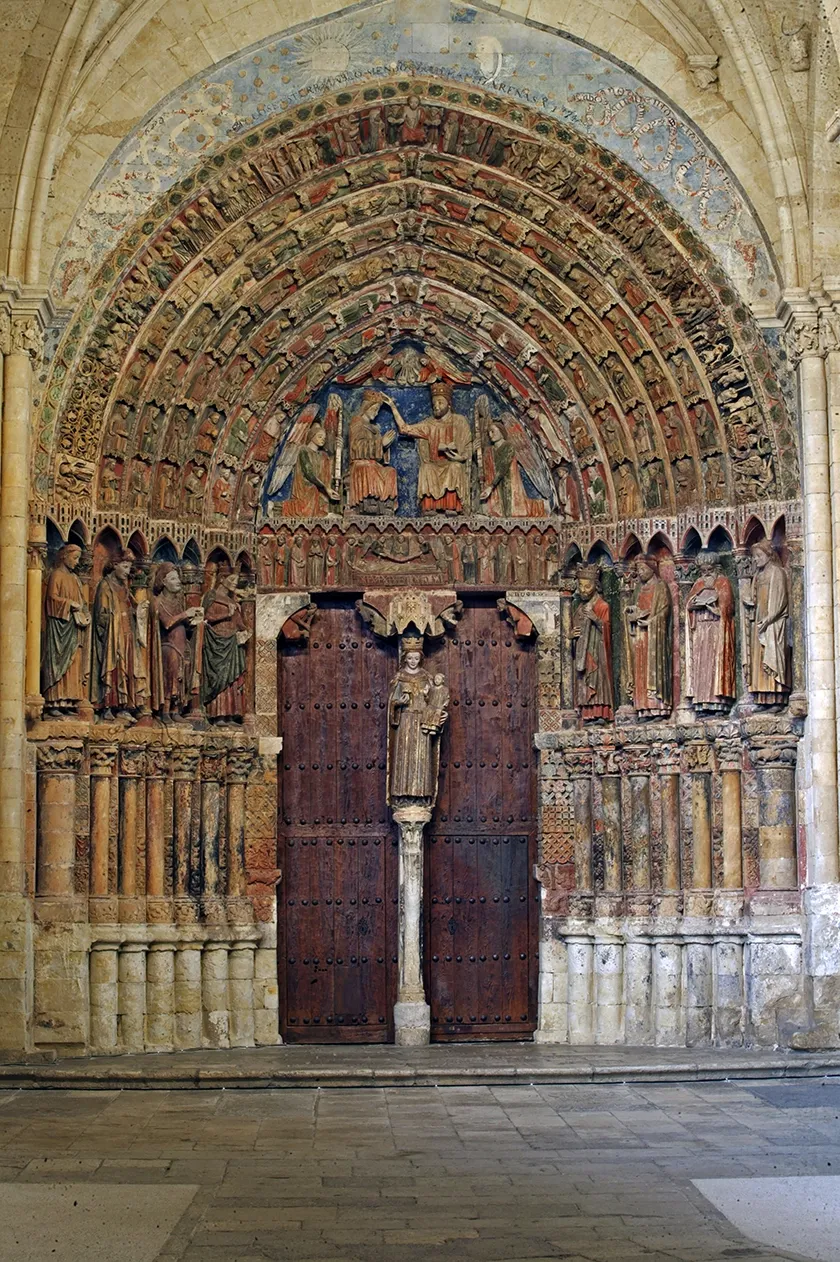
Above it, on the lintel, is the Death of Mary, accompanied by the twelve apostles. Above Mary’s bed, making excellent use of the available space, we see the Assumption of Mary and, in the tympanum, the Coronation of Mary by her son, now as Saviour.
From here, a series of archivolts unfolds, giving the complex the majesty and beauty we see today. In the first archivolt, there are a total of eight angels; in the second, the apostles, among whom Saint Peter and Saint Paul stand out, occupying the two ends of the space; the third is for the martyrs, some of whom are particularly venerated in Toro, such as Saint Lawrence, Saint Tirso and Saint Sebastian; in the fourth are the confessors, among whom we see bishops and abbots; and the fifth features virgins and martyrs, each figure with their attributes.
The sixth archivolt displays another of the great treasures of the façade: eighteen musicians, associated with the glorification of the Virgin Mary, whose presence highlights the importance of music in the Collegiate Church of Toro, linking it to the scene of the twenty-four elders of the Apocalypse with musical instruments on the north façade of the church. It is a magnificent collection of medieval instruments that has been very important in the study of these instruments, which we list below: citterns, hurdy-gurdy, psalteries, flute and bell, drum, bagpipes, oval and eight-shaped fiddles, albogue, square tambourine and quanum.
The last space available on the façade, the seventh archivolt, is dedicated to the Last Judgement, arranged in a radial pattern and depicting this important theme in minute detail. Christ enthroned in the centre, assisted by the Virgin Mary and Saint John and angels carrying the cross, the crown of thorns, the spear and the nails, form the tribunal. To the left of Christ, the resurrection of the damned and the road leading to Hell. The damned are led in single file by macabre demons, bearing the symbols of their sins. Among them are gluttons and misers, knights and clergymen, a coven of witches, and even an architect. All of them are led to Satan, seated at the gates of Hell, a dark place where the punishments of the damned can be seen, hanging by the body part with which they committed their sin, and a burning cauldron into which they are thrown. Such is the meticulousness and detail of the representation that two little devils fan the fire, stoking the flames. Hell ends in the jaws of Leviathan, who devours the crowd pushed by devils.
To the right of Christ, the scene is quite different, with a procession of bishops, nuns and ladies leading up to the figure of the archangel, who replaces his earthly clothes with white robes to present himself before the Eternal Father, who grants access to a representation of paradise where three musicians appear among lush vegetation. This side ends with a representation of Purgatory, where Saint Peter rescues those who emerge from the flames with an attitude of devotion.
Therefore, iconographically it is a superb ensemble, complemented by the preservation of much of its original polychromy, which can be seen as an essential feature of its original design. Its preservation was aided by the construction of a chapel in the 15th century, which protected it from the elements, and several repaintings, up to six, which brought it up to date with the fashions of later periods. An inscription on the lintel names a certain Domingo Pérez, servant of Sancho IV, as the creator of the polychrome decoration, which we can compare to other Gothic paintings in various Mudejar churches in Toro and the excellent Gothic murals of Santa Clara, now preserved in the church of San Sebastián. As we have mentioned, after several repaintings and the accumulation of dirt due to the disappearance of the chapel that protected it, a restoration completed in 1996 has made it possible for us to admire it in all its beauty today.
It is, without a doubt, the Portico of Majesty of the Collegiate Church of Santa María La Mayor in Toro, a unique heritage treasure of our country and one of the best-preserved façades of what we call late Romanesque or early Gothic architecture. This façade bears witness to Toro’s importance at that moment in history, because only a thriving and vibrant city could have undertaken such a monumental challenge.