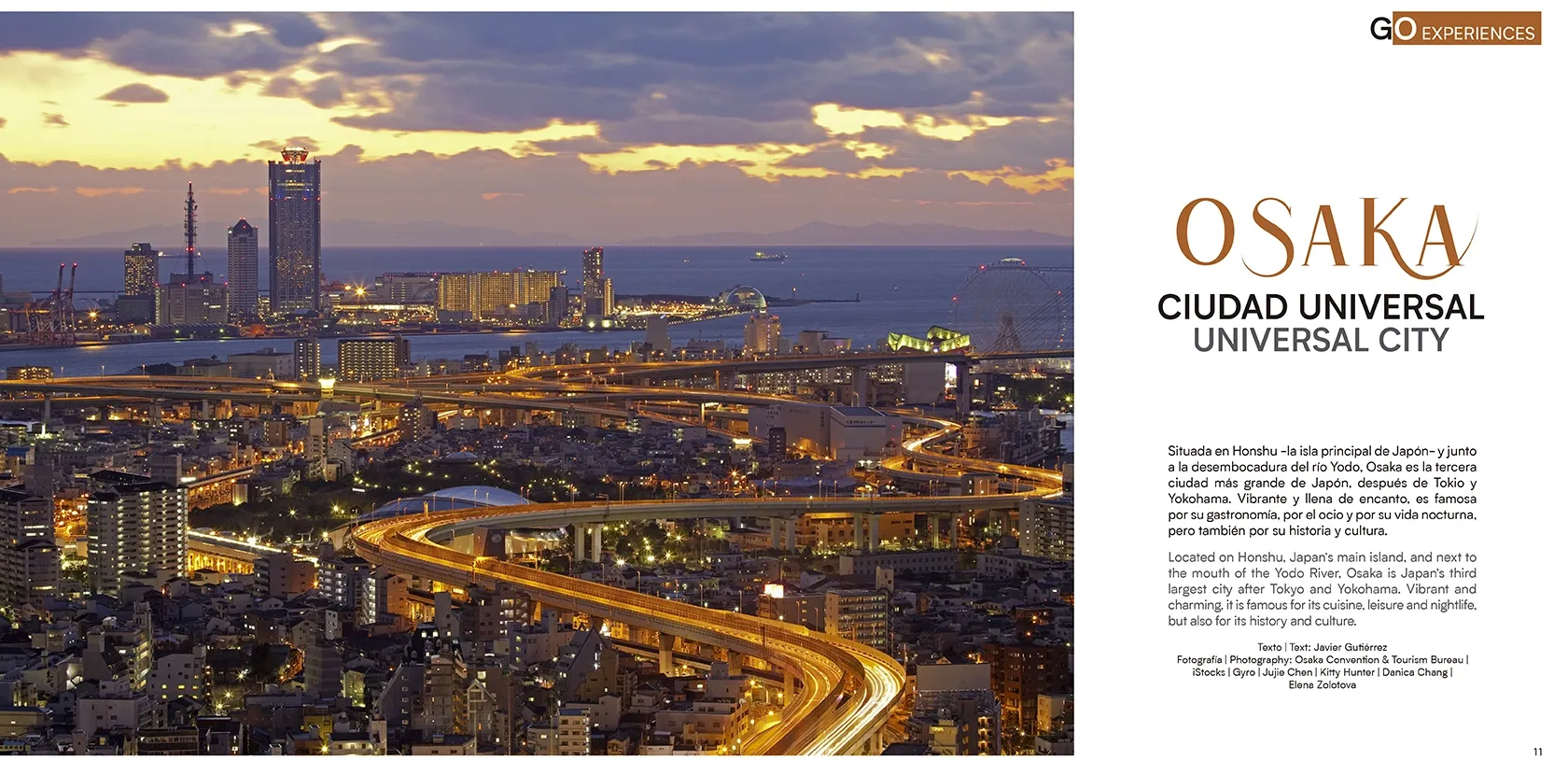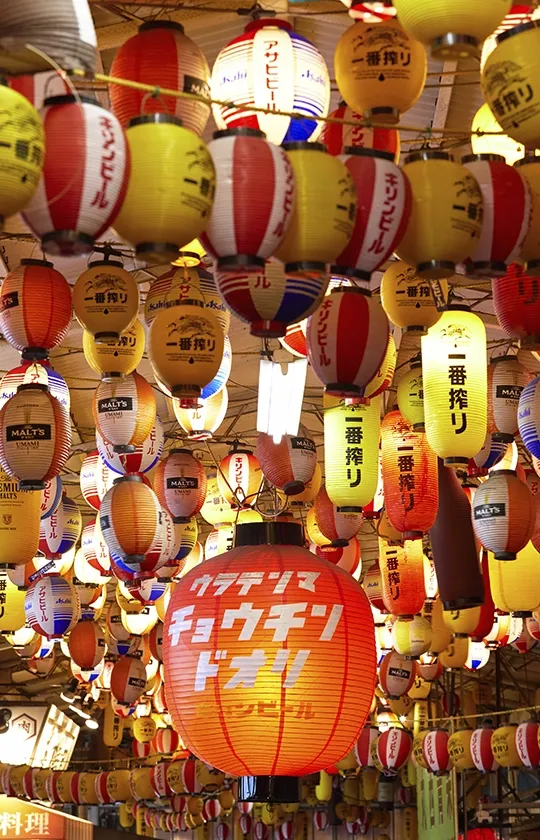

Located on Honshu, Japan’s main island, and next to the mouth of the Yodo River, Osaka is Japan’s third largest city after Tokyo and Yokohama. Vibrant and charming, it is famous for its cuisine, leisure and nightlife, but also for its history and culture.
The capital of the Kansai region is one of Japan’s most important ports and industrial centers. In addition, it is well connected to Tokyo, with two airports, Itami and Kansai, the latter being one of the main entry and exit points of the country, and the Shinkansen bullet train, which covers the distance between the two cities in just over two hours.
Visiting Osaka is a real discovery thanks to its lively nightlife and delicious cuisine, as well as its shopping centres, modern attractions and historical sites such as Osaka Castle, where you can learn about Japanese history, not to mention its friendly and open people.
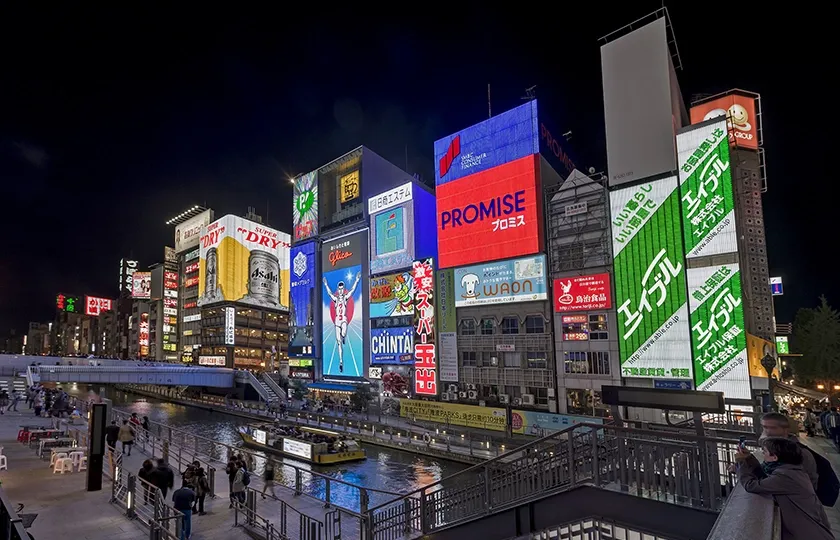
The illuminated signs on the Dotonbori Bridge, the aforementioned Osaka Castle, the 1970 Expo Memorial Park, some of the most important festivals such as Tenjin Matsuri and Ebessan, and the local culinary delights that can be sampled in neighbourhoods such as Tenma and Ura Namba await us in Osaka, perhaps one of the least known cities in Japan. And to top it all off, Osaka is hosting the World Expo this year.
Osaka Kita Ward
Tradition and modernity come together throughout the prefecture, reaching their peak in the northern districts known as Osaka Kita Ward. With elegant shopping areas, this is one of the areas that has experienced the most urban growth in all of Japan, culminating in the creation of Grand Green Osaka, one of the largest urban parks in the country.
Osaka Station is the main transport and commercial hub thanks to its many shops and restaurants.
On the other hand, Umekita Park is the perfect green space to relax and unwind. Cuenta con diferentes cafeterías como TALKS Café & Bar, Boo Boo Voo y SIK Eatery.
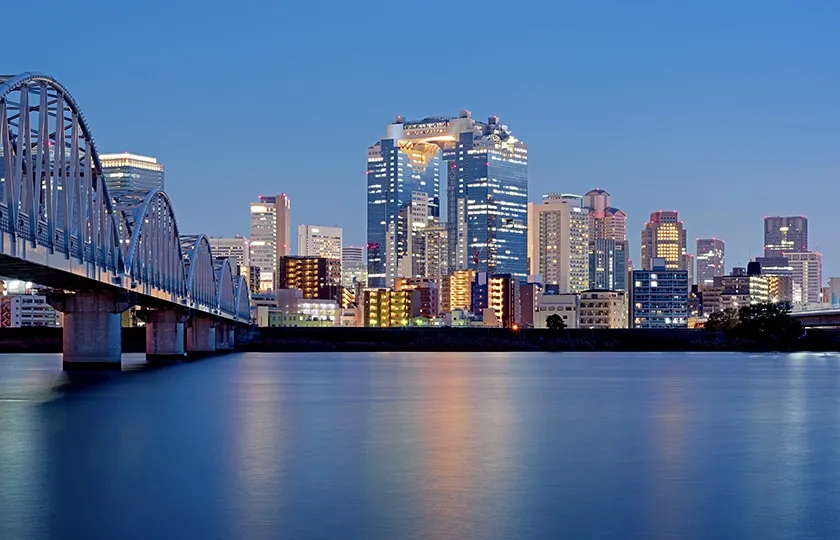
The Umeda Sky Building, one of Osaka’s most iconic landmarks, offers incredible views of the city from its “floating garden”, while Takimi Restaurant Street is an exact replica of Osaka’s cityscape during the Showa period (1868–1989).
Finally, Grand Green Osaka features the Canopy by Hilton hotel, which will soon be joined by the ultra-luxurious Waldorf Astoria Osaka and the Hankyu Gran Respire Osaka Hotel. Meanwhile, Umekita Onsen Ren Wellness Park is home to the Hankyu Grand Respire Osaka Hotel, with its hot springs, swimming pool and gym.
Osaka Bay and surrounding area
Universal Studios Japan in the Sakurajima area and the aquarium in Tempozan have made Osaka Bay world famous and turned it into a top tourist destination.
The Kaiyukan Aquarium in Osaka, one of the best and largest in the world, recreates the spectacular marine life of the Pacific basin, from the Great Barrier Reef to the Arctic. More than thirty thousand creatures from six hundred and twenty different species, including whale sharks, yellow seals and yellow-crested penguins, are just some of those that can be admired in this amazing recreation of their habitats.
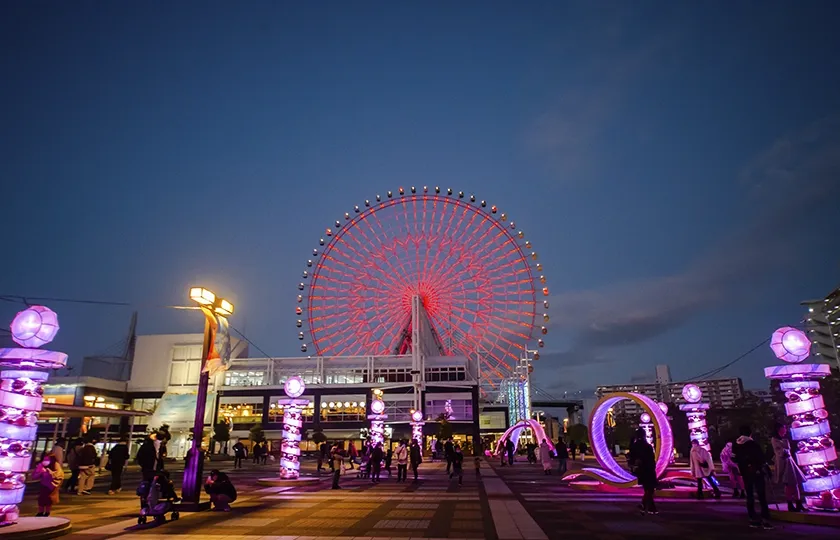
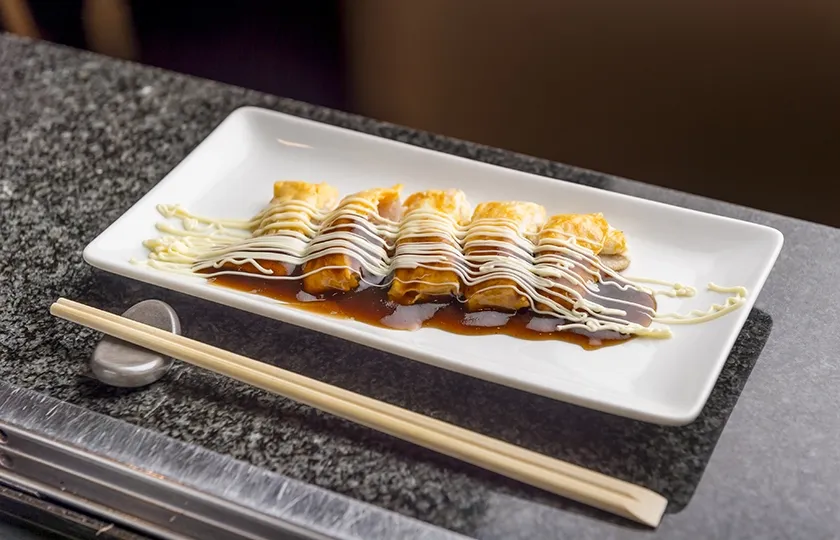
Very close to the aquarium is Tempozan Market Square. A giant Ferris wheel offering the best views of the city and the bay, a street that evokes the centre of Osaka in 1965, and numerous restaurants where you can sample delicacies such as takoyaki (fried octopus balls), okonomiyaki (savoury pancakes) and kushikatsu (fried meat and vegetable skewers) are just some of the attractions of Tenpozan that are sure to make for an unforgettable day. Another must-see is Naniwa Kuisinbo Yokocho, where all the ‘Naniwa gourmet’ restaurants representative of Osaka’s gastronomic culture are gathered.
Finally, Universal Studios Japan opened its doors in 2001. Here you can enjoy the magical world of Harry Potter, watch blockbuster films such as Jaws and Jurassic Park: The Ride, as well as other attractions exclusive to the country, such as Hello Kitty Fashion Avenue and Cool Japan for anime and gaming fans.
Osaka Bay offers other interesting attractions such as the ATC Hall, the city’s main convention centre and venue for interesting exhibitions; Summer Sonic, the music festival that brings together the best bands on the planet every August; and an excursion aboard the Santa María, a ship inspired by Christopher Columbus’s caravel, but twice the size of the original.
Dotonbori and Shinsaibashi
The Dotonbori district is located next to a 400-year-old canal. To cross it, there is a bridge built in 1600 by an enterprising merchant named Shinsai, with the aim of connecting the promising Shinmachi neighbourhood with the theatre district of Dotonbori. Shop assistants and merchants who have been working in Shinsaibashi since the 17th century now share the space with some of Osaka’s best restaurants and shops.
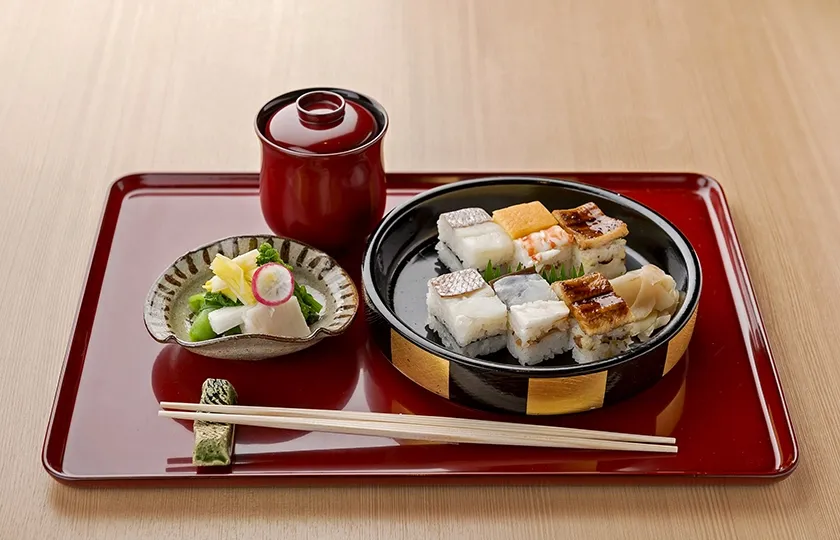
Dotonbori offers a multitude of options for eating and drinking. From izakaya, restaurants and bars located on streets and alleys, to crab restaurants, which are very famous here, and Osaka-style sushi. And don’t worry about the language, as the larger establishments have menus in English. In addition, along the river promenade there are numerous stalls serving takoyaki, bowls of hot ramen and okonomiyaki. But if you’re looking for a little peace and quiet, head to the serene Hozenji Yokocho, which you’ll recognise by its lanterns, where you’ll find a wide variety of traditional restaurants.
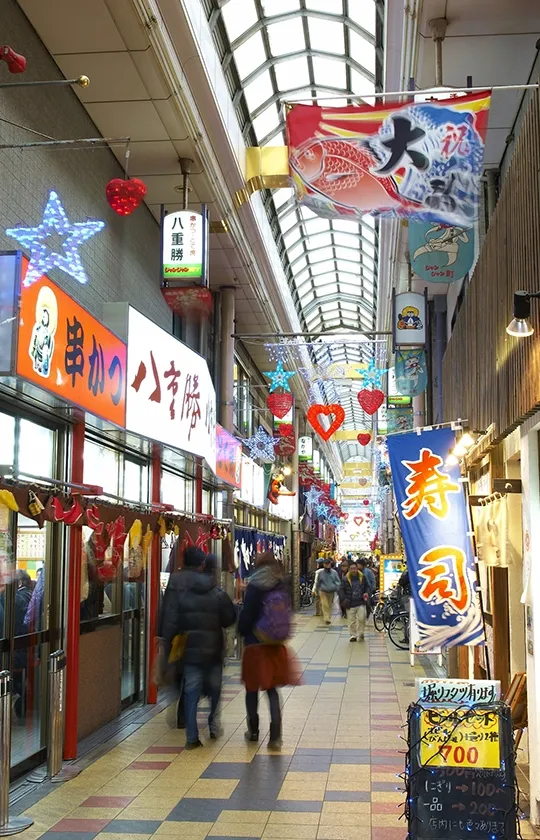
On the other hand, the Shinsaibashi shopping arcade, which is over a kilometre and a half long, stretches from Shinsaibaishi Station to Dotonbori and is one of the busiest and oldest shopping streets in Japan. It has an unlimited variety of cafés and restaurants, as well as shops for all tastes and budgets, from haute couture to traditional crafts.
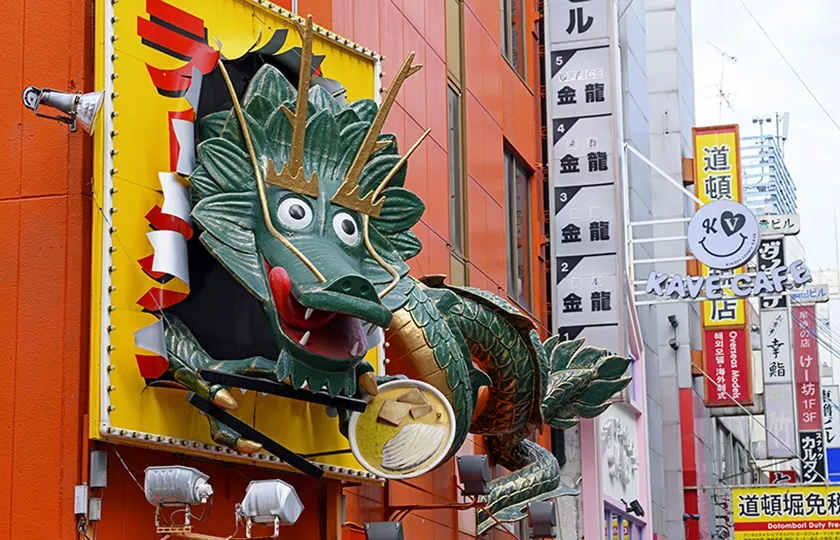
When night falls, the bright lights and bars of Dotombori attract crowds of people under the watchful gaze of giant mechanical sea creatures and clowns who watch the comings and goings of the people from above.
To the west of Shinsaibashi is Amerikamura, where urban fashion and youth culture take centre stage. Known by this name because it was a place where you could buy products from the United States after World War II, this is where teenagers show off their style in an improvised—or not so improvised—Japanese urban fashion show.
Record shops and vintage clothing stores find their niche in Triangle Park, a small square flanked by quirky cafés and also featuring clubs and live music venues for enjoying the nightlife.
Finally, Orange Street and Horie have reinvented themselves as an attractive centre for designer fashion and stylish cafés. There are still some traditional furniture makers, but they share space with elegant boutiques, fashion shops and entertainment venues.
Osaka Castle and surrounding area
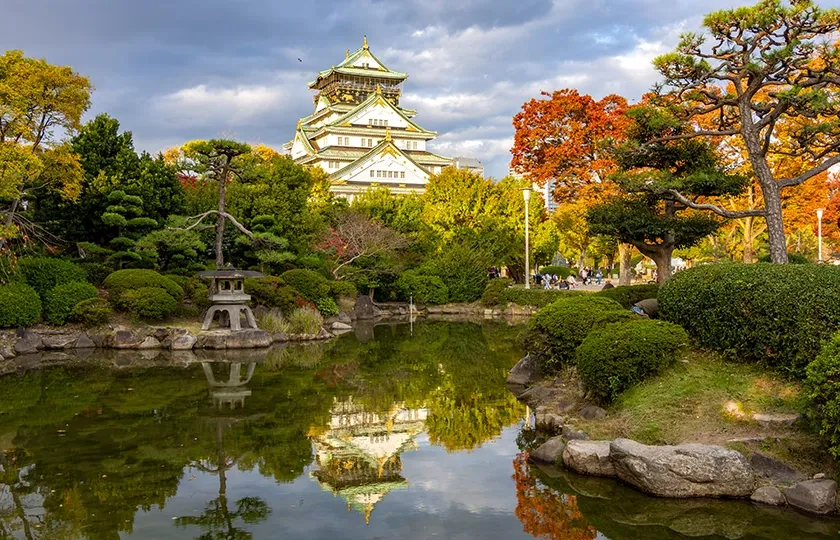
Built between 1583 and 1598 by Toyotomi Hideyoshi, known as the ‘Napoleon of Japan,’ Osaka Castle has been the scene of various conflicts, being burned down and rebuilt several times. Considered Osaka’s most outstanding monument, it houses the History Museum with more than ten thousand historical objects that show the fundamental role Osaka played in Japanese history.
Surrounded by 106 hectares of open parkland, this space is ideal for outdoor activities such as running, cycling or simply relaxing. The abundant cherry, apricot and plum trees and the beautiful floral displays throughout the year make it a meeting place for Osaka residents and a must-see for tourists visiting the city, especially during the hanami season, when the cherry trees are in bloom and hundreds of people gather here to celebrate this important festival in Japanese culture.
Namba
In Namba, you can step back in time to the Edo period (1603-1867), when it was the centre of the city thanks to kabuki and bunraku performances.
Located in the centre of Namba, Hozanji Temple preserves a small part of ancient Japan in the middle of this bustling shopping area. Built in 1637, it pays homage to Fudo Myoo, also affectionately known as Mizukake Fudo, one of the five guardians of Buddhism who, according to tradition, must be sprinkled with water to invoke good luck. The best time of day to visit is first thing in the morning and especially at night, when the temple comes alive with the gentle glow of traditional lanterns that cast a warm orange light through the narrow alleyway and temple gardens.
As we are seeing, gastronomy is Osaka’s main attraction, something that becomes even clearer when you discover that for centuries the Japanese have referred to the city as the ‘kitchen of Japan’. A culinary reputation that is evident in areas such as Ura Namba and the tiny bars in the old Misono building. And, of course, in the small izakaya bars found in the winding alleys behind the shopping centres and shops that dot the main street.
If you are curious to discover where the locals shop, you should visit Kuromon Ichiba, a traditional market with around two hundred years of history.
Finally, bring out your inner geek by visiting Denden Town, where you’ll find all kinds of collectible anime items, classic video games, and electronic gadgets.
Shinsekai, Tsutenkaku Tower and Tennoji
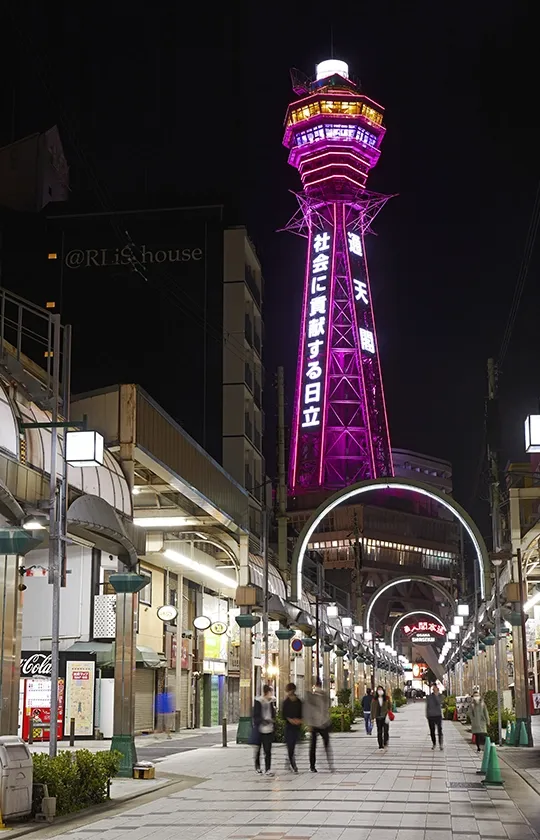
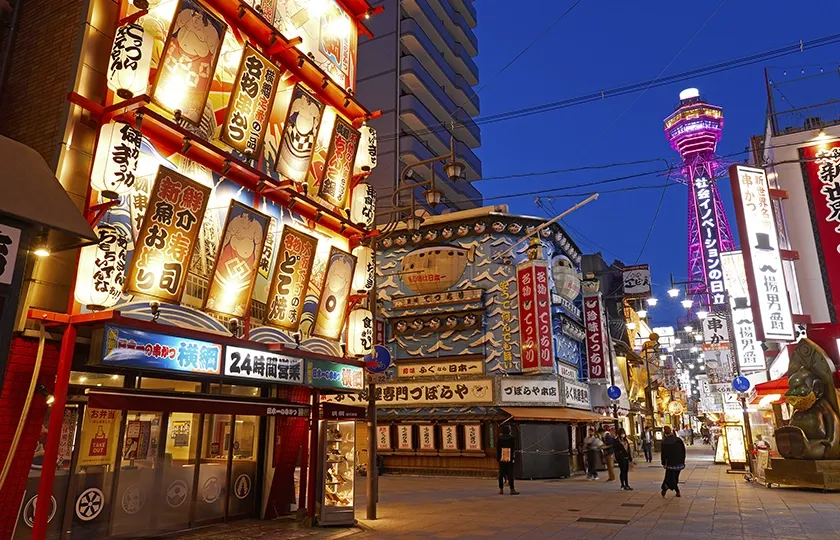
The ‘good old days’ of Osaka are preserved in the Shinsekai (New World) district with its colourful retro signs and billboards. Although its origins date back to the beginning of the last century, it was in 1912 when it began to be known as Shinsekai due to the opening of the Tsutenkaku Tower and the Luna Park amusement park. After World War II, the area fell into decline, only to be reborn as one of the most famous for its authentic architecture and rich culture.
At the heart of the neighbourhood stands Tsutenkaku Tower, one of Osaka’s most beloved symbols. This steel structure has a fascinating history, as well as being inspired by the Eiffel Tower and reaching a height of 103 metres. This construction, which was a symbol of progress in the ‘new world,’ suffered a devastating fire in 1943, after which it was dismantled and its steel reused for armaments in World War II. Later, in 1956, Hitachi, with the support of the Osaka City Council, rebuilt the tower, making it taller and changing its design to withstand earthquakes and typhoons.
Inside the tower, the Tsutenkaku Garden, located on the third floor, is a themed space where wind, light, water and vegetation take centre stage. On this floor you will find the highly recommended Tower Slider, a short but thrilling slide that takes you from this floor to the basement in ten seconds. A little higher up, on the fifth floor, is the observatory, which offers a wonderful view of the city and the golden statue of Billiken, a god who, if you rub the soles of his feet, will bring you good luck. The visit to the tower is completed with views of Osaka from the Tembo Paradise rooftop, located almost 95 metres above the ground, and Tip The Tsutenkaku, a transparent observation platform.
After this fascinating journey to the heights, it’s time to discover Shinsekai. At 130 metres long and with around 50 shops and restaurants, Janjan Yokocho alley is easily recognisable by its large retro-style signs. Without a doubt, it is the ideal place to indulge in culinary delights such as the famous kushikatsu, small pieces of meat or vegetables fried in batter, and dote-yaki, meat simmered in miso and other seasonings.
We’re travelling again, but this time through time, visiting Kasuga Gorakujo, a retro arcade that has been open since the late 1950s. In a more classic style, we find Shinsekai Hihokan, Japan’s largest shooting gallery. In a completely different context, the Asahi Theatre is known for staging comedies and performances by comedians, while Dorakutei is famous for its comedy evenings.
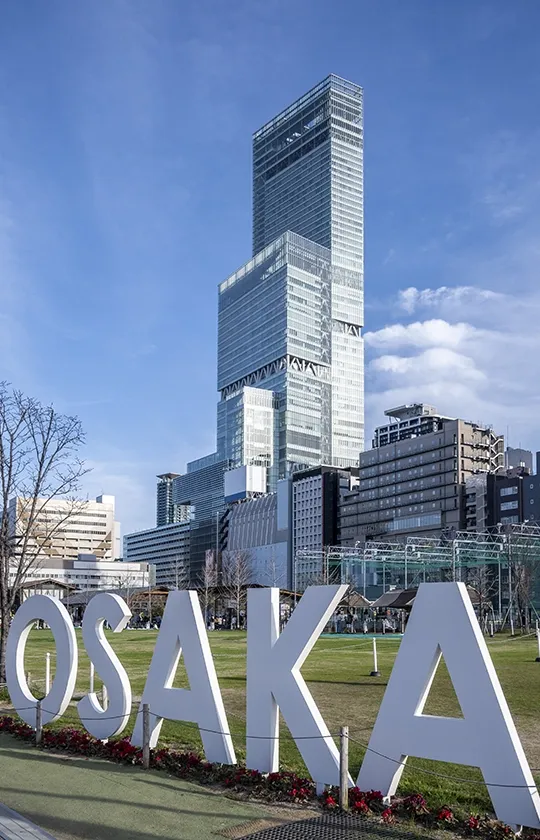
Very close to Shinsekai is the Tennoji neighbourhood, which is spread out around a large 28-hectare park. Like the amusement park, Tennoji Park was built in 1903 for the Osaka National Industrial Exhibition, and on weekends it is a gathering place for families enjoying picnics. Nature tours conducted under the ‘watchful eye’ of Abeno Harukas, which, at 300 metres high, is the tallest building in the city and the second tallest in the country. Abeno Harukas, which means ‘to illuminate’ or ‘to clarify,’ has numerous high-end shops spread across its first twelve floors, as well as restaurants, cafés, an art museum, and a hotel.
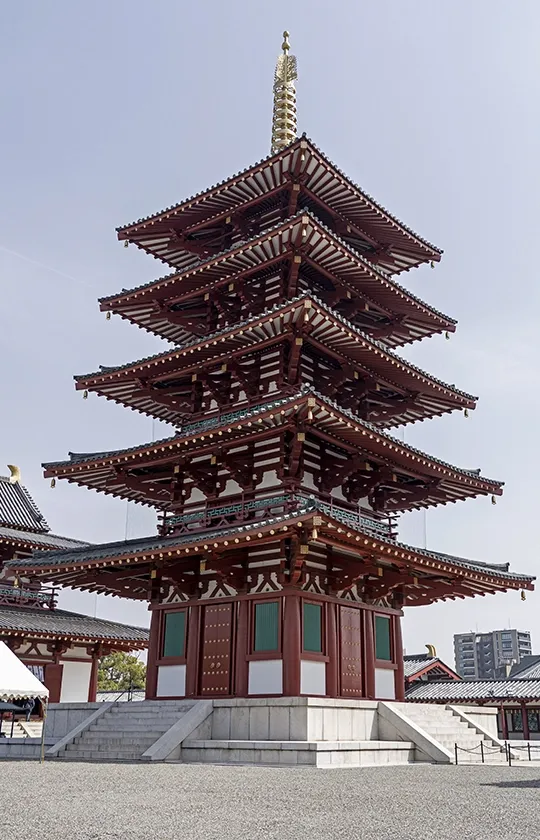
In Tennoji Park, you can visit Shitennoji, Japan’s oldest official Buddhist temple. In addition to being a tourist destination, with its five-story pagoda, it is a very popular place among Osaka residents, who gather here to celebrate their festivities, especially Obon in autumn. Another event held at the temple is the Doya Doya festival, in which half-naked young men douse themselves with ice-cold water.
Sakai and Kishiwada
In the 15th century, Sakai was a prosperous merchant city, commercial port, and birthplace of the revered tea master Sen no Rikyu. Today, it is famous for its handcrafted knives, which are highly sought after by chefs around the world, and bicycles, with Shimano, one of the world’s most renowned bicycle manufacturers, located here. There are museums dedicated to both industries.
But what it is really known for is being home to one of the largest mausoleums on the planet. Built in the 5th century with a keyhole design and on a scale comparable to that of the pyramids, it was declared a World Heritage Site by UNESCO in 2019.
The central mound, which covers an area of 12,000 square metres and is known in Japanese as Daisen Kofun, is believed to contain the remains of Nintoku, a legendary emperor from the 4th century. As this is a sacred site, visitors are not allowed to cross the outer boundary of the mound. To get the best view, head to the observation deck on the 21st floor of Sakai City Hall. You can also take a leisurely stroll around the surrounding area
Sakai’s urban design allows you to discover it on a pleasant bike ride—the routes are well signposted in English—and bikes can be rented at the tourist office.
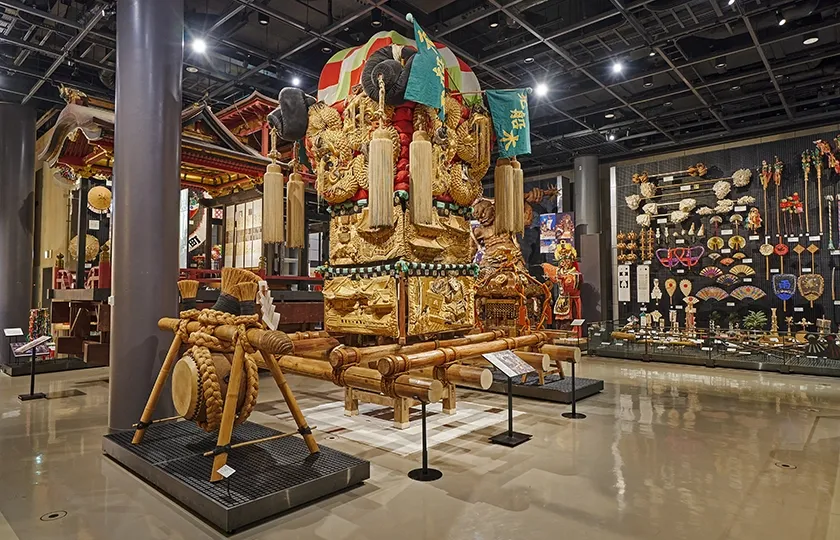
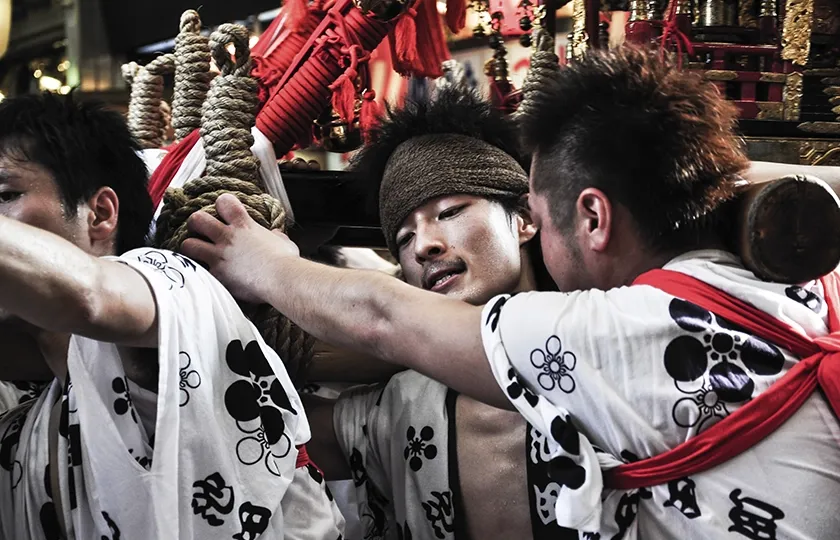
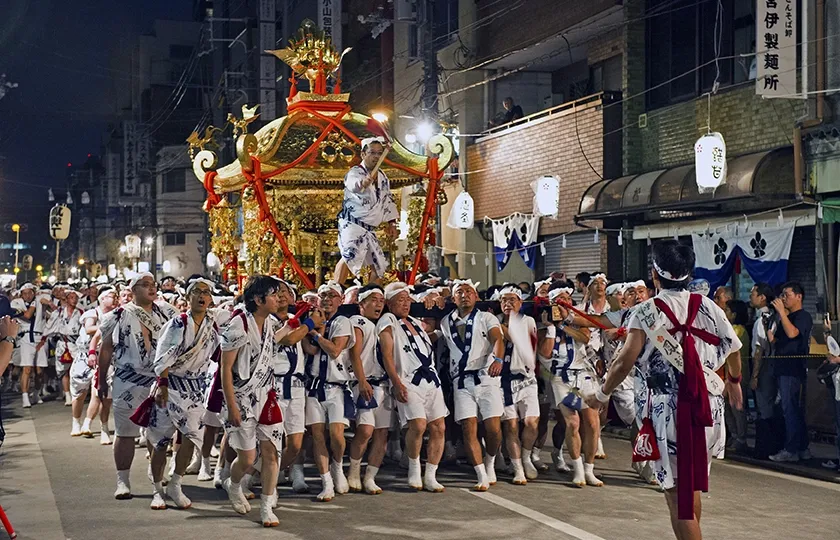
Kishiwada is known for its castle and the Honmaru Garden within the fortress, designated as a National Scenic Spot. Also for the Kishiwada Danjiri Festival, a lively and noisy event that attracts half a million visitors every third weekend in September. Thirty-five beautifully decorated handcrafted floats, each weighing over four tonnes, are driven through the streets at breakneck speed, while hundreds of people run alongside and behind them. On top of each float, the Daiku-Gata, a wild and fearless master of ceremonies, performs daring acrobatics and encourages the group. As night falls, the festival continues and with the arrival of beer and food, the rivalries of the day are forgotten as everyone enjoys the party in harmony.

Ikeda
The 1970 World Expo held in Ikeda marked the rapid growth of Japan’s economy, which was still trying to recover from the ravages of World War II. The land on which it was held was used to create the Expo 1970 Memorial Park, covering 260 hectares with gardens, museums and recreational areas that invite visitors to enjoy nature in any season of the year. The park’s most famous monument is the Torre del Sol, commissioned for the Expo and now a symbol of the city. Opened to the public for the first time in 2018, its interior houses the exhibitions ‘The Tree of Life’ and ‘The Underground Sun’. On the other hand, the National Museum of Ethnology is the workplace of one hundred researchers. It has one of the country’s leading libraries and provides insight into the relationship between Japanese culture and other cultures around the world.
LaLaport Expocity recently opened its doors with state-of-the-art activities, including an IMAX cinema and an aquarium.
Other museums in the city include the Itsuo Museum, which has an interesting collection of art related to Cha no yu, the Japanese tea ceremony, and the Cupnoodles Museum, which reveals the secrets of noodles, allowing visitors to design their own bowl and taste limited edition instant ramen. Meanwhile, the Ikeda Archives hold a collection of Takarazuka, Japan’s oldest female musical theatre company, and other materials related to Hankyu Dentetsu, a local railway company that contributed to the urban development of the city.
Before leaving the city and heading into the countryside, a visit to Osaka Tenmangu Shrine is a must. This Shinto complex, founded in 949 AD, is dedicated to Tenjin, the god of learning. This temple is known for being the site of the Tenjin Matsuri, one of the three major festivals held in Japan.
Ikeda also invites us to enjoy nature. Minoo Park offers various hiking trails with breathtaking views. The paved trail in the park leads to an impressive waterfall that is well worth visiting in autumn when reds, ochres and yellows light up the mountainside. In addition, the Rokko Mountains have a number of trails that lead into a thick forest.
Expo Osaka 2025
Under the slogan ‘Designing the future society for our lives’, the Universal Exhibition opened last April and promises to surprise the world with its innovative proposals throughout its 148-day run. The exhibition is presented as a space for inspiration to foster international collaboration and find solutions to global challenges, inviting visitors to imagine a world in which every individual has the opportunity to shape their own lifestyle and fully develop their potential. In turn, it highlights the importance of global collaboration in building a sustainable society that promotes these aspirations. Expo Osaka 2025 aims to become a space for reflection, dialogue and collaboration to design a better future, and is expected to attract 28.2 million visitors, including 3.5 million from abroad.
One hundred and fifty-eight countries and regions, as well as nine international corporations, are showcasing their proposals in various themed pavilions. Highlights include the Japan Pavilion, the Osaka Health Pavilion, the Kansai Pavilion and the Women’s Pavilion, designed by Japanese architect Yuko Nagayama in collaboration with Cartier, which aims to pay tribute to the role of women in society. It also offers an immersive experience created by Es Devlin with works by artists such as Naomi Kawase and Mariko Mori, exploring themes related to female behaviour, sustainability and social unity. The programme in this pavilion is rounded off with traditional dance and music performances and contemporary art exhibitions reflecting cultural trends in different countries.
Interactive workshops, presentations on advances in artificial intelligence, robotics, renewable energies, and immersive experiences based on virtual and augmented reality will play a prominent role at Expo Osaka 2025. Gastronomy will also be represented with tastings of a wide variety of cuisines from around the world and the presence of renowned chefs who will share techniques and secrets from their traditional kitchens.
Eco-friendly pavilions, designed with sustainable materials and green technologies, lectures and educational workshops addressing issues related to environmental conservation and biodiversity, clearly demonstrate Expo 2025’s commitment to sustainability.
With the aim of promoting and sharing the beauty, culture and attractions of Japan through the ‘Expo + Tourism’ initiative, the Japan National Tourism Organisation (JNTO), supported by the sub-themes ‘Saving Lives’, ‘Empowering Lives’ and ‘Connecting Lives’, aims to inspire people to discover other parts of the country, as well as other ways of life and local communities that maintain their own traditions and unique lifestyles.